
Is There Such a Thing as a “Feminist” Movie?
When a certain summer blockbuster took the world by storm last summer, I found the ensuing (although short-lived) pop culture phenomenon rather concerning. I found myself particularly concerned by claims that this was a “feminist movie,” a definition that I vehemently disagreed with for a variety of reasons.
But that specific term got me thinking. What is a feminist movie? What does it look like? Which qualities or features make a movie unmistakably “feminist”?
As a cinephile and a woman filmmaker, this question puzzled me. I have watched many movies in my lifetime, but I never caught myself thinking, “Oh, this is a feminist movie.” And that is because complex works of art — including films — seldom revolve around one unequivocal “political agenda.” We rarely hear of “anti-racism” or “anti-capitalism” films, and that is because filmmakers and film critics alike don’t tend to categorize films based on their (supposed) political orientation, nor do they enjoy narrowing the scope of an entire film down to a specific socio-political or philosophical label.
Complex works of art — including films — seldom revolve around one unequivocal “political agenda.”
There is no shortage of films dealing with gender inequality or other types of inequality and discrimination. And there might be a statistical lack of women-driven stories, but, again, does that mean that women-driven stories are the only films deserving of the title “feminist”?
When I sat down to try and compile a list of films I could positively identify as “feminist,” I drew a blank. In the end, I was able to come up with a few titles that seemed to fit this ill-defined category: A Woman Under The Influence by John Cassavetes was one of my most solid picks, followed by Chantal Akerman’s Jeanne Dielman, Martin Scorsese’s Alice Doesn’t Live Here Anymore, Luis Buñuel’s Belle de Jour, and, of course, Emerald Fennell’s Promising Young Woman. “But wait a minute,” I told myself, “most of these films were made by men. Do they still count as ‘feminist’ even though they were made by men? I’m sure at least some people would have a problem with that…”
But then again, if only women-made movies can be deemed “feminist,” aren’t we limiting the scope of female storytellers’s voices to stories that revolve around gender inequality? Isn’t assuming that a woman filmmaker has to tackle the theme of gender inequality a form of sexism in itself? And does that imply that women filmmakers who don’t necessarily touch upon those themes are “less than” those who do?
From the perspective of a cinephile, a woman filmmaker, and a woman, these considerations left a bitter taste in my mouth.
Warning: Limited Spoilers Ahead!
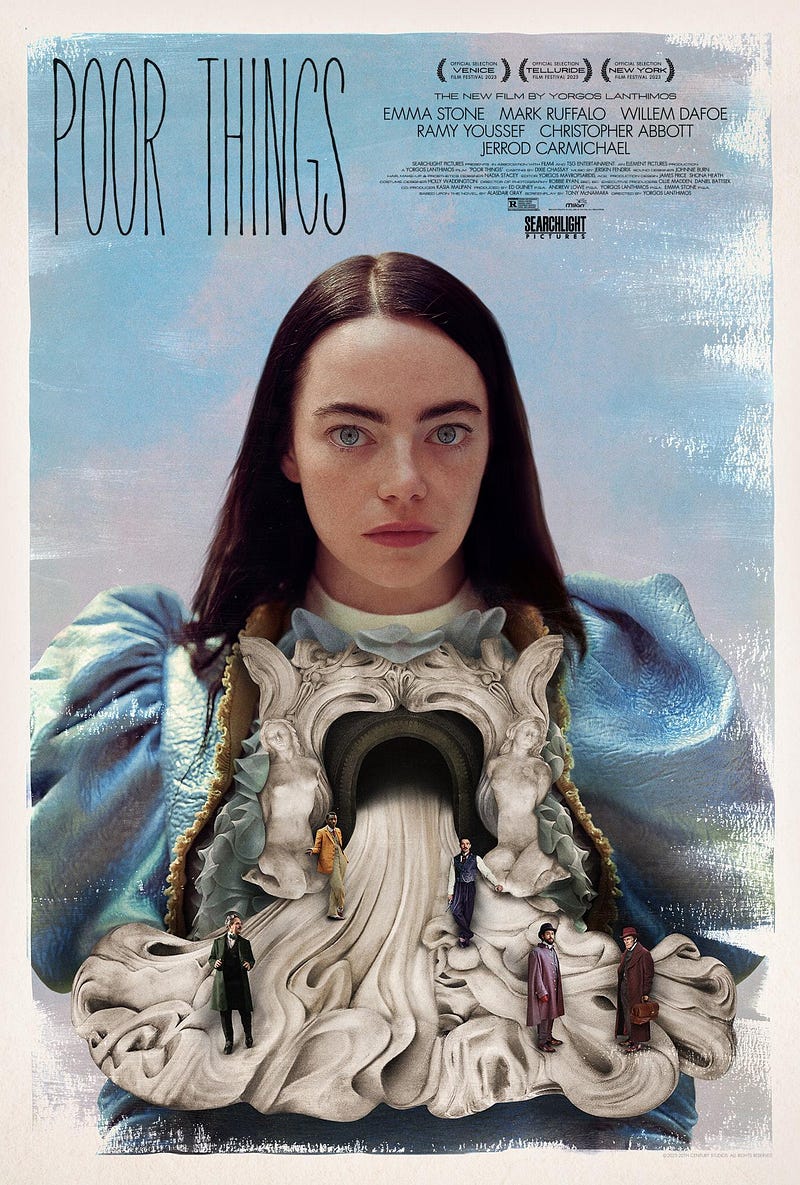
Then, I watched Yorgos Lanthimos’ latest film, Poor Things. I somehow lack the words to describe what I felt when the end credits started rolling: I was awed, I was exhilarated, I was strangely proud (of what, I’m still not quite sure). If any woman-centered story has ever made me feel empowered as a woman, this is the one. And it isn’t because the protagonist achieved some larger-than-life goal (like saving the galaxy) or “smashed the patriarchy,” but for two main reasons; the first one is a stylistic choice: the heroine of this story is a woman freed from societal-imposed shame about her actions, her desires, and her very identity.
The second one is a narrative one: by the end of the film, Bella, the film’s heroine, successfully asserts her will and individuality in a way that is proud and unapologetic. As the camera zooms in (a recurring visual technique throughout the film) on a beautiful, radiant, finally emancipated Emma Stone, I became aware that I had never experienced anything like this before when watching a movie. And me being the old-school, analog-loving cinephile that I am, I felt comfort in the confirmation of what has always been a fundamental belief of mine: that every great film should have the potential to change your life.
So, is Poor Things a feminist movie?
On a technical level, it seems to do everything that a “feminist movie” is supposed to do — even though, once again, there is no single definition of what that should be. It revolves around a female protagonist, it follows her journey to freedom, self-discovery, and emancipation, and it definitely contains inspiring and empowering qualities.
However, I still do not feel comfortable using that label to sum up this film, and that is because, beyond all the aforementioned factors, there is still so much more to this film than a woman unapologetically pursuing her desires, ridding herself of those trying to control or own her, enjoying her sexual identity, and confronting those who view her as a societal danger — or a demon — by employing sheer logic and acumen.
In other words, I don’t want to limit this story — or any story — to the sole function of “denouncing systems of oppression” or “upholding women’s rights” because art has never had a sole function, least of all a political one. And while we can certainly recognize and celebrate stories that push women-driven or women-empowering narratives forward, we shouldn’t be limiting the essence of a film to diminutive labels such as “feminist” while ignoring the many and often nuanced complexities that a great work of art has to offer.
Want to keep reading? Check out these similar stories:
If you enjoyed this story, please consider showing your support and appreciation to the author by buying them a coffee!