
Dream Scenario: The Nightmare of Cancel Culture and Image Appropriation
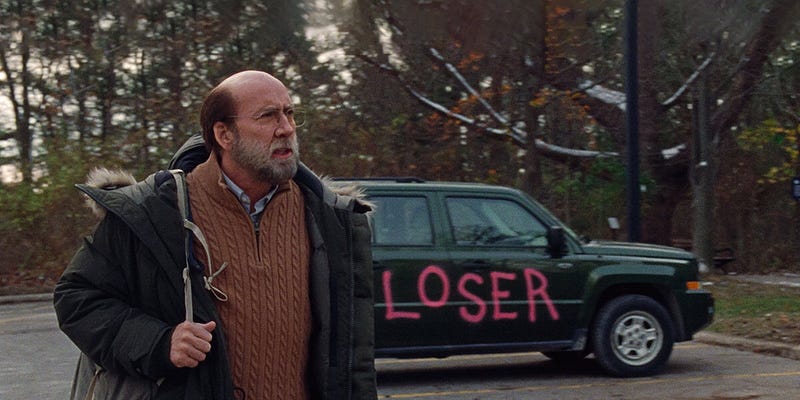
Dream Scenario might be the most disturbing movie of the year.
So far, very few filmmakers have dared to tackle the emerging problems of our increasingly over-digitalized society, with two outstanding exceptions being last year’s Todd Field’s Tár and Halina Reijn’s Bodies Bodies Bodies, with the first one dealing specifically with cancel culture, and the latter critically examining the way that social media shape our relationships.
But Dream Scenario takes the discussion a step further, venturing into the nightmarish reality that our lives have become as a result of the over-digitalization of society and the increasingly problematic role of social media in it.
Warning: Spoilers Ahead!
The Film
In Dream Scenario, college professor Paul Matthews goes from being an ordinary nobody to a media sensation after random people — including those who have never met him — begin to virally dream of him for no apparent reason. After the initial hype, the story takes on a dark twist when the dreams turn into vivid nightmares in which Paul is a villain and an abuser. Paul begins to be the target of hate, discrimination, and violence, and even though he is not doing anything wrong, he is eventually “canceled,” loses his job, and his family, and his life is utterly ruined.
Even his genuine attempts at proving that he is an ordinary and innocuous person are hijacked and demonized by those around him. When he tries to explain how this entire ordeal has affected him and the quality of his life, he is met with a wall of unsympathetic responses and is even mocked by his own family for his emotional sincerity, with his wife commenting that his public message “embarrassed” her.
In a world where everybody villainizes Paul, Paul is the only true victim and has to bear the painful consequences of the irrational and whimsical behavior of those around him, who are not only targeting him for something that is beyond his control but also refusing to take into consideration how any of this is impacting him and his well-being.
In a world where everybody villainizes Paul, Paul is the only true victim, and has to bear the painful consequences of the irrational and whimsical behavior of those around him.
What “Dream Scenario” Says About Contemporary Society
Something that often gets lost in today’s culture is the awareness that there is only so much accountability we can have over people’s perceptions of ourselves. That accountability is defined by our actions, words, and the deliberate ways we interact with our surroundings.
Ideas that people might project onto us, however, are beyond our control and responsibility. For instance, if somebody chooses to judge us as “intentionally sexually provocative” for the way we dress, that judgment is their subjective prerogative, but it bears no objective validity over ourselves, and to think that we can largely dictate the way others think of ourselves is a foolish assumption because everyone — for better or for worse — is entitled to subjective views and perceptions.
Thus, Dream Scenario takes the paradox of subjective projection and cancel culture to its most toxic zenith: a man’s life is completely destroyed by people’s subjective impression of him, over which he has no control whatsoever. It also shows how quickly and whimsically one can go from being idealized in the public eye to being demonized, with the terrifying awareness that this process can be completely independent of our will or control.
In the film, not only is Paul unjustly demonized and canceled, but he is also denied any sympathy or understanding by either the general public or those closest to him, including his family. Instead, his own real-life nightmare intensifies to the point of an emasculating kafkaesque scenario in which he keeps being scapegoated regardless of his actions and reactions.
The societal scapegoat is a vessel for our culture’s repressed anger and frustration, which find a cathartic relief in being projected onto a well-defined target. At different times in history, specific demographics have been lumped into a collective scapegoat to be vilified, demonized, and ultimately expelled from society. And even though such stories should serve as cautionary tales against mob mentality and scapegoating, we keep seeing this same phenomenon happening in today’s society, only on a micro-scale: instead of witch-hunting, we now have cancel culture, which evolved from overdue societal justice against wrongdoers to a form of hysterical mass demand for public persecution, often in utter disregard of factual evidence.
AI and Image Appropriation:
The movie also plays on the idea of image appropriation, a subject that has recently been under fiery debate due to the rise of AI and its ability to create virtual “doubles” of real people, including celebrities and other public figures. With no regulations in place, the physical likeness of any existing individual can be appropriated and exploited in ways that are completely beyond one’s control.
Image manipulators can employ AI-generated “doubles” in whichever way they like, a practice that is not only unethical but also incredibly harmful to those whose physical likeness is thereby appropriated by somebody else for more than questionable ends. In a recent AI-generated TikTok, a digital “twin” of deceased actress Sharon Tate was made to recount the gruesome events of the night she and her unborn child were slayed by the Manson Family. At the same time, some AI-generated images of a sexually provocative “double” of 21-year-old actress Jenna Ortega have been circulating on the web. Needless to say, neither actresses — nor their respective families — had a say in the way that such images were generated or distributed.
All these combined phenomena have led to the frightening possibility that other people might appropriate themselves to our very persona, from the ideas that the public projects onto us to our very physical likeness. Dream Scenario shows us what would happen if such a possibility became a reality, which is all the more disturbing because we know just how likely it is.
Want to keep reading? Check out these similar stories:
If you enjoyed this story, please consider showing your support and appreciation to the author by buying them a coffee!


