
WRITING
How to Write Your About Me Post
Steps and stuff for shameless self-promotion

This month, Queerly Trans invited writers to shamelessly self-promote by showcasing their About Me posts, but for those that haven’t already written one, the task could feel, daunting. So, I’ve written this post to help you get started with your own About Me page. And it’s not just for our QT writers, anyone (and everyone) can use this to get started on their own About Me page.
Contents:
Why Write an About Me Page? Listen to the Pros So, How Do You Do a Thing? Let’s Begin — PWEPO How I Created MY About Me Page Your Worksheet and Template
Think of it as an introduction to yourself.
Why Write an About Me Page?
Your profile has an About Me section and it’s great for a short bio, but to give people more, including all the great ways they can follow and support you, an About Me POST is fantastic. Think of it as an introduction to yourself.
Readers want to know about their favorite writers. Think about the writers you follow — have you clicked through to find more of their posts and maybe, to find out more about them? Well, believe it or not, people feel the same way about YOU. So give them the same thing you are looking for — what a great place to start.
Listen to the Pros
Quy Ma is the founder of About Me Stories. I house my own About Me page on About Me Stories because THAT is what the publication is all about. You can house your About Me page anywhere, even on your own wall, but I chose to publish with About Me Stories because they provided a platform and directions when I was still wet-behind-the-ears as a Medium writer. For me, that was a great decision.
Below are Quy Ma’s guidelines for publishing your About Me page on About Me Stories. Check out point 7 in their style guidelines for some great tips to get started with your About Me page.
FYI, Quy Ma’s own About Me page is a 23-minute read. This is the epitome of sharing a glimpse into the real life of the author. You can read it here:
Of course, as mentioned before, About Me Stories is just one option. Queerly Trans also houses About Me pages for our writers. Have a look our Queerly Trans writers’ About Me pages from Nova and Logan Silkwood:
I asked Logan Silkwood how he wrote his About Me page and this is what he shared:
It was a little bit like writing a dating profile. I would want compatible people to swipe right and incompatible people to move along, so I try to find the code words that will help someone to see who I am quickly and decide whether I’m their people to save everyone some time. But I’m more than just a collection of labels (queer, trans, non-binary, polyamorous, masculine, etc…). I want to find a way to capture my essence, the sort of style readers can expect to find in my writing, and share it in as condensed of a piece as possible. Mine is 6 minutes long, and I’m pretty sure that it’s too long, since most will make up their minds about me in the first few sentences.
So, How Do You Do a Thing?
Perhaps you are already seeing that there isn’t just one way to write your About Me page. Great! Because there really isn’t, but that doesn’t help when you don’t know where to start. I know! As a neurodivergent writer, I understand overwhelm and uncertainty way too well.
And so, I’m going to try to help. Below is a guide I’ve created on how to write your About Me page. I’ve even created a worksheet and template you can download from Google Docs! Now, please remember that the idea of this is to get you started. I trust that once you begin, you’ll realize that you know more about yourself than you thought, and you’ll go off on some fantastic and wonderful tangents that aren’t even mentioned here. BUT, if you need structure, steps to follow, if you need this to be easy, I’ve got you covered. Just remember not to get ‘stuck’ in the rules on the below suggestions and template because they have been created based on what has worked for me. YOU can do whatever the hell you want! After all, the About Me page is about… YOU. I mean ME, because it’s about ME, but your About ME is about YOU… You know what I mean, haha.
Let’s Begin — PWEPO, PWEPO
We are going to cover 5 key points:
- Planning
- Writing
- Extras
- Platform
- Optimizing
Let’s call it PWEPO, haha. No, that is not a thing, I just created it, but PWEPO sounds cute and I’m sticking to it.
Planning:
a) Braindump The first step in PWEPO (see? cute!) is Planning. And the first step in planning your About Me page is a good old braindump! A braindump is like a mindmap but without structure. It is literally you dumping out everything in your brain onto the page. We can sort it out later. So, what are we braindumping? YOU. Braindump your interests, work, school, hobbies, odd facts, what you want people to know about you, labels, desires, dreams, funny stories, your daily routine, likes, dislikes, secrets, etc. Remember, no one will see it except you, so go nuts.
Go back to Quy Ma’s post for some great questions to ask yourself during your braindump.
b) Three key themes After your braindump, you may notice a few connecting items and start to notice some themes. This is where you can start ‘organizing’ your braindump into a mind map where YOU are at the center. From here, choose a few key points or themes that stand out — those things that really epitomize who you are as a person, writer, educator, influencer, etc. For now, focus on three key areas, points, or themes. You can always expand later if you choose to.
c) Structure Remember to keep it simple. Let’s go with a basic structure of Introduction, Body, and Conclusion.
- INTRODUCTION: The introduction is an overview of YOU. This is where you connect with your readers quickly by getting to the crux of who you are. Including a little something about WHY you are on Medium and your goals as a writer are top-notch smart stuffs! Do that.
- BODY: This is where you can explore your three themes a little deeper. This is a great place to drop in some links to relevant articles you’ve written and share external links so that your readers can follow and support you.
- CONCLUSION: This is your wrap-up and could be as simple as reminding the reader to follow you for more articles, sharing more external links, photos, artwork, a quote, etc. Get creative and leave people wanting more but knowing where to get it.
Get creative and leave people wanting more but knowing where to get it.
Writing:
a) Write your body FIRST, then intro and conclusion One of the problems many face when trying to get started is coming up with that first word as if they can never change it and it will forever be a reflection of them. Logically, we know that isn’t the case, but it’s difficult to argue with fear, expectation, and trauma — I’m all too aware. So, we just avoid the whole thing by skipping the ‘start’ and going straight to the guts. We write the ‘easy’ parts first and once they are done, suddenly we have ample fodder for the intro and conclusion. Hey, if we have to trick our brains to make progress, why the hell not?
b) Write one paragraph at a time
“There is only one way to eat an elephant: a bite at a time.” — Desmond Tutu (Fournier, 2018)
Yeah, that’s pretty nasty and I don’t know anyone who is eating an elephant, but the point is, anything can seem too big and overwhelming when you look at the finished product. It’s like writing a book. I don’t have an idea and then the book is just somehow, magically done! It takes planning and consulting with my characters and then, I’m only writing ONE WORD AT A TIME. Think about that. Because just like any post (including the one I am writing right now), you can only write one word at a time. So don’t think about writing your ‘About Me’ page, just think about writing one paragraph about one of your themes. Then, write another one.
- Choose ONE theme.
- Write ONE PARAGRAPH about that theme.
- If you need a word count, aim for around 100 words. That’s NOT a rule, just a suggestion to get you started.
- If you need further help, here’s how you can easily write a paragraph about your theme: -> Write one sentence that states what your theme is -> Write one sentence about why the theme is important to you -> Write one sentence about why others should care about your theme -> Write one sentence about what you hope to achieve in this theme
- OPTIONAL: Add any relevant links to articles or external links.
c) Still stuck? Try talking instead! Here is a great site that could be your savior!
If you struggle with typing or writing, head over to Otter, hit record, and simply TALK. This is particularly great for your introduction where you are telling people all about YOU. Grab your braindump and just start talking through all those things. Remember, no one is going to hear it except you! Then, Otter will transcribe your recording. You simply copy and paste the transcription into your Medium draft and EDIT. Leave out what you don’t want, move your thoughts around, and link it all into a cohesive picture of YOU. Otter is just one option, you could use any voice-to-text software. Yes, it’s free unless you upgrade.
d) Use Grammarly Grammarly is an online editing software and one I swear by. I use the desktop app so even as I am writing THIS post, Grammarly is picking up possible errors and highlighting them. This is available in the free version and I recommend it to anyone who writes on Medium.
Extras:
a) Inclusions: Now that you have the bulk of your About Me post, it’s time to consider what else you may want to include. Here are some ideas:
- Affiliate links including Medium (make sure you remember to state it is an affiliate link as per Medium’s guidelines)
- List of publications -> Publications you own -> Publications you edit for -> Publications you write for
- Linktree
- Your website
- Lists -> Lists are an underutilized opportunity on Medium (and one I need to utilize more myself). They are a great way to gather your writing and keep some of your older writings active for new readers.
- Link to your Medium catalog -> Once you have several articles, create a catalog so that new readers can find your old articles (among many other reasons). Here’s my catalog as an example:
b) ADVANCED: Create a Table of Contents
** This one is for those of you who, like me, enjoy tinkering with a little HTML and internal workings.
You may have noticed that my About Me page, Catalog, and yes, even THIS post, have a Table of Contents with clickable anchor links. You can do that too. I’m not going to explain it here myself but Nikhil Nanjappa wrote an article that will walk you through the process.
Platform:
Ok, now that we have a draft About Me post, where will you publish it?
- About Me Stories — Specifically hosts these types of articles. You will need to apply to become a writer and then, post away!
- Queerly Trans — If you are already a QT writer, post away. Otherwise, if you fit the writer profile, join us and post your About Me.
- Another publication — always check your article meets their guidelines
- Your own publication or on your wall — you don’t NEED to publish in any publication
Optimizing:
Now that you have a published About Me page, it’s time to utilize it.
a) Pin your story to your profile
- On your profile page, click the three dots and choose ‘pin story’.
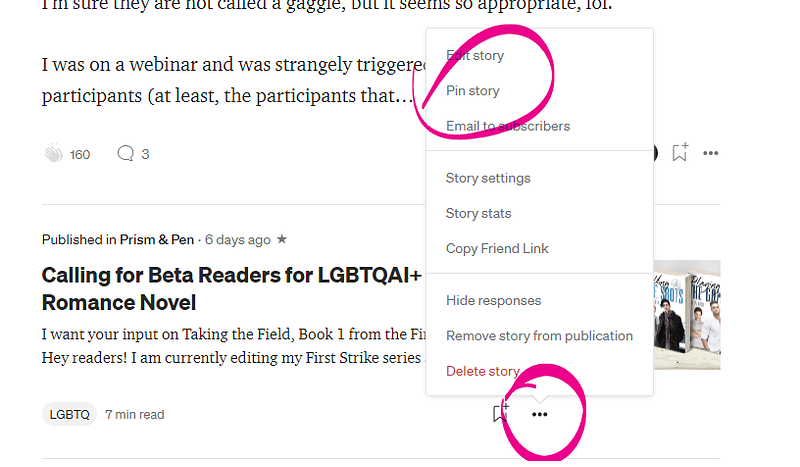
- You can pin up to five stories and your About Me should be one!
b) Include at the bottom of every story If you have a look at any of my stories (except my T-Day and Beyond Journal), you’ll see that my About Me page is linked at the bottom. Go ahead — scroll down because it’s on this one too — Just remember to scroll back up here to continue reading!
You’re back? Good job! Ok, let’s continue.
c) Link in your about on your profile Your ‘about’ on your profile is your mini bio so now, go drop in your link to your About Me post for your readers to ̶s̶t̶a̶l̶k̶ ̶y̶o̶u̶ find out more about you. Here’s mine:
And we’re done. PWEPO! So let’s quickly see how my About Me page used PWEPO — oh yes, I am so making this a thing now.
How I Created MY About Me Page
Here is my About Me page:
1. Planning:
Themes For me, the three key themes that emerged were:
- LGBTQAI+
- Fiction writer
- Podcaster
Structure I have used a table of contents and here is how that fits across the INTRO, BODY, CONCLUSION structure:
- Intro: My Medium Catalog Who is this Weirdo?
- Theme 1: LGBTQAI+ That’s a Fine Queerly Trans Enby!
- Theme 2: Fiction writer: I make Words Good
- Theme 3: Podcaster: Treading Water Fictional Podcast The Character Collective Podcast
- Conclusion: Publication Paradise
Writing:
Paragraphs Here is an example of how I MAY have initially written my paragraph on the theme of Fiction Writer based on the suggested paragraph structure.
First, here is the FINAL draft:
I’m a writer. By that I mean, I’ve written books. Actually, I’ve written A LOT of books. I’ve published a handful too. So, I’m a writer, technically. It’s what I do. It’s what I love. It doesn’t keep me alive, but it DOES keep my heart beating. I have sooooo many characters demanding their stories to be told that I’m really banking on immortality and the cessation of monetary necessity. Otherwise, at this rate, I’m screwed!
And here is how the first draft may have looked:
-> Write one sentence that states what your theme is
I’m a writer who has written several books and even had a few published.
-> Write one sentence about why the theme is important to you
Writing is what I do and love and though it doesn’t technically keep me alive, it DOES keep my heart beating.
-> Write one sentence about why others should care about your theme
I have sooooo many characters demanding their stories to be told and I want to be able to share them all with you.
-> Write one sentence about what you hope to achieve in this theme
I’m really banking on immortality and the cessation of monetary necessity.
Extras:
Inclusions Here’s what I included:
- Link to my Medium catalog
- My Medium affiliate link
- My Linktree (in the intro)
- Links to my books on Amazon
- Links to my podcasts
- List of publications (as my conclusion)
Table of Contents I included an active table of contents
Platform:
I published on About Me Stories.
Optimizing:
My About Me page is pinned to my profile, is linked in my profile bio, and appears as a link at the bottom of my articles.
Your Worksheet and Template
It’s your turn! The below PDF is available on our Queerly Trans Google Docs. Save a copy and then have at it!
Good luck and whether you publish on Queerly Trans or elsewhere, let us know if this guide helped you write your About Me page.
Fournier, D 2018, The Only Way to Eat an Elephant, Psychology Today, April 24, viewed 19 July 2022, <https://www.psychologytoday.com/au/blog/mindfully-present-fully-alive/201804/the-only-way-eat-elephant>
