
How to See Fun As a Compass and a Tool When You Turn Your Life into Fun Games
Fun is always there at our disposal. We just need to take it out and apply it.

My favorite writers on living in the moment, Ariel and Shya Kane, and many who have been inspired by their work and discovered the magic of living in the moment, claim that:
“Fun really is the way to access enlightenment.”
— from a short story “Fear Not, Just Dance” by Simon in Being Here…Too: Short Stories of Modern Day Enlightenment by Ariel and Shya Kane
Emulating this statement, I would dare to say:
Fun is an access point to Self-Gamification, that is to truly and repeatedly turning our lives into exciting and engaging games.
To take this even further, I am convinced that fun is the only compass you can use to turn your life or parts of it into exciting games.
But it is also the ultimate measuring tool for success in your self-motivational game design.
The amount of fun you feel can be a valuable tool when designing and prototyping your games. And your life in general.
I still wonder why fun is often forgotten and underestimated, although it is truly one of the prerequisites and indicators for success. Both having and not having fun, show.
Is it because we are in too much of a hurry to have fun, and don’t notice when we experience it?
Here awareness and kaizen can help us again. Let’s pause, see where and how we are, identify the next little step that we recognize as fun, and take that step.
But what if you can’t identify that fun step?
Then you are resisting something.
That is just an indicator of your resistance and fear of the task at hand. Instead of being curious, you are having a discussion in your head about why this task and the whole project don’t make sense. So, if you can’t come up with an idea to bring the fun factor into a task, then you’re merely saying “No” to that task. Which is neither good nor bad. It simply is.
Here is one of my favorite quotes about observing ourselves:
“Self-discovery isn’t meant to be painful. If it is, then you’re working on yourself, lost in the story of your life, or simply resisting what is.”
— Ariel and Shya Kane, Practical Enlightenment
As soon as you non-judgmentally see that you are resisting and saying “No” to the task at hand, as well as experiencing fear towards it, you will become aware of a threefold choice, to either:
- continue resisting (often along with complaining),
- let the task go, along with the guilt of not doing it, or
- think of a game and other fun elements you know and like and see how they could help you become excited about doing it.
Let’s take the example of cleaning. Many of us consider — or learned to consider — cleaning to be anything but fun. But if you look at it as a game and find ways to make the activity fun, it can become tremendously so. For example, you could put on music before wiping the floor, and make specific movements for each type of cleaning.
You could “play” with the sequence of steps in your routines. I discovered once that I usually started cleaning our house in my daughter’s room. There wasn’t a specific reason, or at least not one I can recall now.
So every time I notice myself marching automatically (and immersed in various thoughts) into my daughter’s room with the vacuum cleaner, I turn around and ask myself, “What room do I want to clean first today?”
Funnily enough, there is always an answer, and I discover a little spark of curiosity and delight in cleaning a specific room first. Sometimes it is my daughter’s room, and other times it is not. But the choice becomes deliberate and fun.
Here is another example, and one of my favorites as a writer.
About a year after turning writing into a game for the first time, I read an article by Rachel Aaron called “How I Went From Writing 2,000 Words a Day to 10,000 Words a Day.”
This article addressed her productivity as a writer. [A side-note: Later she turned this material into a book for writers.] One of the three criteria that best enhanced her productivity and increased her word count was that twin of fun, enthusiasm.
Here is what Rachel Aaron wrote in the section of her article (and the book based on it) titled “Side 3: Enthusiasm”:
“The days when I broke 10k were the days when I was writing scenes I’d been dying to write since I planned the book. They were the candy bar scenes, the ones I wrote all that other stuff to get to. By contrast, my slow days (days when I was struggling to break 5k) corresponded to the scenes I wasn’t that crazy about.
“This was a duh moment for me, but it also brought up a troubling new problem. If I had scenes that were so boring I didn’t want to write them, then there was no way anyone would want to read them. This was my novel, after all. If I didn’t love it, no one would.
“This discovery turned out to be a fantastic one for my writing. I trashed and rewrote several otherwise perfectly good scenes, and the effect on the novel was amazing. Plus, my daily word count numbers shot up again because I was always excited about my work. Double bonus!” — Rachel Aaron, 2k to 10k: Writing Faster, Writing Better, and Writing More of What You Love
I uncovered this effect of fun in everything I do. The more fun I have with the activity, the more productive I become, and the happier I am with the outcome. The more creative I am in bringing joy to whatever I do, the more I feel in control of my life, and the happier I feel.
Yes, we are designers and players of our games. Let’s remember that fun is always at our disposal, we just need to take it out and apply it.
Thank you for reading this article! I hope you enjoyed it.
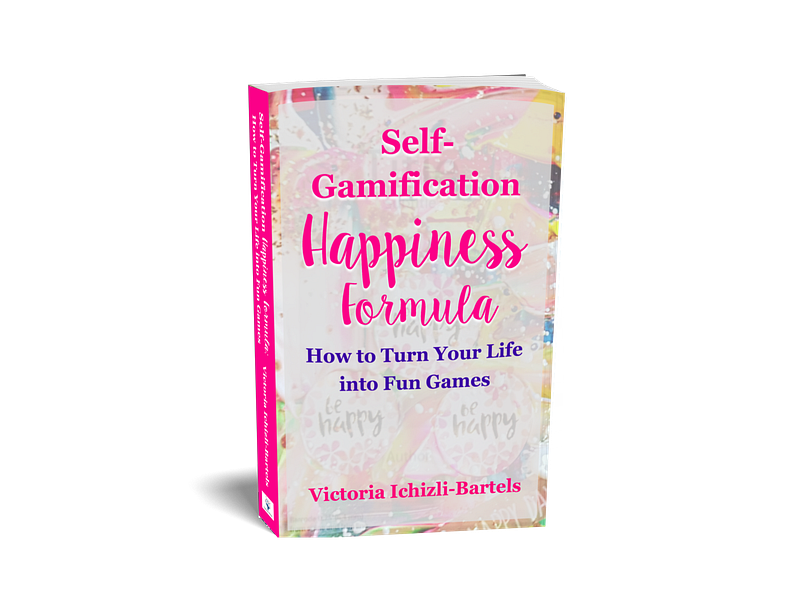
Note: It is a modified excerpt from Self-Gamification Happiness Formula: How to Turn Your Life into Fun Games.
Here are three more stories about fun:
P.S. To stay in touch, join my e-mail list, Optimist Writer.