
Medium Writing Tips
How a Single Medium Article Received 100,000 Views
The power of Medium article SEO and external traffic
Many Medium writers are looking for exposure. While making money from the Medium Partner Program is a nice bonus, they primarily want their content to be seen and accessible.
The good news is — if you are a writer, as described above — it is actually very simple to generate massive traffic for your Medium story.
Medium has extremely high Domain Authority (95/100).
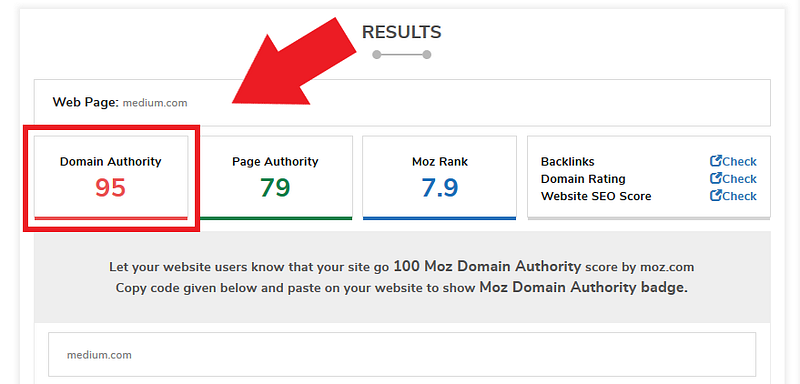
Domain authority is a score that hints at the “strength” and relevance of a website for a specific subject area or industry. It’s a logarithmic scale of points, typically ranging from zero to 100, which predicts how well a website will rank on search engine result pages (SERPs). The higher the number of points, the higher a website’s Domain Authority is.
This means that any content you publish from Medium is already given preferential treatment in search engines. This establishes the potential for large amounts of external traffic to your Medium article.
The Article with Over 100,000 Views
The article that I wrote which received over 100,000 views is How to Bypass Virtually Every News Paywall:
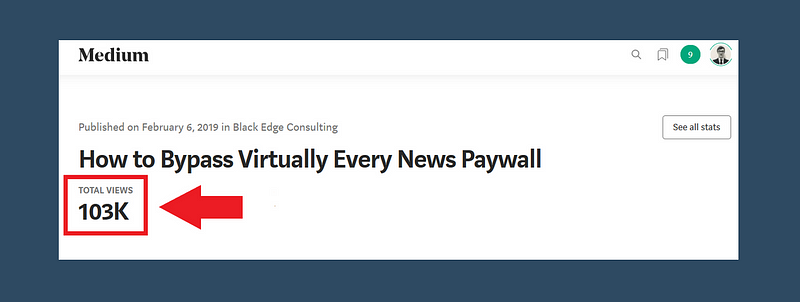
It’s not surprising that this article generated a decent amount of views because it was a timely answer to a popular online question. But it is surprising that it generated so many views.
How did this Medium article accomplish this?
It leveraged Medium’s high domain authority and created content that was attractive to search engines.
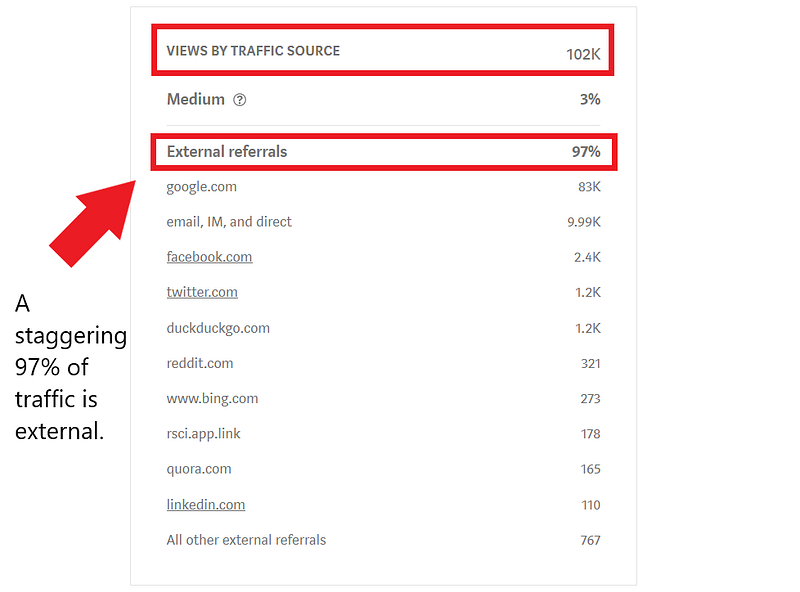
A staggering 97% of the total views received by this article were from external traffic sources. The vast majority of these external sources are search engines. Google alone, generated well over 80,000 views. Even less common search engine like DuckDuckGo generated over 1,000 views.
Did this happen overnight? No. Even the best content will take weeks, if not months to achieve its optimal rank in most search engines.
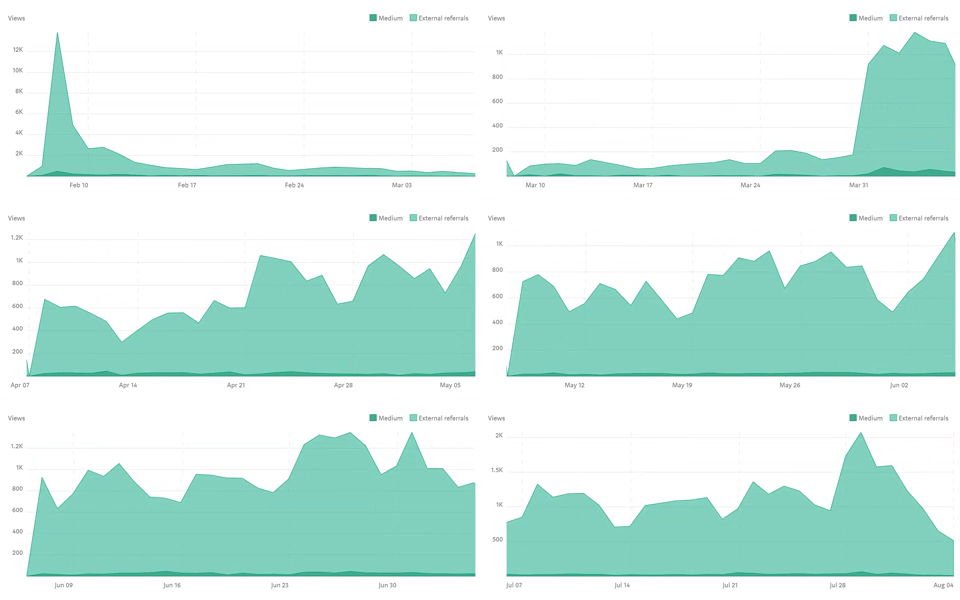
As you can see from the screenshots of my Medium article analytics, below, the article initially saw a surge of traffic a few days in.
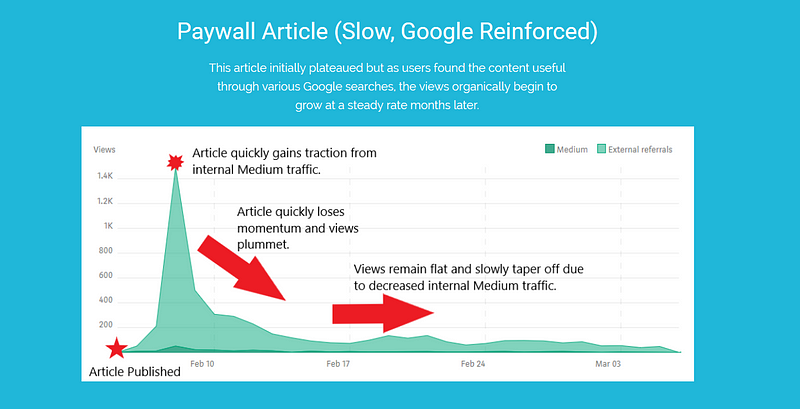
Traffic then remained flat for over a month before it jumped from being completely overlooked (Google Search Results Page 10+) to being somewhat accessible (Google Search Results Page 3–5). Also worth noting, the article was almost immediately indexed in Google after publication due to: (1) Medium being a publishing platform with high domain authority; (2) The initial surge of traffic ensured it would be indexed quickly.
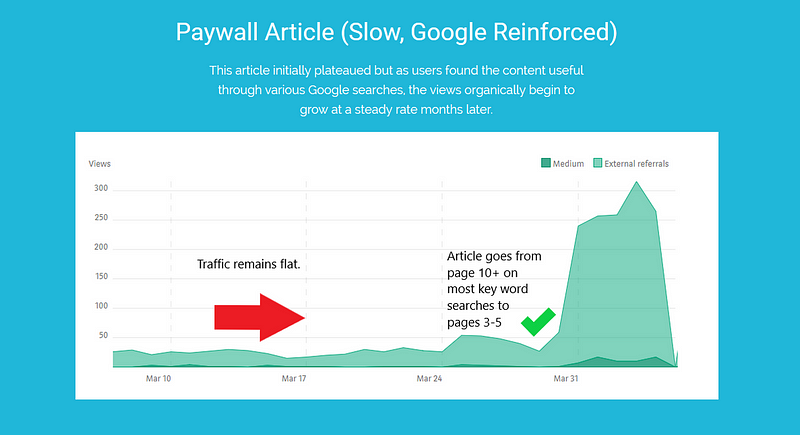
As the article oscillates in page rank in Google’s search algorithm, daily traffic continues to grow at a steady rate:
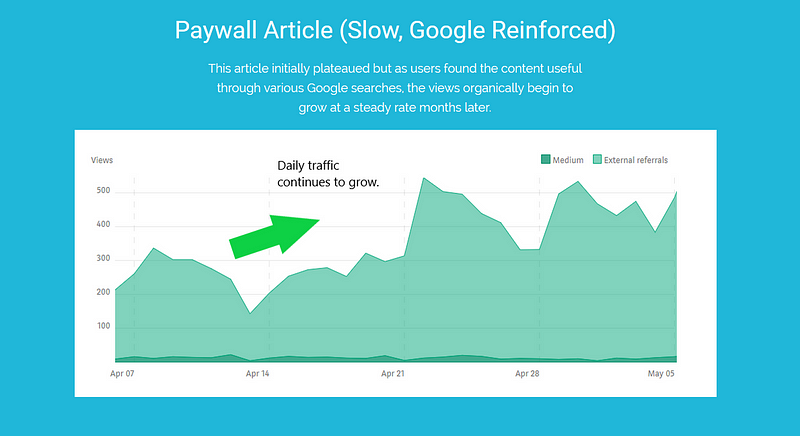
Now, in May and June, several months after the initial article was published, traffic is still consistently growing with approximately 1,000 views per day!
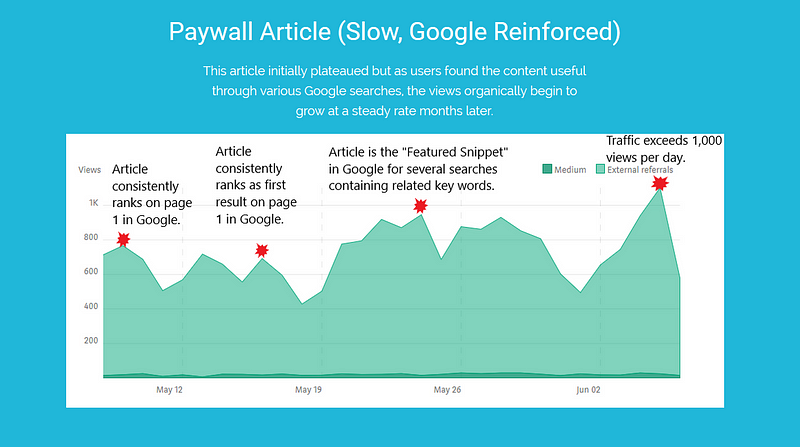
What caused this? Primarily, views continued to grow at a fairly steady pace as the article climbed page rank in Google’s search engine. It gradually reached the bottom of the first page, then the number one spot on page 1, and finally it started becoming the featured snippet (position 0) in Google’s Search results.
How to Optimize Your Medium Article’s Search Engine Performance
Google’s algorithm evaluates a number of “on-page” factors to determine what a page is about. These on-page ranking factors include the following:
- Title
- Subheadings
- Meta description
- URL
- The content of the article
- Image tags
Medium provides writers with the ability to include a target keyword in each of these fields. If you want to generate huge amounts of external views, it is essential to optimize each of these fields.
Title

A title tag is an HTML element that specifies the title of a web page. Title tags are displayed on search engine results pages (SERPs) as the clickable headline for a given result, and are important for usability, SEO, and social sharing. The title tag of a web page is meant to be an accurate and concise description of a page’s content.
- Google typically displays the first 50–60 characters of a title tag. If you keep your titles under 60 characters, our research suggests that you can expect about 90% of your titles to display properly. There’s no exact character limit, because characters can vary in width and Google’s display titles max out (currently) at 600 pixels.
- Avoid titles that are just a list of keywords or repeat variations of the same keyword over and over. These titles are bad for search users and could get you into trouble with search engines. Search engines understand variations of keywords, and it’s unnecessary and counterproductive to stuff every version of your keyword into a title.
- According to Moz’s testing and experience, keywords closer to the beginning of your title tag may have more impact on search rankings. In addition, user experience research shows that people may scan as few as the first two words of a headline. This is why they recommend titles where the most unique aspect of the page (e.g. the product name) appears first. Avoid titles like:
Brand Name | Major Product Category — Minor Product Category — Name of Product
- Titles like this example front-load repetitive information and provide very little unique value at first glance. In addition, if search engines cut off a title like this, the most unique portion is the most likely to disappear.
Subheadings
A subheading, or subhead, are mini-headlines and play a huge role in capturing and holding the scanners attention. It also keeps them moving down the page from one subhead to the next.
The subheading would ideally be:
- Useful — it shows a promise and a benefit to the reader.
- Unique — it contains a fact or opinion your reader may not be aware of.
- Ultra-specific — this makes a subheading stand out and demand attention.
- Urgent — urgency gets your reader to take notice and action.
Meta Description
The meta description is an HTML attribute that provides a brief summary of a web page. Search engines such as Google often display the meta description in search results where they can highly influence user click-through rates.
- Meta descriptions can be any length, but Google generally truncates snippets to ~155–160 characters. It’s best to keep meta descriptions long enough that they’re sufficiently descriptive, so we recommend descriptions between 50–160 characters.
- A page’s meta description should intelligently (read: in a natural, active, non-spammy way) employ the keywords that page is targeting, but also create a compelling description that a searcher will want to click. It should be directly relevant to the page it describes, and unique from the descriptions for other pages.
URL

A URL (Uniform Resource Locator), more commonly known as a “web address”, specifies the location of a resource (such as a web page) on the internet. The URL also specifies how to retrieve that resource, also known as the “protocol”, such as HTTP, HTTPS, FTP, etc.
- A well-crafted URL provides both humans and search engines an easy-to-understand indication of what the destination page will be about.
- URLs are a minor ranking factor search engines use when determining a particular page or resource’s relevance to a search query. While they do give weight to the authority of the overall domain itself, keyword use in a URL can also act as a ranking factor.
- Well-written URLs can serve as their own anchor text when copied and pasted as links in forums, blogs, social media networks, or other online venues.
Article Content
On the Internet, content sends signals to visitors and search engines about the quality and purpose of a site. Good writing, images, and other forms of content help visitors engage with a site and can build trust. Meanwhile, duplicate content and keyword-stuffed copywriting can indicate that a site is low-quality or even spammy. Content, especially when created according to a defined content strategy, is a cornerstone of effective digital marketing.
- Keyword Research: If you want to generate traffic through search, it’s best to do keyword research before you start writing. This way, you can focus on keywords for which a certain amount of search volume already exists — in other words, write toward topics (or find keyword niches!) that people are already searching for information about.
- Keyword Optimization: Know where and how to use keywords in your content for maximum searchability.
- Content Organization: The content on your site should be organized in a logical way. This is not only good for SEO, it also helps visitors on your site find other related content easily. (The longer they stay on your site, the better.)
- Content Promotion: Increase visibility to new content you create by sharing it on social networks and building links to your content (both internally and from external sites). As I’ve written about before, I love to use Signal. Signal auto-tweets your articles on repeat to help you share your articles and grow your audience on your schedule.
Image Tags
Up until recently, Medium did not allow proper image tagging. However, a few weeks ago, Medium added alt-text functionality, which allows writers to properly tag their images.
If you’re creating content on a topic that requires the support of visuals, consider how your audience might prefer to find answers to their questions on that topic. In many cases, Google searchers don’t want the classic blue, hyperlinked search result — they want the image itself, embedded inside your webpage.
One of the most important things image alt text can do for you is turn your images into hyperlinked search results — giving your website yet another way to receive organic visitors.


Summary
- Medium articles can generate huge amounts of external traffic when properly optimized for search engines.
- If you are focused on your writing reaching the most people (as opposed to the most claps), external traffic is critical.
- Even if the Medium curators/internal search algorithm “fails” your article, it is still possible to obtain large amount of views and have your content shared with a large audience.

Thanks for reading this article! Leave a comment below if you have any questions. Be sure to sign up for the Blogging Guide newsletter, to get the latest tips, tricks, and news about writing on Medium and to join our Facebook group, Medium Writing, to share your latest Medium posts and connect with other writers.
If you liked this article, here are some other articles you may enjoy:

Casey Botticello is a partner at Black Edge Consulting. Black Edge Consulting is a strategic communications firm, specializing in online reputation management, digital marketing, and crisis management. Prior to founding Black Edge Consulting, he worked for BGR Group, a bipartisan lobbying and strategic communications firm.
Casey is the founder of the Cryptocurrency Alliance, an independent expenditure-only committee (Super PAC) dedicated to cryptocurrency and blockchain advocacy. He is also the editor of several Medium publications, including Medium Blogging Guide, Investigation, Strategic Communications, K Street, and Escaping the 9 to 5. He is a graduate of The University of Pennsylvania, where he received his B.A. in Urban Studies.


