
Finding Faith in a Ruined Abbey
Lines from a honeymoon composed at Tintern
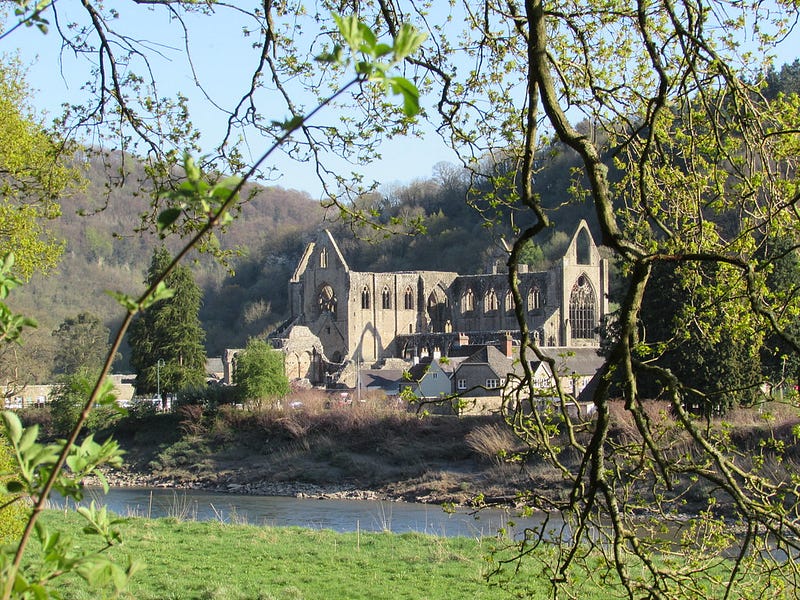
I was no longer single.
The hermit, “alone,” no longer sat “by his fire” without a companion, writing page after page in his cave. I now had a wife. No more defiled pages with blank verse. My pen, alas, back then, did only blanks shoot.
Likewise, two hundred years earlier, as a hermit at 23, William Wordsworth visited the ruins of Tintern Abbey. After college and a stay in France, he was directionless. Five years later, William Wordsworth brought his dear sister, Dorothy, back to Tintern Abbey, the famous and dissolute Cistercian Abbey along the Wye River in Southeast Wales.
In a similar fashion, of connubial nature, I brought Mary Jane, my wife, just a few days after civil marriage.
Was a ruined abbey from 1536 an appropriate substitute for a genuine church? Like the English Romantics, Blake, Wordsworth, and Coleridge, I also was a Romantic, newly made with a purpose and a wife. Did I feel the same pull to Tintern? Ydw. Or, yes.
In Welsh, Tintern Abbey is called Abaty Tyndryn.
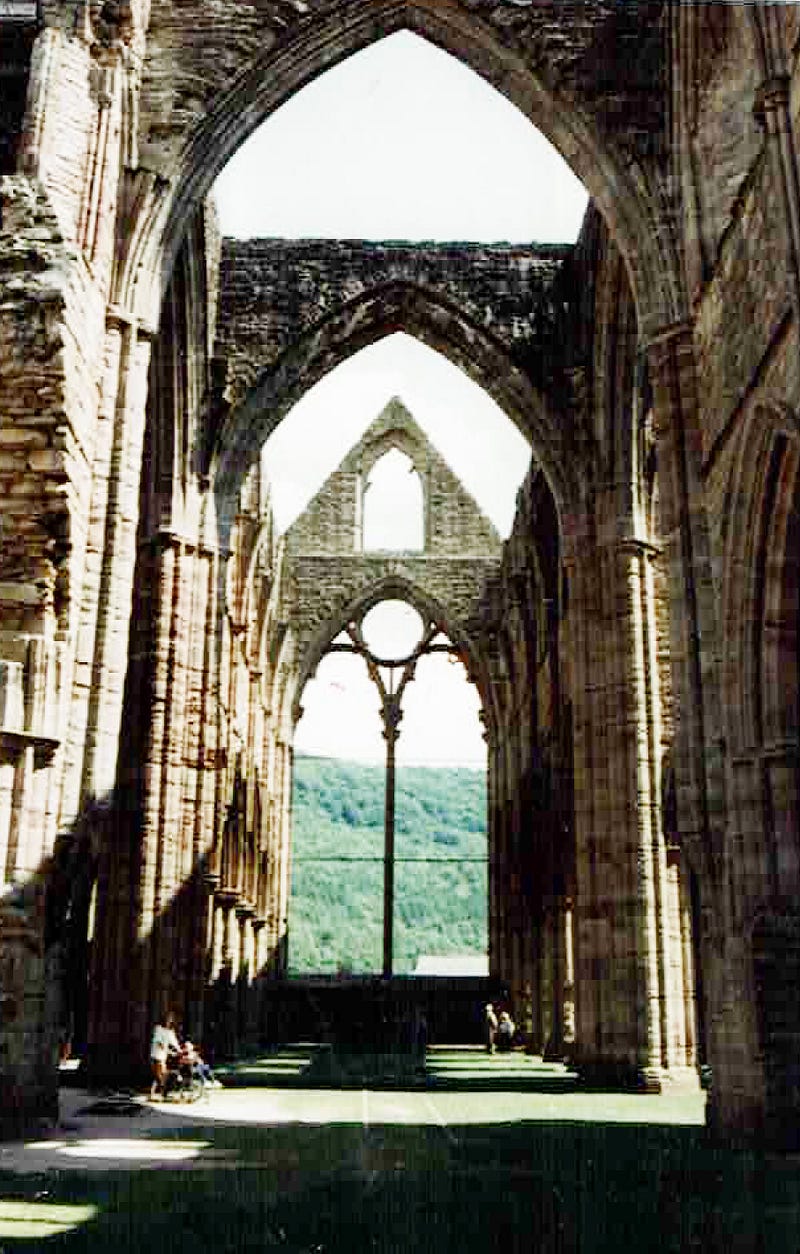
I remember my own wanderings as a youth, alone, even when I had company and friends, so wanting to share my inner and outer worlds, with a kindred spirit. I even rowed a boat with three single women from college in England on beautiful Lake Windermere. I was even their tour guide to Dove Cottage, the home of Wordsworth.
So while I was once a wandering bachelor, I now had Mary Jane who was, in Wordsworth’s poem, “the anchor of my purest thoughts, the nurse, the guide, the guardian of my heart, and the soul of all my being.”
His words, however, were for his sister, Dorothy. That must have been some sister.
But with Mary Jane, I gazed upon what I saw with fresh eyes as if I had always been half-blind. Shut up in a room, writing, it is easy to lose sight and clarity.
What was Mary Jane thinking? Did she know who she was marrying?
Did she worry I would turn out full of bluster and philandering, like the later Romantics, Byron, and Shelley? Just how tired was my fair lady in our wanderings and castle climbs? I could ask her now, but would the number of expletives embarrass me?
While other wives enjoyed the warmth and relaxation of Bermuda, Mexico, and Hawaii, my wife traipsed with me with a rental car through the misty, mystical mountains of Wales and Southeast England. My wife loves me, but I know I was a control freak then, a mixture of behavioral and observational education and basic DNA-hard wiring.
A good excuse? No. But I was used to being the tour guide.
For some reason, Wales often gets overlooked as a destination location. It has more ruins and castles per square mile than anywhere else. I read that somewhere, so just trust me. If in doubt, ask Mary Jane.
Mary Jane and I had been visiting Chester, after two days in Conway, with its magnificent Castle and Walled City, and then we wandered along the border of Wales and England in our dark gray Ford rental car, stopping for the evening in Shrewsbury. I recited the poetry of A.E. Housman, a Shropshire lad, to her in pubs. Ah, the romance!
The next day we were to spend the day in the Wye River Valley and visit a place on “My Bucket List,” Tintern Abbey.
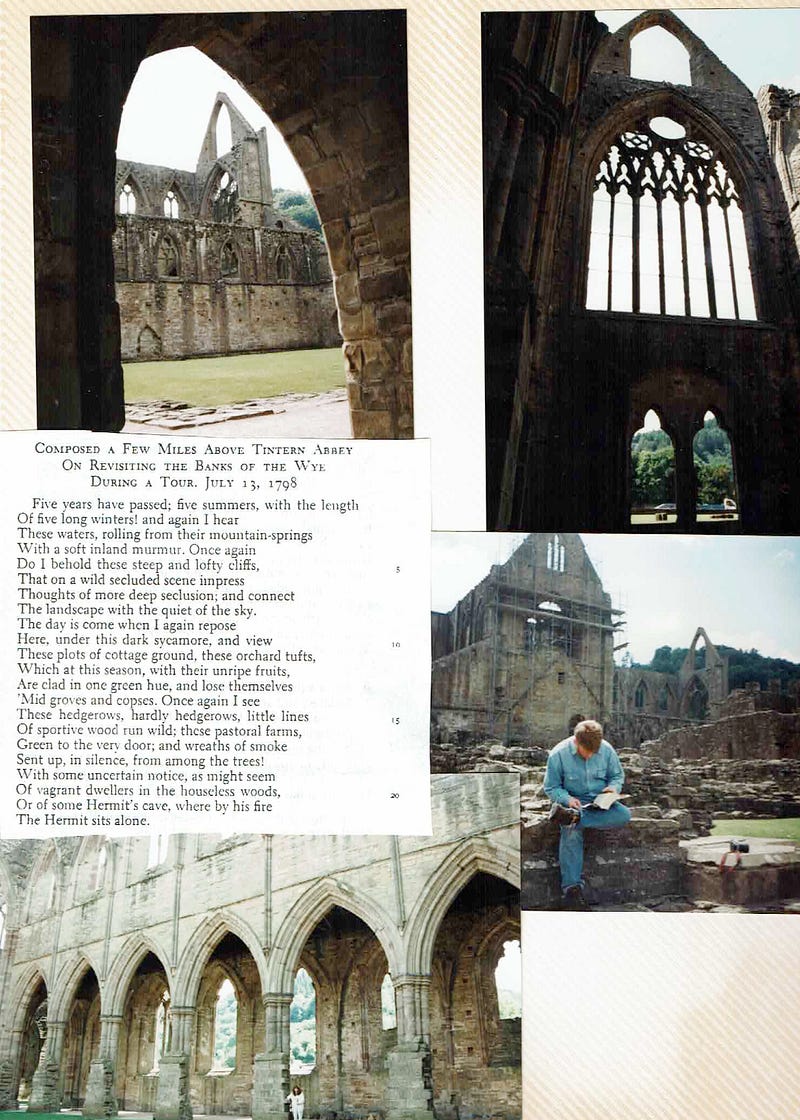
As a modern knight, what better place to bring his Lady Faire than to the Land of Castles and Mountains and Fairies? For me, Mary Jane was like “water, rolling from their mountain-springs,” into my “sweet inland murmur,” as Wordsworth writes.
Mary Jane and Nature rejuvenates. I wanted to show her a “sacred” spot. She may have seen my tears when I read:
I trust To them I may have owed another gift, Of aspect more sublime; that blessed mood, In which the burthen of the mystery, In which the heavy and the weary weight Of all this unintelligible world, Is lightened…
Wordsworth was talking about the Restorative Power of Nature. This was true for me, standing in that restorative, sylvan valley, but it was Mary Jane who “lightened” my “heavy and weary weight” with the “sublime.”
The Epiphany
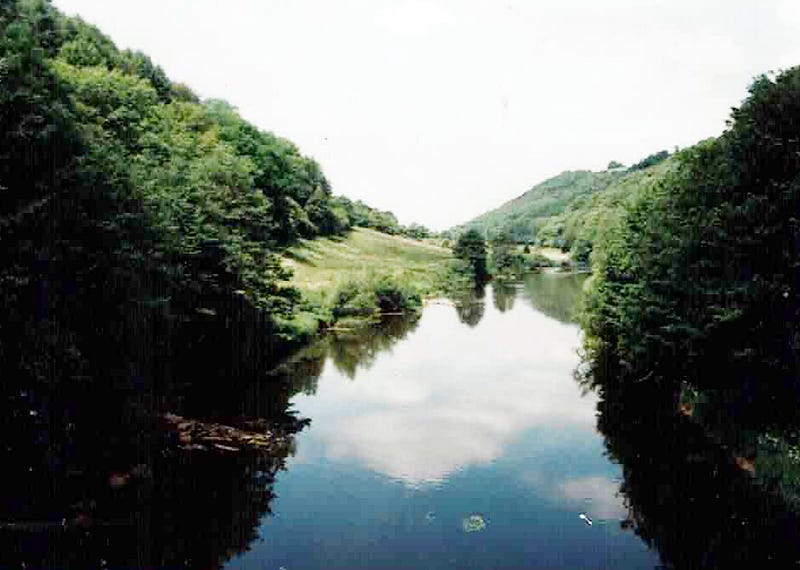
We drove along the A466, had a pleasant picnic by the Old Railway Bridge, and hiked along the gorgeous Wye River. The day was much more pleasant than my camera portrays in the faded pictures. At the White Monk gift shop, I purchased a copy of “Lyrical Ballads” by William Wordsworth. Mary Jane and I explored the ruins.
Even though it may not have been “her thing,” she is one who is always interested in learning, stopping to read an entire plaque or inscription or history.
She was telling me things and history while I was just happy running around like a child taking pictures among the ruins. It would be another twenty-five years before I was diagnosed with Overfocused ADD.
I think it took me ten minutes to read “Lines Written A Few Miles Above Tintern Abbey” to Mary Jane. This was far easier for her to bear than reading yet another revision of a short story of mine where I had sacrificed a few periods for semi-colons.
While other newlyweds have gorgeous shots of themselves in bikinis on the beach with a Long Island Iced Tea, Mary Jane is seen holding up “William Wordsworth” amidst the ruins. Ah, the romance!
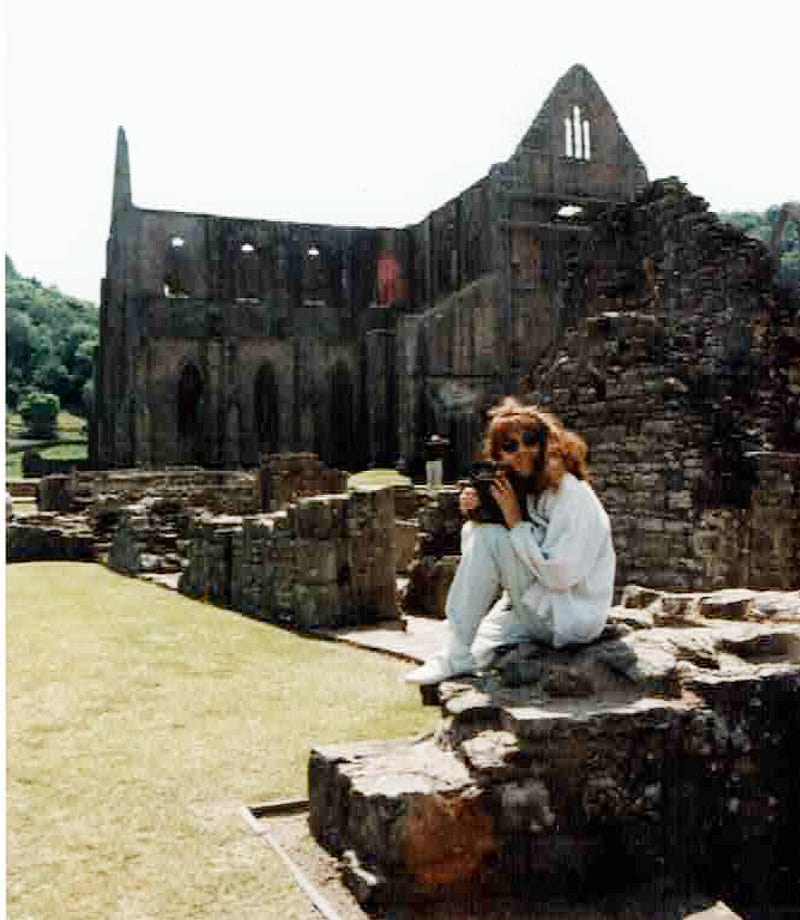
Envy would run deep upon our return home, right?
Leaving, I just had to purchase a Tintern Abbey poster for my future classroom. It hangs there still, laminated and not too wrinkled.
“What pile of rocks are we heading to next?” I imagine a wearied Mary Jane would ask. Within minutes, she was usually asleep in our rental car. That was dangerous. A sleeping wife may end up on a ferry to Ireland.
Historical Context — 1793
Cistercian Abbey at Tintern was founded on May 9th, 1131 by Walter de Clare, Lord of Chepstow. The famous (infamous) Henry VIII disbanded all churches and monasteries and abbeys, plundered their wealth, in his official divorce with the Holy and Apostolic Church of Rome between the years 1536 and 1541.
Now fast forward to 1793. France had just declared war on England. This was six months after the guillotine parted the ways of King Louis XVI and his noggin. Wordsworth was just 23.
Even though he wandered “lonely as a cloud” through the beautiful paths along the Wye River Valley, having crossed the Severn from Bristol, his mind was still with the republican Cause in France, where he had spent thirteen months. A French woman, Annette Vallon, gave birth to their child, Caroline in December of 1792.
I, too, was unsettled like Wordsworth, after having graduated from college. What was I to do?
Wordsworth graduated from St. John’s College in Cambridge. How could he leave his lover and child behind in France? He was known as a “gentleman vagrant” with financial difficulties. His name was not famous yet throughout the world. The Romantic Movement that would eventually flow from his pen at Dove Cottage in the Lake District, was years away.
It’s the same difficulty Thomas Jefferson faced: republican support of the overthrow of a monarchy was one thing; the Reign of Terror in France was quite another. One revolution gave the world Washington and another revolution that America inspired gave us Napolean Bonaparte.
Five Years Later: 1798 — Lyrical Ballads
Lines Written a few Miles Above Tintern Abbey
William Wordsworth was in his proverbial “zone” In the poem, he does not explore the ruins, mentions the Abbey, except as a place holder, a concrete reference, a staple of the Romantic Pilgrimages in England. He does not ponder why the Abbey was destroyed.
He was not interested in the dissolution of 1536, of Henry VIII, Anglicanism vs. Catholicism. The poverty of the region, the ironworks, the shacks, were also not featured.
Instead, he sees the:
serene and blessed moon” and “these steep and lofty cliffs, That on a wild secluded scene impress Thoughts of more deep seclusion.
He walked the ten miles with his sister Dorothy to the Abbey on July 10, 1798. He writes that it was “a very beautiful ruin on the Wye.”
While on a vessel bound for Bristol, on July 13, he added the final touches to his poem. He said, afterward, that “no poem of mine was composed under circumstances more pleasant for me to remember than this.”
It was immediately included in “Lyrical Ballads.”
The poem, after all, while looking at Nature, reflects the Inner Soul of the poet, much like Emerson, writing years later in Concord, Massachusetts, with the conceptions of the Oversoul and the Transparent Eyeball.
Wordsworth ponders what the five years have ushered in for him. He ponders the power of Nature and his own nature.
In the poem, he writes, “I cannot paint what then I was.”
The subject of the poem is Wordsworth, much like Whitman in 1850 will be for his incredible “Song of Myself.”
How does one chart from being tortured in 1793 to feelings of the sublime in 1798? That’s only five years. Then I think of myself. At 20, I was lonely. At 25, I met Mary Jane. I no longer had to weep into my journals.
When one is at peace, one feels the “cause of humanity,” and a kindred spirit that brings one out of themselves: connected to a higher purpose.
Wordsworth writes:
And even the motion of our human blood Almost suspended, we are laid asleep In body, and become a living soul: While with an eye made quiet by the power Of harmony, and the deep power of joy, We see into the life of things.
Classicism and the Age of Reason saw nature as a means to an end; something to subdue and conquer; as where evil lies, with the heathen in the forest, where there was no civilization, and therefore, no God.
This was the complete reversal. Nature was the realm of God, and civilization was where evil lurked. Nature frees the body and the mind. Wordsworth writes, “A sense sublime of something far more deeply interfused.”
He speculates that it may be “a vain belief” to entertain such thoughts, but still:
Though changed, no doubt, from what I was when first I came among these hills; when like a roe I bounded o’er the mountains, by the sides Of the deep rivers, and the lonely streams, Wherever nature led: more like a man Flying from something that he dreads, than one Who sought the thing he loved.
I love his line of the remembered “cataract” that “haunted him like a passion.” But just not the rushing stream, but the tall rock, the mountain, and the deep, and gloomy wood.” It’s what brings us back to nature, right? To the beach, to the mountains, to the lake.
In the poem, Wordsworth proves change is inevitable. The tree will fall. The once-mighty statue of King Ozymandias will crumble and be visited as a ruin. But nothing is lost with memory. In the poem, Wordsworth finds his footing and his faith, both in his powers as a poet, and in his connection to the greater world. Finally, I think, he knew who he was.
And it helped, too, that a legacy fell upon him that helped his financial prospects. It helped he came to terms with his daughter, and being reunited with his sister, Dorothy. The friendship with the influential Samuel Coleridge also nurtured his recovery. The two poets were pioneers of English Romanticism who would later influence Byron, Shelley, Keats, and across the Atlantic, many American writers, including Emily Dickinson and Herman Melville.
Many Romantic tropes are expressed in this poem: the eye that sees inward; a pantheistic theology, as God expressed through ongoing death and birth and resurrection and change.
William Butler Yeats, in Ireland, almost a century later, in 1888, will look to the “Lake Isle of Innisfree” for what Wordsworth expresses here:
How oft, in spirit, have I turned to thee, O sylvan Wye! thou wanderer thro’ the woods, How often has my spirit turned to thee!
Yeats writes:
I will arise and go now, for always night and day I hear lake water lapping with low sounds by the shore; While I stand on the roadway, or on the pavements grey, I hear it in the deep heart’s core.
Wordsworth ends the poem with optimism, which is one of the reasons I love Romanticism. There is hope. There is promise. There is progress. A belief in the dignity of man and woman can survive. And that the individual does not have to bow to the will of those in power, but the Individual does have a role to play in changing society for the better. Think Thoreau and Civil Disobedience, and Martin Luther King.
In the concluding lines, Wordsworth writes:
We stood together; and that I, so long A worshipper of Nature, hither came Unwearied in that service: rather say With warmer love — oh! with far deeper zeal Of holier love. Nor wilt thou then forget, That after many wanderings, many years Of absence, these steep woods and lofty cliffs, And this green pastoral landscape, were to me More dear, both for themselves and for thy sake!
So is it any wonder that such a place would be on my “bucket list” to bring my wife? We stood together with warm love. Not just warm, but holy, even there in that ruin of an Abbey.
I had wandered, she had wandered, and here we were together, apart of something much more dear and powerful than a single, solitary life. And that these memories; the walk along the Wye, the lunch, the love, all of these memories, after so many years, continue to nourish and sustain us.
Thank you for the following sources on research on this essay: Tintern Abbey, An Introduction to Tintern Abbey, and the print copy “William Wordsworth’s Tintern” published by the CADW: Welsh Historic Monuments. 1991.
Follow me on Medium at Walter Bowne and on Spotify at “Down with Bowne.”
Thank you for reading!


