
Financial Markets Are Crashing
Valuations come back down to Earth

It’s been a fun two years. Well, at least financially speaking.
Cash was free-flowing as the government gave out money and the Federal Reserve increased the money supply. Almost everyone made money investing, as assets are more expensive now than before the pandemic began.
But now markets are coming back to Earth. The money supply will be shrinking. The financial dip has already begun. There are signs coming from a variety of industries that the party is ending.
Stock Market
Stock’s have been getting hit hard recently. The S&P is down 8% in the past month and 13% year-to-date.
Tech stocks have been getting hit the worst, for a variety of fundamental and macroeconomic reasons. The NASDAQ is down 20% year-to-date. I saw a tweet claiming that this has been the worst month for the NASDAQ since 2008. One of my favorite tech stocks, AMD, is down 43% year-to-date. RIP my Vanguard account.
Maybe there is reason for hope. Three of the biggest concerns of the stock market — the Federal Reserve, the Russia/Ukraine War, and China’s lockdown — have all been in the news for weeks or months. The optimist in me believes we will get some good news from one of these concerns soon.
Energy Market
Those previously mentioned concerns are also impacting the energy industry. Prices for power and natural gas have been volatile, although volatile might not be the appropriate word…up until recently prices were only going up.
In less than one month, from March 29th to April 18th, forward curves for 2022 natural gas prices were up 50%. Fast forward to April 22 forward curves, prices had dropped; in comparison to March 29th, the forward curves for April 22 were only up 25%.
Moral of the story, prices may have peaked. But it isn't just forward markets worth pointing out. Financial institutions are behaving differently as well.
Companies that were very much against locking in profits and wanted to ride out the higher power prices, hoping they would go up, are now looking to lock in those cash flows. Other large institutions are no longer doing certain financial swaps because they are so exposed it has become an issue of risk.
This signifies that prices might be getting too high and there may be an uncomfortable amount of risk exposure for some firms.
Housing Market and Monetary Policy
Below is the title of a CNBC article from Tuesday (4/26)
Home prices jumped nearly 20% in February, but slowdown may be coming, S&P Case-Shiller says
The housing market has been chugging along for the last two years. Due to supply and demand laws and monetary policy, the rise in real estate prices should not be a shock. Although 20% year-over-year caused me to do a double-take.
Part of the explanation for the rise in assets — real estate, stocks, or crypto — is the amount of money in circulation. The M2 money supply jumped during the early days of the pandemic.
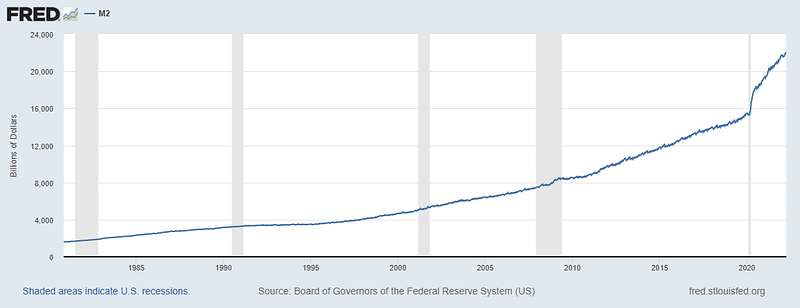
An increase in money supply means the value of a dollar decreases. This leads to increase prices, as you need more dollars (since they have lost value) to buy an asset.
The Federal Reserve has spooked investors with claims it may raise interest rates by 0.50% at the next meeting. The real concern to markets should be how they manage their balance sheet. They will likely work on relating assets off their balance sheet, which should reduce the amount of money in circulation.
Final Thoughts
Margin Call is one of my favorite movies — it is related to the 2008 housing crisis. The CEO, played by Jeremy Irons, emphasizes that he does not want to hold onto assets that will soon lose value.
While the average person does not have the same investment approach as a large bank, there is a common worry — no one wants an asset of theirs to lose value.
Before investing, make sure to have a plan. Markets have been volatile all year. Expect volatile times ahead.
The music won’t stop, but it might slow.


