
Two Signs a Recession is Coming
Indicators to watch as the world is in international turmoil
The economy is sputtering. Between record-high inflation, the Ukraine-Russia crisis, and the Federal Reserve changing to a more hawkish approach, there are reasons to worry.
Most investments have turned sour. Stocks and crypto are down big year-to-date. The period of easy money is over. The music is coming to an end.
While the news (and rising gas prices) paint a grim picture, things are not all that bad. Unemployment is still very low. The chance of a recession is less than 50%. And if one were to occur, it would still be months away, maybe even a year.
Here are two indicators to monitor in the coming months to gauge how likely a recession is.
Yield Curve Inversion
The yield curve inverting is the holy grail of recession indicators. While it does not always predict a recession correctly, it's right most of the time and is a great indicator of the economy.
When people speak about “the yield curve” they are referring to the spread between the 2-year Treasury yield and the 10-year Treasury yield. When the 10-year Treasury yield goes below the 2-year Treasury yield, that is known as the yield curve inverting.
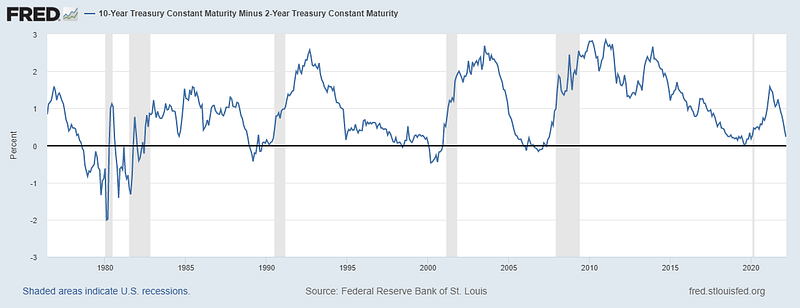
Notice that almost every time the yield curve goes below zero, a recession (gray shaded area) occurs. The last four recessions have all transpired after a yield curve inversion. And you can see all the way on the right (which is the present) our yield curve is dropping fast.
The yield curve is a recession indicator because the 10-year Treasury yield serves as a long-term indicator while the 2-year Treasury yield serves as a short-term indicator. A normal yield curve slopes upward, reflecting the fact that short-term interest rates are usually lower than long-term rates. This is a result of increased risk and liquidity premiums for long-term investments.
But if you are pessimistic about the future, you will not invest as much in the future. Instead, you buy shorter duration Treasuries and are willing to pay a premium for them. Thus resulting in the year curve inverting.
The one downside of the yield curve is that it may invert six months or a year before a recession — there is no perfect length of how long after the curve inverts that a recession will occur.
Surging Energy Prices
If you haven't been following the Ukraine-Russia news, one constant topic of discussion has been energy. Russia is one of the largest suppliers of natural gas and oil.
After sanctions imposed by the US government on Russia’s energy exports to the US, expect prices to rise even more. This is on top of the absurd price increase we have already seen in recent months.
And based on the graph below, there is good reason to worry about rising energy prices.
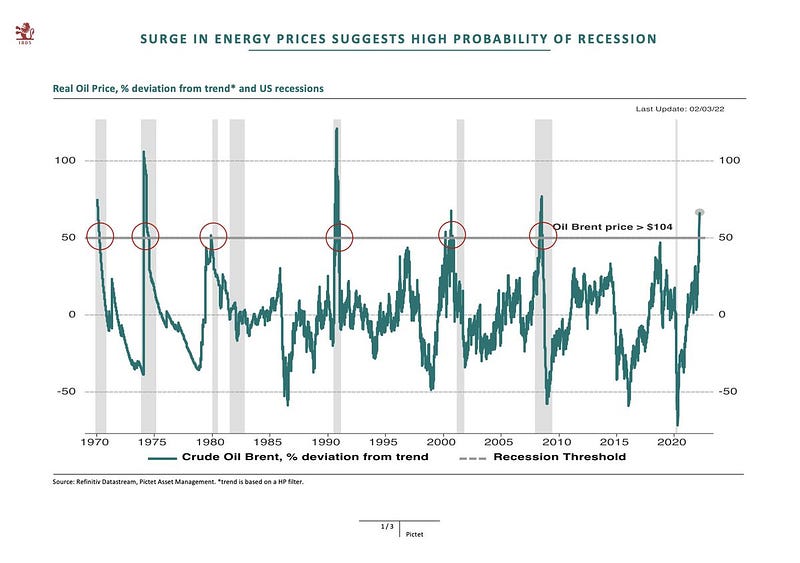
Rising oil and gas prices make living more expensive. Which in turn leads to less disposable income available for other purchases. With less money flowing around, a recession is more likely.
This indicator is less reliable than the inverted yield curve because it focuses only on one industry. But nevertheless, it appears to have a proven track record. And it also appears we are approaching recession territory — especially with no end in sight on how high oil prices will rise.
Final Thoughts
We have been on an economic rollercoaster for the last two years. Due to the Federal Reserve’s policies during the pandemic, inflation is rising at a record pace. All that money can not be created without adverse effects — remember when they insisted inflation was “transitory?”
We now may be entering a period of stagflation — defined as a situation when inflation rises while economic growth slows.
While the news bombards people with updates on the Ukraine-Russia crisis and rising gas prices, it’s best to take a step back.
Take a long-term view on the economy. Assets have increased tremendously in the past few years. Even if a recession occurs, big if, it is not likely to last as long as a period of economic growth. Be prepared for the worst and keep an eye on these indicators, but remember that hard times don't last forever.


