
Inflation Is Coming
Expect higher prices in the coming months

Paul Revere in 1775, “The British are coming.”
Economists (and myself) in 2021, “Inflation is coming.”
As much as I enjoyed writing that introduction, (although most would argue it’s extremely cheesy) inflation is a serious matter that impacts everyone’s daily lives.
Inflation, put simply, is the rise in prices.
Many financial and economic news sources have been discussing inflation more and more over the past few months. Notable items such as lumber, which is needed for and drives up the price of houses, and oil have headlined articles since they are widely used.
It's worth looking into what all the inflation news is about — the increase in producer prices, when consumer prices will increase, and what to do to hedge inflation.
Increases in commodity prices
Part of the formula for increased prices is increased costs. Manufacturers have to pay more to produce goods. They then increase the price of the finished goods we buy.
And prices are up big for producers.
I grabbed the prices of popular commodities for January 2020 and March 2021. I choose January 2020 instead of one year previous (March 2020), because I did not want the effects of the pandemic involved. It's also worth noting the prices will likely be higher in April 2021 than in March 2021.
I know how much Isaiah McCall likes the table I include, so without further ado
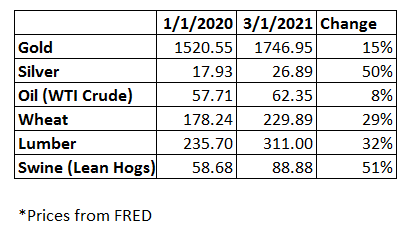
Prices are up way higher than the 2% inflation target of the Federal Reserve.
Oil is an interesting outlier, as the only single-digit percent change. The price for a barrel had a crazy journey the past 14+ months and consumers saw that as prices (at least in NJ) dropped below $2 / gallon. Unfortunately, they have risen back up to $2.80 / gallon and are expected to keep increasing.
The common theme though, prices of inputs are increasing.
Similar to CPI (discussed below) the prices producers pay for goods are also tracked as a “basket”. The PPI, producer price index, measures the change in producer prices. Keeping with the same dates, the PPI for all commodities is up 8.5%. Again, a lot higher than 2–3% inflation we as consumers expect and are used to.
Just because PPI is 8.5% does not mean we will have CPI of 8.5%, that is very unlikely. But above-average consumer price increases can and should be expected.
A few headlines to drive home the inflation in commodity prices,
- Commodity prices are spiking — here’s how traders are hedging the risks (4/22)
- Corn futures jump to a 7-year high on supply concerns (4/26)
- Runaway inflation is the biggest risk facing investors, Leuthold’s Jim Paulsen warns (4/29)
- Soaring lumber prices add $36,000 to the cost of a new home, and a fierce land grab is only making it worse (4/30)
Inflation in earnings reports
Company earnings can give a good indication of what is happening in the economy, especially earnings from large companies. They are also important to look at because each sector is different; case and point, while airlines were getting killed in Spring 2020, Zoom was having an amazing few months.
So when CEOs speak, we should listen. They usually have a good pulse on the economy.
Here’s a crazy stat:
The mention of the word “inflation” on corporate earnings calls has more than tripled so far this quarter.
Tripled! That’s the largest jump in Bank of America’s history of tracking it. And that’s coming from several sectors, such as consumer, industrials, and materials.
Several big-name consumer companies have already announced price increases will occur in the future.
Proctor and Gamble announced on their earnings call in April that consumers can expect price increases in September.
Kimberly-Clark announced North American consumers can expect to see higher prices by late June, to the tune of mid-to-high single digits increases.
Other companies include Coca-Cola, PepsiCo, General Mills, and J.M. Smucker.
And if companies don’t raise prices to battle inflation, other methods include using new packaging, selling smaller-size packs for the same price, or offering promotions that bring the price down until consumers are used to the higher price.
On Saturday (5/1), during Berkshire Hathaway’s annual shareholder meeting, Warren Buffett said that we are seeing substantial inflation and rising prices.
Why is there a delay in price increases?
I’m not aware of any official lag with inflation. It would make sense though that producer prices increase before consumer prices do.
For this current stretch of upcoming inflation, it would make sense for companies to hold off on raising prices.
Due to the pandemic and higher unemployment / lower labor force participation, it's not an ideal time for companies to raise prices. Some people are still in rocky financial times, so higher prices would likely create a greedy image and a PR headache.
What can you do?
There are only three proper ways to deal with inflation.
- Complain
- Stock up on three years worth of toilet paper, peanut butter, and soda before prices increase
- Invest in inflation hedges
As fun as the first two are, the third should be the only option you seriously consider.
Investing your money anywhere is a great way to combat inflation. If inflation is 2% each year and you get 0.5% interest from your savings account, your money is losing purchasing power.
The stock market is a common investment to grow money faster than inflation, with returns of 11.56% the past decade.
Another common investment hedge is real estate. But buying property is expensive and a headache. REITs are an option. As is Fundrise, an option I plan to look more into these coming months.
And then there are cryptocurrencies, which we’ve covered extensively on this publication.
Lastly, invest in commodities themselves. I’m not familiar with how, but there’s likely a way to get future contracts in oil, wheat, lumber, and other commodities that are up big this year.
Gold has an ETF ($GLD) at a reasonable price, and for what it's worth, my old college roommate always preached about investing in gold!
CPI
It’s worth noting that CPI, the consumer price index, rose in March. It was up 0.6% from February, but more importantly, it was up 2.6% from March 2020.
While there is no official metric for inflation, CPI is widely considered the closest indicator. (Although ScoJo may disagree)
CPI data for April will be released on May 12th. Investors and economists will be looking at that number, in addition to April’s unemployment number (which comes out May 7th,) to get a gauge on what the Federal Reserve may do regarding interest rates and inflation.
Final Thoughts
Prices are going to rise, it doesn't seem that there is much we can do in that regard. We will always need gas for our car or peanut butter for PB&Js.
What we can do is learn more about great investment strategies, including inflation hedges, so that our purchasing power is not decreased. Financial literacy can be a powerful weapon.
Neither I or my old college roommate are licensed professionals. The above references an opinion and is for information purposes only. It is not investment advice.


