
The New Great Depression: How to Prepare for the Worst
Stop investing
Here is what the cost of bread was in Reichsmark, Germany nearly one century ago today:
January 1918: 0.25 January 1922: $3 January 1923: $700 May 1923: $1,200 July 1923: $100,000 September 1923: 2 million October 1923: 670 million November 1923: 80 billion
And here we are in America. Hey, do you remember how much a Mcdonald’s hamburger cost in 1955? It was fifteen cents…
So, in 2022, in addition to rising prices on literally everything and no increase in wages coupled with mass unemployment — and to top that all off, more money being printed than ever before I’d say we’re in for a great depression.
A new great depression! And the sequel will not be better than the first.
Depression is Depressed Growth
During the housing crisis back in 2008 we suffered what is called a “demand shock,” meaning nobody had spendable cash to support economic growth. In the 70s the United States suffered a “supply shock” after the Opec nations decided to cut off oil supply to the US.
In 2022, we’re looking at both a supply shock and a demand shock.
The supply chain is still recovering from the pandemic but now also has to factor in the effects of the Russian-Ukraine war; meanwhile, overall faith in the US economy is plummeting both domestically and globally.
We’re headed for a total economic disaster.
“When your debt is going up faster than your GDP you’re going to go broke. We are looking at inter-generational changes and it all comes out of the Covid pandemic… We’re not going to be out of this in 30 weeks, 30 months, it’s going to take 30 years. ”
— Jim Rickards, Author of The New Great Depression
You can literally feel it too. People aren’t talking about how much they made on crypto or stocks anymore. It’s: “Wait, how much is your job paying you?” and “Oh my God can you believe the price of gas, groceries, cars, hamburgers?”
Bretton Woods, the current US financial system, is over. Dead. Gone. The world will segue into a new financial paradigm by 2025 (most likely we’ll see the introduction of a central-backed digital currency very soon).
We are now slowly transitioning into a new polycentric world order.
The American empire is finished.
The Petrodollar and its Potential Collapse
While it is true that the US dollar is no longer pegged to gold after 1971. It is pegged to something more important: OIL.
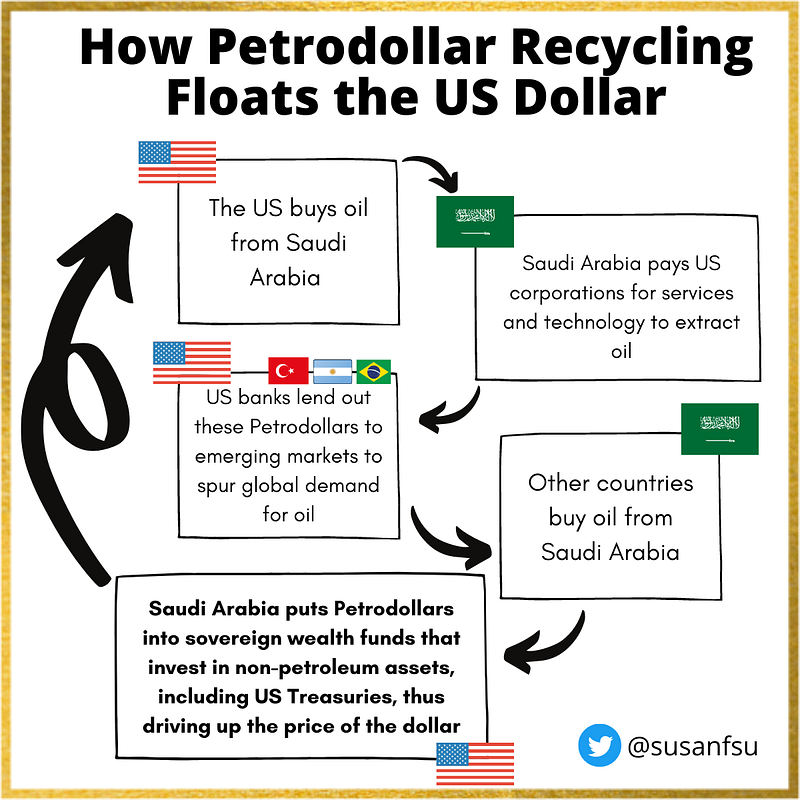
For the last few decades, our economy has thrived on Saudi Arabia being able to buy US treasury bills before they were auctioned. In return, Saudi Arabia only sold its oil in US dollars effectively creating what is known as the ‘Petrodollar.’
The Petrodollar is what kept the dollar relevant after we defaulted on the gold standard in the 70s.
And now for the first time ever, the Saudis have agreed to sell oil to China not for American money, but in Chinese currency. Uh-oh. If this Saudi-China deal takes off, then other countries may ask for similar treatment and it very well could destabilize the entire American economy.
Pandora’s box is now open.
(At the moment, 2.48% of the world’s reserves are held in yuan, compared to 55% for the dollar, according to IMF data.)
There will come a day when people lose faith in the US dollar.
Every empire that has debased its currency or removed something of tangible value from backing it has fallen.
The mistake was thinking that the downfall would happen from the removal of the gold standard. It’s the petrol removal that should have been our greatest fear — and now it’s happening.
Here are 3 more reasons why the Petrodollar system was stupid from the start:
- Effectively the US now had to support countries like Saudi Arabia and the UAE which support genocides in Yemen and the mistreatment of women.
- The USA was able to print much more currency because of the Petrodollar. This means the US can and was taxing the world with inflation.
- The national debt is mathematically impossible to pay off, not because it is too large — but because most of US money is earned from debt. That may sound paradoxical, but I don’t know, maybe Cody Collins will do an article on it or something. All you need to know is this model is not sustainable.
In an economic depression, growth is not impossible, it’s just depressed growth. The Petrodollar made life simple not only for America but for the entire world. It made record-breaking global economic growth possible.
Now that the Saudis are backing out — and because of global mistrust in the Petrodollar system — we’ll start heading back towards a quasi-barter economy by mutually exchanging each other’s currency. (India’s doing it too)
The US dollar is no longer the undisputed “king.”
How to Prepare for the Worst
And now for the good news!
…
… …

The end.
Just kidding. It’s important to remember that America is experiencing a slow-motion car crash. As we saw the Fed warn us about inflation, your purchasing power will slowly be impacted in the coming months and years.
It won’t happen overnight.
High inflation will become the standard. That’s right. The standard. You have to get used to it.
And get used to whoever's in charge — whether that be Democrat or Republican — blaming other countries for our economic problems when they can be easily traced back to the fault of our own.
Depending on your temperament you’ll have to invest your money in one of three ways:
1. Stocks
It took 25 years to break even from the top of the 1929 stock market after the crash. Stocks fell 89% to hit the bottom. We haven’t seen a real stock market crash like that in our lifetimes. That might change.
What I will say is, yes, stocks especially ones like the Vanguard Total Stock Market Index Fund ETF (VTI) and Vanguard 500 Index Fund ETF (VOO) will still be safe investments.
But the stock market as a whole is certainly at risk if we’re to go into an economic recession (which is very likely) or a depression.
And as every economic expert is predicting right now: It’s better to have an economic crash than to risk inflation getting out of control.
Understand that stocks may fall to levels you are not accustomed to and when you “buy the dip” they will not immediately recover.
2. Crypto
The creator of Bitcoin had excellent foresight.
He saw what is playing out right now as we speak: US hegemonic fiat currency has no future besides a melodramatic end.
Times are changing — yet the fundamentals of Bitcoin and Ethereum are still there, plain to see.
Economically speaking, we are at the most confusing point in the nation’s history since the Bretton Woods conference. The only system that remains simple is Bitcoin (21 m will ever be made).
I’m not a big believer in a global “Bitcoin standard” but in times like these, anything is possible. At the very least, it would be prudent for any investor to consider crypto as a financial vehicle (which global institutions have also been doing for the past few years).
3. Pokémon Cards
Only a true miracle from God could reset our economy.
Either that or Pokémon Cards.
Nah. I wish.
If you’re looking for a super-safe historically-proven investment then you should look into gold.
Besides being something shiny to look at, gold is one of the best conductors of heat and electricity. It is also very malleable and doesn’t rust or oxidize.
Gold has been hitting record highs lately due to the uncertainty from the pandemic and the Russia-Ukraine war. It’d be smart to look into it.
Takeaway
We talked a lot. It was kind of depressing at first but, you know, America will pull through this. We always do.
Things just might get really really bad beforehand.
How bad? I don’t know. But things are set up for really bad:
- Record-high inflation
- Both a supply and demand shock resulting in what could become stagflation
- The collapse of the Petrodollar
- The potential guard change from America to many different countries (incidentally this was predicted by the World Economic Forum).
Sanguine.
That’s the word of the day.
Be it. Exhibit it. And please be careful out there.
Ever since I was a child it was my dream to become a financial advisor. Unfortunately, it never came true. Therefore I am not a financial advisor and you should do your own research and not just listen to random people on the internet. Nothing contained in this publication should be construed as investment advice.
This article contains excerpts from my new book “Gold 2.0,” join 2000+ people on my Substack for a limited copy of the eBook version!