
1971: The Year Everyone in America Became Poor
Everything changed after this decision

The middle class is dying in slow motion.
Inflation is at record highs, no one wants to work anymore, nobody is getting married, and for the first time, we have a younger generation that’s clearly not doing better than their parents.
Spoiler alert: If the middle class falls apart, the country falls apart. It’s why we feel like we’re on the brink of societal collapse right this second.
So, what went wrong here?
1971.
That’s the year we can trace back all our problems.
Establishment of America as the world’s superpower
Here are the atrocities that happened after 1971…
- Inflation went from 4% to 12% by the end of the 70s
- Average household debt increased because buying a house rose at a faster rate than household income.
- And suspiciously enough, college tuition began to rise after 1971 as well
Ok, but to understand what happened in 1971, first, you need a little background on how America sewed the seeds for economic destruction.
The United States wasn’t always the head honcho of the global economy. They only recently seized that position after World War II, when an agreement was drawn up between 44 nations that established the U.S. dollar as the world’s reserve currency, which would be pegged to gold.
This event was called the Bretton Woods Conference.
After Bretton Woods, most currencies around the world (i.e. British pound, Euro, Ruble, etc) would be pegged to the U.S. dollar to smooth over world trade and boost the post-war recovery.
In one fell swoop, America became the number one superpower capable of controlling the global economy like a marionette.
Wealth inequality went wild after 1971
“Power corrupts, and absolute power corrupts absolutely” — Lord Acton
After the Vietnam war, the US was in major debt.
It didn’t matter.
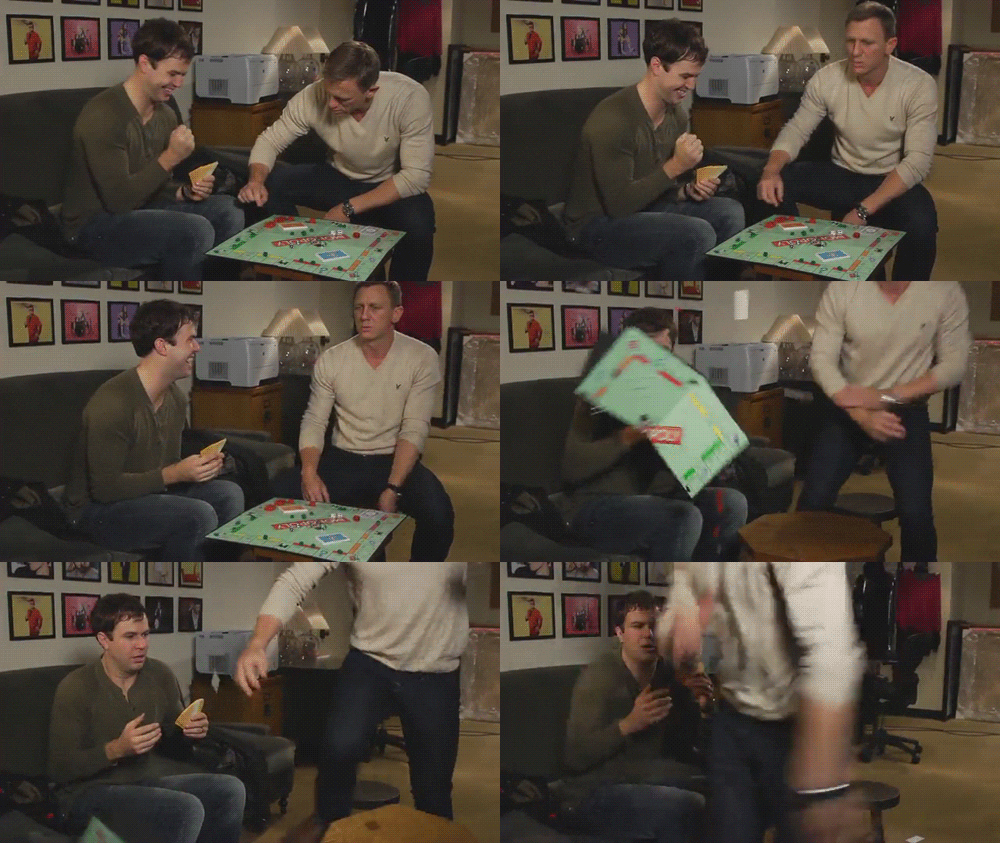
We were the world reserve currency and held the keys to the global economy. The US was like a cheating banker in Monopoly: they could hand themselves as much money as they wanted without asking permission.
This pissed the rest of the world off, as you might imagine.
Endless money printing devalues everyone’s individual holdings, so the world wanted this system to end. The first was France, who actually sent a battleship to New York harbor to get their money returned to them, in gold, not US dollars.
Then something crazy happened.
President Nixon said, “fuck you France”. Ok, he actually said “no” and canceled the ability for anyone to exchange their US dollars for gold. Nixon called this a ‘temporary’ measure.
It wasn’t temporary.
This quietly turned our economy into a giant fraud. The Federal Reserve was able to print infinite money, create inflation, and keep wages the same while decreasing the value of the dollar.
Now you’re screwed, and you don’t even know it
Wealth inequality will and should always exist to some extent in a meritocracy— but nowhere near the level it’s at now.
The game is rigged, and most people don’t even know how or why.
It’s 1971. That’s why!
When too much money is printed it immediately takes away from your purchasing power. Moreover, you’re the one who pays for stimulus packages, government programs, and the support of the $30tn debt crisis.
Does any of this upset you? (It should)
Inflation = More money printing + less stuff being created (i.e. broken supply chain)
People never acted as if the gold standard ended. They believe their money stays the same value every day.
It doesn’t. Only those who own stocks, crypto and other assets benefit from a non-backed reserve currency; and, unsurprisingly enough, the middle class and poorer communities are least likely to own any of that.
Final Thoughts
I‘m reminded of a quote from Bernie Madoff after he was arrested: “Why are you guys even talking to me? The US government is running the biggest Ponzi scheme in the world.”
Although Bernie lacks credibility, he knows a Ponzi scheme when he sees one.
When you have the ability to control your money supply, you don’t default on debt. And the only people who suffer are the people in the middle.
In other words: YOU
America will reap what it sewed eventually. If you have an unbalanced budget and reserve currency you lose industry and you end up creating a manufacturing superpower, something like China.
Right now the only thing you can do is get the f*ck out of the dollar and invest in assets whether that be stocks, crypto, real estate, or any other investment that you’ve done your research on.
Either that or watch your net worth bleed, slowly.
Ever since I was a child it was my dream to become a financial advisor. Unfortunately, it never came true. Therefore I am not a financial advisor and you should do your own research and not just listen to random people on the internet. Nothing contained in this publication should be construed as investment advice.
Join 1500+ people on my newsletter for a free copy of my eBook “Mind and Muscle.”