
Inflation Isn’t Going Anywhere Soon
Prepare for your money to lose value
Here we are, almost a year after first mentioning that inflation is going to soar. And inflation is still elevated. Worse yet, there’s no end in sight.
At first, high inflation was blamed on elevated used car prices. Now energy prices are to blame — but energy prices can’t go higher than the record prices we are currently seeing, can they? (Hint: they can.)
What will be the source of blame next? Will there be a drought that drastically raises food prices? I don’t expect, and certainly don’t hope, so.
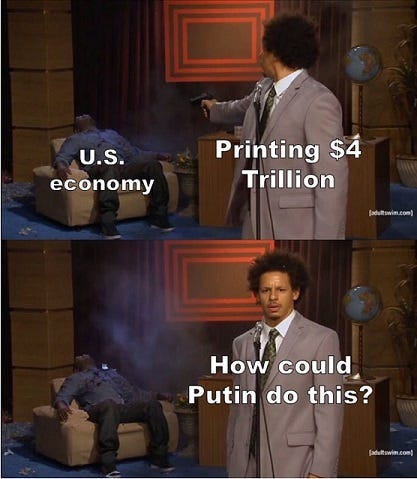
When will the Federal Reserve mention that the increased money supply is having undesired impacts on the economy? (Up until yesterday, they were still buying billions in bonds each month!)
Excerpt from the Federal Open Market Committee’s March 16th press release:
Inflation remains elevated, reflecting supply and demand imbalances related to the pandemic, higher energy prices, and broader price pressures.
Fed Raised Rates
It’s been a long time coming, but on Wednesday (3/16), the Federal Reserve voted to raise the benchmark interest rates. Rates are increasing from 0% to 0.25%.
And make no mistake on the timing of this move, the Fed had to wait until they finished the tapering of their bond purchases to raise rates — it would have made no sense to raise rates before, even when inflation was already present.
With the raised rates, investors now know that inflation is the main concern for the Fed. There are six more meetings for the Federal Open Market Committee. Rate increases are expected at each meeting. And then three more rate increases are expected in 2023.
Each increase is excepted to be 0.25%. Excluding yesterday’s increase, the Fed wants to raise interest rates by 1.50% more for 2022 and another 0.75% in 2023. The expectation is that they will increase by 0.25% each meeting, which is a smoother transition. But there is the outside chance they hike rates by 0.50% at a time.
The Fed also announced Wednesday they would start shrinking their balance sheet, which is almost $9 trillion, as early as May.
Market Reactions
The stock market closed Wednesday up 2.2%. After initially turning negative after Powell’s announcement to raise rates, the S&P closed at a high for the week. Why would the market rejoice from such an announcement, when higher rates mean more expensive debt and less growth?
Because the situation has gotten so bad that investors were worried about a 0.50% increase today. They will happily take only a 0.25% increase.
Bond markets reacted the opposite way. They initially rose after the announcement, but then gave up those gains. The yield curve, the gap between the 10-year and 2-year, narrowed. An inverted yield curve signals trouble for the economy’s future.
Inflation Will Get Worse
Previously, Federal Reserve officials were saying inflation was transitory. Look at us now, dealing with inflation of 7.9% over the last twelve months.
I’m not optimistic this situation will subdue anytime soon. Neither are others.
Last week, Treasury Secretary and former chair of the Federal Reserve Janet Yellen told us to get ready for more inflation.
We’re likely to see another year in which 12-month inflation numbers remain very uncomfortably high.
Mohamed El-Erian, Chief Economic Advisor at Allianz, also warned us of worsening inflation this past week.
“We will probably get very close or above 10% before we come down.”
Moral of the story: inflation is not getting better anytime soon. CPI, the consumer price index, is often used as the inflation gauge. Another measure, the Producer Price Index (PPI), is also showing worrying signs.
PPI is essentially an inflation gauge for producers, instead of consumers. It measures the increase in the costs of inputs. On an annual basis, PPI increased 10% in February. February’s monthly increase was 0.8%.
If producers are still facing increasing prices, these higher prices will be continued to be passed on to consumers.
Final Thoughts
Inflation is not our friend.
It will remain elevated for the foreseeable future. Even when it does subdue, what mark will it leave? Don’t expect prices to magically drop to pre-pandemic levels.
For the time being, there is not too much we can do. Most investments will face a bumpy road. The period of easy money is ending — its now time to be smart with where we put our money. At least until the next recession occurs and we go through the cycle all over again.


