
Can the Next Recession Be Predicted This Easily?
Interset rates show us when to expect it

The Federal Reserve has created an economy that runs like clockwork. Over the long term, the economy has hummed along without any major, unforgiving issues. In the short term though, the economy has gone through boom and bust periods, which are especially reflected in the stock market.
The primary purpose of the Fed is to make sure the economy runs smoothly.
The mission of the Board is to foster the stability, integrity, and efficiency of the nation’s monetary, financial, and payment systems so as to promote optimal macroeconomic performance.
But looking at their actions and the subsequent results, the economy has not been smooth. In fact, it has followed a pattern.
History
Below is a graph of the Federal Funds Effective Rate set by the Federal Reserve — this is essentially a fancy term for interest rates.
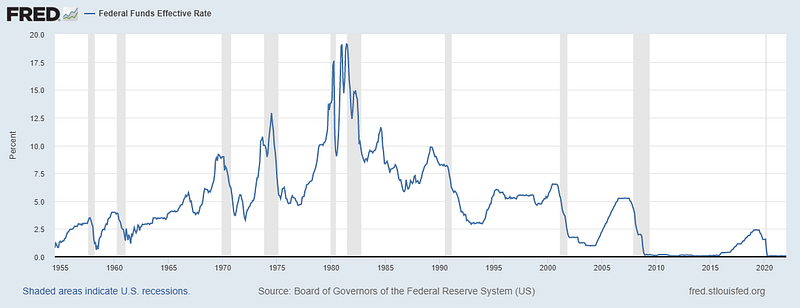
The gray bars represent recessions.
The past three market crashes (Dot-com bubble, housing crisis, and March-April 2020) all followed a similar pattern.
- Interest rates were slowly increased — until they hit the Fed’s target rate or were paused because signs of future economic trouble were appearing.
- Markets fell, the economy was in danger, and jobs were lost. As a result, the Fed drastically lowered interest rates.
- After extended periods of low-interest rates, the economy starts to recover. Once the economy is on solid ground, the Fed starts to slowly raise interest rates again.
4. The cycle repeats itself.
We are currently in step 3 — the economy is recovered and the Fed is planning on multiple interest rate hikes this year.
Current Interest Rate Expectations
To combat high inflation levels, the Federal Reserve is utilizing the tools it has at its disposal. While there are several actions the Fed is taking, the action garnering the most attention is increasing interest rates.
The Fed has implied they will raise interest rates at their upcoming March meeting. This will be followed by subsequent interest rate raises throughout 2022, 2023, and 2024. Most raises will be 0.25% increases. There’s the outside chance they raise rates 0.50% at once, but highly unlikely.
For reference, this past week the Bank of England raised interest rates 0.25%, their second increase in three months, bringing them from 0% to 0.50%. They were only one “yes” vote away from raising it 0.50% this past week, which would have brought their interest rates up to 0.75%.
A month ago, the expectation was that the Fed would raise rates three times in 2022, twice in 2023, and twice in 2024. This would get the economy close to the desired 2% rate.
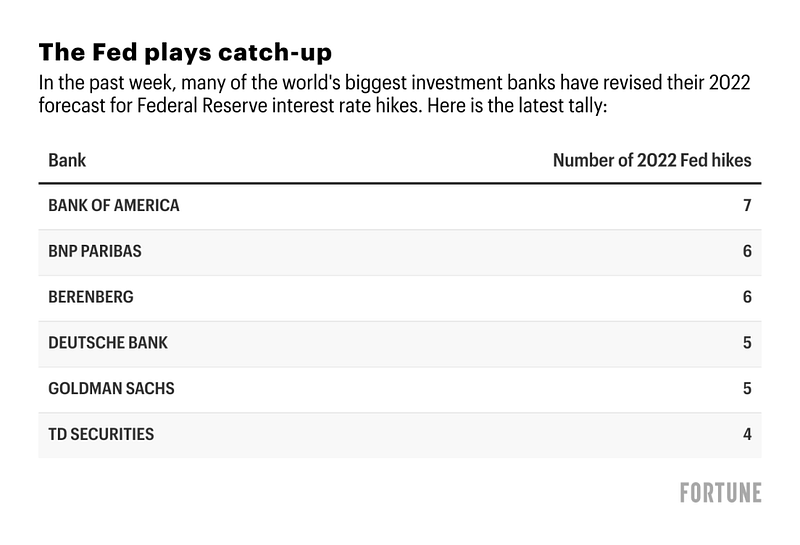
Banks are now expecting more rate hikes in 2022. Bank of America predicted an absurd seven rate hikes this year. While other banks don’t expect that many, most now expect more than three.
When To Expect the Next Recession
Perfectly timing the market is impossible. No one is able to buy in at the absolute bottom and sell at the peak.
The market is designed to reward investors in the long term. That’s why the saying, “time in the market beats timing the market” rings so true. But one can use economic indicators to know when to start stockpiling cash versus when to put that cash to work.
Now that we know recessions come shortly after interest rates level off, the next variable to look at is when interest rates will level off at the Fed’s desired amount. Currently, the Fed’s goal is for inflation to be 2% a year, which would coincide with 2% interest rates.
The Fed may speed up or slow down their rate adjusting, pending how the economy reacts. But as of right now, we can expect 2% rates to appear in mid-2024, with a market downturn following several months after.
Black Friday in 2024 might give us great deals on cheap appliances and quality stocks.
The fun part of the future is no one knows what will happen. If I could accurately predict when the market will crash, I would be a lot richer than I am right now. But understanding past events and economic policy can help guide investment decisions to mitigate losses.