
Why I Will Dollar-Cost Average Every Investment Going Forward
It’s the best way to make money
I used to think I was knowledgeable about stocks, markets, and finance. I soon realized that “knowledge” didn’t help for shit.
After making a few safe investments that worked out, staying up to date with the market, and going to school for finance, I thought I knew what I was doing. I started getting cocky with trades and not listening to those with more experience. And my losses reflected that.
Then I found the solution to it all, Dollar-Cost Averaging. It's a strategy so simple yet so great.
Dollar-cost average (DCA) is when you slowly buy into a position. It can be over hours, days, months, or years. It all depends on your horizon and strategy.
You can dollar cost average based on time, percentage change, or anything really. If you’re investing for retirement you might buy one share of stock “X” on the first of every month. If you’re day trading you might buy-in through the first three hours of the day whenever the price drops half a percent.
The benefit of dollar-cost averaging is that you spread out your purchases so you won’t get caught buying high. You also won't benefit from buying low. But if you buy-in consistently, it should even out between highs and low.
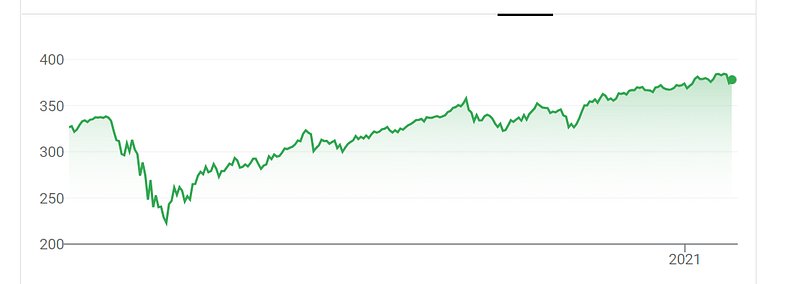
Trying to time when it is the right moment to invest is difficult and stressful. Just looking at this chart of $SPY from the last year shows how easily it can fluctuate up and down. If instead, you decided you would invest every month on a certain day, say the 7th for example, it would make things a lot easier.
I had so many signs in the past year pointing me to this realization that I should just dollar-cost average. While these personal stories have more of an impact on me, hopefully, they can convince you to consider dollar-cost averaging going forward.
One of the no brainers for me was my experience with $SAP and $INTC. I had already written about that in a previous story; with the emphasis being that if you don't learn from your investment mistakes, you are bound to have a tough time making money. Essentailly, $INTC dropped one day on news. So I put in a bunch of money looking to make a quick buck. The stock continued to trade lower in the pursuing days. It took a month to be profitable on that trade. So when $SAP dropped on news, I put a little bit of money in that day and continued putting money in for a week or so. That trade was profitable in less than two weeks.
Sam Dogen is an investor I follow who has a wealth of knowledge on financial markets. He has his own newsletter to help people achieve financial freedom called Financial Samurai, which I highly recommend. He had an interesting article in December that provides a better dollar-cost averaging strategy. Part of his strategy is to invest more than his normal amount whenever the S&P 500 corrects by more than 1%. There are other facets of it, but the key for my story is the 1%. What fascinated me from the article was the chart below.
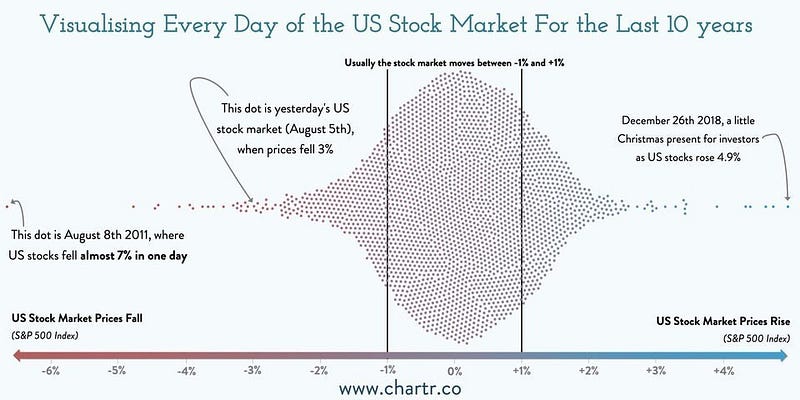
As you can see, most days the S&P 500 index is up or down less than 1%. I don’t have as much cash to invest as he does, so I adopted an altered strategy. Anytime the $SPY is down more than 2% in a day, I invest. So when it was down about 2.5% on Wednesday (1/27), I was buying. Adding this dollar-cost averaging method will help me buy-in when the market is down.
The Practical World, a fellow Medium author, wrote an article a few weeks back giving a good explanation of DCA and his strategy. His strategy was interesting and a little more complicated than mine. But his has worked the past few years beating the standard dollar cost average approach of investing methodically each month.
This far into the story and I still haven’t explained in full my DCA strategy, I’m getting there.
I’ve been talking with my uncle recently regarding investing. He introduced me to a Roth 401(k), which I still need to research more on, but the biggest point I got from him was about dollar-cost averaging. If, starting in your twenties, you consistently dollar cost average into a fund or ETF that tracks the market, you will be sitting pretty come retirement. And if you look at a chart of $SPY from 40 years ago to today, it's hard to argue that.
How I Dollar-Cost Average
So here’s my strategy going forward. On the first of every month, I am buying into $SPY. And anytime $SPY is down more than 2% in one day, I’m also buying in. Simple as that. It might not be the sexiest strategy or make me rich quick, but over time it should help me build my wealth.
In terms of my dollar-cost averaging strategy for individuals stock, I don’t have one that is as defined.
Part of my “knowledge” I previously thought I had was built from my time at Ramapo College. I was lucky to be able to learn from and work with someone who had actually worked in finance. He was able to time stocks better than anyone I know, yet he still bought into positions over time. In hindsight, I should have realized earlier the power of dollar-cost averaging and not thinking I could time stocks perfectly.
I like to put my money where my mouth is. The last stock I invested in was Veeva Systems Inc ($VEEV). I bought in each day for a week.
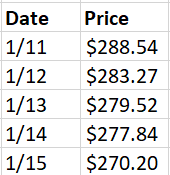
Had I bought in all on the first day (1/11) I’d be down on my investment until it hit $288 again, on 2/2. Instead, I was able to dollar cost average and I got a mix of the low prices and high prices, making my cost basis $279.87. That’s almost $10 a share more profit than had I invested all at once.
Stocks fluctuate. That's what they’re supposed to do. Most people don’t have the time to predict when they will hit their lows or their highs. And those that do have the time, usually get it wrong anyway. Dollar-Cost Averaging is a great way to take emotion and stress out of investing and hopefully help you make some money along the way.
Hopefully, these lessons I learned can help you with your investments. Check out some of my other pieces related to investing.


