
EVs In Our Cities: The Good, The Bad, and the Ugly
Electric vehicles have the power to greatly enhance city life, but today’s popular electric SUVs will only make things worse.
Electric cars are highly visible symbols of environmental responsibility, proudly flaunted by individuals, companies, and governments alike. Sadly, the truth is that they offer no real climate benefits, will remain unsustainable for decades to come, and introduce serious new environmental concerns from critical mineral mining and processing.
But still, electric car greenwashing is very easy to pull off and will probably continue unabated for years to come. As a result, we’ll see many more large and flashy “planet-saving” electric cars in our cities as the 2020s play out.
It’s not all bad, though. There are several electric vehicles that can greatly benefit our cities (and the environment). These represent “the good” in the title of this post. Unfortunately, the types of cars driving all the EV hype fall squarely in “the bad” category, and their long-term effects can be downright ugly.
The Good
In small-scale applications, battery electric drive wipes the floor with the internal combustion engine. EVs in this segment have the potential to make our cities a whole lot better.
E-bikes
At the smallest level, e-bikes offer electric mobility at a low price point with negligible consumption of energy and battery materials (with some precious exercise thrown in). However, safety and practicality remain serious hurdles in many of the world’s cities that are clearly built for cars instead of people (we’ll return to this topic soon).
Electric 2-and-3-wheelers
One level up, we find road-going electric scooters. As reviewed earlier, these are about 6x more efficient than gasoline equivalents, offer the same range, and are more convenient to “fill up.”
These 2-wheelers have the power to give hundreds of millions around the world access to affordable mobility and, in so doing, take hundreds of millions of cars off our roads. The scooter in the video above runs on only 2.6 kWh of batteries and delivers most of the on-demand mobility service offered by an electric car with a 30x larger battery pack. Greater practicality and weather-proofing are also increasingly available from emerging 3-wheeler models with battery sizes in the range of 5 kWh.
Tiny commuter cars
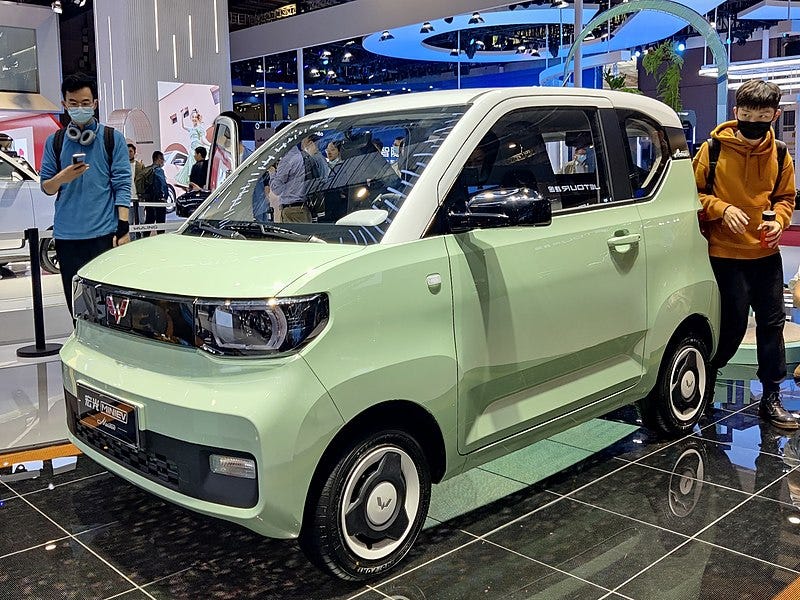
EVs can be beneficial in the car segment, too. For example, the tiny commuter car with its 12 kWh battery pack shown below easily took the top spot in Chinese electric car sales. Battery swapping is no longer practical at this scale, but the sales volumes say this is no problem for many Chinese city dwellers.
Plug-in hybrids
For those who need a large family car that will be primarily used in the city, a plug-in hybrid offers a good electromobility solution. These much larger vehicles have similar battery sizes to the little electric car shown above with the peace of mind of an internal combustion engine offering 1000 km of range whenever needed.
Smart use of a plug-in hybrid can allow most driving to be done on electricity using an 80% smaller battery pack than an equivalent electric car. However, it can also be misused, driving mostly on the gasoline engine and wasting much of the battery material savings. Such misuses would demote plug-in hybrids to “the bad” category, and a regular hybrid (with a 10x smaller battery) would have been a better choice.
The Bad
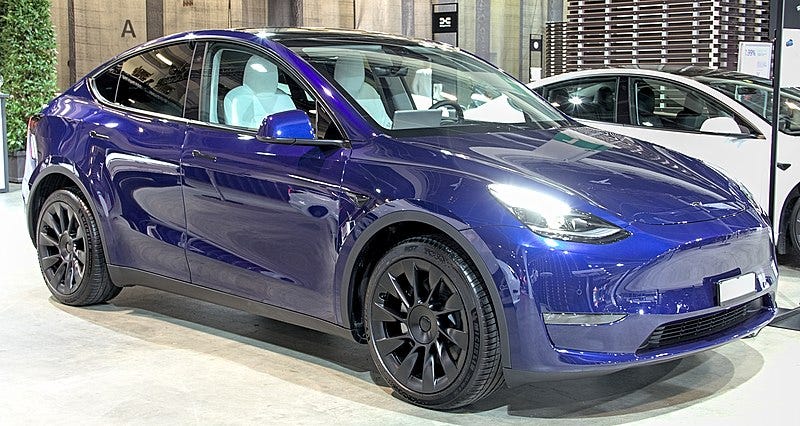
Essentially all the electric cars driving the EV hype in the West fall in this category, especially upmarket SUVs like the Tesla Model Y.
The Model Y requires 82 kWh of battery capacity to give the legions of Tesla enthusiasts the range they desire. And yes, this huge battery will still not be enough for many people, prompting manufacturers to develop far larger packs. Such enormous batteries are being worn as badges of honor instead of the environmental and supply security disasters they truly are.
Summary of today’s electric car impacts
Electric car incentives are driving a destructive Jevons paradox (greater efficiency gets canceled by more consumption) effect in Western markets. In Norway, the undisputed leader in EV market share, massive EV tax breaks caused the average new car to gain a ridiculous 700 kg over the last decade.
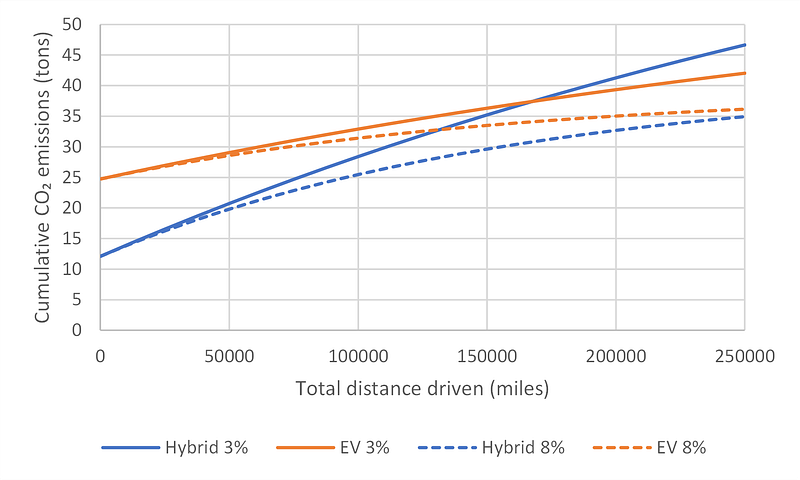
Large electric cars have far greater upfront environmental costs than regular cars. As a result, the environmental payback period is very long, even when the car is charged with relatively clean electricity.
Large battery packs also come with serious non-CO2 environmental impacts, mainly related to critical mineral extraction and processing. The average electric car needs earth and ore equivalent to about 100x its weight to be moved and processed to get the materials used for its batteries. These processes involve a wide range of impacts ranging from ecosystem destruction to freshwater depletion to air, water, and land toxicity. In fact, the mining industry required for a battery-powered society may well be more environmentally destructive than today’s coal industry.
Supply security will also worsen. For example, the current commodity price spike increases battery costs by about $5000. With this money, you can absorb a 50 $/barrel oil price shock for 20 years in a hybrid. Furthermore, electricity can be even more volatile than oil, and this will get worse (not better) as we build more variable and non-dispatchable wind and solar generation.
Air pollution
Large electric SUVs also turn another oft-cited EV benefit into a liability. Following decades of incredible progress with reducing tailpipe emissions, non-exhaust particulate matter (especially fine particulates, PM2.5) is now the central air pollution issue. And these emissions scale primarily with vehicle weight.
To give some context, most hybrids are rated “extremely low (trace)” for NOx emissions. As an example, the current generation Corolla hybrid has NOx and particulate emissions of 2.5 and 0.13 mg/km, respectively, which is almost nothing. For comparison, the non-hybrid Corolla has NOx emissions of 13.5 mg/km, and the V8 Land Cruiser is rated at 143.3 mg/km. Cars of yesteryear had NOx emissions measured in g/km. Note that PM2.5 and NOx are responsible for almost the entire air pollution health burden, with PM2.5 being about 5x more potent than NOx.
Non-exhaust PM2.5 emissions originate from brake, tire, and road wear. Due to their extra weight, EVs perform worse in terms of tire and road wear, although regenerative braking saves emissions from brake wear. However, hybrids can also benefit from regenerative braking and still offer considerably lower tire and road wear emissions.
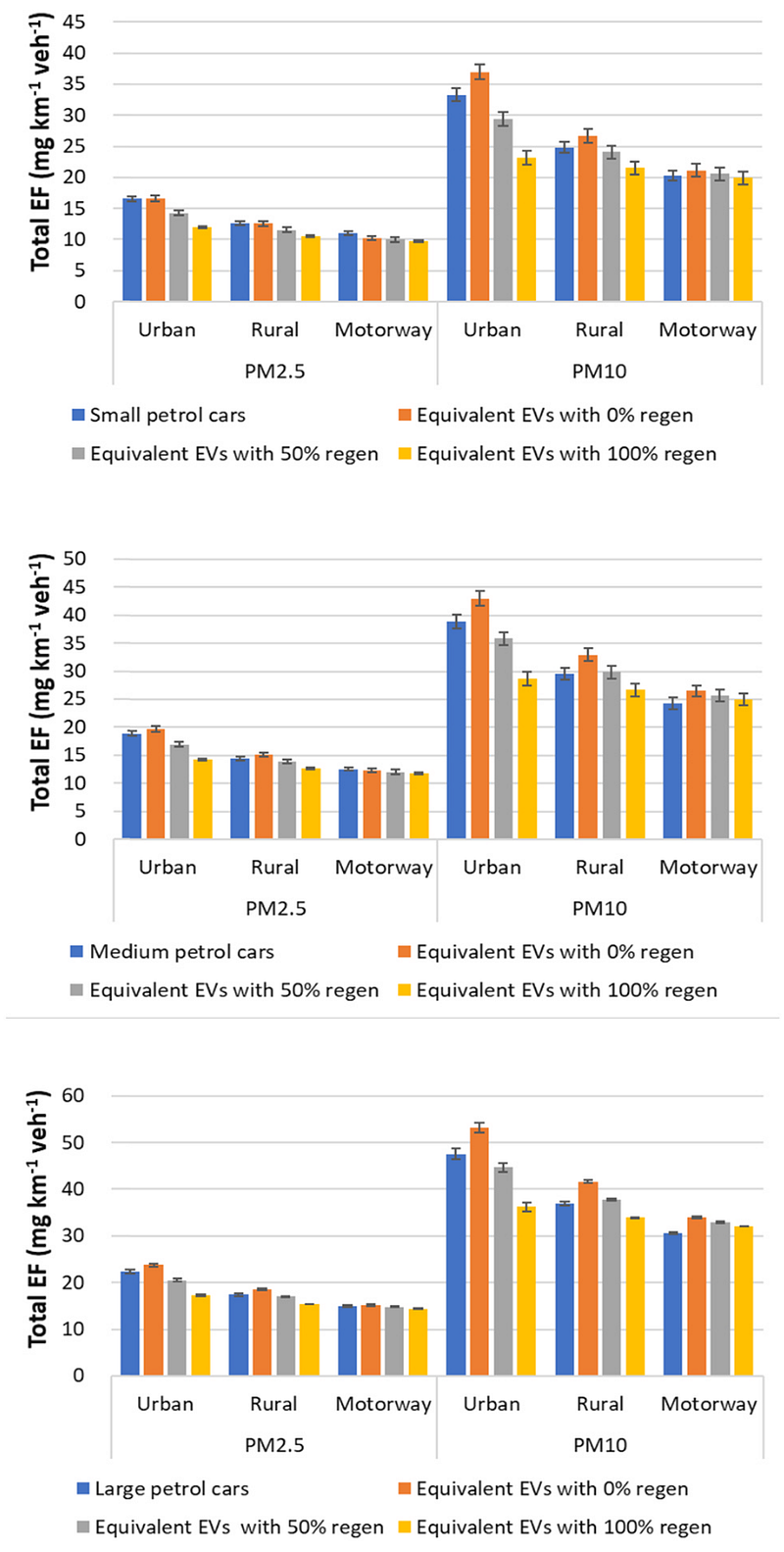
The figure above shows the effect of regenerative braking on EV particulate emissions compared to a (non-hybrid) petrol car. The petrol car rating also includes 1.2–1.8 mg/km of tailpipe emissions.
For a comparison to modern hybrids, we can subtract the tailpipe emissions and compare the petrol car to the EV with 0% regen, given that the hybrid also does regenerative braking. In this case, the EV would cause about 10% more particulate pollution than the hybrid.
Furthermore, the Jevons paradox means that the more relevant comparison is between the petrol car and the EV from a larger size class. In this case, the additional air pollution caused by the EV would increase to about 30%. And this is without even considering pollution from “the long tailpipe” of electric cars, which can be quite bad in large coal-dependent Asian markets.
Smaller electric cars
More sensible electric cars like the Nissan Leaf with 40 kWh of battery capacity are obviously less of a problem. However, these cars find themselves in an awkward no-man’s-land where the battery pack is too small to grant the freedom that most people want from a car but still too large to make economic and environmental sense.
Shoppers in this segment would get much more value from a hybrid like the Toyota Yaris if they want freedom or one of the smaller EVs covered earlier in “the good” section if they want clean and economic urban mobility.
The Ugly
An EV revolution based on policy-forcing of electric SUVs with 80 kWh battery packs can have several downright ugly consequences. I will highlight three of those here.
Persistence of car-centered societies
Regardless of what’s under the hood, hauling two tons of environmentally destructive materials over a vast network of roads on high-value real-estate while generating PM2.5 pollution, creating large strategic dependencies, wasting loads of time in traffic, causing death and injury from accidents, creating depressing concrete jungles, and enforcing dangerous sedentary lifestyles is a fundamentally flawed way to get people from point A to point B.
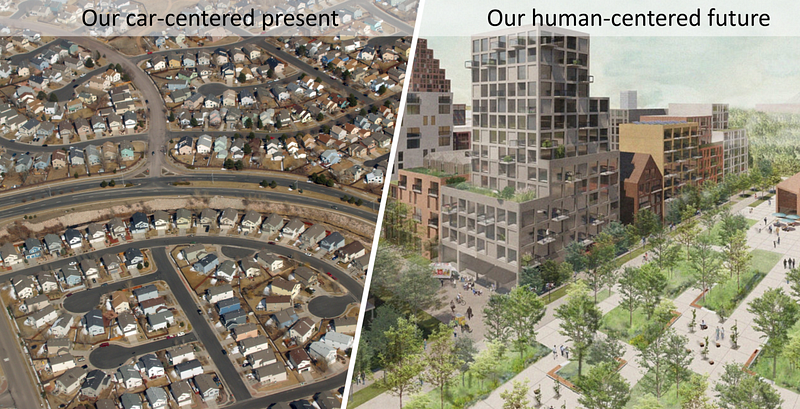
We really need to get over our car obsession, but the type of EV revolution that current policy frameworks are encouraging will do the exact opposite. Indeed, future growth in automobile sales seems secured, mainly because the electric car has become such an effective climate action poster child for governments to project a green image and powerful auto-lobbies clearly understand how much they will benefit from these policies. In addition, influential rich folks with vast environmental footprints can drive around in their Teslas and pretend that their subsidized luxury car is saving the world.
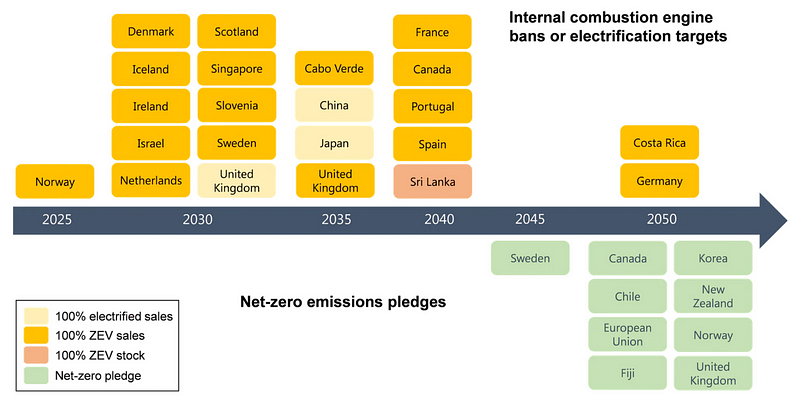
All these perverse incentives will perpetuate highly inefficient car-centered societies like in the US where per capita oil consumption for passenger road transport is a mindboggling 300% greater than in Europe. It’s easy to see links between the long list of externalized costs of such extreme car dependence (first paragraph of this section) and the inferior human development and health/happiness outcomes of the US relative to Western Europe.
This massive waste of achieving less with (much) more will only worsen as we transition to policy-mandated vehicles with low running costs that incentivize people to buy ever-larger cars and drive them at every opportunity. Another great irony is that such a situation will make cities unattractive and unsafe for the small EVs in “the good” section, creating a vicious cycle where too many cars mandate even more cars.
The best way to limit these huge externalities is to internalize them in the running cost of the vehicle. And the best way to do that is a large fuel tax. Unfortunately, taxing the “fuel” used by electric cars is all but impossible, meaning that car-related externalities will remain unaddressed in the US and could greatly increase in Europe and Asia, reversing decades of progress.
Geopolitical and economic instability
Humans are not particularly good at sharing scarce and concentrated resources. That’s why the strategic dependences created by the highly uneven distribution of critical minerals needed by electric cars can have serious long-term consequences. With the Jevons paradox in full swing to supercharge the demand for critical minerals and electricity among the rich, new critical mineral cartels, shifting strategic alliances, and increasingly volatile electricity markets could create large global and local challenges.
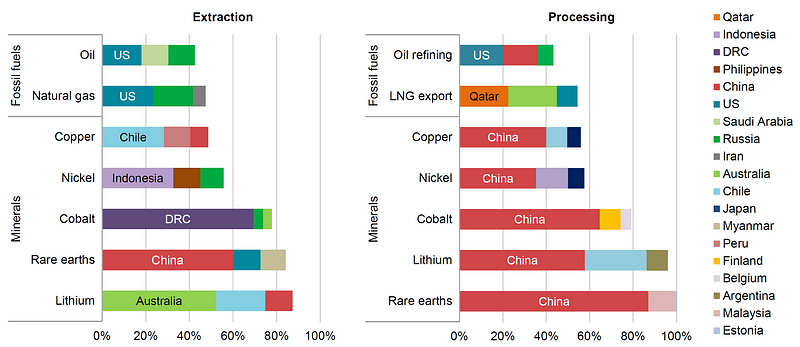
There is also a potential for compounding boom-bust cycles created by wild fluctuations in critical mineral and electricity prices. As calculated earlier, current commodity prices increase battery costs by about $5000, which will eventually destroy plenty of demand. If this coincides with record-high electricity prices (e.g., Europe at the time of writing), economic headwinds will compound further. This situation can easily lead to a recession and an associated crash in commodity prices that makes investments in new capacity very risky, setting us up for the next price explosion.
This is important because the timeframes for bringing online new mines and firm electricity generation and transmission capacity are so long. For example, the IEA gives an average time of 16.5 years between discovery and first production of critical minerals and grid expansions are giving the Energiewende serious headaches. In comparison, oil production can respond much more rapidly to changes in demand via OPEC’s spare capacity and the short development timelines offered by fracking. The fact that oil prices fluctuate strongly despite this flexibility should serve as a stark warning of future instability in critical mineral pricing (and the associated geopolitical and economic instability).
Perpetuating gross global inequalities
I see the tragic state of global inequality of opportunity as the world’s #1 problem. For perspective, consider that the average rich-world citizen in the 95th percentile gets to consume as much as 50 people in the 5th percentile just because he was lucky enough to be born into a prosperous society.
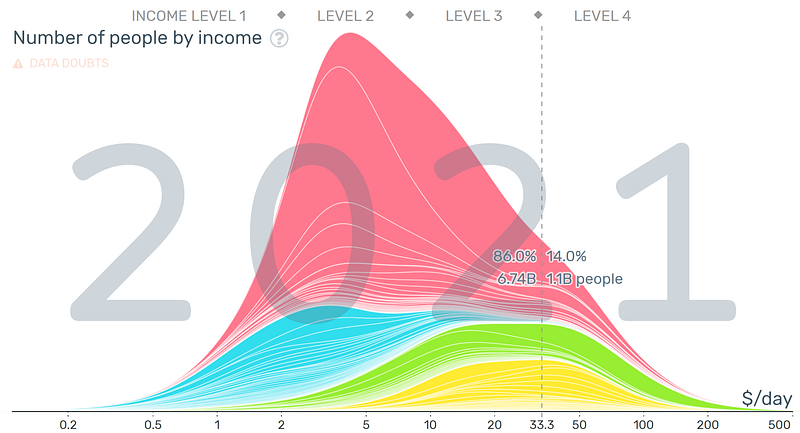
Large policy-mandated electric cars will only worsen this effect. Aside from the economic inefficiency and instability mentioned in the previous two sections, the capital-heavy cost structure of electric cars is ill-suited to facilitating rapid economic development (see problem #10 in this previous article). Simply put, giving capital-intensive green technologies preferential treatment pulls some of our limited supply of investment capital away from a wide array of much more important life-enhancing infrastructure such as decent housing, schools, hospitals, and the like.
Furthermore, the social and environmental impacts of vast operations to extract and process critical minerals will be heavily concentrated in the developing world with potentially disastrous effects. A recent scientific paper identifies three key problem categories:
- Processes of dispossession that displace local populations and communities from land and livelihood through processes of expropriation and resource exploitation
- The pollution and degradation of local and global ecosystems at the extraction, production, transportation, and disposal/recycling points of the supply chain
- Systemic patterns of unequal environmental exchange that lock regional and national economies into destructive development dependencies of primary extraction, land expropriation, elite capture, and unsafe disposal of toxic and hazardous waste
Supercharging the resource curse by deploying electric cars to soothe environmental guilt with luxury SUVs in the rich world is a terrible idea. Unfortunately, that’s exactly what the EV revolution is shaping up to do.
Getting the Best Out of EVs
As clearly outlined in the first section of this article, EVs can have major positive effects on society. Sadly, current policy momentum is heavily skewed to the bad and ugly sides of EVs. Here are some ways to turn the tide.
Technology neutrality
Electric car technology-forcing is a bad idea, especially if incentives also apply to luxury cars. Battery prices have been low enough for electric cars to sell in their best niches for years, so further subsidies will do more harm than good.
If concerned about climate change, impose a CO2 tax that rewards any method that avoids greenhouse gas emissions (including embodied emissions) equally. If concerned about supply security, tax gasoline and critical mineral imports equally. If concerned about air pollution, tax all cars for NOx and PM2.5 (crucially including non-exhaust emissions).
Such policies will allow us to address all these concerns in the most efficient way possible (as opposed to current EV technology-forcing policies that are likely to make all these issues even worse).
Internalize car externalities
Aside from the environmental and energy security issues mentioned above, other car-specific externalities like time lost in traffic, death and injury from accidents, psychological effects of depressing car-centric environments, and the disease burden from sedentary lifestyles must also be internalized.
Fuel taxes offer a natural way of doing this for gasoline (or fuel cell) cars, but this simple solution cannot work for electric cars. Automated electronic tolling probably offers the best (albeit far from perfect) solution to address this concerning electric car problem.
Provide viable alternatives
Supporters of car-centered living emphasize the freedom a car gives you. But if a car is the only viable mode of personal transport, is that really freedom?
No, true freedom is when everyone has a range of personal mobility solutions at their (safe) disposal, including walking, cycling, several modes of public transport, 2-and-3-wheelers, and personal automobiles. Everyone has different needs, and such freedom is essential to fairly cater to those needs.
Investments in things like public transit networks, bicycle lanes, and 2-and-3-wheeler battery swapping stations are therefore crucial in avoiding the bad and ugly consequences of EVs. These infrastructure investments (or lack thereof) have long-lasting consequences on the way our cities develop, so it’s critical that we take the right actions today.
I really hope this article can provide a little nudge in the direction of a bright urban future where EVs get to showcase their very best attributes.


