avatarSchalk Cloete

Free AI web copilot to create summaries, insights and extended knowledge, download it at here

4785

Abstract

y energy-intensive and environmentally destructive.</p><h1 id="6606">Moving Mountains of Earth and Ore</h1><p id="2e67">Yes, the mass of critical minerals required in an electric car battery is far less than the mass of oil a conventional car will burn over its lifetime. But while oil is extracted in a relatively pure form, critical minerals are typically found in ore grades around 1%, requiring vast amounts of earth to be moved and equally vast quantities of energy, water, and chemicals to extract the refined product.</p><p id="471a">For example, low ore grades mean the average battery pack requires about <a href="https://www.manhattan-institute.org/mines-minerals-and-green-energy-reality-check">40 tons of ore</a> to be extracted and refined. In addition, about 200 tons of “overburden” has to be moved to get to the ore. The next time you see an electric car, imagine a pile of 100 such cars. That’s the amount of material that needs to be moved and processed to make the battery that powers it.</p><figure id="9777"><img src="https://cdn-images-1.readmedium.com/v2/resize:fit:800/0*OZe04rEG9litl0f1.png"><figcaption>The inevitable decline of ore grades over time | <a href="https://www.mdpi.com/2075-163X/5/1/1/htm#">Watling</a></figcaption></figure><p id="bc53">As ore grades keep declining over time, this imaginary pile of cars will only keep growing. Fighting this trend will be technological advancements in battery chemistry striving to store more energy in lower amounts of more abundant materials. Lithium-ion batteries don’t have much more to give in this respect. Hence, our hopes ride on future battery breakthroughs that, if they prove to be economical, scalable, safe, and reliable, will take decades to scale to the level lithium-ion technology is today.</p><p id="d80f">In the meantime, lithium-iron-phosphate (LFP) batteries look like our best bet to reduce the impact of mining and refinement, given that they avoid nickel and cobalt. However, concerns with lithium, copper, and graphite remain, with <a href="https://www.nature.com/articles/s43246-020-00095-x">copper and graphite demand increasing further</a>.</p><p id="4c94">Furthermore, the fundamentally lower energy density of LFP batteries will only add to the weight-related challenges <a href="https://readmedium.com/three-little-known-climate-change-impacts-of-electric-cars-108d3f6efc4f">discussed previously</a>. More importantly, the larger mass and volume of these batteries make them impractical for reaching the battery pack sizes that the mainstream Western consumer demands to eliminate range anxiety, maintaining our dependency on nickel and cobalt.</p><h1 id="671b">As Bad as Coal?</h1><p id="a425">If each electric car requires <a href="https://www.manhattan-institute.org/mines-minerals-and-green-energy-reality-check">40 tons of ore</a> to be mined, 100 million annual cars require about 4000 million tons of ore to be mined each year. For comparison, global coal production stood at <a href="https://www.bp.com/en/global/corporate/energy-economics/statistical-review-of-world-energy.html">7742 million tons in 2020</a>. If we want to use batteries in other forms of road transport as well, the total mass of ore for batteries will be similar to that of coal today.</p><p id="ced2">In the coming decades, improvements in battery technology will strive to overcome ever-declining ore grades that increase the impact both of mining and refining the ore. It’s unclear which of these forces will be stronger, so this comparison seems reasonable for the long-term future.</p><p id="8781">Furthermore, while coal is mined in a relatively pure form, battery material ore grades are very low (see the previous figure for copper and nickel). Thus, a lot of processing is required to refine the material. This refined material then needs to undergo even more processing to be turned into a battery cell. The toxicity and water impacts of critical mineral mining and refining mentioned at the start of the article should also be considered.</p><p id="524b">Interestingly, the comparison between coal and batteries extends even to the economic value. 80 kWh of battery cells produced from 40 tons of extracted ore costs about <a href="https://about.bnef.com/blog/battery-pack-prices-fall-to-an-average-of-132-kwh-but-rising-commodity-prices-start-to-bite/">8000</a>. In comparison, 40 tons of coal can be used to produce about 100 MWh of electricity that, <a href="https://pubs.acs.org/doi/10.1021/acs.est.1c01144">when including CCS</a>, would also be worth about 8000. Since all economic activity involves environmental impacts and the most environmentally destructive parts of the respective value chains are similar, this suggests that the lifecycle impact of a future battery-powered tr

Options

ansportation system is comparable to the lifecycle impact of coal use today.</p><p id="5553">Put another way, switching from gasoline and diesel to batteries in road transport could end up replacing <a href="https://www.iea.org/data-and-statistics/charts/world-oil-final-consumption-by-sector-2018">half the current oil industry</a> with the equivalent of an entire new coal industry. And that doesn’t even count the environmental impact of the electricity generation, balancing, and distribution required to power all these electric vehicles.</p><h1 id="4d5f">Recycling and Second-Life Uses</h1><p id="05dc">A popular answer to these concerns is that we’ll be recycling and reusing all the critical materials in our batteries, displacing regular mining with “urban mining.” Unfortunately, we first need to have something to recycle and reuse, and as pointed out earlier, we will need about 1000x more critical minerals than the amount we have extracted to date to power the world.</p><p id="d8a5">In the long run, recycling and second-life applications will undoubtedly play a prominent role. Such a reuse and recycle philosophy is mandatory to avoid an environmental disaster from loads of toxic materials ending up in landfills. However, profitable battery recycling will be a challenge, given that only about <a href="https://cen.acs.org/materials/energy-storage/time-serious-recycling-lithium/97/i28">5% of lithium-ion batteries</a> are recycled at the moment, despite their high content of valuable metals like cobalt and nickel.</p><p id="8fab">In the longer term, battery recycling could be profitable, but it depends heavily on recovering high-value materials at a very large scale in countries with low labor costs (which implicitly relies on cheap transportation costs).</p><figure id="e057"><img src="https://cdn-images-1.readmedium.com/v2/resize:fit:800/1*y4m4XX6DkAWLdrBGXuqMTg.png"><figcaption>Projected battery recycling profits with optimistic transportation costs from the UK | <a href="https://www.sciencedirect.com/science/article/pii/S2589004221007550">Lander et al.</a></figcaption></figure><figure id="e87a"><img src="https://cdn-images-1.readmedium.com/v2/resize:fit:800/1*Nj_By0g3kp7KryD3WSKNJw.png"><figcaption>Projected battery recycling profits with pessimistic transportation costs from the UK | <a href="https://www.sciencedirect.com/science/article/pii/S2589004221007550">Lander et al.</a></figcaption></figure><p id="c5f2">Another crucial component of recycling profitability is the successful scale-up of “direct” recycling, where the electrode is recovered and healed without breaking it down to its material components. Although <a href="https://www.sciencedirect.com/science/article/pii/S2542435120304979">lab-scale tests show promise</a>, scaling this methodology while ensuring that the healed electrodes match the performance of new electrodes will be challenging.</p><h1 id="b05e">Knee-Jerk Environmentalism</h1><p id="3189">One can only hope that the environmental movement will proactively address these concerns. Unfortunately, environmentalists will probably keep <a href="https://www.edf.org/setting-record-straight-electric-vehicles">enthusiastically promoting electric cars</a> until mining impacts become so severe that they can no longer be ignored.</p><p id="801b">Then, after many more protests like the one below, the tide will finally turn and the projected electric car revolution will hit a major roadblock. EVs will always shine in the niches where electric drive makes sense (e.g., 2-and-3-wheelers and small commuter cars), but the large battery packs required for a wide range of other transport applications will become unviable.</p> <figure id="c76c"> <div> <div> <img class="ratio" src="http://placehold.it/16x9"> <iframe class="" src="https://cdn.embedly.com/widgets/media.html?src=https%3A%2F%2Fwww.youtube.com%2Fembed%2FJcctQ5qlT6g%3Ffeature%3Doembed&amp;display_name=YouTube&amp;url=https%3A%2F%2Fwww.youtube.com%2Fwatch%3Fv%3DJcctQ5qlT6g&amp;image=https%3A%2F%2Fi.ytimg.com%2Fvi%2FJcctQ5qlT6g%2Fhqdefault.jpg&amp;key=a19fcc184b9711e1b4764040d3dc5c07&amp;type=text%2Fhtml&amp;schema=youtube" allowfullscreen="" frameborder="0" height="480" width="854"> </div> </div> </figure></iframe></div></div></figure><p id="7e5b">At that point, the world will need another strategy for sustainable transportation, despite the incredible amount of resources invested into the electric car revolution. Hopefully, companies like Toyota manage to stand firm among all the EV pressure and continue developing fuel-sipping hybrids and fuel cell technologies for this likely scenario.</p><p id="27c1">Time will tell.</p></article></body>

The Troubling Environmental Impacts of a Battery-Related Mining Boom

Did you know that the average electric car has a mining footprint 100x its weight in earth and ore?
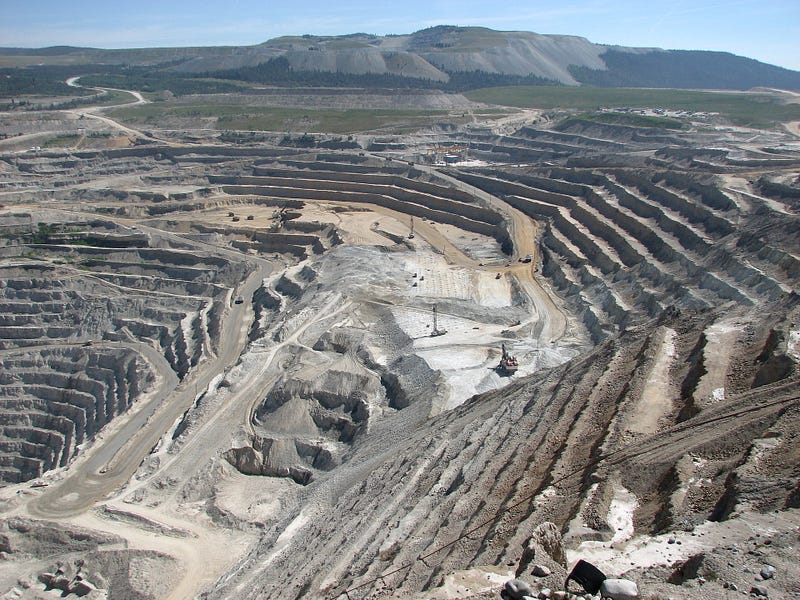
The reality behind all those pretty advertisements of “zero-emission” electric cars | Pixabay

The world is slowly waking up to a rather inconvenient truth about electric cars: They’re simply replacing unsustainable extraction of fossil fuels with unsustainable extraction of critical battery minerals.

Mining is an inherently environmentally destructive endeavor, and several of the materials required by EVs are particularly problematic. But still, it will probably take far too long for advocates to overcome their carbon tunnel vision and recognize these serious impacts.
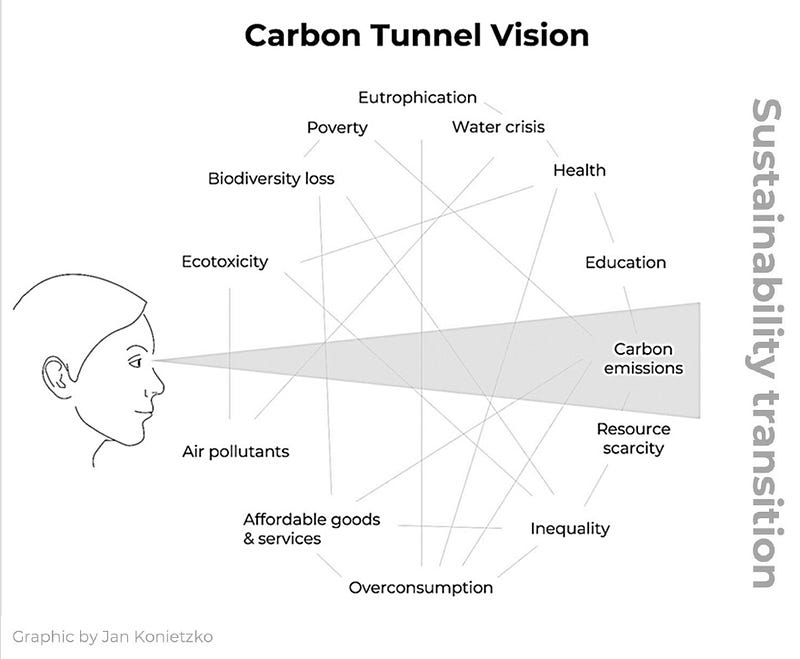
A recent depiction of carbon tunnel vision that made some waves on social media

Here’s a quick rundown of the impacts related to some key EV minerals:

  • Lithium mining needs lots of water, but resources are generally located in water-stressed areas. It also causes high levels of environmental toxicity.
  • Nickel has substantial ecological toxicity that is spread by the large amounts of dust created in the mining and refining process.
  • Cobalt brings similar toxicity challenges in addition to its serious human rights issues.
  • Graphite extraction involves substantial dust emissions and multiple toxic chemicals in the refining process.
  • Mining copper, a more common resource demanded in high volumes by EVs, causes large-scale contamination of water, air, and natural habitats.
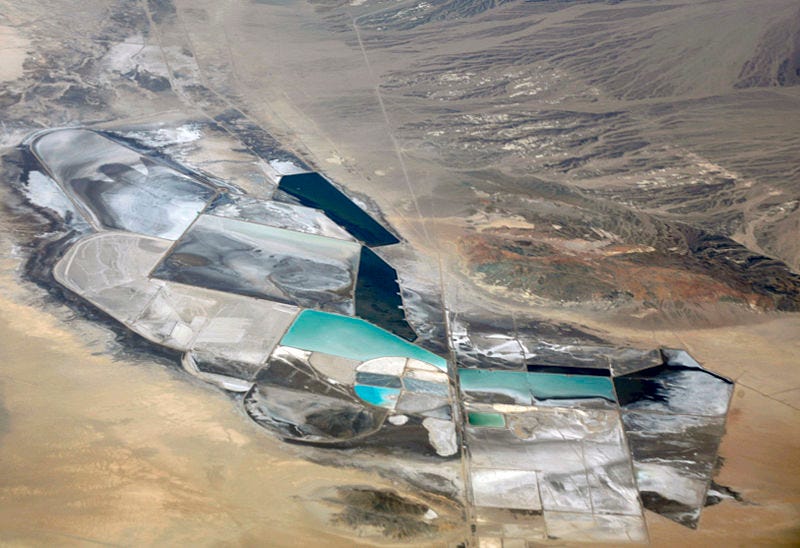
A typical lithium mining operation | Wikipedia commons

Multiply By 1000

The number of these mines we will require to drive a true EV revolution is tremendous. To date, the world has produced about 12 million battery-electric cars, many with battery packs that are far too small for the demands of the mainstream consumer. We will need billions of electric cars with large battery packs to push oil out of the car business. And even if we manage this, we would only have displaced about 25% of global oil consumption. Electrifying heavy-duty transportation and going big on stationary energy storage will need several times more mining.

Overall, we’ve mined only about 0.1% of the material required for the battery revolution envisioned by enthusiasts (ignoring the similarly gigantic material demand from a primary energy supply based on wind and solar and the vast grid expansions they require). Given this tiny fraction, it’s scary to see these environmental issues already becoming a major concern.
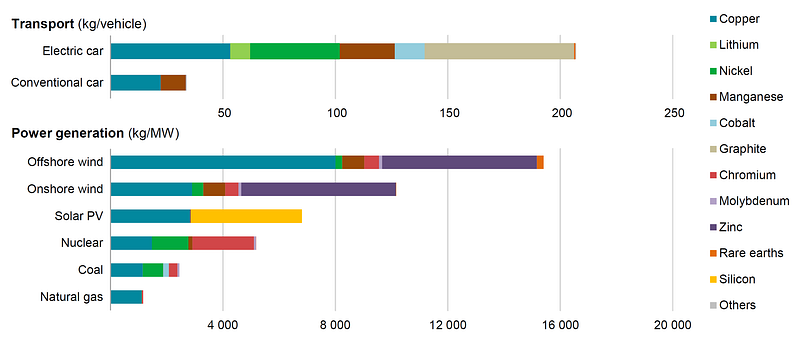
A comparison of critical material needs of green technologies relative to conventional alternatives | IEA

To use an oil analogy, EV material mining is now in its “gusher” phase — the initial period of resource exploitation where we enjoy a limited amount of high-grade resources that are cheap to extract. From here, it will only get tougher as ore grades decline and critical material extraction and refinement becomes increasingly energy-intensive and environmentally destructive.

Moving Mountains of Earth and Ore

Yes, the mass of critical minerals required in an electric car battery is far less than the mass of oil a conventional car will burn over its lifetime. But while oil is extracted in a relatively pure form, critical minerals are typically found in ore grades around 1%, requiring vast amounts of earth to be moved and equally vast quantities of energy, water, and chemicals to extract the refined product.

For example, low ore grades mean the average battery pack requires about 40 tons of ore to be extracted and refined. In addition, about 200 tons of “overburden” has to be moved to get to the ore. The next time you see an electric car, imagine a pile of 100 such cars. That’s the amount of material that needs to be moved and processed to make the battery that powers it.
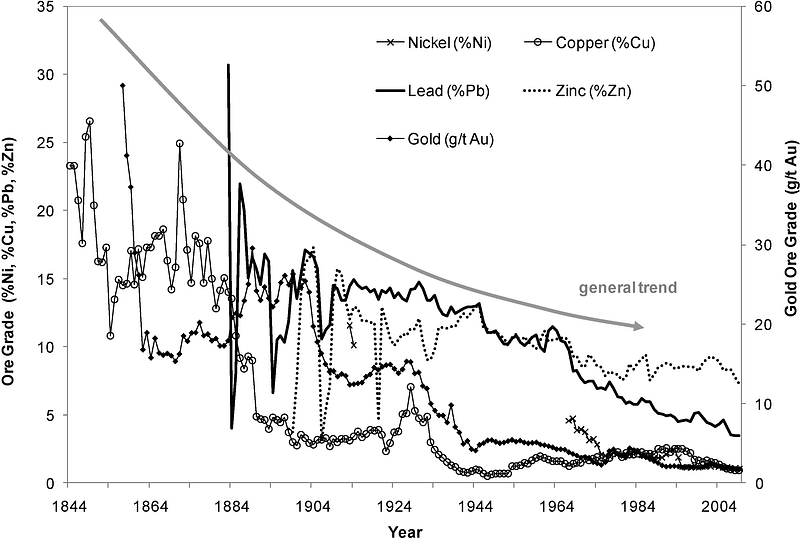
The inevitable decline of ore grades over time | Watling

As ore grades keep declining over time, this imaginary pile of cars will only keep growing. Fighting this trend will be technological advancements in battery chemistry striving to store more energy in lower amounts of more abundant materials. Lithium-ion batteries don’t have much more to give in this respect. Hence, our hopes ride on future battery breakthroughs that, if they prove to be economical, scalable, safe, and reliable, will take decades to scale to the level lithium-ion technology is today.

In the meantime, lithium-iron-phosphate (LFP) batteries look like our best bet to reduce the impact of mining and refinement, given that they avoid nickel and cobalt. However, concerns with lithium, copper, and graphite remain, with copper and graphite demand increasing further.

Furthermore, the fundamentally lower energy density of LFP batteries will only add to the weight-related challenges discussed previously. More importantly, the larger mass and volume of these batteries make them impractical for reaching the battery pack sizes that the mainstream Western consumer demands to eliminate range anxiety, maintaining our dependency on nickel and cobalt.

As Bad as Coal?

If each electric car requires 40 tons of ore to be mined, 100 million annual cars require about 4000 million tons of ore to be mined each year. For comparison, global coal production stood at 7742 million tons in 2020. If we want to use batteries in other forms of road transport as well, the total mass of ore for batteries will be similar to that of coal today.

In the coming decades, improvements in battery technology will strive to overcome ever-declining ore grades that increase the impact both of mining and refining the ore. It’s unclear which of these forces will be stronger, so this comparison seems reasonable for the long-term future.

Furthermore, while coal is mined in a relatively pure form, battery material ore grades are very low (see the previous figure for copper and nickel). Thus, a lot of processing is required to refine the material. This refined material then needs to undergo even more processing to be turned into a battery cell. The toxicity and water impacts of critical mineral mining and refining mentioned at the start of the article should also be considered.

Interestingly, the comparison between coal and batteries extends even to the economic value. 80 kWh of battery cells produced from 40 tons of extracted ore costs about $8000. In comparison, 40 tons of coal can be used to produce about 100 MWh of electricity that, when including CCS, would also be worth about $8000. Since all economic activity involves environmental impacts and the most environmentally destructive parts of the respective value chains are similar, this suggests that the lifecycle impact of a future battery-powered transportation system is comparable to the lifecycle impact of coal use today.

Put another way, switching from gasoline and diesel to batteries in road transport could end up replacing half the current oil industry with the equivalent of an entire new coal industry. And that doesn’t even count the environmental impact of the electricity generation, balancing, and distribution required to power all these electric vehicles.

Recycling and Second-Life Uses

A popular answer to these concerns is that we’ll be recycling and reusing all the critical materials in our batteries, displacing regular mining with “urban mining.” Unfortunately, we first need to have something to recycle and reuse, and as pointed out earlier, we will need about 1000x more critical minerals than the amount we have extracted to date to power the world.

In the long run, recycling and second-life applications will undoubtedly play a prominent role. Such a reuse and recycle philosophy is mandatory to avoid an environmental disaster from loads of toxic materials ending up in landfills. However, profitable battery recycling will be a challenge, given that only about 5% of lithium-ion batteries are recycled at the moment, despite their high content of valuable metals like cobalt and nickel.

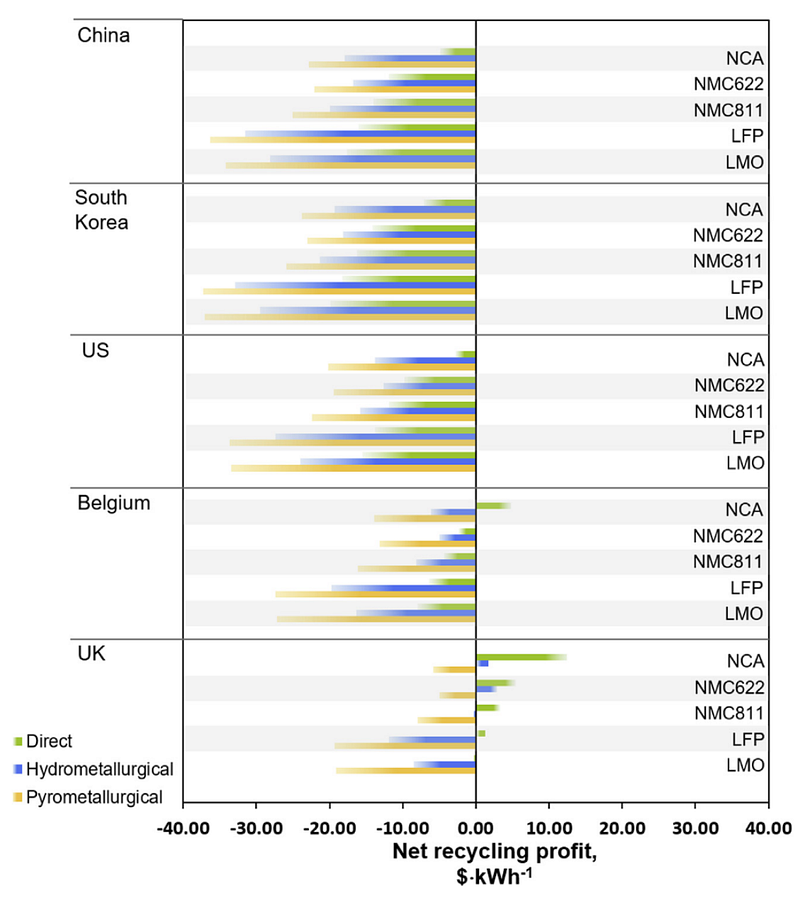
In the longer term, battery recycling could be profitable, but it depends heavily on recovering high-value materials at a very large scale in countries with low labor costs (which implicitly relies on cheap transportation costs).
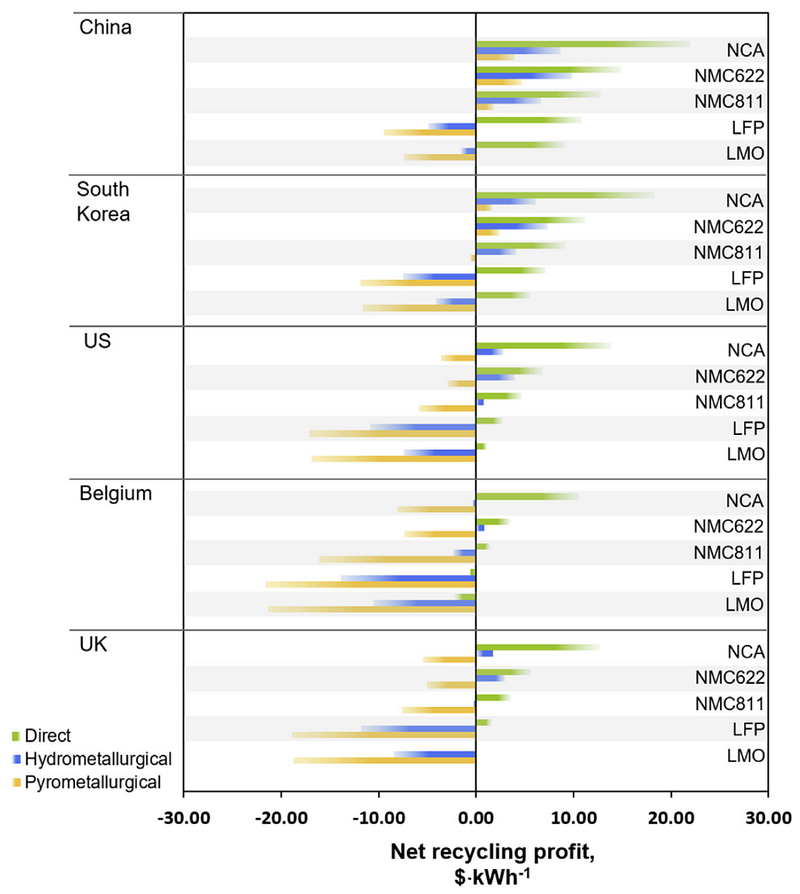
Projected battery recycling profits with optimistic transportation costs from the UK | Lander et al.
Projected battery recycling profits with pessimistic transportation costs from the UK | Lander et al.

Another crucial component of recycling profitability is the successful scale-up of “direct” recycling, where the electrode is recovered and healed without breaking it down to its material components. Although lab-scale tests show promise, scaling this methodology while ensuring that the healed electrodes match the performance of new electrodes will be challenging.

Knee-Jerk Environmentalism

One can only hope that the environmental movement will proactively address these concerns. Unfortunately, environmentalists will probably keep enthusiastically promoting electric cars until mining impacts become so severe that they can no longer be ignored.

Then, after many more protests like the one below, the tide will finally turn and the projected electric car revolution will hit a major roadblock. EVs will always shine in the niches where electric drive makes sense (e.g., 2-and-3-wheelers and small commuter cars), but the large battery packs required for a wide range of other transport applications will become unviable.

At that point, the world will need another strategy for sustainable transportation, despite the incredible amount of resources invested into the electric car revolution. Hopefully, companies like Toyota manage to stand firm among all the EV pressure and continue developing fuel-sipping hybrids and fuel cell technologies for this likely scenario.

Time will tell.

Electric Car
Environment
Mining
Transportation
Battery
Recommended from ReadMedium