
Electric Cars and Energy Security: Out of the Frying Pan and Into the Fire
An EV revolution will exchange strategic oil dependencies for strategic critical mineral and electricity dependencies.

As the tragic events in Ukraine unfold and oil & gas prices keep rising, energy security is once more rising up the policy agenda. Europeans are feeling the pinch especially strongly with extreme energy prices now threatening the post-Covid economic recovery.
The standard response to issues of energy security is that we should build lots of wind and solar farms and electrify everything to reduce our fossil fuel dependence. As this article will show, however, it’s not nearly that simple.
Uneven Distribution of Natural Resources
The current global situation illustrates the risks inherent in a highly uneven geographic distribution of the hydrocarbon resources on which all our lives quite literally depend. Unfortunately, electrifying transportation to reduce our oil dependence will help very little in this respect because the critical minerals required for electric cars are even more unevenly distributed than oil and gas.
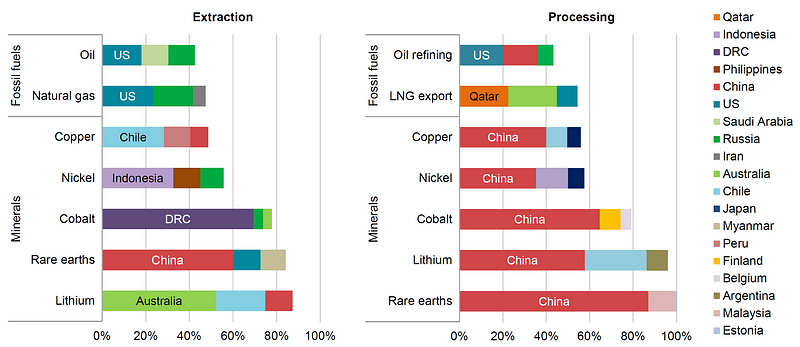
Adding to this problem, we have vast lead times for mining projects extracting these minerals. The IEA lists an average of 16.5 years to move projects from discovery to first production. Thus, we have critical resources almost exclusively controlled by a few (not particularly trustworthy) states and decadal timescales involved in bringing new supply online if political events suddenly cut off access to part of this highly concentrated supply.
Furthermore, whereas oil is just one commodity that is required to power our transportation systems, battery electric vehicles are dependent on a much broader supply of highly geographically concentrated commodities. A supply disruption in any of those commodities can upset the entire supply chain and send prices through the roof.
Oil Price Shocks vs. Battery Price Shocks
For example, the recent explosion in lithium prices is the major driver behind the approximately 60 $/kWh increase in cathode active material (CAM) costs illustrated below (although gains in nickel and cobalt also contribute). Price hikes in various other commodities and international shipping would make the total increase considerably larger, but let’s neglect that for simplicity.
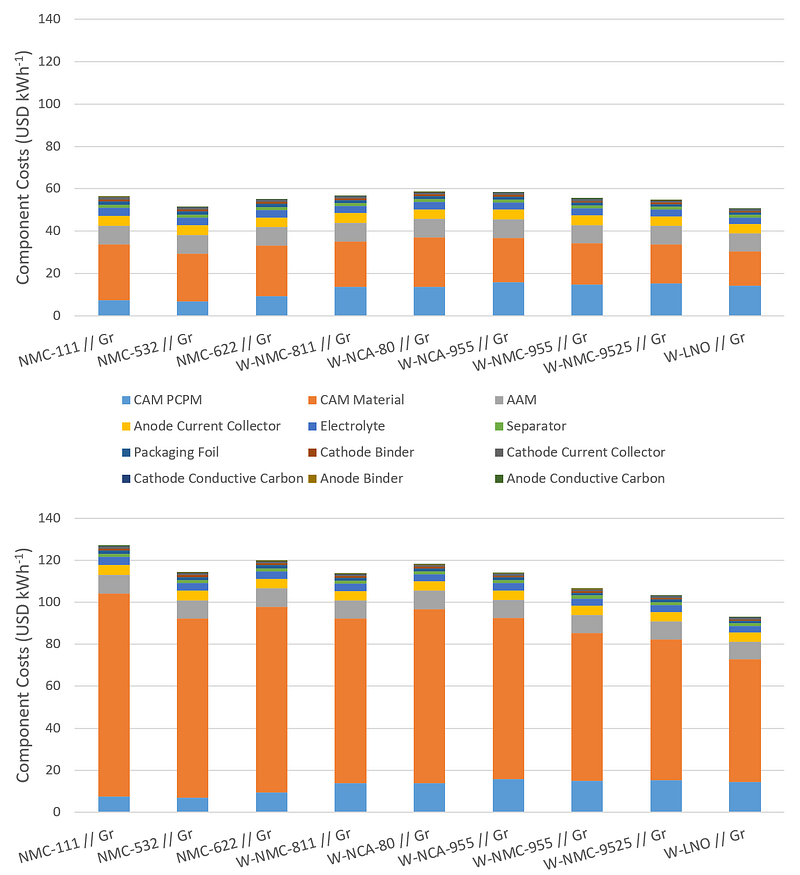
For comparison to oil, let’s consider an EV with a battery pack of 80 kWh where a 60 $/kWh commodity price hike will add a cost of $4800 and compare that to the effect of a 50 $/barrel hike in oil prices. Such a spike in oil prices increases the cost of gasoline by about 1.2 $/gallon, meaning that you can absorb the oil price hike for 4000 gallons of gasoline with the $4800 battery price hike. A 50 MPG hybrid driving 10000 miles/year can go for 20 years on this amount of gas. Accounting for the time-value of money discussed earlier would make the EV look even worse in this comparison.
Oil Price Shocks vs. Electricity Price Shocks
Critical mineral price shocks are bad enough, but electric cars also need lots of energy that, when correctly compared to hybrids with all taxes backed out, costs as much as oil. In the “electrify everything” world envisioned by enthusiasts (a far cry from today’s situation), each country will supposedly have its own stable supply of renewable electricity to guarantee high energy security for electric cars and the rest of the economy.
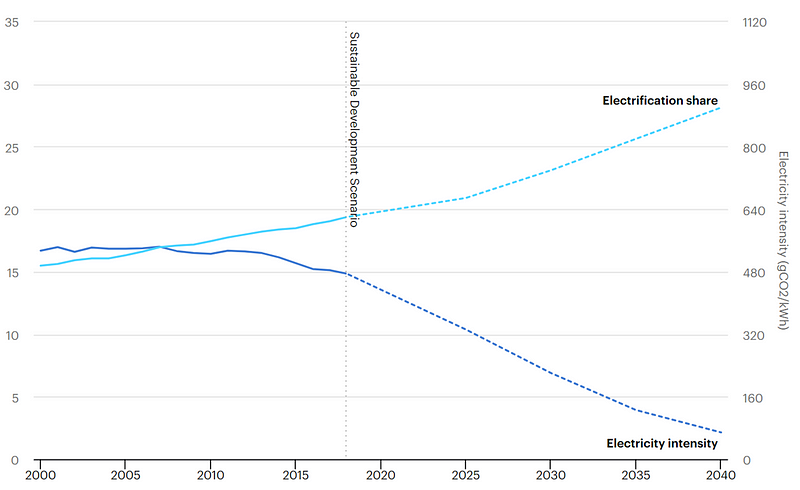
Unfortunately, the current energy crisis in Europe has shown once more that electricity prices can fluctuate even more wildly than oil prices. Also, whereas oil only affects certain sectors of the economy, electricity affects everything (even more so in the “electrify everything” vision).
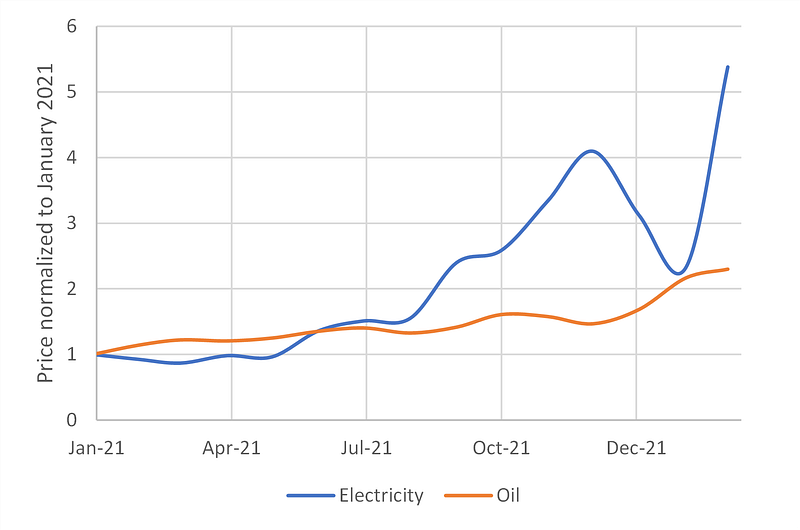
Of course, the huge electricity price spike shown above was driven mainly by a shortage of natural gas (driven to a large extent by several years of underinvestment), but this only serves to illustrate another important point: It takes only a minor undersupply to send prices sky-high. After all, our economies are completely dependent on the energy sector and we would rather pay triple prices for energy to overcome a 5% supply shortfall than shut down 5% of the economy and enter a deep recession.
In the wind/solar/EV electrify-everything strategy, such shortfalls would happen all too frequently. As illustrated below, wind and solar output vary strongly on monthly and even annual timescales. Strong months can see double the supply of weak months and strong years can see a third more energy production than weak years. And the problem is that we have no way of knowing when the next weak year will roll around.
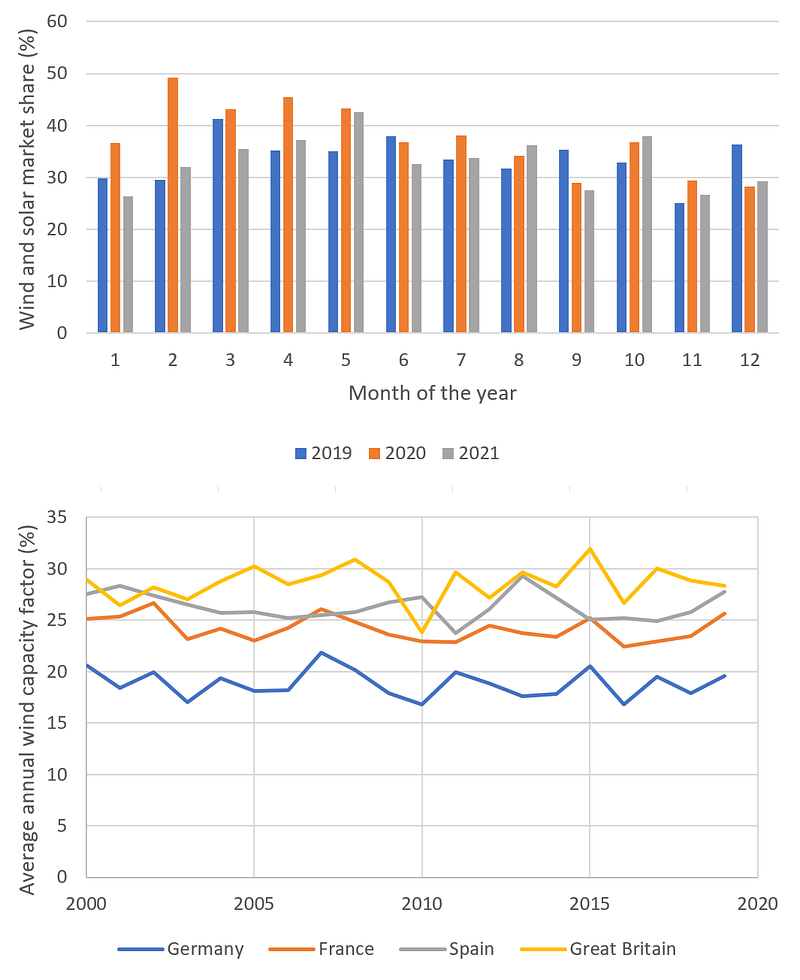
Unlike oil, renewable electricity is very expensive to store on monthly or yearly timescales, making these natural variations in wind and solar power output very difficult and costly to manage.
Thus, we can add large energy insecurity to large critical mineral insecurity when evaluating the EV revolution. The multiplier effect of these two factors will make historical oil price shocks look tame by comparison.
More Mining, More Public Resistance
As more people appreciate the supply security issues involved in a green transition, some are calling for developed nations to start mining again. For example, this article offers a good discussion of the complexities Europe (with all its virtue-signaling pledges to ban ICEs) is facing regarding the critical raw materials demanded by wind/solar/EV pathways and all the challenges with ramping up local mining activity.
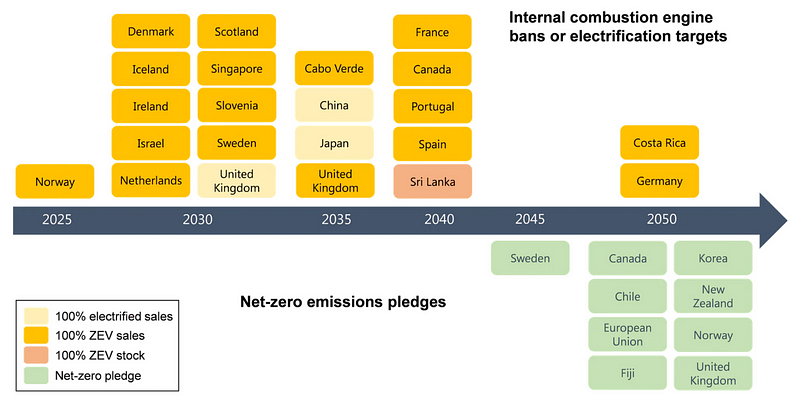
It’s hard to see how such mining ambitions have any greater chance of lifting off than fracking. A couple of projects might get approval, but when they finally come online a decade or two later, environmental groups will see the serious impacts and block any further progress. Add to this the resistance already presenting large obstacles to onshore wind and the vast grid expansions it requires, and the wind/solar/EV vision gets even cloudier.
A theme I often return to is that green technologies only look environmentally attractive today because they meet such a tiny fraction of current demand (wind and solar currently stand at 2–4% of global energy supply and electric cars at 1% of the global fleet). As these technologies scale up by an order of magnitude, a wide range of issues ranging from the impacts of raw material extraction to high system complexity to public resistance to end-of-life waste concerns will rival and even eclipse the current problems with fossil fuels (which supply well over 80% of global energy and power essentially our entire transportation network).
It’s unclear how long it will take environmentalists to realize this simple truth. Until then, we’ll push on with green technology-forcing policies that do very little for sustainability and security at an exceedingly high cost.
Out of the (Well-Oiled) Frying Pan and Into the (EV Battery) Fire
To wrap things up, let’s summarize the supply security issues involved in the large-scale shift to EVs mandated by bans on ICE cars:
- Oil dependency would fall (but only by about 25%). Those driving electric cars would then be insulated against gasoline price rises from the occasional oil price shock.
- Critical mineral dependencies would rise, presenting a considerably larger strategic problem due to their high geographical concentration and the number of materials required to make a battery. From the consumer viewpoint, material price shocks like the one we’re currently experiencing are equivalent to many consecutive oil price shocks.
- Dependence on hard-to-store electricity would rise. In a highly electrified economy, a poor month or year of renewable energy output would create large economic headwinds.
- Despite the tiny market shares of EVs and renewables, public resistance against critical mineral mining projects and wind power is already a key problem for developers. As these headwinds keep strengthening with further growth, points 2 and 3 will only get worse.
All told, the strategic dependency issues of electric cars are quite intimidating. Yes, battery electric drive has an important role to play in the future of transportation when deployed in the niches where it makes sense (e.g., 2-and-3-wheelers and small commuter cars). However, the heavy and powerful electric SUVs driving much of the EV enthusiasm will do more harm than good.
One can only hope for the political foresight needed to avert the serious environmental and supply security problems associated with the highly overhyped EV revolution.