
THE QUEST FOR QUALITY, PART 2
Everything You Always Wanted to Know About Quality*
(*Writing but were afraid to ask)
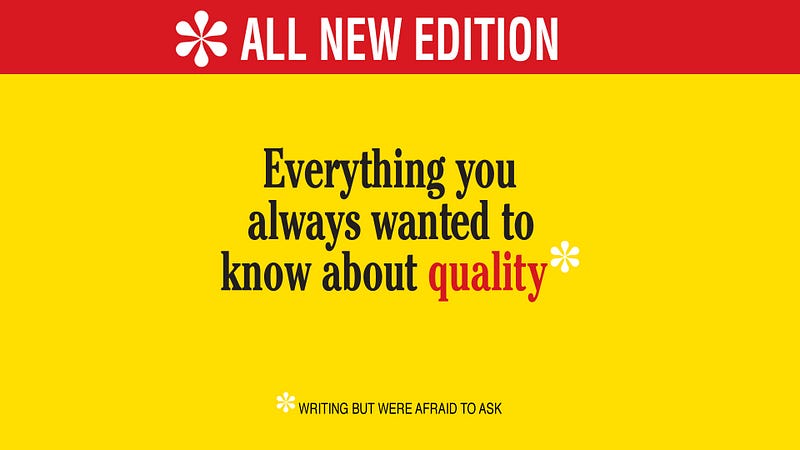
Like that famous book about sex written in the 60s, writers around here are obsessed with another taboo subject: quality.
You know you want it.
You dream about it. You lust after it.
The mere mention of the word sends tingles up your spine (or other more erectile body parts). But you don’t have any idea what it is.
Certainly not in a virtual space where turds and diamonds float through your daily feed, anonymously clothed in familiar-sounding clickbait headlines, with nondescript royalty-free photos.
Nobody gets down and dirty to explain what it means. Our current definition of quality is about as precise as Supreme Court Justice Potter Steward’s analysis of hardcore pornography, “I know it when I see it.”
I prefer George Carlin’s modern take on “One man’s meat is another man’s poison.”
“Have you noticed that their stuff is shit and your shit is stuff?” — George Carlin
Not only was he a brilliant comedian, but he really knew his shit.
So what exactly is high-quality writing?
In Part One, I looked to ancient philosophers, brilliant innovators, and a flawed self-help guru, and they had no answer.
Since they don’t know, how about asking a writing coach?
Linda Caroll is one of my favorite writing coaches on this site because she offers concrete advice on how to master the craft of writing. Here’s a passage from “10 Ways to Avoid Bad Writing According To a New York Literary Agent”
Problem is, there’s no such thing as good writing. Good is subjective. I might love a book — you think it’s a dud. Taste is personal. And on top of preference and taste, no two people read the same book.
That’s why no one can teach good writing. College can’t. Writing classes can’t. Take as many classes as you want, they can’t teach you good writing because what makes writing good is entirely subjective.
All they can do is teach you not to write badly.
“Good writing is subjective. Bad writing is obvious.” — Linda Caroll
If we can’t control each reader’s personal preferences, there is no chance with editors, publishers, and curators.
For absolute proof that nobody has a clue about quality, check out this article on “The Most-Rejected Books of All Time.”
All that’s left is to examine the proxies for quality.
What about financial success? That’s gotta be the answer, right?
When my sons became teenagers, my only goal was to try and teach them how to write well. I shared great authors with them to inspire them and expand their imagination:
- We laughed at passages Joseph Heller’s Catch 22¹, and Tim Dorsey’s Florida crime caper Stingray Shuffle, two of the funniest books I’ve ever read.
- We laughed at intentionally terrible writing, finding excerpts from the Bad Hemingway contest, and…
- We laughed at unintentionally terrible writing, by no less than a New York Times Bestselling author.
While good writing is subjective, bad writing does break rules like “show, don’t tell.” I hope you can laugh at the following terrible sentence:
“She headed downtown, under a sky the color of malice, dark and foreboding” — Sidney Sheldon
But Mr. Sheldon is not the only person to make money by writing crap. Why do sensationalist newspapers, direct mail ads, and reality TV shows even exist?
Writing about controversial subjects can create massive reader response but how does that connect to quality?
Not that long ago, this site curated a̶ ̶p̶a̶c̶k̶ ̶o̶f̶ ̶l̶i̶e̶s̶ an essay written by a Trump supporter that outraged the community. In response, I examined all the ways this “Popular” article violated the sacrosanct curation rules.
If the gatekeepers think an article will help the company’s bottom line, they will flush all those curation rules and regulations down the toilet and right into your feed.
Remember that as you toil away on a well-documented, logical essay.
Social media popularity may be the one sure way to have your writing featured as one of “today’s best stories picked by our editors.”
Just do the math. With 20,000 followers, all it takes is one percent of your fans to clap ten times for your article to vault into the exclusive top 1% of stories.
If you search for the subject of “goals,” you will find that the top 39 articles accumulated over 415,000 claps from over 70,000 fans. And surprise, surprise — each article contradicts the next. That’s because these writers are salesmen trying to get you to buy their “offerings” (the most diplomatic term I could come up with).
You won’t find one writer with any credibility in the field of peak performance. Not one sports psychologist or someone who coaches a professional athlete. Why do we listen to salesmen and ignore scientists?
A huge following will make you successful, regardless of whether your writing is transcendent or trash-ready. But there’s no correlation to quality.
How did we get so lost?
For new writers, the desire for readers and money become a proxy for quality, along with a heavy dose of gaslighting from the system.
You may be overwhelmed by the mysteries of curation, and prominent placement in platform-owned magazines. All you will hear are their solemn pronouncements about the desire for quality, backed up by the chorus of the “I made $11,369 last month and you can, too” crowd.
But as you read those popular articles, you realize a lot of them have no value other than the arbitrary financial benefits bestowed on them.
“Quality content” is an oxymoron that has been weaponized to mislead new writers into following, subscribing, and paying for stuff they don’t need from people who could never deliver on their promises. “Quality” is a word roared by people to justify their BS, but they never dare to define it.
I can guarantee you that no Pulitzer Prize-winning author has ever referred to herself as a “content creator.”
And don’t get me started on the word “content.”
To paraphrase Samuel L. Jackson as Jules Winnfield in Pulp Fiction: “Say content again. [yelling even louder] SAY CONTENT AGAIN… I DARE YOU… I DOUBLE-DARE YOU, MUTHAFUCKA!”
I can guarantee you no Pulitzer Prize-winning author has ever referred to herself as a “content creator.” So why are so many people hypnotized by this nonsense?
Unless you are paid to create social media posts by some corporate overlord (not the quasi-slave work you do here), how can you define the act of leaving your blood, sweat, and tears on a page as anything other than art?
And if you’re still not sure you’re an artist, you need to take this simple test.
Even veteran writers can become frustrated, discouraged, and confused as they play this arbitrary, absurd, and addictive game.
That’s why so many writers have either talked about quitting, changed their profiles to escape the wrath of the curation bots, left the site to create their art elsewhere, or simply fade away because they find out they can spend their time doing better things than being ignored.
- P.G. Barnett has bled all over the page about his struggles to keep writing: “How many times have I simply pulled up hard and quit writing? More than I can count — even with a calculator.”
- Sherry McGuinn may joke “I have a bit of a masochistic streak, therefore checking my stats fills me with a kind of evil glee,” but she still rants about struggling to “stand out amid a steaming pile of dung.” (And I don’t think she was writing a travel blog.)
- Kristi Keller writes about deleting old articles, not because of their quality, but because they don’t earn enough money.
- Roz Warren is one of our queens of comedy, and yet she’ll write clickbait headlines to get more views. (If you’re good enough to be a New York Times columnist there’s something fundamentally wrong with a system where you have to ask readers to buy you a cup of coffee, regardless of whether it’s done as a joke.)
- Linda Caroll wrote, “Part of the reason we have so much bad writing here is that writers have no real barometer with which to measure our own performance.” And by performance, she means money. (Et Tu, Linda?)
- Even the guy who made $5,000 off a mindless “what to do when you wake up each morning” self-help article has been cast aside by the algorithm. Like me, he has been stuck in Curgatory™, that place for lost souls whose only contact with the outside world may be the following words:
“Not distributed in topics”
If you want an indication of the crazy-making machine we’re dealing with here, just look up the term “Curation Jail.”
You’ll find over 50 articles to explain, refute, or solve this corporate-endorsed mind fuckery.
You came here thinking that great writing means something, but the truth is this site analyzes data to determine which stories will attract new subscribers.
One day you might realize the algorithm is the wheel, and we are the hamsters.
And guess what attracts the most new subscribers?
Get-rich-quick promises. Sex confessionals. Political manifestos for people seeking confirmation. Tone deaf tech bros. Regurgitated self-help gruel. Narcissistic personal essays that contain no evidence of personal growth.
The only difference is that clickbait factories and sensational newspapers never claimed that they showcase quality writing.
One day you might realize the algorithm is the wheel, and we are the hamsters.
The bottom line is there is no bottom line, so get comfortable with uncertainty.
Searching for guaranteed ways to earn external rewards outside of your control is a formula for madness.
You might be better off just playing the lottery. After all, a lottery ticket holder only needs to buy lottery tickets and hope, while prolific online writers might work 60+ hours a week and still face terrible odds in hitting the jackpot.
Instead, think about what kind of writing turns you on and learn what you can from those writers.
The risk is you may realize your definition of quality writing isn’t what sells.
You may have to face some hard decisions about who you want to be, but at least you’ll have a clear vision of your journey ahead as a writer.
Good luck!
Thanks for reading. If this article helps even one person avoid being overcome by the noxious fumes of data-driven content, I’ll consider it a high-quality piece of writing. If you enjoyed this article, please check out The Inner Game of Writing.
Here’s to Better Writing

FOOTNOTES:
¹Heller’s brilliant novel was rejected 22 times.


