THE SECRETS OF WRITING ON MEDIUM, PART 9
From Newbie to Addict: How Easily Did Medium Hook You?
An exploration of Medium’s game and its effect on players.
If Medium’s algorithm were a hamster, I can understand why it would hate my guts.
For the last three years I’ve been poking and prodding the algorithm from every which angle, trying to uncover its secrets. About the only thing I’ve gotten for my efforts has been a handful of droppings.
Here’s a brief summary of previous findings about the algorithm.
- Consistent scoring in the top 1% of articles (a minimum of 2K claps) is almost directly dependent on a writer’s social media following. But social media popularity has almost zero correlation to writing quality. If it didn’t, why are we complaining en masse about the terrible quality of our feed?
- The use of a social media mechanism to determine compensation gamifies Medium, which makes it even more addictive. Medium’s feed makes it difficult to find our favorite writers because it goes against their goals of monetizing social media.
- There are many skills needed to be “successful” on Medium, and people have set up side businesses to teach us those skills. Writing coaches and content marketers want to teach you how to write powerful headlines, improve formatting techniques, understand curation guidelines, and, most importantly, follow them and clap for their articles so they can make more money.
- The system has made it almost impossible for unaffiliated writers to have their work show up as a featured article. The only way to get this exposure is to submit articles to publications owned by Medium. But they already have paid writers on staff, so this is extremely difficult.
- Compensation on articles doesn’t seem to be based on views, reads, fans, claps, or curation. The only thing that seemed to work for me was getting a plug from Gutbloom.
- With the changes in the feature articles section, it turns out that even having articles curated will not give that much of a bump. Medium continues to increase the percentage of “Editor’s Picks” (articles from Medium-owned publications) that show up in your feed.
- Improving as a writer is a good thing; just don’t wait for it to change your compensation. There’s no guarantee all this work will pay off in terms of compensation or popularity.
A teacher is trying to earn money to buy Christmas presents. An unemployed college graduate hopes to begin an online writing career. A published author toils away in anonymity.
Each of us has a story to tell. Each of us has a story behind why we write. And each of us experiences a combination of inspiration, frustration, exhilaration, and desperation on the game known as Medium.
At first, I didn’t realize it, but now I see that the algorithm is the wheel, and we are the hamsters.

Why is Medium so addictive?
It’s clear from the above that Medium is a game designed to make the founder more money, with a small number of high earners who serve as beacons of hope.
Shouldn’t we be asking the bigger question of why we continue playing this game? And why do so many of us waste time trying to solve the riddle?
Medium is a private company, so they are not compelled to make any information public. They claim the lack of transparency is to prevent people from hacking the system.
But isn’t the system rigged to begin with?
We’ve already seen that 99.9% of all Medium Featured Stories (which get all the eyeballs in their feed, email newsletters and other social media promos) are stories that appear on Medium-owned publications.
We also know that people with huge social media followings are the top earners.
If we examine the limited statistics that Medium shares with the public, the gaming aspects of the site become more clear.
Why do they provide certain information, such as each writer’s number of followers, and those artificially created “Top Writer” credits that appear under each person’s bio? (And yes, these credits have nothing to do with writing quality, or number of fans. If you use the same tag on all of your posts, you will eventually get to Top Writer status for that tag.)
In their email newsletter, Medium reports that 58% of “active” writers earned at least 1¢, 8.9% of “active” writers earned at least $100, and the top writer earned $30,638.81.
Wow!
Just think how many articles you will see in the coming weeks that will tell you to be inspired by this insane amount?
How about a quick dose of reality?
Just do the math. For you to make $100 in a month, you need 20 subscribers to do nothing but clap for your articles and no one else.
You need 20 subscribers who don’t write anything.
Is there something wrong with this picture?
How can there be all these articles talking about how much money they made in a month and that you can too?
Apparently “you can too” does not apply to 20 times the number of total writers on Medium who pay $5 per month to read bland self-help articles when they could spend that same $5 per month and subscribe to Wired, INC, and Time Magazine.
But wait, there’s more!
What happens if you are earning $1000 per month? Doesn’t that mean you need 200 paying subscribers to never write and only clap for your articles?
And if you’re going to quit your job and become a professional writer on Medium you’ll need at least $3000 per month? Now you need 600 people to subscribe, never write and only clap for you.
Does this system sound sustainable?
Okay, let’s get back to the Medium Game.
Less than 9% of Medium’s writers will make $100 in a month.
Why did Medium choose the $100 mark?
Don’t you feel just the slightest tinge of insecurity about your writing skills when you don’t make that amount?
Why don’t they supply statistics showing the five quintiles of income and a distribution of the number of people earning in those brackets?
Could it be that if Medium was transparent, too many people would realize the game is almost impossible to beat?
This is Kevin Werbach from the University of Pennsylvania on the subject of gamification. 70,000 people are taking his online class.
By applying game design to business and marketing uses you can motivate people to do something that would be viewed as complete lunacy by rational people who are not involved in that process.
“A well-designed game is a guided missile to the motivational heart of the human psyche.” — Kevin Werbach¹
Check out Werbach’s bio on coursera. This guy is thinking so far outside the box on business, technology and politics, he’s a real world version of Neo, seeing through the Matrix.
Let’s do a simple ROI analysis of our writing habits on Medium.
If you are writing every day on this site, I would guess that the minimum amount of time spent writing, researching and reading other people’s articles would be two hours per day.
In other words, you are spending somewhere between 50–60 hours per month in the hopes of making at least $100. That translates to about $2.00 per hour (if you are part of the 8.9%; for the other 91.1%, of course, it’s even worse.)
Now think of how many ways you could make $100.
Given the fact that people can make at least $10 an hour walking corgis (otherwise known as curators), we could make $100 in 10 hours, and then use the other 40–50 hours to do something important, like finishing that book we’ve all dreamed about writing.
I’m not trying to put down anyone’s writing efforts, or minimize the personal value that comes from writing — I’m here writing this article, aren’t I? But consider this a public service message for our collective mental health.
There is a huge difference between the benefits people gain from writing and the compensation they can expect to gain from writing.
There’s a big difference between a blogger who writes and a writer who blogs.
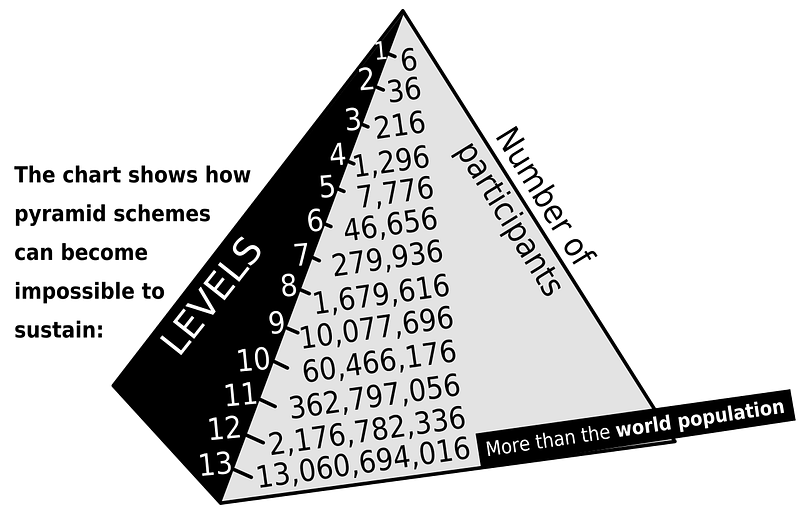
I want everyone to understand that Medium’s compensation system is at best a zero-sum game and at worst a pyramid scheme.
Zero-sum games: If Medium has a stable population, it is a zero-sum game.
To put it simply, if 100 people each throw $5 into a pot and then everyone claps for everyone else, there’s only a $500 pot to be divided. Either everyone makes $5, or a tiny group of people make $100.
A lottery is a form of zero-sum game where people are attracted to play because of the huge possible reward and the small investment. Just remember, the house always takes it cut, and the odds against winning are astronomical. (I’ll share those odds later.)
Pyramid scheme: If you listen to all the content marketers who claim everyone can increase their fans and make more money, then Medium becomes a pyramid scheme.
The people at the top (established social media superstars) make tons of money because hundreds of people follow them and clap for their articles. If you follow their advice, you have to hope that new subscribers will follow you and clap for your articles, allowing you to make tons of money. (Remember, if you peel off fans for the existing top earners, you would decrease their earnings, as it would in a zero-sum game).
The problem with this model is it means Medium has to grow continuously to keep compensating each new level of writer who becomes a top earner. Eventually, the entire world has joined Medium and all the people who came late have no chance to improve their compensation without decreasing the compensation of the more established people. Thus the promise of “I made $$$ this month and you can, too” is broken.
This is why multi-level marketing companies have to work so hard to avoid being sued as a pyramid scheme — the base assumptions are flawed.
It bothers me when I see get-rich-quick infomercials for real estate and multi-level marketing companies. I feel the same way when I read self-proclaimed writing experts preach the same kind of message to beginners.
These people know full well that only an infinitesimal percentage of people will actually make the kind of money they claim, but have no problem asking you to subscribe to their newsletter, buy their online course or pay for their personal coaching.
Unfortunately, there are three more diabolical forces that complement the power of gamification and fuel our irrational pursuit of “success.”

Three forces reinforce our addiction to Medium, and pull us in conflicting directions.
#1: Relative Deprivation is the perception that you’re worse off because you compare yourself to a small group of people similar to you, rather than making a global comparison.
Do you compare yourself to well-educated writers with tech devices and online access who compare themselves to Medium’s 230,000 other members, instead of the world’s 7.5 billion people?
Instead of being grateful to have so many resources, how many of us are wondering “why don’t I have more?”
When I read stories from people who have earned $30,000 on Medium over the last year complain about not getting attention, I think the answer is pretty obvious.
Only a handful of people atop this pyramid scheme we call Medium are currently happy with how they are doing.
But they’re concerned why they can’t get a book deal.
I found this idea while reading Malcolm Gladwell’s David and Goliath.
Samuel A Stouffer’s original sociology study focused on feelings of satisfaction within the military.
In his book, Gladwell wrote about the surprising studies on the professional achievement of students who were big fish in a little pond.
It turns out they outperformed students who were little fish in a big pond (not in the top 5–10% of their class at prestige schools).
“The Big Pond takes really bright students and demoralizes them.” — Malcolm Gladwell [2]
Medium is banking on us to compare ourselves to the social media superstars who earn all the money and applause on the site.
How many times have you read stories by shovel salesmen with this kind of headline: “I made $$$$ last month on Medium and you can, too!” (You’re reading this story, aren’t you?)
These stories may have the intention of inspiring you, but they end up demoralizing most people, who then read more stories because they want to somehow make more money and be happy.
Let’s look at the last phrase again, but this time you fill in the blanks:
“…who then [fill in action] because they want to somehow [fill in unlikely result] and be happy.”
Does that behavior sound familiar?
Relative Deprivation helps drive the addiction that fuels the game Medium has created, and guess who profits?
#2: Cognitive Dissonance describes the feelings of discomfort that result when our beliefs run counter to our behaviors.
“Psychologist Leon Festinger suggested that people have an inner need to ensure that their beliefs and behaviors are consistent. Inconsistent or conflicting beliefs lead to disharmony, which people strive to avoid.” [3]
“He had very few doubts, and when the facts contradicted his views on life, he shut his eyes in disapproval.” ― Hermann Hesse [4]
So instead of changing our bad behavior, we engage in irrational rationalizations to explain something away.
We are figuratively shutting our eyes in disapproval as we continue to do the dumb thing we’re doing.
I worked out the odds of winning $10,000 in the lottery, versus the odds of earning the same amount in a month on Medium:
If you spend $5 in lottery tickets, your odds improve to 1 in 129,795.
9 out of 230,000 writers means you have a 1 in 25,555 chance to earn $10,000. Those odds are small but definitely better than the lottery.
A lottery ticket holder only needs to buy lottery tickets and hope, while the top earning writers on Medium treat it like a full time job.
While most of us would be more than happy to work 68 hours a week to make $10,000, only 1 in 25,555 of us who would put in those hours would actually earn that money.
While most people would gamble $5 at an infinitesimal chance to win $10,000, how many people would be willing to work 68 hours a week to have five times better odds at winning?
Instead of people getting fed up with those impossible odds, the shovel salesmen point to these rare instances as proof that their shovels were actually responsible for someone striking it rich.
And somehow we still swallow that bullshit.[5]
We avoid cognitive dissonance by closing our eyes to simple facts (your 1 in 25,555 chance of making $10,000 in a month on Medium) and instead reading more articles to find the secret that will lead us to our get rich quick dreams.
I’ll bet a lot of you have already closed this article because dealing with these facts is too painful.
#3: Our irrational responses are reinforced by the Dunning Kruger effect.
“We Are All Confident Idiots” is one of my all time favorite articles. The absurdity of how we think is pure comedy. As David Dunning, Ph.D. and Nobel Prize winner puts it, “To a great degree, we fail to recognize the frequency and scope of our ignorance.”
Dunning and his partner Justin Kruger, Ph.D., found that people who fail a test display as much confidence in their performance as the experts who took the same test.
Dunning continues, “Interestingly, this effect not only applies to those with lower abilities thinking they are better but also to experts who think they’re not exceptional. That is, the least & most skilled groups are both deficient in their ability to evaluate their skills” [6]
To put it simply, the idiots have no idea they are idiots, while the smart people assume everyone else is as smart as they are.
But here’s where it gets even trickier.
People who are successful in one field automatically assume that they are experts in every field.[7] (Which may explain why so many engineers love libertarianism in spite of the fact that it is impossible to implement on a society larger than survivalists living out in the wilds, or when you have neighbors more demanding than Tom Hanks’ volleyball.)
Like they say in French⁸, “when it rains, it always comes in three.”
“The problem with failure is that it is subject to more attributional ambiguity than success. For success to occur, many things must go right: The person must be skilled, apply effort, and perhaps be a bit lucky. For failure to occur, the lack of any one of these components is sufficient.“
— Justin Kruger and David Dunning
The quote above sums up how difficult it can be to learn from our failures. Medium constantly adjusts their algorithm so we remain confused and frustrated, which increases our desire to keep playing the game.
If you learn one thing from this article, I hope it will be to look at the forces driving our addiction, instead of how to make a few more cents per hour on Medium.
I will leave you with one ray of sunshine, though.

Instead of playing the Medium game, you can learn the Inner Game of writing.
All of the benefits you derive from writing existed long before there was a Medium paywall, claps, or even little green hearts.
Writing has the same effect on us as playing your favorite sport, working out for at least 20 minutes, or having sex. WRITING RELEASES ENDORPHINS.
Everything that makes you feel good as you write are valid, internally generated goals. Everything that makes you feel bad about your situation as a writer is an external result that is arbitrary, absurd and out of your control.
I can’t stress enough the importance of learning to value process over results. Process is internally generated and within your control, while results involve external feedback from factors and people over which you have very little control.
After a lifetime spent as a professional athlete and coach, I applied the principles of peak performance to writing.
Applying the Inner Game to your writing will make you a happier and more productive writer.
But to do that, you have to recognize the game you are currently playing is based on the illusion that we can control the wheel, when in fact we are the hamsters.
Good luck in your journey. This is the one activity where I can tell you, with complete honesty, “you can too!”
If you have questions about the Inner Game, please ask them in the comments below.
If you’re interested in reading the earlier chapters in this writing guide, you can find them in this publication.
Thanks for reading, highlighting, commenting and sharing.
Here’s to better writing.
Footnotes:
¹Kevin Werbach, For the Win: How Game Thinking Can Revolutionize Your Business
²Malcolm Gladwell, David and Goliath, p. 90
³Kendra Cherry, verywell mind, Updated July 08, 2019, “What is Cognitive Dissonance?”
⁴Quote from The Fairy Tales of Hermann Hesse.
⁵There is a finite amount of money generated by paid subscribers. And yet our feed is clogged by get-rich-quick stories. What’s wrong with this picture?
⁶David Dunning, Updated Jun 14, 2017: “We Are All Confident Idiots”
⁷In my case, not only do I (1) compare myself to an impossibly selective group, but my success in writing on Quora and in my professional life creates (2) a powerful cognitive dissonance which has led me to waste massive amounts of time trying to figure out what is wrong with the system instead of (3) figuring out that I’m the one who is incompetent at playing the writing game on Medium.
⁸The original phrase is “jamais deux sans trois,” which means never two without three, sort of the negative version of “three’s a charm.”
Special Bonus:
Superscript numbers! Just copy and paste.
⁰¹²³⁴⁵⁶⁷⁸⁹⁺⁻⁼⁽¹⁾