
Life Strategy: Ecological Strategic Cognition
The Ecological Practice approach to Strategic Cognition

This article is part of a possible book Advanced Life Strategy: Anticipatory Activity System and Life Achievements. I consider the Strategic Curation model as a part of the possible book.
The Strategic Curation Model is a five-space model.
- Experience Space: It refers to the facts of the Past.
- Challenge Space: It refers to the problems in the Present
- Response Space: It refers to the solutions for the Future
- Reference Space: It refers to reliable and validated knowledge for thinking
- Speculative Space: It refers to imaginative thinking such as Counterfactual Thinking about the Past and Prefactual Thinking about the Future.
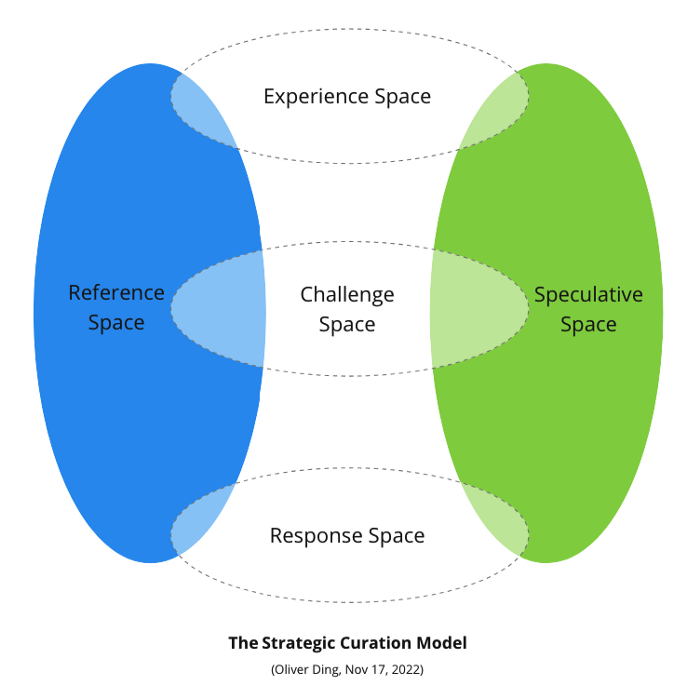
What does Strategic Curation mean?
It refers to using a specific strategy to curate pieces of experience, knowledge, and resources into a meaningful whole for a better future.
You can find more details about the model in the following links
- Life Strategy: A Five-space Model for Strategic Curation
- Life Strategy: Three Meta-knowledge of Strategic Curation
- Life Strategy: Turning Potential Knowledge into Actual Knowledge
- Life Strategy: Conceptual Change and Developmental Resources
This article will discuss the concept of “Ecological Strategic Cognition”.
I consider the Strategic Curation model as a new approach to Strategic Cognition which is about strategy-related thinking and doing. The new approach emphasizes the “thinking-doing” connection, spatial cognition, and temporal structure. Since the approach is based on the concept of “Thematic Spaces” which is a core idea of the Ecological Practice approach, I name it Ecological Strategic Cognition.
You can use the Strategic Curation model as a map to visualize your thoughts about some strategy-related concepts or ideas.
Aspects of Strategic Cognition
The term “Strategic Cognition” represents the Cognitive Perspective to theory building and empirical research in strategic management. Its focus is cognitive structures and processes in organizations. Some scholars also pay attention to the Top Management Team (TMT)’s cognitive style and bias.
For the Life Strategy project, I use “Strategic Cognition” to refer to strategy-related thinking and doing. Since the Life Strategy project’s primary unit of analysis is individual life development, I don’t have to consider the complexity of organizational structure. Thus, the term “Strategic Cognition” is very close to Rationality.
The term “System I/System II” of Mind is introduced to business thinkers by Daniel Kahneman’s 2011 book Thinking, Fast and Slow.
Keith Stanovich and his co-workers developed a tripartite theory of mind which introduces three types of mind: Autonomous mind, Algorithmic mind, and Reflective Mind.
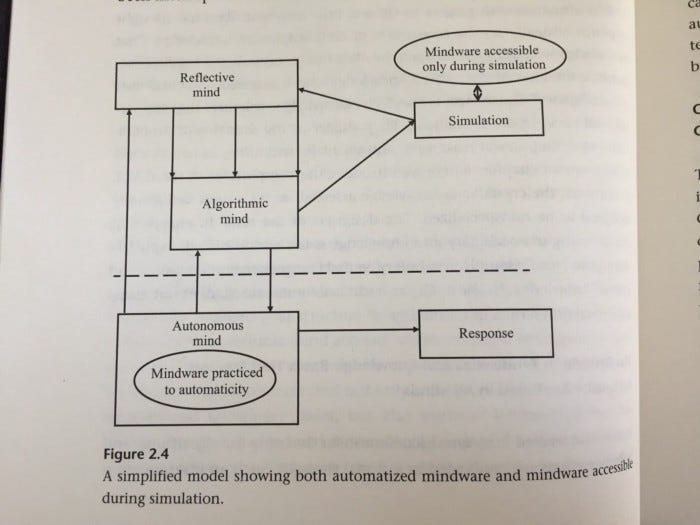
The tripartite theory of mind suggests that there are two types of mind for Type 2 processing: Algorithmic mind (individual differences in fluid intelligence) and Reflective mind (individual differences in thinking dispositions or cognitive styles). According to Stanovich, “Many thinking dispositions concern beliefs, belief structure, and, importantly, attitudes toward forming and changing beliefs. Other thinking dispositions that have been identified concern a person’s goals and goal hierarchy.” (2016, p.25)
Stanovich points out that there are five types of reasoning errors (2016, p.49). One of these errors is Contaminated Mindware. The reason is very simple if we misunderstand some knowledge, rules, procedures, and strategies, this learned mindware is not original mindware.
Strategic Cognition is about Rationality and Intelligence, as well as Anticipation, Activity, Affection, and Affordance.
The Life Strategy project adopts the Anticipatory Activity System framework to study Advanced Life Strategy. The framework highlights two aspects of Strategic Cognition: Anticipation and Activity. We will use the Strategic Curation model to discuss the other two aspects.

These 4A aspects of Strategic Cognition point to a new approach to Strategy-related thinking and doing.
The Ecological Practice Approach
The Ecological Practice Approach is inspired by Ecological Psychology, Activity Theory, and social practice theories. In a broad sense, the Ecological Practice approach has its philosophical roots in traditional Pragmatism and contemporary embodied cognitive science.
In 1942, Stephen C. Pepper pointed out that there are four root metaphors of world views or conceptual systems: formism, mechanism, contextualism, and organicism in World Hypotheses: a study of evidence. In 1987, Altman and Rogoff reviewed the world views of psychologists and suggested a similar typology: trait, interactional, organismic, and transactionalism.
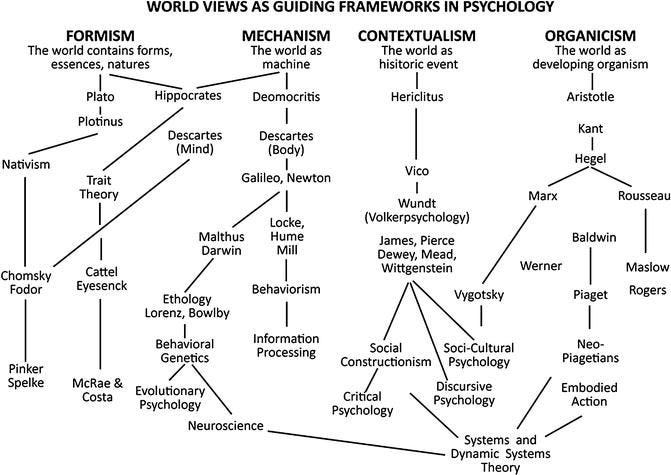
According to Harry Heft (2012), the foundation of various ecological approaches to psychology is transactionalism, “Frameworks more sympathetic to ecological thinking had been simmering among psychology’s early writings, notably in William James’ radical empiricism and Kurt Lewin’s field theory, but became realized only in the 1960s through the works of James J. Gibson, Roger G. Barker, and others. These frameworks share many of the assumptions of the ecological sciences and, collectively, can be located within a transactional worldview.”
The major difference between the interactional worldview and the transactionalism worldview is their unit of analysis.
- Interactional worldview: The unit of analysis is the individual viewed as a bounded, independent entity, operating separately from the surrounding, while subject to influences from outside its boundaries.
- Transactionalism worldview: The unit of analysis is the person-environment dynamic system. The components of this system operate in a relational, interdependent manner, rather than as independent entities.
The Ecological Practice approach adopts the Transactionalism worldview and its unit of analysis is the person-environment dynamic system. In this way, Strategic Cognition is an unfolding process of developing strategy-related mindsets and tacit knowledge in the real world.
Moving between Thematic Spaces
In the past three years, I developed several versions of the Ecological Practice approach.
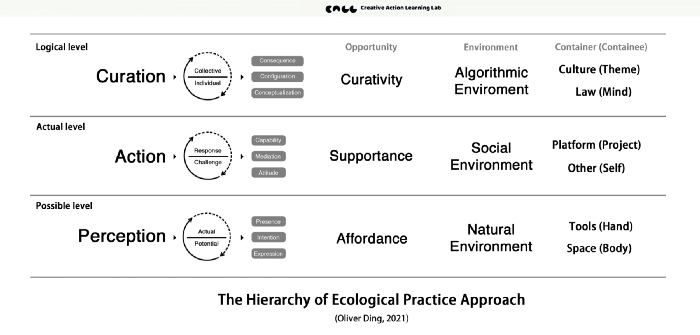
The above diagram is the 2021 version of the approach. You can find more details in The Development of Ecological Practice Approach.
The approach uses Container (Containee) as its primary unit of analysis.
The concept of Container is inspired by George Lakoff and Mark Johnson’s conceptual metaphor Container and image schema Containment.
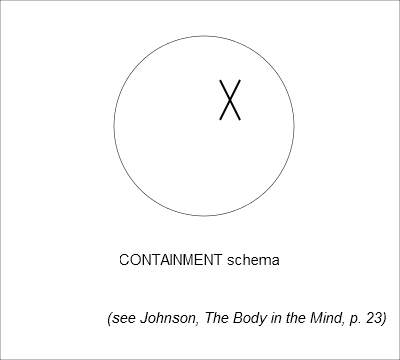
According to Mark Johnson (1987), “If we look for common structure in our many experiences of being in something, or for locating something within another thing, we find recurring organization of structures: the experiential basis for in-out orientation is that of spatial boundedness. The most experientially salient sense of boundedness seems to be that of three-dimensional containment (i.e., being limited or held within some three-dimensional enclosure, such as a womb, a crib, or a room).” He also pointed out there are at least five important entailments or consequences of these recurring experiential image-schematic structures for in-out orientation. (pp.21–22)
I coined the term “Containee” in order to describe Things-in-Container.
Moreover, there is a dynamic around Container (Containee). See the diagram below.
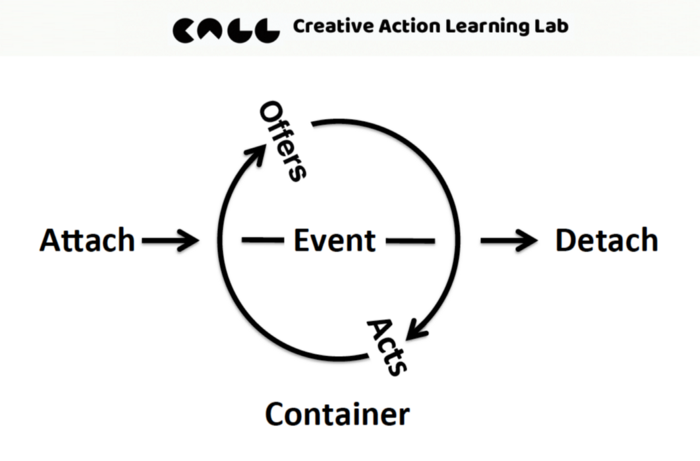
The above diagram combines three core concepts of the Ecological Practice approach together: Affordance, Attachance, and Containance. The term “Offers” is an affordance-inspired concept, it refers to opportunities afforded by the Container. The group of “Offer — Act” forms “Event” which changes the status of the Container. The new status of the Container affords new opportunities which guide new acts and events.
The Ecological Practice approach is a meta-theory. I also developed other concepts for its applications. For example, Thematic Space is an application of the concept of Container.
A Thematic Space refers to a large cognitive container around a particular theme.
The Strategic Curation model is designed with two types of Thematic Spaces:
- “Thinking” Thematic Space
- “Doing” Thematic Space
- Experience Space: Type=Doing, Theme=Experience
- Challenge Space: Type=Doing, Theme=Challenge
- Response Space: Type=Doing, Theme=Response
- Reference Space: Type=Thinking, Theme=Reference
- Speculative Space: Type=Thinking, Theme=Speculative
The above five thematic spaces form a “Time, Space, Thinking, Doing” structure which offers a map for understanding the complexity of Strategic Cognition.
Based on the Strategic Curation model, we can claim that Strategic Cognition is a process of moving between five thematic spaces in order to master strategy-related thinking and doing.
The Temporal Structure of Creative Life
There is a “Past — Present — Future” structure behind the Strategic Curation model.
It was adopted from the following diagram about the Temporal Structure of Creative Life.
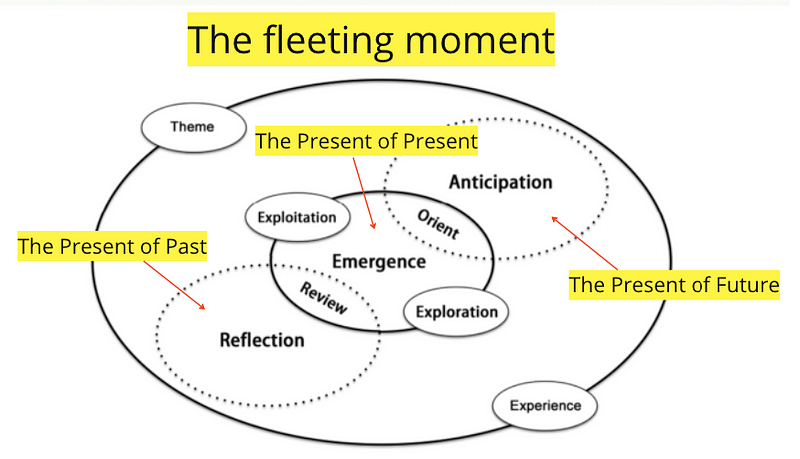
My primary interest is located in the intersection between Knowledge, Creativity, and Adult Development. I roughly use Creative Life to name this focus. It’s clear that I don’t want to develop a general framework about adult development for everyone. I only consider Knowledge Workers and Creators as my target audience.
The diagram was based on my diagram about The Path of Creative Life and Ping-keung Lui’s theoretical sociology, especially the notion of the fleeting moment.
In 2007, Lui published a book titled Gaze, Action, and the Social World in which he presented his account of theoretical sociology. The fundamental starting point of his approach is an Ontology of action, which was inspired by Saint Augustine (354–430), Martin Heidegger (1889–1976), and Maurice Merleau-Ponty (1908–1961). See the statement below:
The body is in action, action is in the fleeting moment, the fleeting moment is in the body.
According to Lui, “This moment is Augustinian, it comprises at the same time the Present of the Past, the Present of the Present, and the Present of the Future. The actor Remembers in the present of the past, Pays Attention in the present of the present, Expects in the present of the future.” (p.235–236, 2010, The Scientific Project of Sociology)
There is a connection between the Path of Creative Life and Lui’s ontology of action.
- Reflection: Remembers in the present of the past
- Emergence: Pays Attention in the present of the present
- Anticipation: Expects in the present of the future
The connection encouraged me to adopt Lui’s theoretical sociology as a reference frame for the Creative Life Curation project and the Life Strategy project. You can find more details in Three Paths of Creative Life and A Semiotic System and A Semiotic System Diagram for Creative Life Curation.
The Strategic Curation model as a Map
Scholars of strategic management have developed many frameworks of strategic cognition. For example, V.K.Narayanan, Lee Jeffrey Zane, and Benedict Kemmerer developed an integrative framework in 2011. See the diagram below. You can find more details in The Cognitive Perspective in Strategy: An Integrative Review.
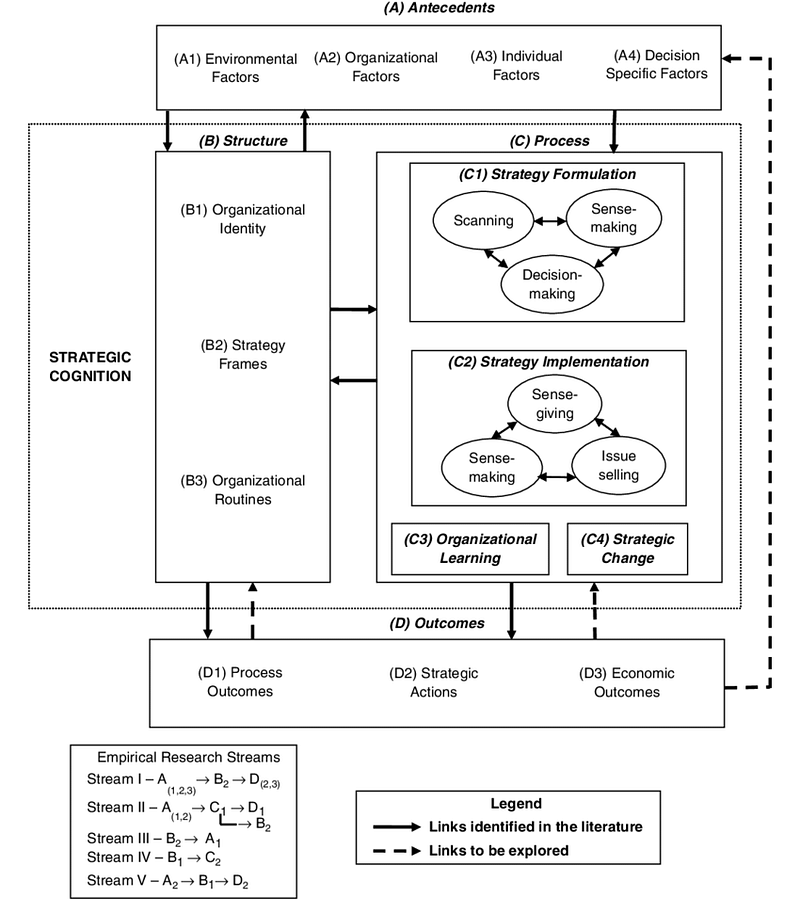
The difference between the above framework and the Strategic Curation model is the latter is a “Map”.
You can use the Strategic Curation model to visualize some strategy-related concepts and issues.
For example, “Opportunity” is an important concept of Strategic Cognition. The diagram below is an example of using the Strategic Curation model to discuss the concept of “Opportunity”.
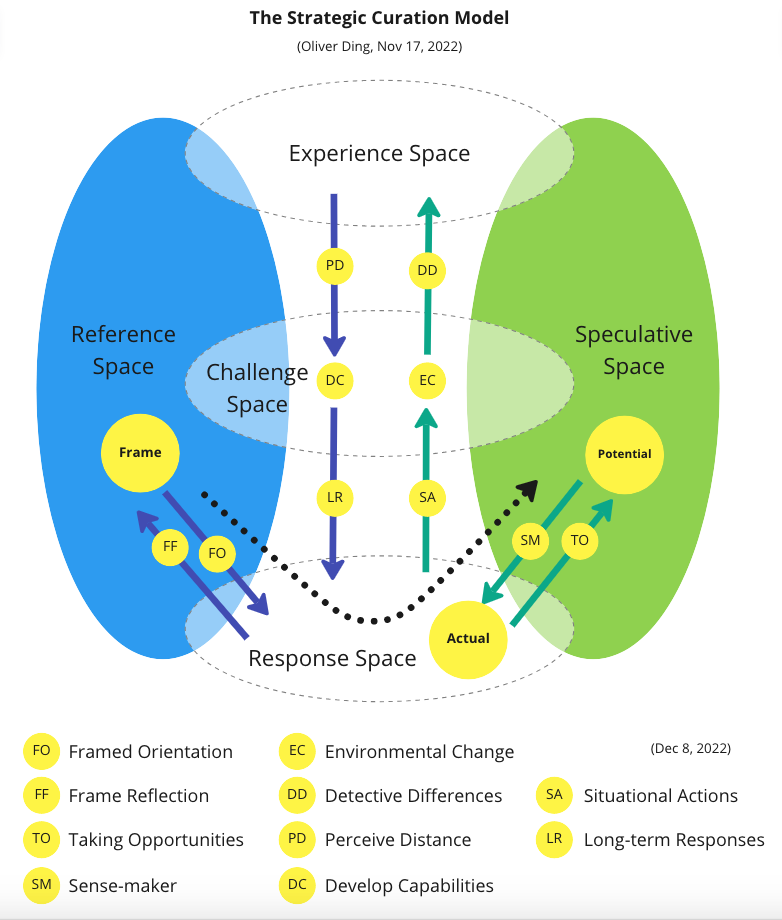
The Strategic Curation model doesn’t offer a particular framework for Strategic Cognition.
However, you can use it to develop a particular framework for your situation.
You can be the strategist of your life.


