
Earth, Moved
How the early work of Herbert Bayer became human-scale environments of positive or negative volumes in the landscape…
Artist and designer Herbert Bayer is perhaps best known for being a Master at the Bauhaus design school, in charge of graphic design, advertising, and typography. In the early-1920s, he’d studied large-scale painting and murals under Wassily Kandinsky at their Weimar campus, where he also devised the Universal typeface by combining aspects of upper and lower case lettering into a single consistent design. On graduation, he was kept on, teaching at both their Weimar and Dessau campuses from 1925–1928 whilst pursuing his own artistic vision.
In its heyday, the Bauhaus was a hotbed of innovation in all aspects of art and design and Bayer was collaborating with influential colleagues including László Moholy-Nagy, with whom he progressed the graphic uses of photomontage and photograms. Whilst based at Dessau, he also designed most of the distinctive typefaces used on Bauhaus signage and official literature.
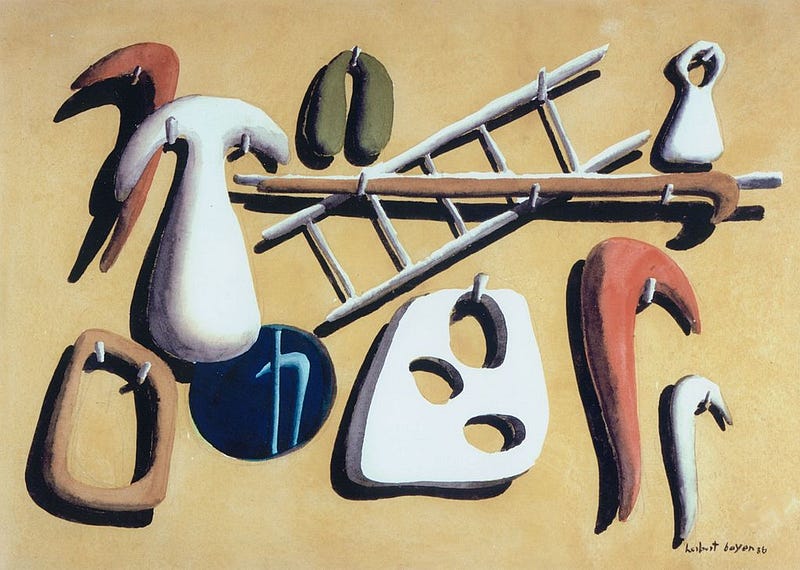
Parallel to this period, his personal work was already multidisciplinary and his earlier training as an architect was evident. His sketch work demonstrated a fascination with the interplay of planes and the balancing of volumes. Biomorphic soft forms suggesting ‘everyday objects’ were recurring motifs, influencing the development of Organic Surrealism. He also recognised the equal importance of positive and negative volumes.
This is perhaps best exemplified by his early, deconstructive studies of cellos and guitars — it was immediately clear to him that the ‘nothing’ within the instrument governed the overall form and affected the tone of the music it made. The clear correlation with architecture was unavoidable. Although the methods and materials used were essential considerations (and, yes, the function of a construction may include a stylistic statement) it’s the ‘nothing’ within a building that’s the most important element of its design. Or should be.
Following his tenure with the Bauhaus, he progressed his sculptural approach, often using photomontage to visualise works that would be too large or costly for him to realise at the time. He termed these photographic works, Fotoplastiks. Many of these works feature simple geometric objects and suggest sculptures and constructions within a landscape, illustrating his balanced treatment of both positive and negative formal elements.
He also used the Fotoplastik approach in finished pieces and much of his graphic design work. The influence of Surrealism asserted itself again in a series, produced during the 1930s, that explored his own dreams and imaginings and left some of his most enduring images. Many of these, such as The Lonely Metropolitan, remain familiar via visual quotes across recent media from album covers to fantasy films.
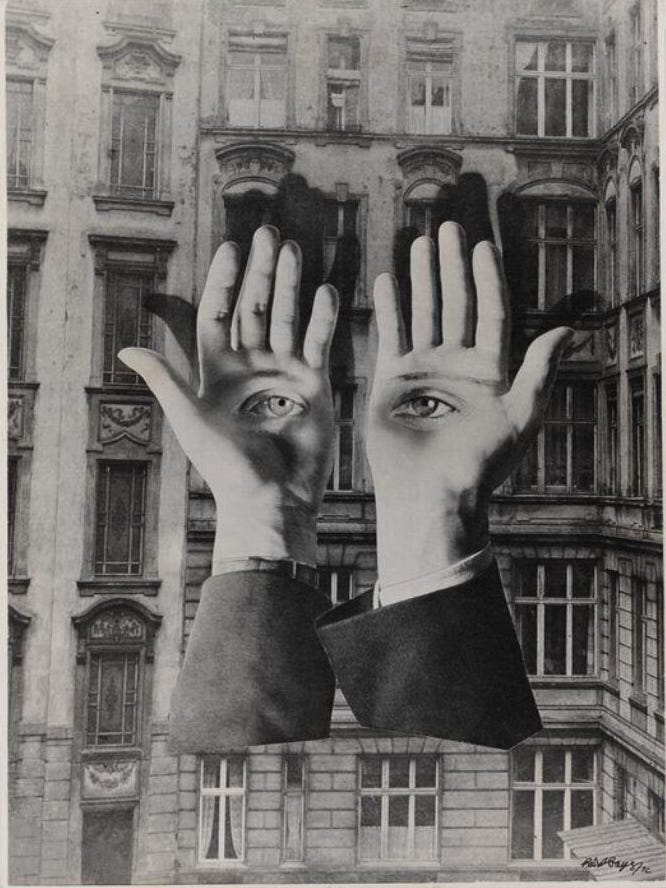
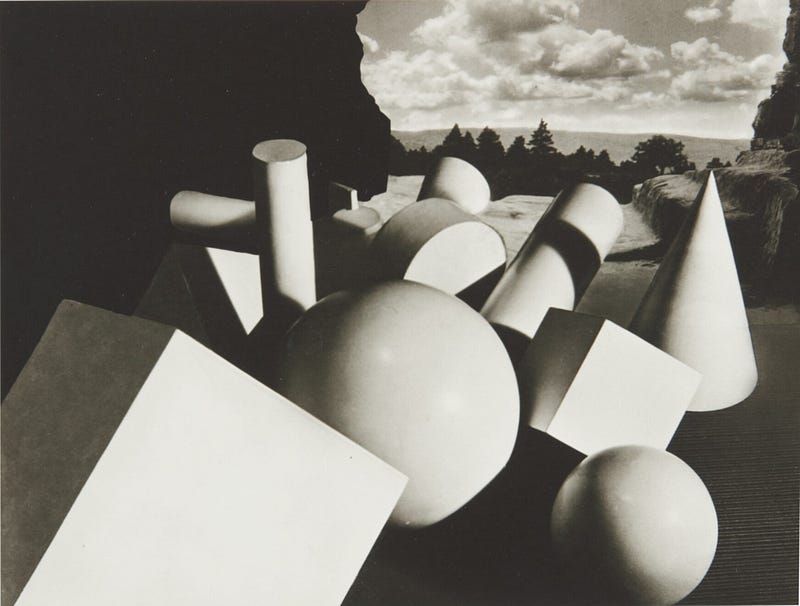
However, it was his obsession with how a positive form balances with negative space that remained with him. He was aware that any object implies a corresponding void. The materials used to make a thing must come from somewhere and therefore must leave a negative volume equal to its mass.
Since classical times, sculptors have been keenly aware that what they chip away creates the carving, the negative space defines the form. However, what is removed does not simply cease to exist and so it follows the material also leaves a hollow at its place of origin. A hole remains in the quarry that sourced a block of marble. There is a clearing in the forest where a tree was felled to provide a chunk of wood.
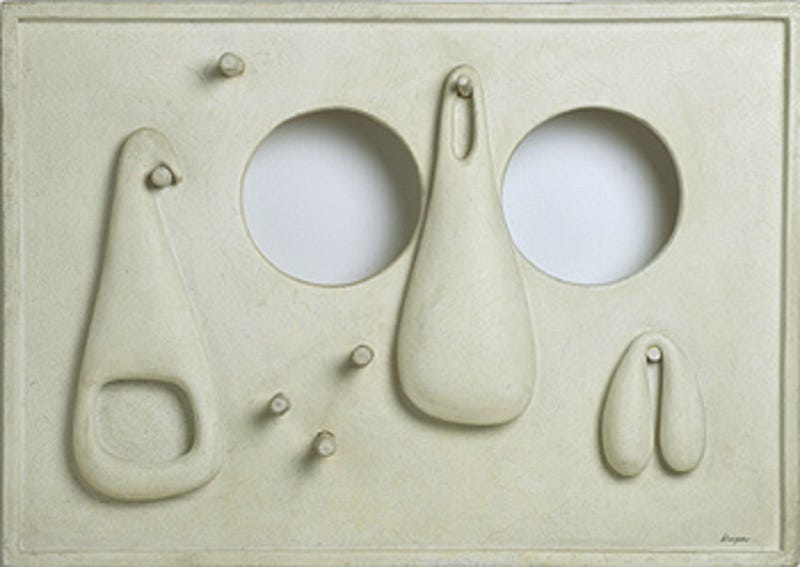
By the close of the 1920’s Herbert Bayer was already making conceptual drawings that visualised large-scale, sculptural landscapes that could be walked through and experienced as an environment — open air architecture. They would involve moving volumes of earth, simultaneously creating a recess and a hill of equal mass. He then introduced other compositional elements such as troughs and ridges, a ditch and a raised bank, and so on. Initially, these ideas were expressed as drawings, then as reliefs in plaster and would not reach human-scale until a couple of decades later…
This innovative idea was really nothing new. Humans have been creating earthworks for millennia. The example that springs most readily to my mind is the sacred landscape of the Salisbury Plain surrounding Stonehenge in Wiltshire, England. The construction of a system of mounds, barrows, and hollows began as early as 3.5 millennia BCE, more than a 1,000 years before the iconic stones were placed, and continued to develop into the Bronze Age.
There is increasing evidence of extensive ancient earthworks across Amazonia, some of these large enough to support entire towns on their artificial plateaus, connected by a network of raised roadways and predating the ritual mounds and stepped pyramids of Aztecs. It seems mimicking mountains has had spiritual significance for a very long time. The Great Pyramids of Egypt are artificial mountains intended to reference a particular landscape that dominates the Valley of the Pharaohs. Likewise, the later Mausoleum of the First Qin Emperor of China, completed around the first century BCE after more than a century under construction, is also known as Mount Li due to its immense scale.
By 1933, the Bauhaus had been shut down by the Nazis and although Herbert Bayer continued to work in the following years, including designing some promotional graphics for the 1936 Berlin Olympics, his work would soon be labelled as ‘degenerate’ and he fled Nazi Germany in 1938. His first professional commission on arrival in the USA was designing a highly influential exhibition to showcase Bauhaus design at New York’s Museum of Modern Art. But it was the mountains of Colorado that provided a revelation of tectonic proportions that finally consolidated Bayer’s ideas of sculptural landscapes.
He began to understand great mountains as simplified volumes and surmised that their mass must, somewhere, have left a corresponding absence. Not unlike the ripples on the surface of water, he realised that mountains undulated through geological time and space. Their slopes and peaks were counterbalanced by valleys and lakes. So, he set about making sculptures that would mediate their grandeur at a more human-scale, providing a connection to their underlying forms and ungraspable timeframe. For he knew they represented something primal and profound.
Alongside many prestigious architectural and public art commissions, he began designing monumental earthworks in the late 1940s and by the mid-1950s the first had been realised in the Aspen Valley. Under the patronage of Walter Paepcke, they formed part of a major development of the area into a ski resort that would fund the non-profit Aspen Institute for Humanistic Studies and host an annual International Design Conference.
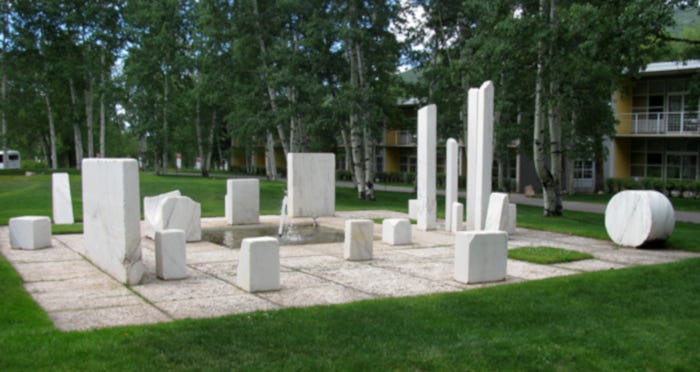
As well as buildings and murals, Herbert Bayer designed two significant landscape elements: the Marble Garden and Grass Mound. The former was a sculptural extension of many of his Fotoplastik visualisations of simple forms in a landscape and drew inspiration from Japanese stone gardens as well as the geometric reductionism of painter Paul Cézanne. A rectangular area is paved in a grid pattern of concrete slabs, their rhythm interrupted by three squares of turf, and containing a square pond. Around this rippling sky-reflecting focal point, stand sets of geometric marble monoliths in the form of cylinders, cubes, triangles, and tall rectilinear columns. It resembles a board game with the pieces at mid-play — a deliberately asymmetric arrangement that would present a different dynamic from any angle and offered various paths through its composition.
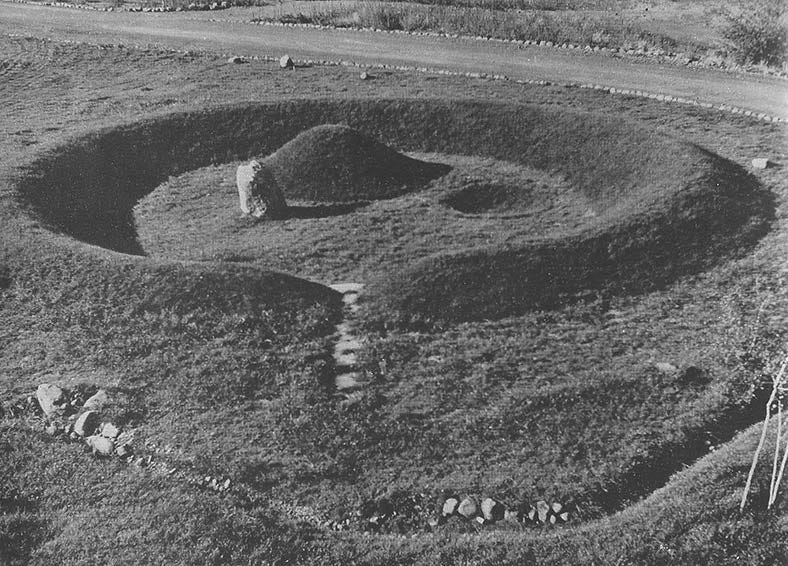
Grass Mound was completed around the same time and offers softer, more organic forms. With a diameter of around 12 metres, the circular bank, interrupted at a single point on its circumference, encloses a gentle mound and corresponding hollow as well as a rough-hewn chunk of stone. Its references to ancient barrow-works and the earthworks of pre-Columbian peoples of the Americas are unavoidable. However, Bayer maintained that its design and meaning are purely formal whilst acknowledging that the people who engage with the work will add the very human element of imagination, leading to many and varied individual interpretations. It certainly suggests a significant spot, a place of gathering, and resonates with the human experience of the surrounding landscape comprising mountains, valleys and enclosed plains.
Herbert Bayer’s land art goes beyond landscaped garden or public park. It adheres to the same compositional principles and proportioning he’d been exploring more than two decades earlier. In the broader context of art history, these works prefigure the Land Art movement that would emerge the following decade, perhaps best exemplified by Robert Smithson’s Spiral Jetty and Nancy Holt’s Sun Tunnels, both constructed in the 1970s. Bayer would play a key, though oft-overlooked, role in the movement and produce two more hugely significant works in addition to numerous architectural commissions…
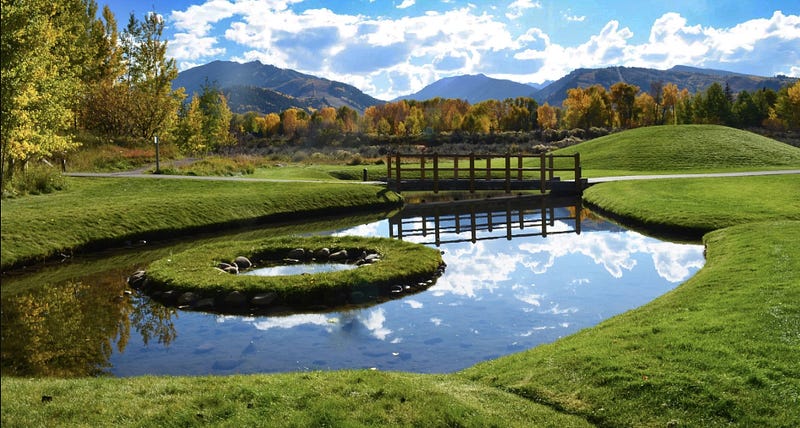
In 1973 Anderson Park extended the ideas expressed in Grass Mound onto a larger adjacent landscape within the Aspen Meadows resort. The two are connected by paths that pass the Marble Garden. The further development of the earthworks comprises a series of circular mounds, including one with a dimpled crown and one plateau-topped, as well as a larger ovoid barrow. Through these runs a sinuous channel, echoing the course of the nearby Roaring Fork River and leading to a gravelled hollow and pond, bridged by the walkway that boldly cuts through the composition. Whilst effective as an abstract arrangement of formal elements, Anderson Park scales down and simplifies features of the surrounding landscape and also has an appeal akin to a model village, plus the grassy slopes are perfect for youngsters to enjoying rolling down… Yes, Bayer’s work here is stridently Modern, yet accessible and not at all elitist.
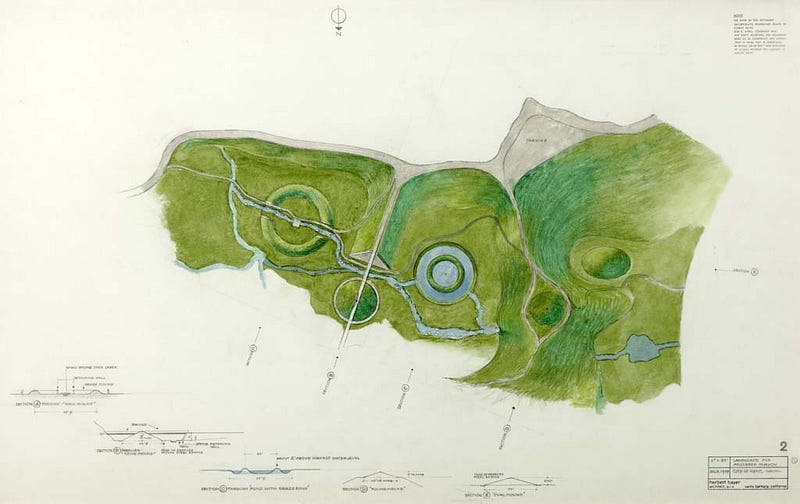
The Herbert Bayer Mill Creek Canyon Earthworks, completed in 1982, is an extensive complex of hills, ring-mounds, circular ponds, dykes, hollows, and meandering walkways. Not only is this landmark a public park for Kent, Washington, it also serves a practical purpose, engineered as a flood mitigation system.
* All images are used with license, or presented here for educational purposes under fair usage policy.


