
Double Trouble: Pain is Depressing. Depression is Painful.
Millions of Americans struggle with both conditions, new research finds, suggesting a rethink of treatment options
This article is part of a Wise & Well Special Report: The United States of Depression.
Two of the most vexing health problems in America and much of Western society are depression and chronic pain. Might the two conditions be related? Highly related, new research finds.
While statistics on both conditions vary depending on how they are collected and analyzed, studies suggest somewhere between 18% and 29% of American adults have struggled with depression at some point in their lives, and more than 8% are clinically depressed at any given time. Meanwhile, somewhere between 15% and 21% of US adults face chronic pain on a daily basis. The prevalence of both is increasing, even as solutions often remain out of reach for many people.
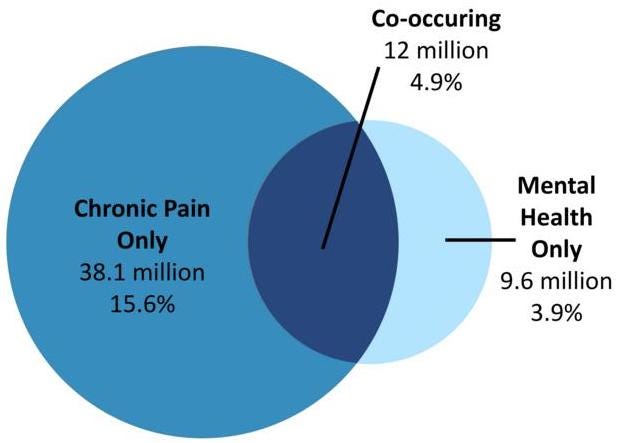
Now this: Some 12 million US adults have co-occurring chronic pain with anxiety or depression symptoms, scientists concluded last week in the journal Pain.
The impact on individual lives and on society as a whole is profound. Among people who struggle with chronic pain and anxiety or depression, 70% report limited abilities at work, 55% find social activities difficult, and 44% have trouble just doing their own errands, the study found. Having the conditions together also complicates efforts to treat either one.
“When someone is experiencing both chronic pain and anxiety or depression symptoms, achieving positive health outcomes can become more challenging,” said the study’s senior author, Todd Vanderah, PhD, a professor and director of the University of Arizona’s Comprehensive Pain and Addiction Center.
Which causes what?
If there’s a silver lining in the research, it’s the realization that mental health problems and chronic pain are often interdependent, suggesting a rethink of treatment options, as well as a greater awareness that chronic pain should set off alarm bells for potential depression symptoms to come.
“Policymakers, health researchers, and advocates often make reference to our national mental health crisis — that the amount of people living with clinically-elevated depression or anxiety symptoms is unacceptably high,” said the journal article’s lead author, Jennifer S. De La Rosa, PhD, a medical sociologist and data scientist at the university’s Pain and Addiction Center. “Our research showed that the majority (55.5%) of people with these elevated mental health symptoms are people living with chronic pain; in other words, chronic pain is a central feature of our national mental health crisis.”
So does pain cause depression, or does depression cause pain? The short answer is “yes.”
“The relative importance of each could differ from person to person,” De La Rosa told me. “Depression is known to increase people’s emotional reactivity to pain, and behaviors associated with depression, such as sleep disturbance, eating too much or too little, and low activity levels, all can contribute to onset and maintenance of chronic pain. Emotions are really inextricable from the experience of pain.”
Indeed, other research has shown that chronic pain — the sort that lasts for a few months or more — is not just a physical sensation but a mental and emotional construct. While the acute phase of pain can sometimes be easily linked to an injury or disease, chronic pain often involves sensations that have settled into the mind and the body’s neural pathways, something akin to a memory—even when there’s no longer an identifiable physical source.
De La Rosa offered an example of the emotional reality of pain: A patient who’s hurting is typically asked to rate the pain using a scale of emoticons, where a 1 is represented by a smiley face, and the face of 10 is overwhelmed with anguish.
“It is really striking that the only way we can communicate with others about pain severity is by describing our emotional reaction to it,” she said. “It makes a lot of sense with chronic pain lasting three months or longer, that a chronic mood disorder might not be far behind.”
Treatment options
Scientists are largely baffled about how to treat chronic pain. Opioids and other pain medications are not effective, multiple studies have concluded. Somewhat ironically, antidepressants used in the treatment of depression are also often prescribed for chronic pain, but research published earlier this year found “no reliable evidence for the long-term efficacy of any antidepressant” in treating pain, said study team member Tamar Pincus, PhD, a professor of health psychology at UK’s University of Southampton.
Only 10.4% of people diagnosed with chronic pain are free of it a year later, I’ve reported previously. “Chronic pain is an astonishingly difficult condition to treat,” said Hanna Grol-Prokopczyk, PhD, a University at Buffalo associate professor of sociology. “Indeed, many pain clinicians prefer to describe themselves as managing pain rather than treating it, to make clear that they cannot promise a cure.”
While the US healthcare system leans heavily on drugs for treating chronic pain and so many other ills, a growing number of doctors and scientists say lifestyle remedies — including physical activity, improved diet and better sleep — should take on far greater priority in any pain treatment plan.
Conveniently, lifestyle changes are also vital in the treatment of depression.
And compared to chronic pain, depression is much more treatable for most people, experts say, even though it can prove intractable for some individuals. Treatment typically involves multiple remedies working in concert — including lifestyle changes, often some talk therapy, and sometimes medication, too — and must be highly individualized, as the causes of depression for any person can be many and varied.
If there’s one overriding need for people afflicted with depression or chronic pain or both, it’s hope. De La Rosa acknowledged the courage it takes for people to live with both conditions.
“I hope they will keep on showing up to their lives as much as possible — exploring physical, mental health, and integrative treatments, making small sustainable improvements in eating, sleeping, and moving, and incorporating mindfulness, stress reduction, and relaxation where it might be helpful,” she said. “I also hope readers will consider sharing their lived experiences with others, including participating in advocacy work to increase awareness of the connection between chronic pain and mental health, and to energize the development of more effective treatments.”
This article is part of a Wise & Well Special Report: The United States of Depression. If you or a loved one is depressed, it’s vital to talk about it. Because depression increases the risk of suicide, consider calling the confidential National Suicide Prevention Lifeline at 1–800–273-TALK (8255) for English, 1–888–628–9454 for Spanish, or call or text 988. Global support in 44 languages is available from Befrienders Worldwide.


