
Cryptocurrency Trends
Thoughts on the Dilemmas of ICOs and the Rise of DeFi
Is there a way to make ICOs (Initial Coin Offerings) work on the rise of DeFi (Decentralized Finance)?

The crypto world talks a lot about ICOs and DeFi (Decentralized Finance). While America is relatively warmer to ICOs, China and North Korea banned them. Many other countries are still evaluating.
There is no consensus on the future of ICOs. It is unchartered territory. Valuations, structures, and legalities are the critical focus of ICO globally.
On the one hand, we hear success stories from entrepreneurs. But, on the other hand, a plethora of scams and unregulated unpredictability shake the confidence of stakeholders.
To give you an idea of the earnestness and urgency of this issue, I want to provide you with four recent cases and concerns as documented by Coindesk.
Fraud Alleged at Three Israeli ICOs That Raised $250M — June 2021:
”As reported by The Times of Israel on Monday, the lawsuit filed May 25 claims token sales from Sirin Labs, Stx Technologies Limited (Stox) and Leadcoin had raised $250 million in total from investors, but the companies didn’t develop products as investors had been promised.”
Blockchain Consultant Pleads Guilty to Extortion Charge — April 2021: “Michael Hlady, an associate at blockchain consulting firm Alchemist, pleaded guilty on Monday to conspiring to extort a startup company for millions of dollars in the cryptocurrency ether (ETH, +4.76%). He now faces up to 20 years in prison and a fine.”
Centra Tech Co-Founder Gets 8 Years for Crypto Fraud — March 2021: “Sohrab Sharma, aka “Sam Sharma,” a co-founder of the cryptocurrency firm Centra Tech, has been sentenced to eight years in jail for conducting an illegal initial coin offering (ICO) that fleeced investors of $25 million”.
US Man Sentenced to Prison for Embezzling $20M of ICO Investors’ Funds — January 2021: “Jerry Ji Guo, 33, was handed a six-month sentenced by U.S. District Judge Beth Labson Freeman and ordered to pay nearly $4.4 million in restitution after he had pleaded guilty to initial coin offering (ICO) fraud”.
There are many more reported and documented incidents in America and other countries. These types of news undoubtedly concern investors.
ICOs revolve around cryptocurrencies. Cryptocurrency news is vibrating the world. While some countries are trying to ban them, other countries are giving green light.
For example, as reported by Tanzeel Akhtar on Coindesk a few days ago, “El Salvador became the first nation in the world to recognize bitcoin as legal tender and mandate that all businesses in the country accept it as payment.”
The central premise of ICOs is to provide a mechanism for startups to raise funds by selling crypto tokens to their potential investors.
From a historical perspective, ICOs hit the headline in 2017. As pointed out in a report by Coindesk, ICOs exceeded VCs Venture Capitals (VC) in 2017. While VCs produced $295 million, ICOs produced $327 million in funds.
From my review of the recent news in the crypto world, there is a comparison of ICOs with DeFi. Even though ICO and DeFi are different concepts, they also relate from entrepreneurial investment perspectives.
While ICOs have seen extreme risk due to attention paid by SEC with warnings and, finally, its first enforcement against an ICO for securities law violations, DeFi has not experienced such severe regulatory intervention yet. However, regulatory discussions are happening.
In the crypto world, there is a comparison of De-Fi to replace ICOs. However, there are persuasive arguments on why we shouldn’t put DeFi and ICO in the same row.
De-Fi has become so popular and compelling that some experts like Martin D. Weiss, the founder of Weiss Ratings, call it “the greatest money revolution of all time”.
According to MoneyShow, Weis Rating is “the nation’s leading provider of 100% independent grades on stocks, mutual funds, and financial institutions, as well as the world’s only rating agency that grades cryptocurrencies”. Forbes called Mr Weis “Mr Independence”. The US Government Accountability Office reported that the Weiss insurance company's ratings outperformed those of its closest competitors by a factor of three to one.
According to Pantera Capital CEO Dan Morehead, DeFi has more chances to grow 100X in the next five years than Bitcoin, as discussed in this YouTube video.
Current public perceptions after new SEC regulations reflect that DeFi does not face scams as ICOs have been facing, as discussed in this article titled “The Death of the ICO: Has the US SEC Closed the Global Window on New Tokens?”.
To give you an idea of discussions on social media about ICO versus DeFi, I want to share a thread with three interesting tweets representing two opposing views.
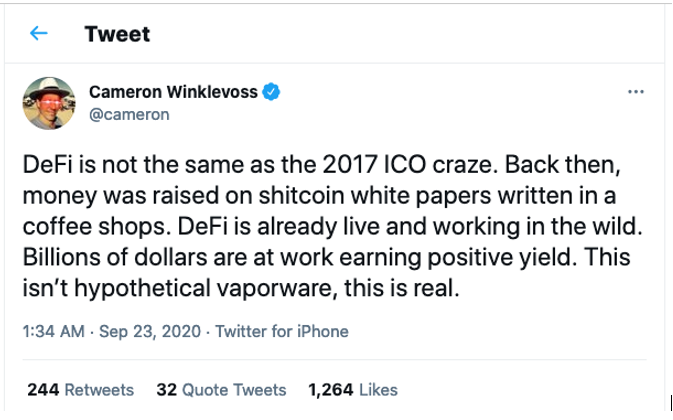
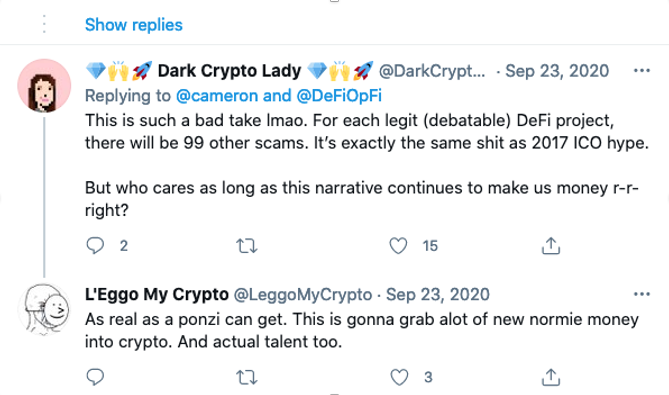
The formal position from The U.S. Securities and Exchange Commission on ICOs is:
“Companies and individuals are increasingly considering initial coin offerings (ICOs) as a way to raise capital or participate in investment opportunities. While these digital assets and the technology behind them may present a new and efficient means for carrying out financial transactions, they also bring increased risk of fraud and manipulation because the markets for these assets are less regulated than traditional capital markets”.
SEC provides regular updates on a web portal called Spotlight on Initial Coin Offerings (ICOs).
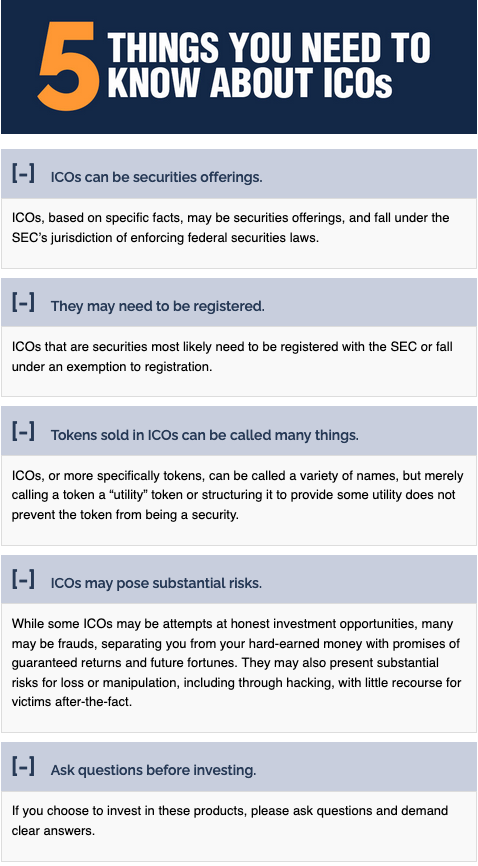
Here is the guidance provided by SEC for the public.
My understanding from discussions, unlike other countries, the US government seem to not ban ICOs but control them tightly. The main reason might be that ICOs can contribute to innovations planned by startup ventures, and they can contribute to the growth of the American economy.
While the perception of ICOs relates to many scams, there are also many legitimate ventures that used ICOs successfully. For example, I know that IOTA, NXT, Ethereum, NEO, and Stratis made noticeable progress in this area as observed in my previous technology engagements.
Both ICOs and DeFi are complex and fluid financial constructs. Therefore, investment in these areas requires substantial knowledge of crypto technologies, tools, processes, business models, and an understanding of financial concepts.
These two terms grace the pages of the financial news, and they are expected to flood them soon. Thus, it will be helpful to understand the concept and follow the advice from the SEC and other government organizations.
While there are many hypes and scams, the crypto market is real, exciting, and promising.
Thank you for reading my perspectives. I wish you a healthy and happy life.
Thank you also for subscribing to my content. I share my health and well-being stories in my publication, Euphoria. If you are new to Medium, you may join by following this link.
You can join my publications as a writer requesting access via this weblink.
I write about health as it matters. I believe health is all about homeostasis.
Sample Health Improvement Articles for New Readers
Defeat Metabolic Syndrome and Slim Down Waistline with Three Tips
Why 442 Million People Live Diabetic and What We Can Do About it
Six Tips to Prevent Brain Atrophy and Lower the Risks of Mental Disorders
What Can We Do About NCDs Killing 41 Million People Yearly?.
Reduce the Risks of Neonatal Disorders to Prevent Infant Mortality.
Reduce the Risks of Major Diseases with Healthy Lifestyle Habits
I also write about valuable nutrients. Here are the links for easy access:
Boron, Urolithin, taurine, citrulline malate, biotin, lithium orotate, alpha-lipoic acid, n-acetyl-cysteine, acetyl-l-carnitine, CoQ10, NADH, TMG, creatine, choline, digestive enzymes, magnesium, hydrolyzed collagen, nootropics, pure nicotine, activated charcoal, Vitamin B12, Vitamin B1, Vitamin D, Vitamin K2, Omega-3 Fatty Acids, and other nutrients that might help to improve metabolism and mental health.
I share important life lessons from people in my professional and social circles compiled in the attached collection.

About the Author
Dr Mehmet Yildiz is a technologist, postdoctoral researcher, published author of multiple books, chief editor, and digital marketing strategist with four decades of industry experience.
He writes articles for Medium, NewsBreak, and Vocal Media. On Medium, he established ILLUMINATION, ILLUMINATION-Curated, ILLUMINATION’ S MIRROR, ILLUMINATION Book Chapters, Technology Hits, SYNERGY, and Readers Hope publications supporting around 15,000 writers on Medium.
You can join his publications requesting access here.


