
Day 48: 60 days of Data Science and Machine Learning Series
Multilayer Perceptron with project…
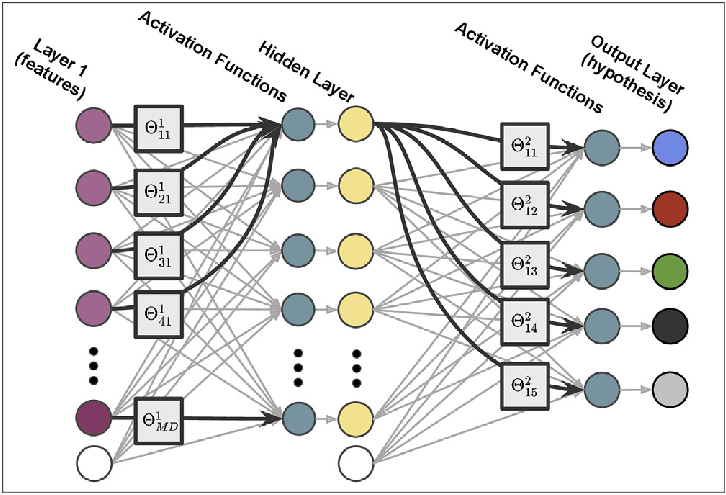
Multilayer Perceptron is basically ( or a class of ) a feedforward artificial neural network which is composed of an input layer to receive the signal, an output layer that makes a decision or prediction about the input, and an arbitrary number of hidden layers for the computation. They provide a nonlinear mapping between the input layer and a corresponding output layer. They are like “hello world” of deep learning.
Some of the other best Series —
100 days : Your Data Science and Machine Learning Degree Series with projects
Complete Data Visualization and Pre-processing Series with projects
Projects Videos —
All the projects, data structures, SQL, algorithms, system design, Data Science and ML , Data Analytics, Data Engineering, , Implemented Data Science and ML projects, Implemented Data Engineering Projects, Implemented Deep Learning Projects, Implemented Machine Learning Ops Projects, Implemented Time Series Analysis and Forecasting Projects, Implemented Applied Machine Learning Projects, Implemented Tensorflow and Keras Projects, Implemented PyTorch Projects, Implemented Scikit Learn Projects, Implemented Big Data Projects, Implemented Cloud Machine Learning Projects, Implemented Neural Networks Projects, Implemented OpenCV Projects,Complete ML Research Papers Summarized, Implemented Data Analytics projects, Implemented Data Visualization Projects, Implemented Data Mining Projects, Implemented Natural Leaning Processing Projects, MLOps and Deep Learning, Applied Machine Learning with Projects Series, PyTorch with Projects Series, Tensorflow and Keras with Projects Series, Scikit Learn Series with Projects, Time Series Analysis and Forecasting with Projects Series, ML System Design Case Studies Series videos will be published on our youtube channel ( just launched).
Subscribe today!
Tech Newsletter —
If you are interested, you can join my newsletter through which I send tech interview tips, techniques, patterns, hacks — Software Development, ML, Data Science, Startups and Technology projects to more than 30K readers. You can subscribe to Tech Brew :
A good introduction about MLP can be found ( at link below) —
In this project we are going to implement a multilayer Perceptron model with Keras.
Let’s dive in!
Import Necessary Libraries
%matplotlib inline
import matplotlib.pyplot as plt
import numpy as np
np.random.seed(0)
import tensorflow as tf
from tensorflow.keras.datasets import reuters
from tensorflow.keras.models import Sequential
from tensorflow.keras.layers import Dense, Dropout, Activation
from tensorflow.keras.preprocessing.text import TokenizerLoad Dataset
( x_train, y_train), (x_test,y_test) = reuters.load_data(num_words=10000,test_split=0.2)
print(len(x_train))
print(len(x_test))
num_classes = np.max(y_train) +1
print(num_classes)
Output —
8982
2246
46
Vectorize and One-hot Encoding
tokenizer = Tokenizer(num_words=10000)
x_train = tokenizer.sequences_to_matrix(x_train,mode='binary')
x_test = tokenizer.sequences_to_matrix(x_test,mode='binary')
y_train = tf.keras.utils.to_categorical(y_train,num_classes)
y_test = tf.keras.utils.to_categorical(y_test,num_classes)x_train.shape,x_test.shape
y_train.shape, y_test.shapeOutput —
((8982, 10000), (2246, 10000))((8982, 46), (2246, 46))Build Multilayer Perceptron Model
model = Sequential([
    Dense(512,input_shape = (10000,)),
    Activation('relu'),
    Dropout(0.5),
    Dense(num_classes),
    Activation('softmax')


])
model.summary()
Output —
Model: "sequential"
_________________________________________________________________
Layer (type)                 Output Shape              Param #
=================================================================
dense (Dense)                (None, 512)               5120512
_________________________________________________________________
activation (Activation)      (None, 512)               0
_________________________________________________________________
dropout (Dropout)            (None, 512)               0
_________________________________________________________________
dense_1 (Dense)              (None, 46)                23598
_________________________________________________________________
activation_1 (Activation)    (None, 46)                0
=================================================================
Total params: 5,144,110
Trainable params: 5,144,110
Non-trainable params: 0
_________________________________________________________________
Train Model
from tensorflow.keras.callbacks import EarlyStoppinges = EarlyStopping(monitor = 'val_loss',patience=3,verbose=1,mode='min')
model.compile(optimizer ='adam',
loss= 'categorical_crossentropy',
metrics = ['accuracy'])
h = model.fit(x_train, y_train,
epochs=100,
batch_size=32,
validation_split=0.1,
callbacks=[es])Output —
Train on 8083 samples, validate on 899 samples
Epoch 1/100
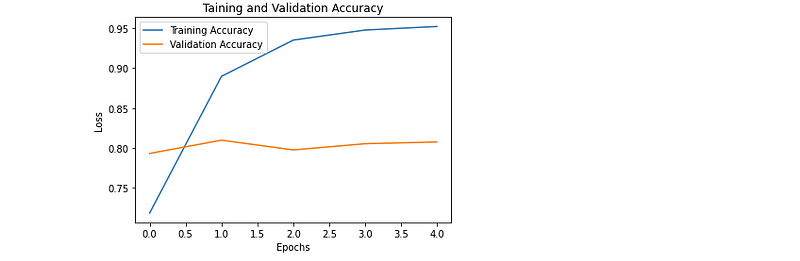
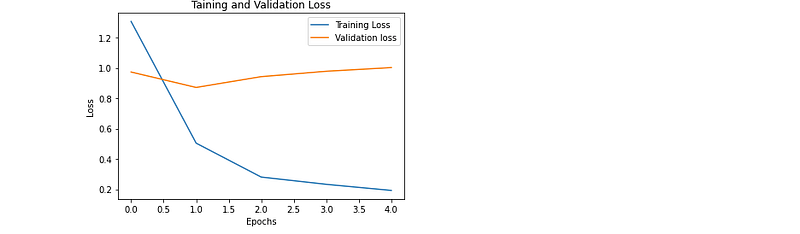
8083/8083 [==============================] - 9s 1ms/sample - loss: 1.3059 - accuracy: 0.7185 - val_loss: 0.9727 - val_accuracy: 0.7931
Epoch 2/100
8083/8083 [==============================] - 8s 1ms/sample - loss: 0.5040 - accuracy: 0.8898 - val_loss: 0.8712 - val_accuracy: 0.8098
Epoch 3/100
8083/8083 [==============================] - 9s 1ms/sample - loss: 0.2806 - accuracy: 0.9352 - val_loss: 0.9423 - val_accuracy: 0.7976
Epoch 4/100
8083/8083 [==============================] - 9s 1ms/sample - loss: 0.2328 - accuracy: 0.9478 - val_loss: 0.9777 - val_accuracy: 0.8053
Epoch 5/100
8083/8083 [==============================] - 10s 1ms/sample - loss: 0.1925 - accuracy: 0.9522 - val_loss: 1.0022 - val_accuracy: 0.8076
Epoch 00005: early stopping
Evaluate Model
model.evaluate(x_test,y_test,batch_size=32,verbose=1)
Output —
2246/2246 [==============================] - 1s 516us/sample - loss: 0.9245 - accuracy: 0.8077[0.9245196666870389, 0.8076581]Training and Validation Accuracy
plt.plot(h.history['accuracy'],label='Training Accuracy')
plt.plot(h.history['val_accuracy'],label = 'Validation Accuracy')
plt.title('Taining and Validation Accuracy')
plt.xlabel('Epochs')
plt.ylabel('Loss')
plt.legend()
plt.show()
Output —
Training and Validation Loss
plt.plot(h.history['loss'],label='Training Loss')
plt.plot(h.history['val_loss'],label = 'Validation loss')
plt.title('Taining and Validation Loss')
plt.xlabel('Epochs')
plt.ylabel('Loss')
plt.legend()
plt.show()
Output —
Learnings —
How to build and train a multilayer perceptron and perform topic classification with Keras
Day 49: Coming soon!
Follow and Stay tuned. Keep coding :)
For other projects, tune to —
Build Machine Learning Pipelines( With Code)
Recurrent Neural Network with Keras
Clustering Geolocation Data in Python using DBSCAN and K-Means
Facial Expression Recognition using Keras
Hyperparameter Tuning with Keras Tuner
Custom Layers in Keras
That’s it fellas. Peace out and keep coding :)
Stay Tuned and of-course let me end this post with a quote by Steve Jobs ;)
“Your work is going to fill a large part of your life, and the only way to be truly satisfied is to do what you believe is great work. And the only way to do great work is to love what you do. If you haven’t found it yet, keep looking. Don’t settle. As with all matters of the heart, you’ll know when you find it.”


