
Day 24 : 60 days of Data Science and Machine Learning Series
Classification Project 2 ( Part 1)..

Welcome back peeps. Hope you all had amazing thanks giving party (I’m still not over it ;) ). Anyways, In this post we will cover ML Classification in detail with another project ( Part 1).
Some of the other best Series —
100 days : Your Data Science and Machine Learning Degree Series with projects
Complete Data Visualization and Pre-processing Series with projects
Projects Videos —
All the projects, data structures, SQL, algorithms, system design, Data Science and ML , Data Analytics, Data Engineering, , Implemented Data Science and ML projects, Implemented Data Engineering Projects, Implemented Deep Learning Projects, Implemented Machine Learning Ops Projects, Implemented Time Series Analysis and Forecasting Projects, Implemented Applied Machine Learning Projects, Implemented Tensorflow and Keras Projects, Implemented PyTorch Projects, Implemented Scikit Learn Projects, Implemented Big Data Projects, Implemented Cloud Machine Learning Projects, Implemented Neural Networks Projects, Implemented OpenCV Projects,Complete ML Research Papers Summarized, Implemented Data Analytics projects, Implemented Data Visualization Projects, Implemented Data Mining Projects, Implemented Natural Leaning Processing Projects, MLOps and Deep Learning, Applied Machine Learning with Projects Series, PyTorch with Projects Series, Tensorflow and Keras with Projects Series, Scikit Learn Series with Projects, Time Series Analysis and Forecasting with Projects Series, ML System Design Case Studies Series videos will be published on our youtube channel ( just launched).
Subscribe today!
Tech Newsletter —
If you are interested, you can join my newsletter through which I send tech interview tips, techniques, patterns, hacks — Software Development, ML, Data Science, Startups and Technology projects to more than 30K readers. You can subscribe to Tech Brew :
For the first project please refer the link below —
Classification algorithms are used for predictive modeling problem where input training data is used to predict the probability that future data will fall into one of the predetermined/labelled categories.
In this post we are going to build a project. The data for this project can be found in the link below —
Let’s deep dive —
Import necessary libraries
import numpy as np # linear algebra
import pandas as pd # data processing, CSV file I/O (e.g. pd.read_csv)
import seaborn as sns
from matplotlib import pyplot as plt
from matplotlib.colors import rgb2hex
import matplotlib.cm as cm
from wordcloud import WordCloud
from PIL import Image
import nltk
import re
nltk.download('stopwords')
from nltk.corpus import stopwords
nltk.download('wordnet')
from nltk.stem.porter import PorterStemmer
from sklearn import metrics
from sklearn.model_selection import train_test_split
from sklearn.preprocessing import LabelEncoder
from sklearn.model_selection import train_test_split
from sklearn.pipeline import Pipeline
from sklearn.feature_extraction.text import CountVectorizer
from sklearn.naive_bayes import MultinomialNB
from sklearn.ensemble import RandomForestClassifier
from sklearn.metrics import confusion_matrix, accuracy_score, classification_report
import matplotlib.colors
from collections import Counter
cmap2 = cm.get_cmap('twilight',13)
colors1= []
for i in range(cmap2.N):
rgb= cmap2(i)[:4]
colors1.append(rgb2hex(rgb))
#print(rgb2hex(rgb))
# Set style
sns.set(style='whitegrid')Load the data
df = pd.read_csv('/path to file/Data_file.csv',low_memory=False,index_col=0)# Drop duplicates and Null Valuesdf.drop_duplicates(inplace=True)
df.dropna()Output —
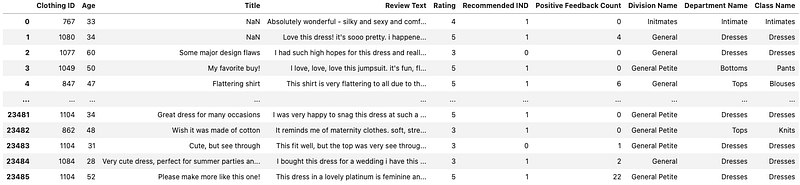
Attribute information —
This dataset includes 23486 rows and 10 feature variables. Each row corresponds to a customer review, and includes the variables:- Clothing ID: Integer Categorical variable that refers to the specific piece being reviewed.
- Age: Positive Integer variable of the reviewers age.
- Title: String variable for the title of the review.
- Review Text: String variable for the review body.
- Rating: Positive Ordinal Integer variable for the product score granted by the customer from 1 Worst, to 5 Best.
- Recommended IND: Binary variable stating where the customer recommends the product where 1 is recommended, 0 is not recommended.
- Positive Feedback Count: Positive Integer documenting the number of other customers who found this review positive.
- Division Name: Categorical name of the product high level division.
- Department Name: Categorical name of the product department name.
- Class Name: Categorical name of the product class name.
# Get to know your datadf.info()Output —
<class 'pandas.core.frame.DataFrame'>
Int64Index: 23486 entries, 0 to 23485
Data columns (total 10 columns):
 #   Column                   Non-Null Count  Dtype
---  ------                   --------------  -----
 0   Clothing ID              23486 non-null  int64
 1   Age                      23486 non-null  int64
 2   Title                    19676 non-null  object
 3   Review Text              22641 non-null  object
 4   Rating                   23486 non-null  int64
 5   Recommended IND          23486 non-null  int64
 6   Positive Feedback Count  23486 non-null  int64
 7   Division Name            23472 non-null  object
 8   Department Name          23472 non-null  object
 9   Class Name               23472 non-null  object
dtypes: int64(5), object(5)
memory usage: 2.0+ MB
# Missing Values
df.isna().sum()Output —
Clothing ID                   0
Age                           0
Title                      3810
Review Text                 845
Rating                        0
Recommended IND               0
Positive Feedback Count       0
Division Name                14
Department Name              14
Class Name                   14
dtype: int64
# See the statsdf.describe().T# Get unique Valuesdf.Rating.value_counts()Output —
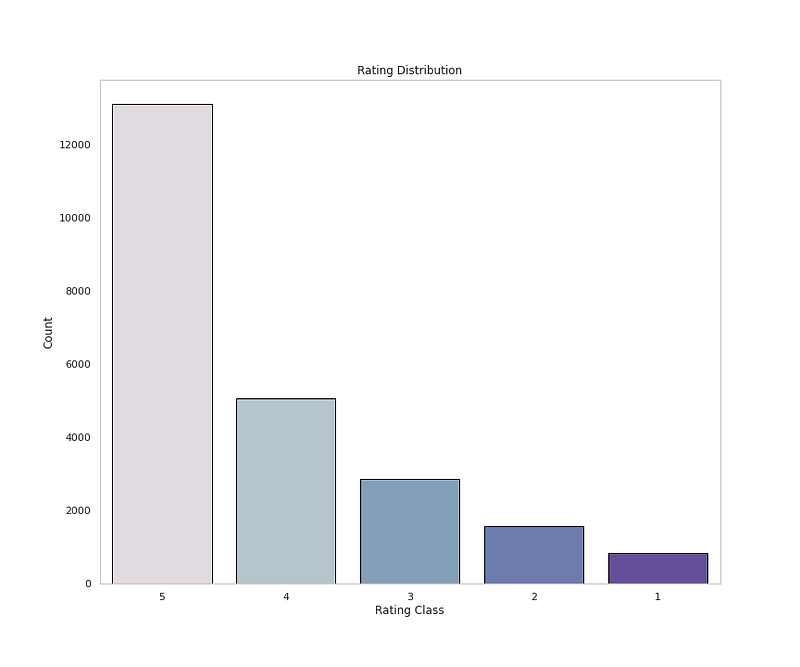
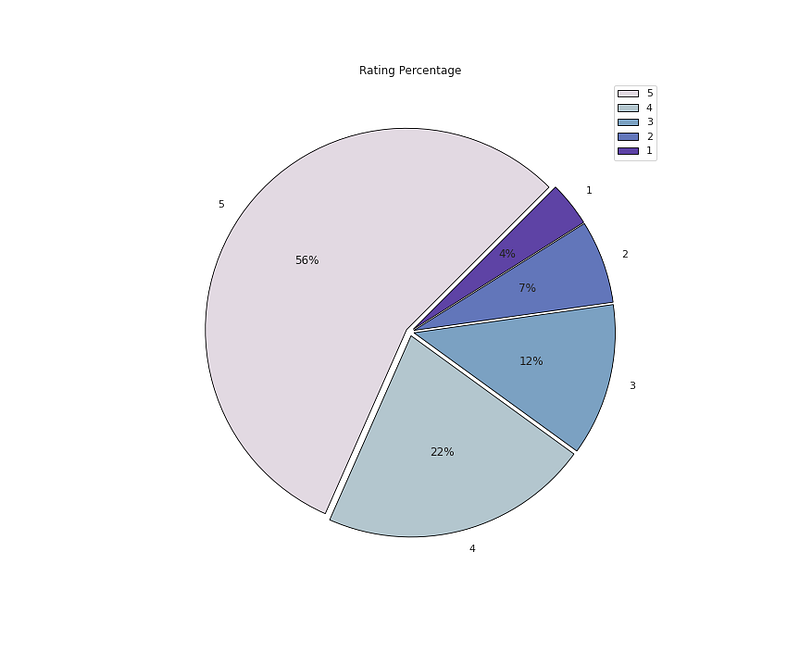
5    13131
4     5077
3     2871
2     1565
1      842
Name: Rating, dtype: int64
# Get Class name Countsdf['Class Name'].value_counts()Output —
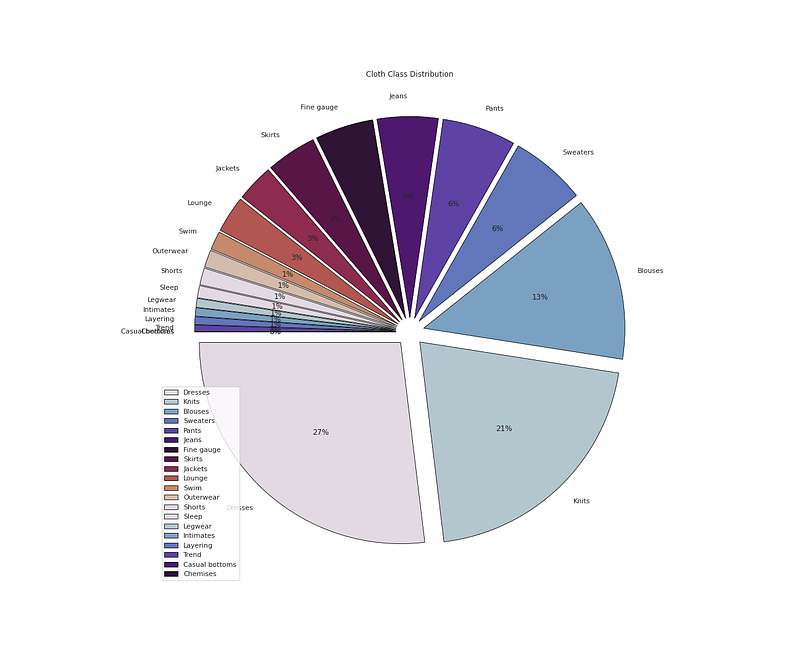
Dresses           6319
Knits             4843
Blouses           3097
Sweaters          1428
Pants             1388
Jeans             1147
Fine gauge        1100
Skirts             945
Jackets            704
Lounge             691
Swim               350
Outerwear          328
Shorts             317
Sleep              228
Legwear            165
Intimates          154
Layering           146
Trend              119
Casual bottoms       2
Chemises             1
Name: Class Name, dtype: int64
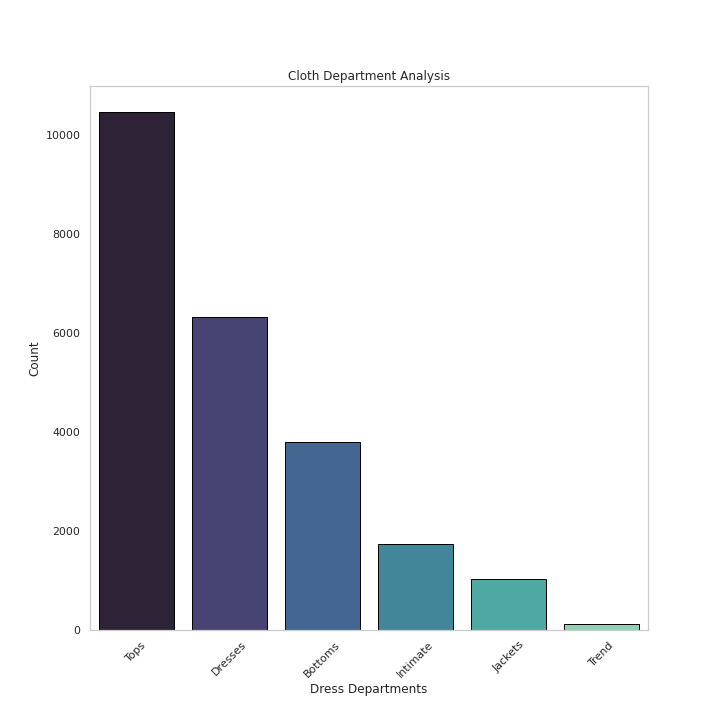
# Get Count of Department Namedf['Department Name'].value_counts()Output —
Tops        10468
Dresses      6319
Bottoms      3799
Intimate     1735
Jackets      1032
Trend         119
Name: Department Name, dtype: int64
Data Visualization
# Cloth Department Analysisplt.figure(figsize=(10,10))
sns.countplot(x='Department Name',data=df,palette='mako',order=df['Department Name'].value_counts().index,edgecolor='black',linewidth=1)
plt.xlabel('Dress Departments')
plt.ylabel('Count')
plt.xticks(rotation=45)
plt.title('Cloth Department Analysis')
plt.grid(False)plt.show()Output —
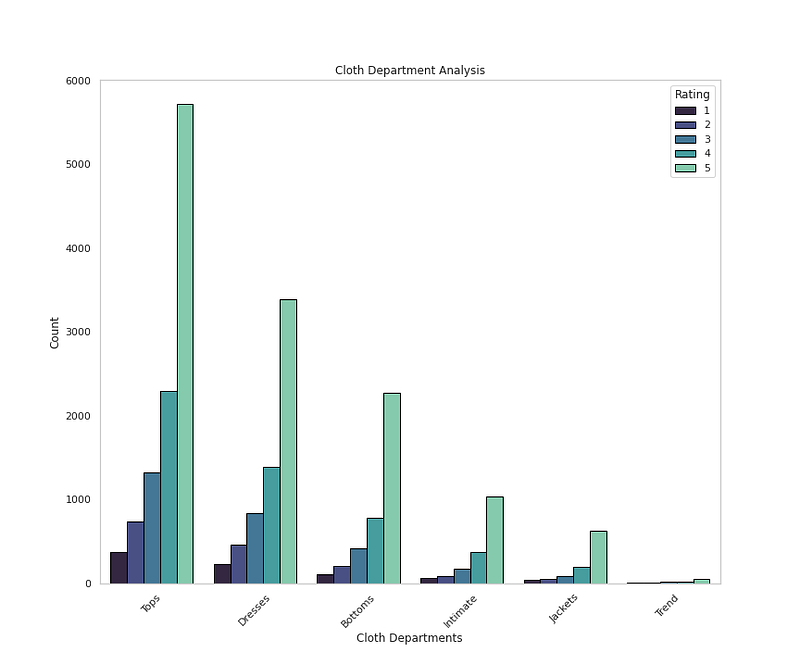
# Cloth Department by Ratingsplt.figure(figsize=(12,10))
sns.countplot(x='Department Name',data=df,palette='mako',order=df['Department Name'].value_counts().index,hue='Rating',edgecolor='black',linewidth=1)
plt.xlabel('Cloth Departments')
plt.ylabel('Count')
plt.xticks(rotation=45)
plt.title('Cloth Department Analysis')
plt.grid(False)plt.show()Output —
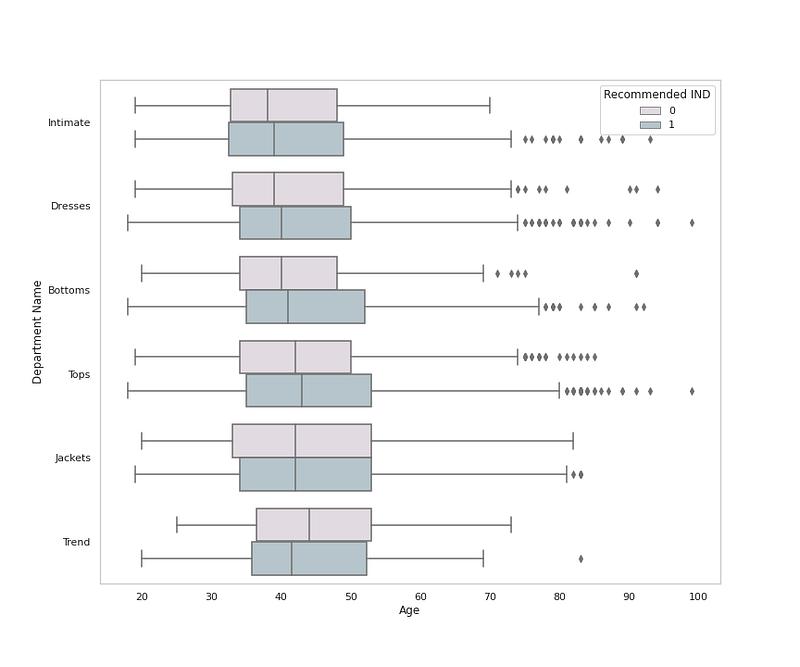
# Cloth Department by Age, Department and Recommendationplt.figure(figsize=(12,10))
sns.boxplot(x = 'Age', y = 'Department Name', data = df,palette=colors1,hue='Recommended IND')
plt.grid(False)
plt.title('Cloth Department by Age and Recommendation ')
plt.show()Output —
# Cloth Department Distributionplt.figure(figsize=(12,10))
plt.pie(x=df['Department Name'].value_counts().values,data=df,colors=colors1,labels=df['Department Name'].value_counts().index,autopct='%.0f%%',explode=[0.02 for i in df['Department Name'].value_counts().index],startangle=45,wedgeprops={'linewidth':0.8,'edgecolor':'black'})
plt.title('Cloth Department Distribution')
plt.legend(loc='lower left')
plt.show()Output —
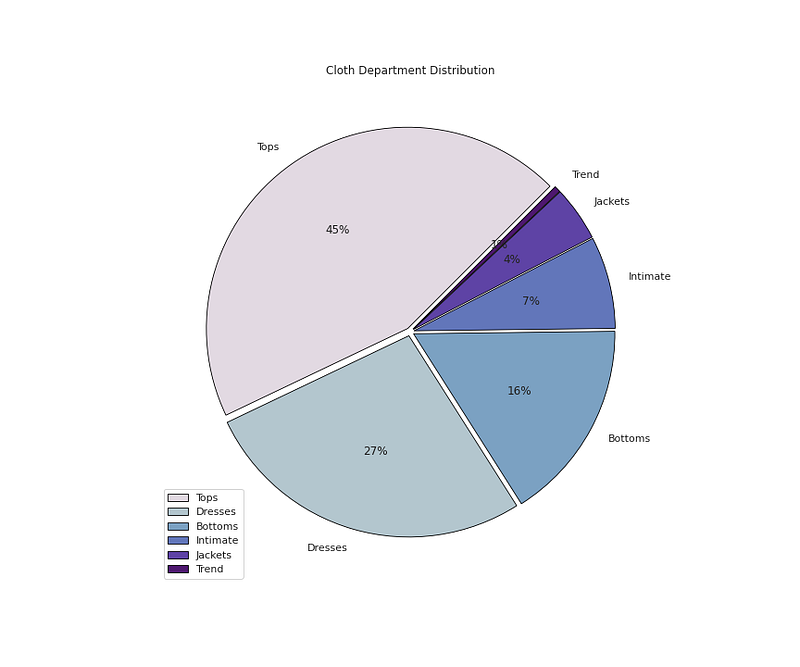
# Cloth Class by Age, Department and Recommendationplt.figure(figsize=(12,10))
sns.violinplot(x = 'Department Name', y = 'Age', data = df,palette='mako',hue='Recommended IND',orient='v')
plt.grid(False)
plt.title('Cloth Department by Age and Recommendation ')
plt.show()Output —
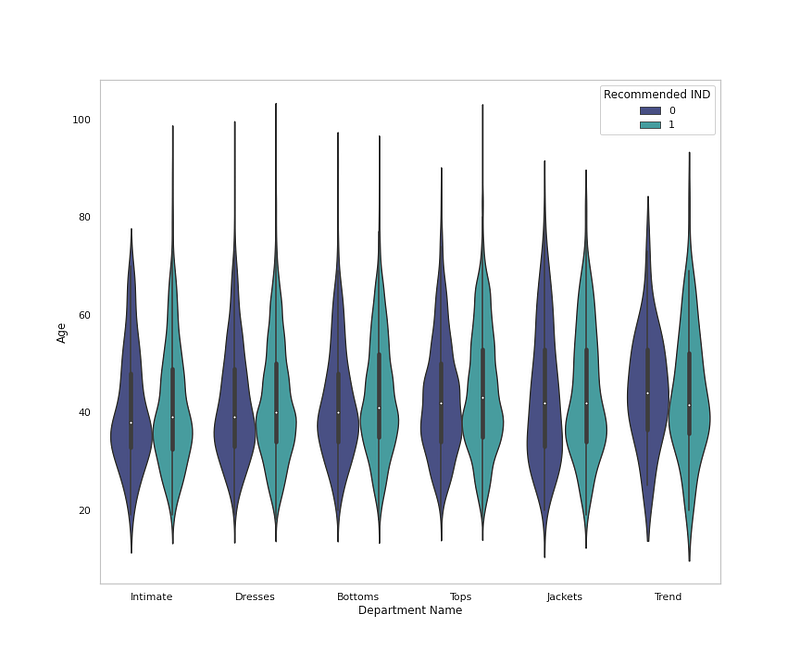
# Cloth Class Analysisplt.figure(figsize=(12,10))
sns.countplot(x='Class Name',data=df,palette=colors1,order=df['Class Name'].value_counts().index,edgecolor='black',linewidth=1)
plt.xlabel('Cloth Class')
plt.ylabel('Count')
plt.xticks(rotation=45)
plt.title('Cloth Class Analysis')
plt.grid(False)plt.show()Output —
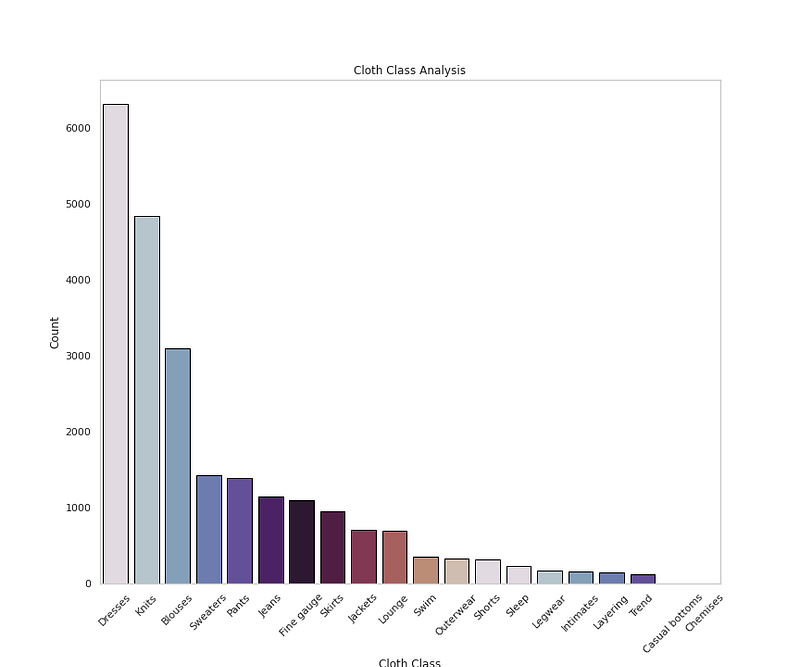
# Cloth Class Analysis by Ratingplt.figure(figsize=(22,12))
sns.countplot(x=df['Class Name'],data=df,palette=colors1,order=df['Class Name'].value_counts().index,edgecolor='black',linewidth=1,hue='Rating')
plt.xlabel('Cloth Class')
plt.ylabel('Count')
plt.xticks(rotation=45)
plt.title('Cloth Class Analysis by Ratings')
plt.grid(False)
plt.legend(loc='right')
plt.show()Output —
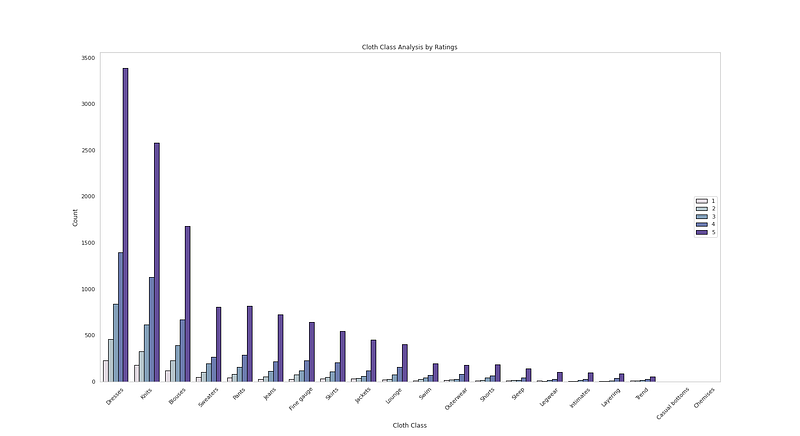
# Cloth Class Distributionplt.figure(figsize=(18,15))
plt.pie(x=df['Class Name'].value_counts().values,data=df,colors=colors1,labels=df['Class Name'].value_counts().index,autopct='%.0f%%',explode=[0.07 for i in df['Class Name'].value_counts().index],startangle=180,wedgeprops={'linewidth':0.8,'edgecolor':'black'})
plt.title('Cloth Class Distribution')
#plt.grid(False)
plt.legend(loc='lower left')plt.show()Output —
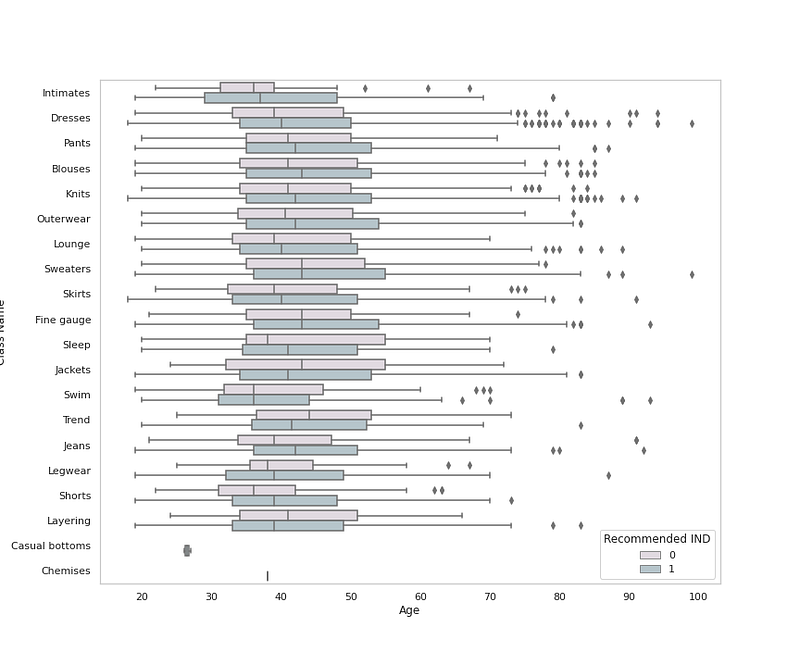
# Cloth Class by Age, Department and Recommendationplt.figure(figsize=(12,10))
sns.boxplot(x = 'Age', y = 'Class Name', data = df,palette=colors1,hue='Recommended IND')
plt.grid(False)
plt.title('Cloth Class by Age and Recommendation ')
plt.show()Output —
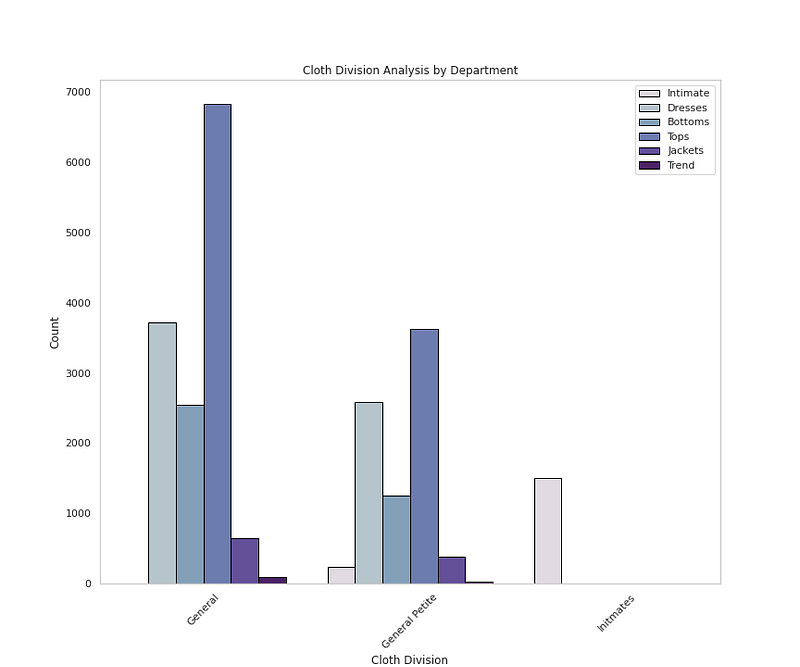
# Division Value Countsdf['Division Name'].value_counts()Output —
General           13839
General Petite     8110
Initmates          1502
Name: Division Name, dtype: int64
# Cloth Division Analysis by Departmentplt.figure(figsize=(12,10))
sns.countplot(x='Division Name',data=df,palette=colors1,order=df['Division Name'].value_counts().index,edgecolor='black',linewidth=1,hue='Department Name')
plt.xlabel('Cloth Division')
plt.ylabel('Count')
plt.xticks(rotation=45)
plt.title('Cloth Division Analysis by Department')
plt.grid(False)
plt.legend(loc='upper right')
plt.show()Output —
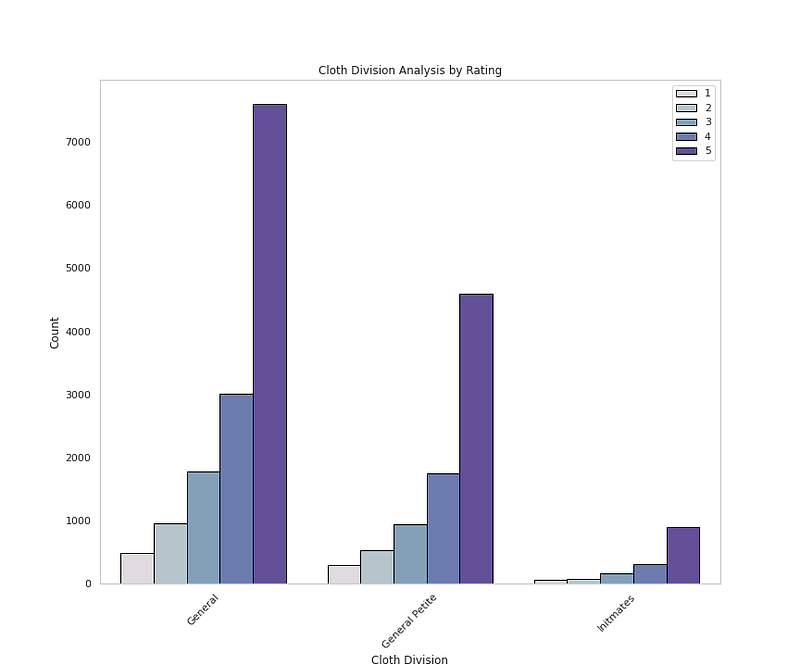
# Cloth Division by Ratingplt.figure(figsize=(12,10))
sns.countplot(x='Division Name',data=df,palette=colors1,order=df['Division Name'].value_counts().index,edgecolor='black',linewidth=1,hue='Rating')
plt.xlabel('Cloth Division')
plt.ylabel('Count')
plt.xticks(rotation=45)
plt.title('Cloth Division Analysis by Rating')
plt.grid(False)
plt.legend(loc='upper right')
plt.show()Output —
# Cloth Division Percentageplt.figure(figsize=(12,10))
plt.pie(x=df['Division Name'].value_counts().values,data=df,colors=colors1,labels=df['Division Name'].value_counts().index,autopct='%.0f%%',explode=[0.02 for i in df['Division Name'].value_counts().index],startangle=45,wedgeprops={'linewidth':0.8,'edgecolor':'black'})plt.title('Cloth Division Percentage')plt.legend()
plt.show()Output —
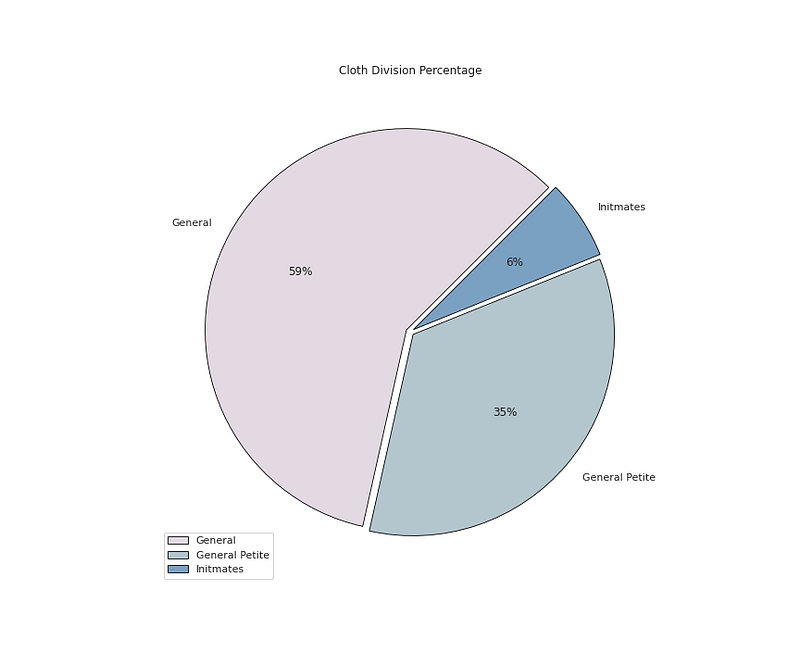
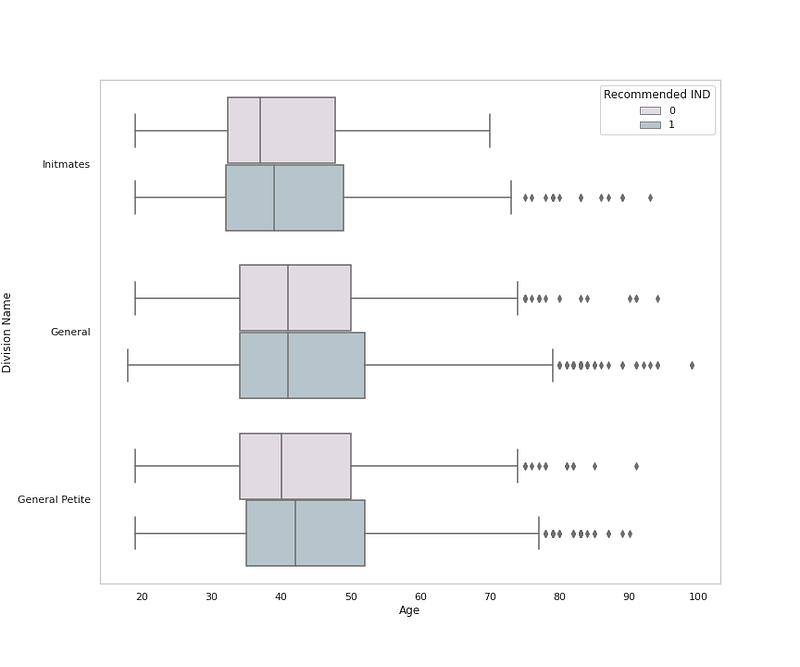
# Cloth Division Name by Ageplt.figure(figsize=(12,10))
sns.boxplot(x = 'Age', y = 'Division Name', data = df,palette=colors1,hue='Recommended IND')
plt.grid(False)
plt.title('Cloth Division by Age and Recommendation ')
plt.show()Output —
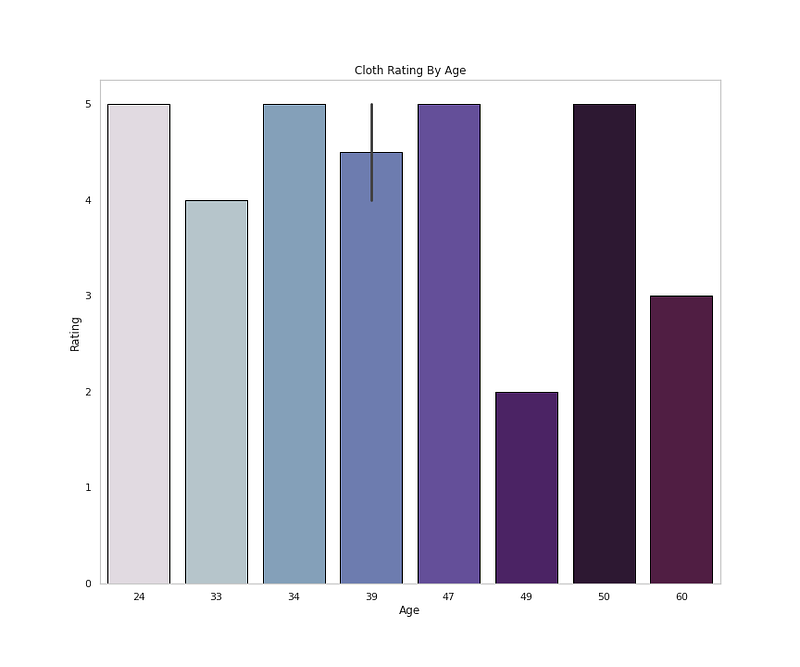
# Rating by Ageplt.figure(figsize=(12,10))
sns.barplot(x=df['Age'].head(10),y='Rating',data=df,palette=colors1,edgecolor='black',linewidth=1)
plt.title('Cloth Rating By Age')
plt.grid(False)
plt.show()Output —
# Rating Distributionplt.figure(figsize=(12,10))
sns.countplot(x='Rating',data=df,palette=colors1,order=df['Rating'].value_counts().index,edgecolor='black',linewidth=1)
plt.xlabel('Rating Class')
plt.ylabel('Count')plt.title('Rating Distribution')
plt.grid(False)plt.show()Output —
# Rating Percentageplt.figure(figsize=(12,10))
plt.pie(x=df['Rating'].value_counts().values,data=df,colors=colors1,labels=df['Rating'].value_counts().index,autopct='%.0f%%',explode=[0.02 for i in df['Rating'].value_counts().index],startangle=45,wedgeprops={'linewidth':0.8,'edgecolor':'black'})
plt.title('Rating Percentage')
plt.legend()
plt.show()
Output —
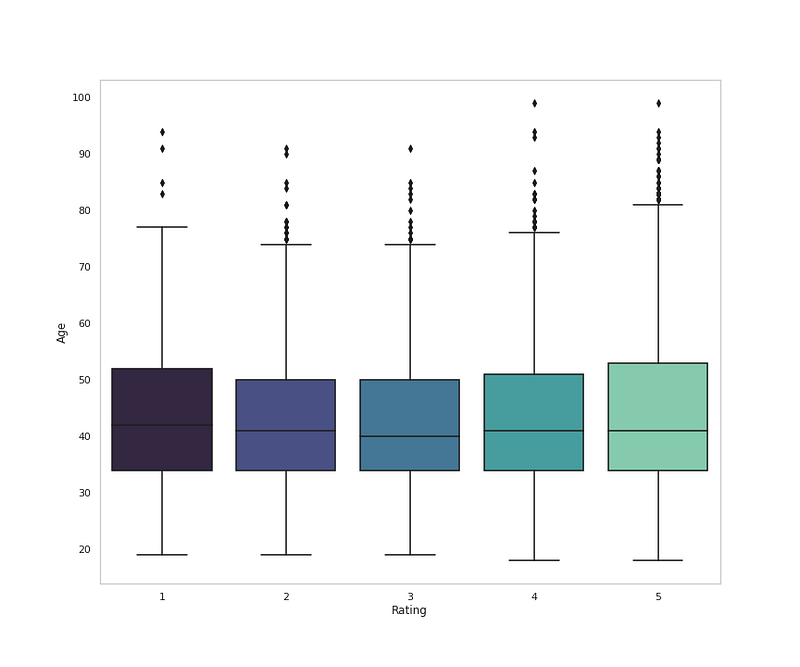
# Rating Distribution by Ageplt.figure(figsize=(12,10))
sns.boxplot(x = 'Rating', y = 'Age', data = df,palette='mako')
plt.grid(False)
plt.title('Rating Distribution by Age')
plt.show()Output —
Part 2 of this project : Coming soon!
Follow and Stay tuned.
For other projects, tune to —
Build Machine Learning Pipelines( With Code)
Recurrent Neural Network with Keras
Clustering Geolocation Data in Python using DBSCAN and K-Means
Facial Expression Recognition using Keras
Hyperparameter Tuning with Keras Tuner
Custom Layers in Keras
That’s it fellas. Peace out and keep coding :)
Stay Tuned and of-course let me end this post with a quote by Vincent Gogh
“The beginning is perhaps more difficult than anything else, but keep heart, it will turn out all right.”


