
Platform Genidentity: The Movements of Unfolding Uniqueness
Introducing the Platform Genidentity framework and toolkit for knowledge creators

In the past few years, I worked on the Ecological Practice approach which is a meta-theory. How did I connect it with Practice?
Basically, my strategy is One Year One Step. Each year, I write a book that focuses on one core concept of the approach. Each book is designed with a structure of “concept — framework — phenomenon”. This is the top-down approach.
I didn’t always follow this path. Sometimes, I work on projects first, then move to write a book or develop some new concepts and frameworks. This is the bottom-up approach.
- How did I choose a phenomenon for a concept in order to write a book?
- How did I choose a phenomenon for a project in order to conduct research?
- How did I choose a framework for a research project?
Actually, I didn’t have an ideal model to respond to these challenges. Sometimes it depended on “framed orientations” and “situational opportunities”.
This article aims to introduce the Platform Genidentity framework and considers Theory as a type of Developmental Platform.
I will use my theoretical projects such as “Curativity”, “Knowledge Curation”, “Platform Ecology”, and “Anticipatory Activity System (AAS)” as examples to develop the framework.
If you want to know more about my enterprises of knowledge, you can find detail in Meet with Oliver Ding: 1 Mission, 4 Theories, and 12 Possible Books.
1. Framed Orientations
The framed orientations refer to some directions framed by my theoretical concepts. For example, one task of the Ecological Practice approach is expanding Ecological Psychology from physical environments to digital environments. I applied the Ecological Physical Method to discuss Twitter, a digital platform, in June 2020.
However, I found the method too hard for ordinary readers to understand. Then, I moved to search for an ideal opportunity to showcase the concept of Affordance which is the core concept of Ecological Psychology. Also, my work on the Ecological Practice approach is not only about the concept of Affordance, but also about other theoretical concepts.
So, I decided to adopt a framework called Infoniche which is part of the Ecological Practice approach to discuss platforms. The result is the Platform-for-Development framework (v2.0) which was published on March 31, 2021.
2. Situational Opportunities
In April 2021, I realized that digital whiteboards are a perfect object for studying Affordance in digital environments. At that time, a friend of mine invited me to join a two-month online workshop program. I realized that was a perfect opportunity for testing the Platform-for-Development framework (v2.0). So, I started the Once Upon A Whiteboard project.
Then, I created several sub-projects for the Once Upon A Whiteboard project. One of these sub-projects is the D as Diagramming project which led to two books about diagrams and diagramming.
This is an example of “situational opportunities”.
In a recent article, I used “the Unfoldness of Activity” to discuss a similar experience from the perspective of the Anticipatory Activity System (AAS) framework and the AAS for Life Transitions (#AAS4LT) framework.
In fact, the AAS framework was an outcome of the unfolding of a Project Engagement.
Last April, I noticed that a friend of mine started an adult development program. In the beginning, I just gave feedback to her. She replied to me and we had several rounds of discussions. Eventually, I became an advisor to the program.
The insight of AAS was born from diving into the program. This is another example of “situational opportunities”. But the opportunity was not discovered immediately, it was unfolded from the process of Project Engagement which is a slow process.
3. The Network Effect of Discovery
The Once Upon A Whiteboard project started with a high-level idea without a clear goal, I follow the frame to focus my attention on relevant changes in my digital experience and discovered some insights. I used “sub-projects” to record these insights.
Since these insights connect to each other, there is a “potential project network.” These “sub-projects” are not real projects, but they form a meaningful whole for generating one or more real projects. Finally, I found a sub-project about diagramming really matches my passion for “diagramming and tacit knowledge”, then, the “potential project network” produced one real project.
At the end of the D as Diagramming project (phase I), I had to revisit my 2017 framework “Mind as Play” in order to make an integrated framework for understanding Diagramming as Practice. I used the “Mind as Play” framework to curate theoretical knowledge I learned after 2017 such as Activity Theory. The task curated my various psychological knowledge into a meaningful framework.
The by-product of the task is a new model of Knowledge Curation and a new canvas.
Later, I changed the name of the item for the model and its canvas. The renaming action led to a new project and a new canvas: Thematic Space Canvas. Then, it led to a new possible book Knowledge Discovery: Developing Tacit Knowledge with Thematic Space Canvas.
This is an example of “Network Effect of Discovery” because I always work with a project network. Each real project is born from a project network, and they also expand the original project network.
Eventually, the project network creates its own uniqueness.
4. The Concept of Genidentity
In an article about my “center” thematic space, I introduced the notion of “Platform Genidentity”. Today I’d like to use it to discuss the above experience.
The Platform Genidentity Framework is an application of the Ecological Practice Approach. Why do I consider the concept of “Genidentity” as a member of the approach?
The diagram below is the basic model of the approach. However, The Ecological Practice Approach considers the world as a nested container system. Things move between different containers.
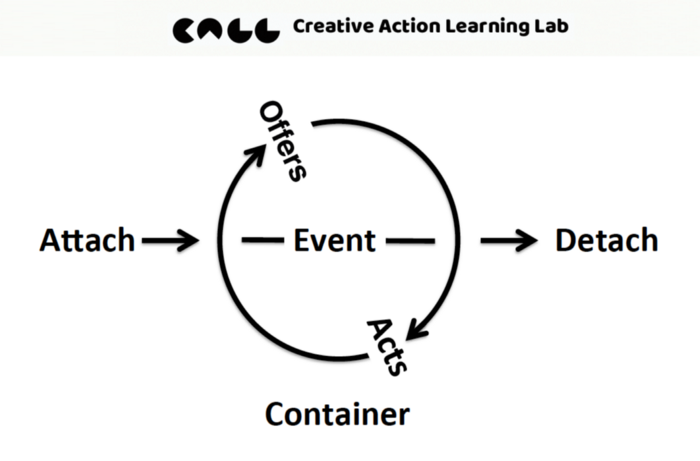
For a particular thing, its trajectory is called “Lifeflow”. There is a theoretical issue with Lifeflow:
How can a thing keep its uniqueness over time?
In order to answer this question, I adopted Kurt Lewin’s concept Genidentity as a solution.
What’s Genidentity? Let’s quote a short piece from Wikipedia:
- As introduced by Kurt Lewin, genidentity is an existential relationship underlying the genesis of an object from one moment to the next.
- What we usually consider to be an object really consists of multiple entities, which are the phases of the object at various times. Two objects are not identical because they have the same properties in common, but because one has developed from the other.
- Lewin introduced the concept in his 1922 Habilitationsschrift Der Begriff der Genese in Physik, Biologie und Entwicklungsgeschichte. It is today perhaps the only surviving evidence of Lewin’s influence on the philosophy of science. However, this concept never became an object of widespread discussion and debate in its own terms. Rather, it was extracted from its context by philosophers such as Rudolf Carnap, Hans Hermes, Hans Reichenbach, Adolph Grünbaum, and Bas van Fraassen who incorporated this concept into their own theories such as the topology of the universe or the axiomatization of mechanics.
- Lewin’s idea was to compare and contrast the concept of genidentity in various branches of science, thereby laying bare the characteristic structure of each and making their classification possible in the first place.
Though Genidentity was originally developed for discussing the difference between various branches of science and their dynamic development, it is about a “topology of identity” and temporal dynamics from my perspective.
I developed an operational definition for the concept of Genidentity: A thing’s Genidentity is defined by Essential Differences with Situated Dynamics. In this way, we turn a philosophical concept into a practical concept for empirical research.
Now we can use “Essential Differences” and “Situated Dynamics” to reflect on the above story.
- Essential Differences: It refers to “Framed Orientations”
- Situated Dynamics: It refers to “Situational Opportunities”
Why did I use “Framed Orientations” to develop some new projects? Because I want to maintain the essential differences of my theoretical approach.
Why did I attract to “Situational Opportunities” for some new projects? Because I have to adapt to situated dynamics and find opportunities from the change in my environments.
5. The Platform Genidentity Framework
In 2019, I worked on the early version of Platform Ecology and applied the concept of Genidentity to study digital platform design and development.
I used the diagram below to represent a rough idea of the “Platform Genidentity” framework.
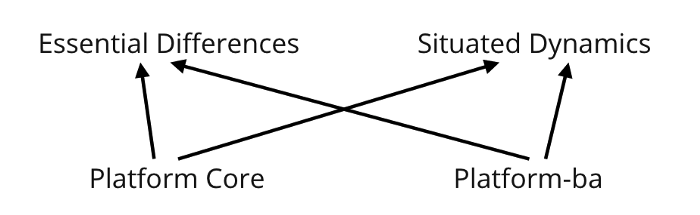
What’s Platform Genidentity? I use the concept of Platform Genidentity to describe a process of keeping the uniqueness of a platform within a long-term duration. For example, Google.com (a Search Engine), Wikipedia.org, YouTube.com, these three websites keep their original core design without major changes.
In order to understand the complexity of Platform Genidentity, I developed the following two new concepts:
- Platform Core: a basic unit of a platform. For example, a Tweet, a YouTube video page, a Q&A page on Quora, etc.
- Platform-ba: a platform-based sociocultural field. For example, YouTube-ba is a YouTube-based sociocultural space. You can find more details here.
As mentioned above, we have an operational definition of the concept of Genidentity: A thing’s Genidentity is defined by Essential Differences with Situated Dynamics.
For Platform Ecology, we need to discover the sources of Essential Differences and Situated Dynamics. I think the sources are Platform Core and Platform-ba. However, they don’t work as a one-to-one mapping relationship. See the above diagram.
Finally, we need to add “Platform” back to the framework. The whole structure is a nested whole.
- Platform-ba [Platform (Platform-core)]
This structure of Platform-ba can be understood as the following model:
- Platform-ba{Project [Zone (People)]} which is the focus of the Platform-for-Development framework.
Since the Platform Genidentity Framework focuses on the perspective of platform owners, we will pay attention to the relationship between Platform-core, Platform, and Platform-ba.
6. Theory as Developmental Platform
The concept of “Developmental Platform” was developed for the Platform-for-Development framework in Feb 2021. See the diagram below.
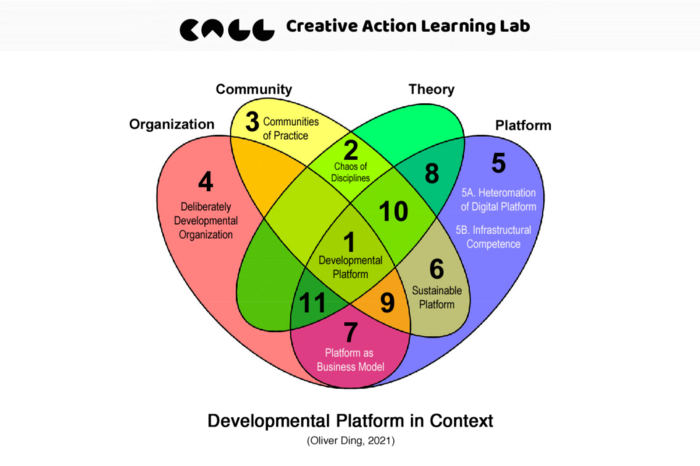
As an interdisciplinary concept, the term Developmental Platform refers to a social environment that could strongly support adult development in various ways. There are three keywords in this definition:
- social environment
- strongly support
- adult development
The term “social environment” is a rough term. It can refer to traditional social structures such as organization and community. I also consider emergent social contexts such as digital platforms as social environments.
The term “strongly support” divides social environments into two groups from the perspective of strongness. Any social environment could support people, however, there are only a few social environments that could strongly support people. Thus, we can consider some strong social environments as platforms.
The term “adult development” is a solid term in developmental science. According to Wikipedia, “Adult development encompasses the changes that occur in biological and psychological domains of human life from the end of adolescence until the end of one’s life. These changes may be gradual or rapid and can reflect positive, negative, or no change from previous levels of functioning.” Thus, the Developmental Platform highlights the perspective of developmental science.
I consider Theory as a type of developmental platform. For example, Activity Theory is an established theoretical tradition that supports some scholars’ career development.
We can understand it from the perspective of Platform-core and Platform-ba.
- Platform-core: The theoretical uniqueness of Activity Theory
- Platform-ba: The knowledge community of Activity Theory
In the past three years, I worked on the Activity U project which is a knowledge curation project about Activity Theory. The project is a Developmental Project for me.
- Developmental Platform (Developmental Project)
The above Platform(Project) model is a basic model of the Platform-for-Development framework. From the perspective of Platform Development, the Developmental Project is a way of growing the Platform-ba.
7. Starting from a Platform-core
While the Platform-for-Development framework considers the perspective of individual adult development, the Platform Genidentity framework focuses on the perspective of platform creators.
Now we can consider the Ecological Practice Approach as a Possible Developmental Platform which means that it could grow into a Developmental Platform for others. However, it is just an individual project.
The next step is building a knowledge center for the Ecological Practice approach.
What’s a knowledge center?
As mentioned in Mapping Thematic Space #4: The “Center” Thematic Space, the term “Knowledge Center” refers to a Double-theme theme. For me, it means a center for developing a certain knowledge.
A “center” should have its own uniqueness in order to establish its identity and theme. Otherwise, there is no need to build a “center”.
Does the Ecological Practice Approach have its uniqueness? Can we identify the Platform-core of the possible developmental platform?
We can find the answer from the diagram below which is the basic model of the Ecological Practice Approach.
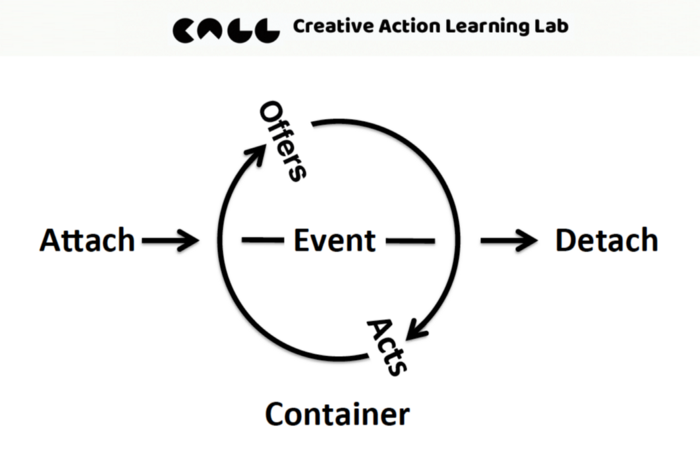
In 2020, I developed the above diagram to represent the germ-cell of the Ecological Practice approach.
According to Andy Blunden (2017), “The idea of the ‘cell’ originates with the philosopher of history, Johann Gottfried Herder (1744–1803). In his effort to understand the differences between peoples, Herder introduced the idea of a Schwerpunkt (‘strong point’)…Herder’s friend, Johann Wolfgang von Goethe (1749–1832), sought to utilize this idea in his study of botany during his Italian journey in 1786, to understand the continuity and differences between the plants found in different parts of the country. Goethe came to the idea of an Urphänomen ‒ not a law or principle, but a simple, archetypal phenomenon in which all the essential features of a whole complex process are manifested.”
A Germ Cell of a theoretical approach is its smallest entity which can represent the whole of thinking in different levels of analysis.
The above diagram combines three core concepts of the Ecological Practice approach together: Affordance, Attachance, and Containance. The term “Offers” is an affordance-inspired concept, it refers to opportunities afforded by the Container. The group of “Offer — Act” forms “Event” which changes the status of the Container. The new status of the Container affords new opportunities which guide the new acts and events. In a broad sense, the Ecological Practice approach has its philosophical roots in traditional Pragmatism and contemporary embodied cognitive science.
8. Objectification of Platform-core
A Platform-core is an untouchable thing. The movements of Objectification of Platform-core aim to make things that touchable. In other words, while Platform-core is an internal product, Platform is the final product for end-users.
In fact, a Platform-core can be understood as a Concept. Now we can adopt Project-oriented Activity Theory to understand the movements of Objectification.
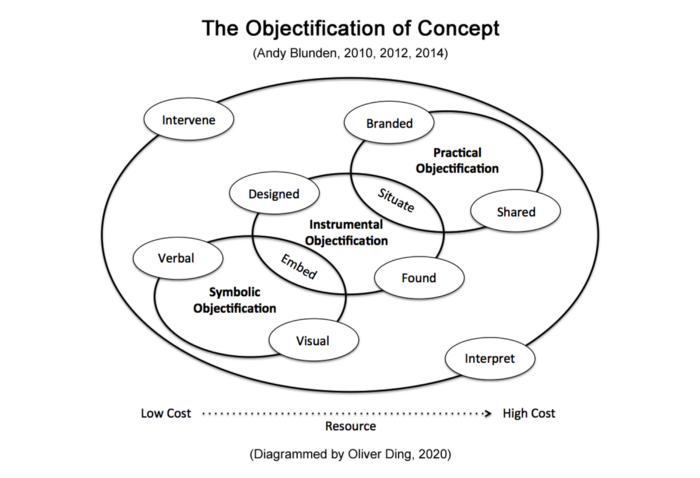
The above diagram is a model of Project-oriented Activity Theory. It represents three types of objectification of a concept:
- Symbolic Objectification: “Verbal” and “Visual”
- Instrumental Objectification: “designed” and “found”
- Practical Objectification: “Branded” and “Shared”
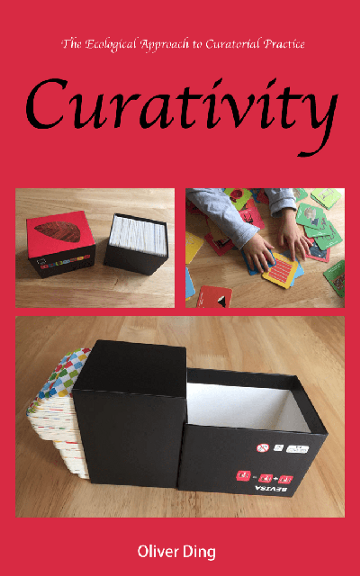
For example, one core concept of the Ecological Practice Approach is Curativity which was coined in my 2019 book Curativity: The Ecological Approach to General Curation Practice. The picture below is the cover of the book. It’s a symbolic objectification of the concept of Curativity.
In the past three years, I applied Curativity Theory to the Knowledge Curation project and developed a series of tools such as the HERO U framework, the model of Knowledge Curation and its canvas, the Knowledge Discovery Canvas, etc.
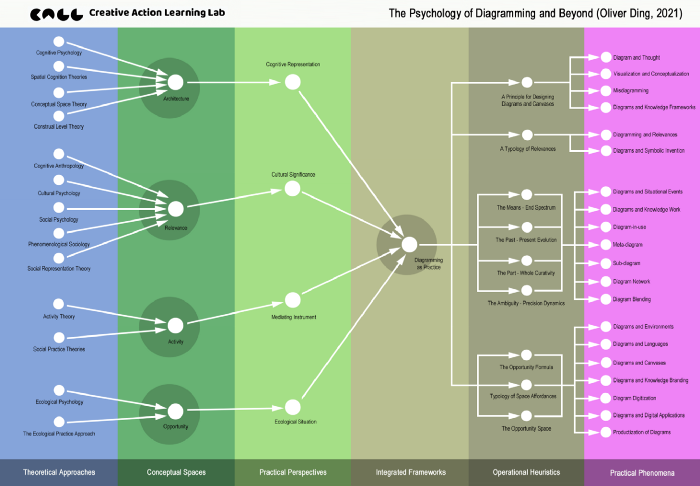
The above picture is the Knowledge Curation Canvas which uses six columns to display six types of Objects for Curating. The content of the canvas is adopted from the Diagramming as Practice framework. You can find more details here.
This is an example of Instrumental objectification of the concept of “Knowledge Curation” which is an application of “Curativity”.
Another example of Instrumental objectification is the Thematic Space Canvas which is designed for “the Objective — Subjective Knowledge Curation”.
In the past four months, I did several things with the Thematic Space Canvas. For example, I run the first Thematic Spirit with a friend on March 19, 2022. The diagram below represents the landscape of my practice around the theme of “Tacit Knowledge” and the concept of “Thematic space”. These two ideas are related to “the Objective — Subjective Knowledge Curation”.
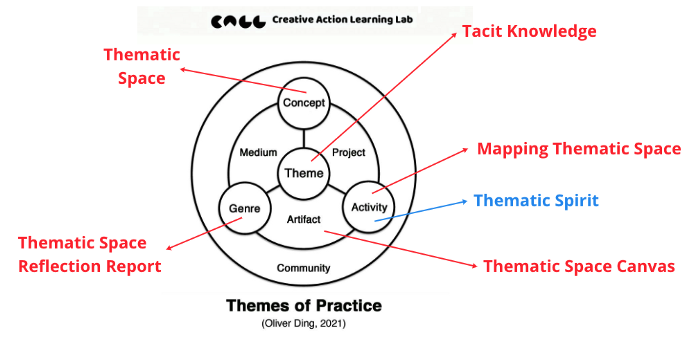
This is an example of Practical objectification of the concept of Knowledge Curation and the concept of Thematic Spaces.
We can also find some examples of objectification from the D as Diagramming project. The logo below of the project refers to symbolic objectification. I also defined a series of new terms such as Meta-diagram, Diagram Blending, Diagram Network, Diagram Notation, Sub-diagrams, etc. These are examples of symbolic objectification too.
I also designed a set of Meta-diagrams. Some meta-diagrams were designed years ago, others were designed recently. The picture below is an updated version of my diagrams.
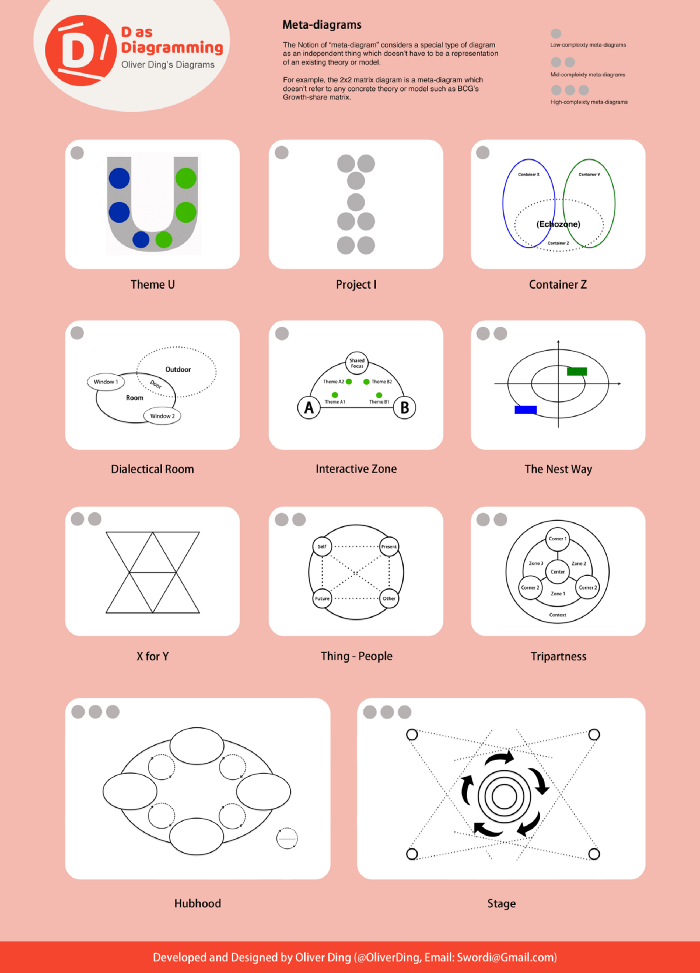
This set of meta-diagram is the Instrumental objectification of the concept of meta-diagrams and the concept of diagram networks.
So far, only one person has practiced the Diagram Blending practice. I’d like to say this is a possible social practice. If more and more people accept the idea and practice it in their real-life world, then it could grow into real social practice.
You can find more details about the objectification of a concept from Activity U (VIIII): Project-oriented Activity Theory.
9. Construal Levels of Platform Objectification
There is another tool that is really useful to design projects of Platform Objectification which refers to the movements of Objectification of Platform-core.
Construal level theory (CLT) is a social psychology theory that describes the relationship between psychological distance and the extent to which people’s thinking is abstract or concrete.
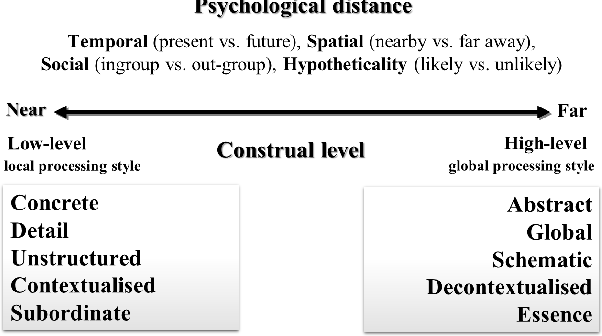
Yaacov Trope and Nira Liberman pointed out in their article Construal-Level Theory of Psychological Distance, “According to CLT, then, people traverse different psychological distances by using similar mental construal processes. Because the various distances have the same egocentric reference point, they should all be cognitively related to each other and similarly affect and be affected by level of construal. As psychological distance increases, construals would become more abstract, and as level of abstraction increases, so too would the psychological distances people envisage. Construal levels thus expand and contract one’s mental horizon.”
Sometimes, a Platform-core is a high-level thing. The challenge of Platform Objectification is to design low-level things for end-users. Thus, we need to design a strategy that can push Platform Objectification from a high-level construal level to a low-level construal level. Each time, we need to choose target audiences for Platform Objectification and make suitable things.
The Ecological Practice Approach is a meta-theory that is located at the high construal level. I used the HERO U framework to manage the Platform Objectification of the approach. See the diagram below:
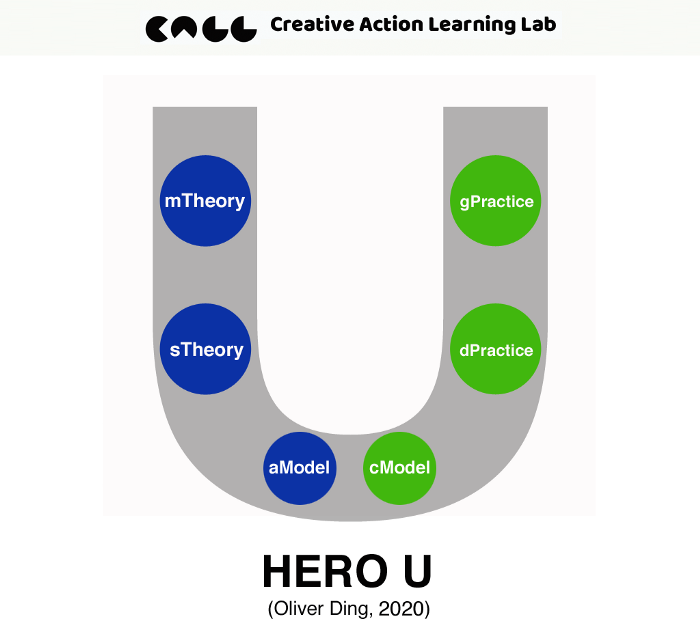
The about diagram looks like a pipeline and balls. It presents six types of “Objective of Knowing”. Let’s look at the terms I used for the diagram.
mTheory: Meta-theory sTheory: Specific Theory aModel: Abstract Model cModel: Concrete Model dPractice: Domain Practice gPractice: General Practice
For example, the diagram below is called “Activity U” which represents the landscape of Activity Theory with the HERO U diagram.
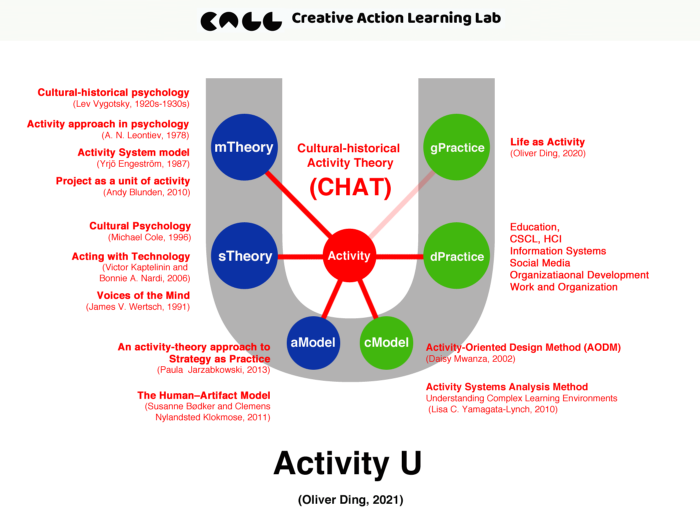
You can find more details about the HERO U diagram here and the landscape of Activity Theory here.
How do we use it to manage Platform Objectification? The diagram below is the landscape of the Platform Ecology project which is an application of the Ecological Practice Approach. You can find more details here.
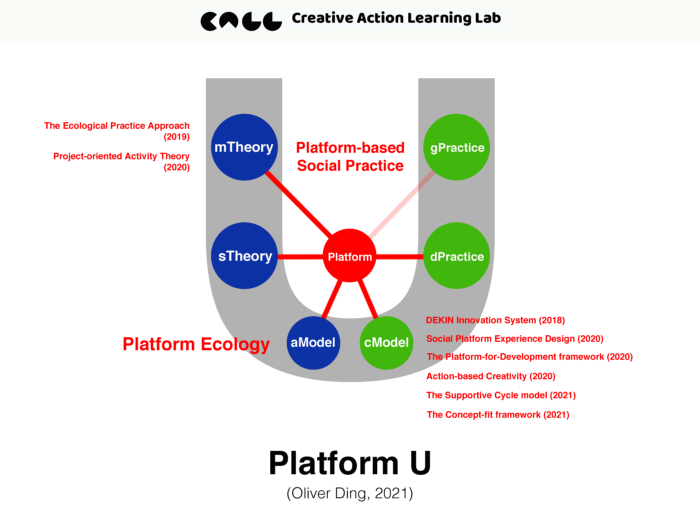
Another example is the Anticipatory Activity System (AAS) framework:
- Meta-theory: Activity Theory and Anticipatory System Theory
- Specific Theory: Anticipatory Activity System (AAS)
- Abstract Model: The AAS framework
- Concrete Model: The AAS4LT framework
- Domain Practice: The AAS4LT 1:1 life coaching program
- General Practice: Life Development
You can find more details about the AAS framework here.
10. Curating Platform-based Projects
Now we have two models:
- The Movements of Objectification of Platform-core (Three types)
- Construal Levels of Platform Objectification (Six levels)
If we combine these two together, we can generate a 3x6 matrix. This is our strategic map for curating Platform-based Projects.
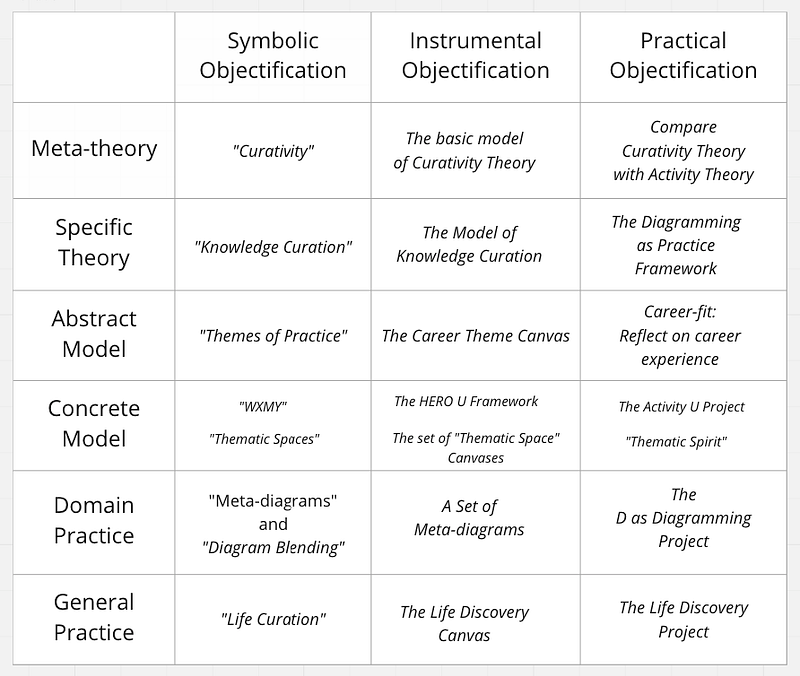
The above chart is an example of the Platform Genidentity Matrix. I use “Curativity” as an example of the meta-theory. Though the concept of “Curativity” is a member of the Ecological Practice Approach, it led to a series of projects such as the Knowlege Curation project, the Life Curation project, and the Career Curation project. My “Curativity” thematic space became a large knowledge enterprise.
Last month, I started building the “Curativity Center” on Milanote. See the screenshot below.
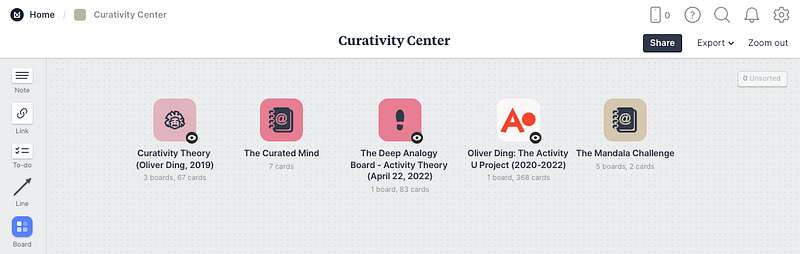
On May 17, 2022), I edited a Table of Contents for a possible book: Ecological Practice Design: The Lifesystem Approach to Everyday Life Innovation.
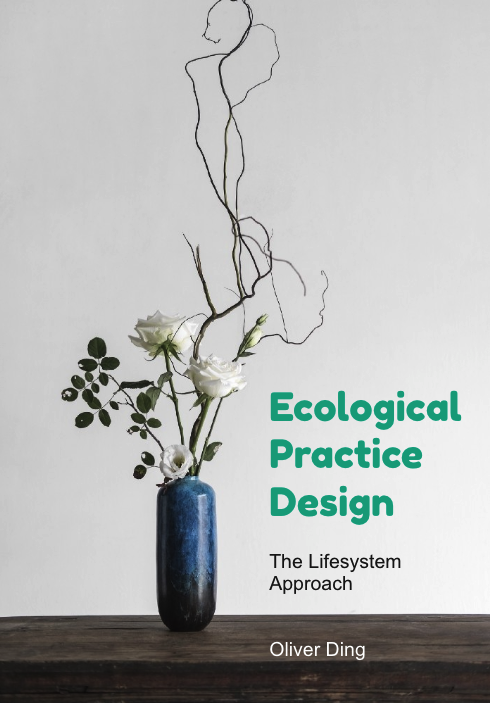
The book aims to connect the Ecological Practice Approach with the field of Design and Innovation. I selected the Lifesystem Framework as a connected hub for this task.
It is also pointing to a new knowledge center: Lifesystem Center.
As mentioned above, the Platform Genidentity Matrix is our strategic map for curating Platform-based Projects. Now we have an instrument to deal with “Situated Dynamics”.
The changes in environments will bring us “Situated Dynamics” which refers to potential action opportunities. We perceive opportunities and select some opportunities for our next actions.
How do we select them? While the Platform-core determines the vision and direction, the Platform Genidentity Matrix offers a map for our decision-making for growing the Platform with concrete actions.
11. Building A Platform-ba with “Service Thinking”
The biggest challenge is building a Platform-ba which refers to a Knowledge Community for the present discussion.
There are two models are related to this challenge. One is “Service Thinking” and the other one is the DEEP framework.
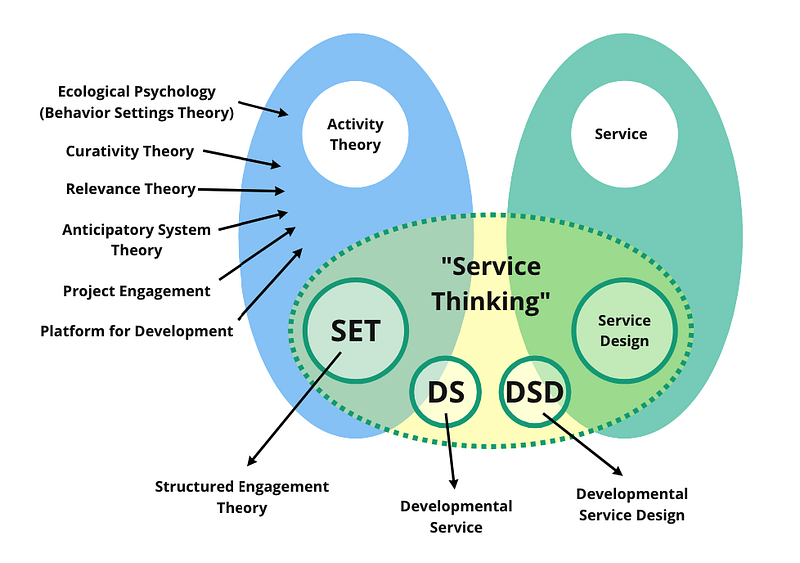
The above diagram is about the notion of “Service Thinking”. It offers several ideas:
- SET: Structured Engagement Theory
- DS: Developmental Service
- DSD: Developmental Service Design
- SD: Service Design
The notion of “Developmental Service” refers to a special type of service such as educational services, summer camps, adult life development programs, life discovery activities, etc. This is a perfect idea for building a knowledge community.
The SET Framework was originally named the Ecological—Activity Hybrid Approach. It was developed from 2017 to 2020 when I worked on several projects which refer to a new type of social action platform. In 2021, I used the SET framework to study Digital Whiteboard Platforms. I recently used the SET framework to study an adult developmental program.
For building a knowledge community, the SET framework is a useful framework for the research and design of Developmental Service programs. You can find more details here.
Finally, we are going to meet with the DEEP framework. See the diagram below.
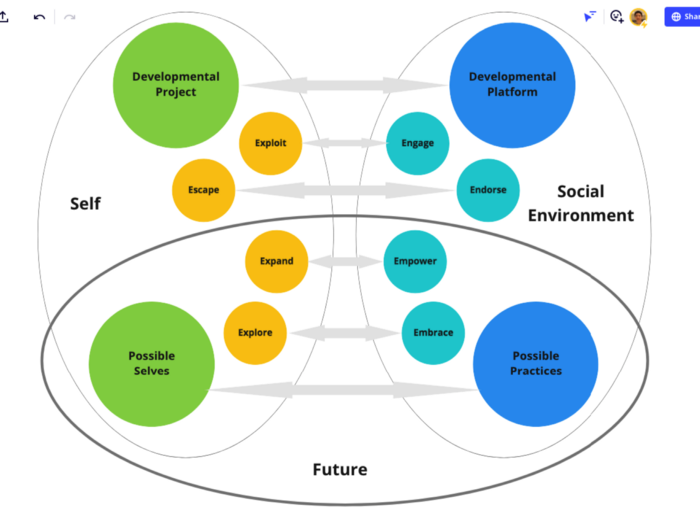
The above framework connects “Self” and “Social Environment” from the perspective of a shared “Future”. For “Self”, the key is “Developmental Projects” while the key is “Developmental Platforms” for “social environment”.
I identified the following four movements for discussion:
- The Exploit — Engage movement
- The Escape — Endorse movement
- The Expand — Empower movement
- The Explore — Embrace movement
Here I use “movement” to refer to an ideal social interactive situation between Self and Social Environment. Each movement is formed with a Challenge and a Response. For example, a person takes a step to escape from a task on the platform or leaves the platform. For the platform, this action means a Challenge. Ideally, the person expects a supportive response from the platform. For example, the platform responds to the Challenge with an endorsement that highlights the person’s contribution and achievement.
I roughly listed the above four ideal movements. It’s possible to discover more than four movements. Of course, a person can’t always receive supportive responses from his social environment. I just select the ideal situation for our discussion.
You can find more details about the DEEP framework here.
Conclusion
The above discussion introduces the Platform Genidentity Framework and related frameworks. We can call it a toolkit.
The concept of “Platform Genidentity” aims to understand the process of keeping the uniqueness of a platform within a long-term duration. The framework is formed with the following concepts:
- Platform
- Platform-core
- Platform-ba
- Genidentity
- Essential Differences
- Situated Dynamics
The basic model of the Platform Genidentity is represented with the following diagram:
The Platform Genidentity Toolkit considers the following tools for practical work.
Platform Genidentity Matrix:
- The Movements of Objectification of Platform-core (Three types)
- Construal Levels of Platform Objectification (Six levels)
Platform-based Service:
- The SET Framework
- The DEEP Framework
Though the above discussion uses Theory as a type of Developmental Platform, the logic behind the framework and toolkit can be applied to other types of Developmental platforms.
Related Articles
- CALL: Annual Review (2020–2021)
- CALL: How to Grow A Knowledge Enterprise
- Meet with Oliver Ding: 1 Mission, 4 Theories, and 12 Possible Books
- Platform for Development (2.0)
I am also working on building a new website for the Platform Ecology project. You can save the following links:
- PlatformEcology.org
- Twitter: @PlatformEcology
- Linkedin: @PlatformEcology
You are most welcome to connect via the following social platforms:
Linkedin: https://www.linkedin.com/in/oliverding Twitter: https://twitter.com/oliverding Polywork: https://www.polywork.com/oliverding Boardle: https://www.boardle.io/users/oliver-ding


