avatarDesiree Driesenaar

Free AI web copilot to create summaries, insights and extended knowledge, download it at here

6810

Abstract

GNg.jpeg)"></div> </div> </div> </a> </div><p id="c186">People are working on this! We need to see the problems in relation to one another before we can weigh any solutions and make wise choices. I don’t have all the answers, but let’s discuss and weigh…</p><p id="2fa3">And one advice: stop the tunnel vision! We have killed many technologies that could have saved us (car on water, free energy out of the air, etc.) just because of their threats to the status quo. Let’s look past that now. The urgency is too big not to…</p><p id="bcce"><b>Systemic thinking is key here!</b></p><p id="808d">And don’t think systemic thinking is too complicated. I agree it’s not linear. It requires a different approach. But complicated? No. The more radical choices we dare to make on what we really want from life, the easier it gets.</p><p id="dd94">It’s a matter of phasing-out what we don’t want. And stimulating what we do want. Step by step, day by day. Every step a foundation for the next one.</p><p id="5cf3" type="7">“Any intelligent fool can make things bigger, more complex, and more violent. It takes a touch of genius — and a lot of courage — to move in the opposite direction.” ― E.F. Schumacher</p><p id="e5c4">Okay, on to solutions now. What are the steps to be taken?</p><ul><li>Look at the problems in connection with each other</li><li>Find nature-based solutions that solve several of these problems and not cause damage in other areas</li><li>Prioritize the solutions for minimum effort, maximum impact</li><li>Go for a diversity of flexible solutions, depending on the local situation</li><li>Choose combinations of solutions with short term benefits (people can see those) and long term impact</li></ul><p id="1818">To move from abstract theory to practical application, let’s look at a real-life example.</p><p id="da70">In my country, the Netherlands, our government tried to find shortcut ways to deal with <a href="https://www.usgs.gov/special-topic/water-science-school/science/nitrogen-and-water?qt-science_center_objects=0#qt-science_center_objects">nitrogen-levels</a> and <a href="https://www.rivm.nl/en/pfas">PFAS</a>, the ‘forever chemicals’ that are found in too high quantities in our soil. The court of justice, however, told them off.</p><p id="e169">As a result, at the end of 2019, our government was forced to stop many building permits and farmer expansions. <a href="https://en.wikipedia.org/wiki/Dutch_farmers_protests">Farmers</a> and builders were protesting fiercely in The Hague.</p><p id="3228">And let’s be realistic. That fear is very valid. The farmers’ anger is valid. They see their jobs change and don’t know what the future will bring. The picture at the top says: <b>‘Papa can I still become a farmer?’</b></p><p id="53d8">Children ask these kinds of questions and what can we answer? People just cannot live with long term catastrophes in mind without becoming paralyzed, fearful, angry… We don’t want to feel guilty every day. Who can blame us? I certainly won’t.</p><p id="d5a3">So what can be solutions then? We have to look at connecting factors to find them. What is one big connecting factor here?</p><p id="69a0">Nitrogen is in the <i>soil</i>, leaking into our water. PFAS is in the <i>soil</i>. And CO2 can be absorbed by <i>healthy soil</i>. So the way I see it, <i>the soil</i> is one of the big connecting factors that would be somewhere on the top of the list in terms of solutions.</p><p id="320a">I wrote about how it can halt climate change for 20 years while we work on other nature-based solutions.</p><div id="0898" class="link-block"> <a href="https://readmedium.com/the-solution-to-halt-climate-change-for-20-years-is-available-706665159005"> <div> <div> <h2>The Solution to Halt Climate Change for 20 Years is Available</h2> <div><h3>So let’s get on with it!</h3></div> <div><p>medium.com</p></div> </div> <div> <div style="background-image: url(https://miro.readmedium.com/v2/resize:fit:320/1*Rqll_1mWhiqzaAOWV8nOcw.jpeg)"></div> </div> </div> </a> </div><p id="8e7b">So what can we do to better the situation long term?</p><ul><li>First of all, make a <b>long term vision</b> of how to align people’s real priorities (health, love, basic needs) and the planet. And present it in such a way that people understand where we are going and why. The vision should have more than just money-driven values in it. We are no <a href="https://www.investopedia.com/terms/h/homoeconomicus.asp">homo economicus</a>. We are not just rational beings, we have hearts… So lots of attention to clean water, clean air, food, health, and well-being</li><li>Put your money where your mouth is. That means: <b>governments</b> should make laws to stop damaging technologies, such as PFAS. Stop subsidizing damaging technologies that do not go into the direction wanted. Give subsidies only as a stimulant, empowering those who go in the right direction</li><li>Start a big program on innovation with <a href="https://readmedium.com/technology-a-different-view-e122a83ec111">nature-based</a> and <a href="https://readmedium.com/teaching-about-nature-has-many-faces-dont-limit-it-to-biology-45fcc059c1cc">nature-inspired</a> technologies. <b>Entrepreneurs</b>, here is the role for you! You can be the changemakers having a fulfilling life in your business. Creating jobs, while changing the world with the great new technologies we need</li><li>And the role of <b>individuals</b> is to become active in their own neighborhoods. Build your communities! Find diversity in your teams and complement each other in achieving a goal. And spend your money just on the things you really love. Put your money where your heart is…</li></ul><p id="8bd1">In this specific case of nitrogen and PFAS, actions can be:</p><ul><li>Phase-out damaging technologies, such as PFAS, and invest in the technologies of the future instead</li><li>Use farmer subsidies to help them transition away from chemical fertilizers and pesticides and towards healthy soil to prevent nitrogen flushing out and store carbon in the soil</li><li>Stimulate the building sector towards <a href="https://healthybuildingnetwork.com/">healthy buildings</a>. Use local, abundantly available materials, and creative building methods</li><li>Use spaces in cities to dense the urban environment in a smart way. This way we do not have to build on soil and still find ways to solve the housing crisis. <a href="http://www.arievoorburg.com/">Arie Voorburg </a>has done some great projects in this field</li><li>At the same time, use all wasteland areas in cities and business areas to regenerate t

Options

he soil and plant <a href="https://permaculturenews.org/2011/10/21/why-food-forests/">food forest</a> or temporary food/nature projects among the buildings</li><li>Start a dialogue about <a href="https://www.becomingminimalist.com/what-is-minimalism/">minimalism</a> and choosing what is really important in your life. Let’s not create buildings just for storing stuff or boosting egos, but build for housing LIFE instead…</li></ul><p id="7f4c">One big aspect here is that we should please be kind to each other. Let’s <b>inspire</b> instead of being self-righteous and judgmental. There is not just one right way. There is a broad path of possibilities. Big opportunities for <a href="https://www.fritjofcapra.net/qualitative-growth/">qualitative growth</a> even. And if we think the economy will not flourish this way. <a href="https://readmedium.com/how-to-build-a-strong-island-economy-without-mass-tourism-7c2401930b28">Think again!</a></p><p id="82f5"><b>Let’s explore.</b> Let’s see the path as one big experiment. We cannot fail, we can only go forward. Let’s take flexible steps that can change again when needed. Let’s not put ourselves in the next technological lock-ins.</p><p id="5861">Life is about change. Let’s try things. Let’s motivate each other. And let’s have lots of fun in the process!</p><p id="6042">Some suggestions for the technologies of the future? Well, we can start to look at the 100 technologies Project Drawdown identified.</p><div id="57e7" class="link-block"> <a href="https://www.drawdown.org/"> <div> <div> <h2>Drawdown</h2> <div><h3>Project Drawdown is the most comprehensive plan ever proposed to reverse global warming. We gathered a qualified and…</h3></div> <div><p>www.drawdown.org</p></div> </div> <div> <div style="background-image: url(https://miro.readmedium.com/v2/resize:fit:320/0*BBinY5Ki68QEt728)"></div> </div> </div> </a> </div><p id="ac4e">We can also look at <a href="https://amp-theguardian-com.cdn.ampproject.org/c/s/amp.theguardian.com/cities/2020/jan/15/the-case-for-making-low-tech-dumb-cities-instead-of-smart-ones">this article in the Guardian</a>, where many technologies for the built environment are mentioned. There are really inspiring things going on in the world! And as said, there are hundreds of nature-based technologies for the built environment that have not been explored yet.</p><p id="c5af">Personally, I think that the only way to go to align people and the planet is to look for nature-based solutions. The principles of <a href="https://www.theblueeconomy.org/">the Blue Economy</a> are very helpful to identify what is really bringing us forward and what isn’t. Let’s go for <i>fully biodegradable, it’s just a matter of time</i>. And for <i>local, abundantly available resources</i>. And for <i>temperature and pressure as found on site</i>.</p><div id="58ea" class="link-block"> <a href="https://www.theblueeconomy.org/principles.html"> <div> <div> <h2>Principles</h2> <div><h3> s Zeri´s philosophy in action. Is where the best for health and the environment is cheapest and the necessities for…</h3></div> <div><p>www.theblueeconomy.org</p></div> </div> <div> <div style="background-image: url(https://miro.readmedium.com/v2/resize:fit:320/0*ygSmq7aS1uXpvD5t)"></div> </div> </div> </a> </div><p id="c636">Let’s invest all our efforts in <b>physics, biology and green chemistry</b> and combinations of all three.</p><p id="a227">Now, we invest in many projects that kill the planet, let’s instead invest in projects that will help us stay within planetary boundaries. No subsidies for anything else and lots of job creation in these sectors…</p><p id="3def">But for the time being, we are not there yet. Lots of people cannot see the bigger picture yet, so I agree with economist Angela Francis that we should not try to get these problems to the top of everyone's list. We should show that we actually improve everyday lives by making the right decisions.</p> <figure id="b271"> <div> <div> <img class="ratio" src="http://placehold.it/16x9"> <iframe class="" src="https://cdn.embedly.com/widgets/media.html?src=https%3A%2F%2Fwww.youtube.com%2Fembed%2Fvk7zXHE4kzA%3Ffeature%3Doembed&amp;url=https%3A%2F%2Fwww.youtube.com%2Fwatch%3Fv%3Dvk7zXHE4kzA&amp;image=https%3A%2F%2Fi.ytimg.com%2Fvi%2Fvk7zXHE4kzA%2Fhqdefault.jpg&amp;key=a19fcc184b9711e1b4764040d3dc5c07&amp;type=text%2Fhtml&amp;schema=youtube" allowfullscreen="" frameborder="0" height="480" width="854"> </div> </div> </figure></iframe></div></div></figure><p id="c2a6"><i>‘It’s not so simple.’</i> But we can definitely make it understandable, choose what is important in our lives and take action.</p><p id="18f6">And if you want to connect or discuss, you can always find me on <a href="https://www.linkedin.com/in/desireedriesenaar/">LinkedIn</a>, <a href="https://www.facebook.com/desiree.driesenaar">Facebook</a> or somewhere enjoying nature’s vast intelligence…</p><h2 id="bc6b">More reading</h2><div id="0a96" class="link-block"> <a href="https://readmedium.com/how-to-navigate-complexity-with-radical-choices-afefeecdb4af"> <div> <div> <h2>How to Navigate Complexity with Radical Choices</h2> <div><h3>Sinking Jakarta, Coast Protection, Nitrogen, PFAS, Climate Change, Food Production. Here Is a Compass for Systemic…</h3></div> <div><p>medium.com</p></div> </div> <div> <div style="background-image: url(https://miro.readmedium.com/v2/resize:fit:320/1*m7kgSsYU_4voj2JjqdDdIA.jpeg)"></div> </div> </div> </a> </div><div id="2d93" class="link-block"> <a href="https://readmedium.com/business-models-from-linear-to-circular-to-regenerative-9f10c19f337"> <div> <div> <h2>Business Models: from Linear to Circular to Regenerative</h2> <div><h3>How can we create regenerative business models? How can business models benefit from synergy and create abundance for…</h3></div> <div><p>medium.com</p></div> </div> <div> <div style="background-image: url(https://miro.readmedium.com/v2/resize:fit:320/1*Cn2C62fhDmjAnqwwMVWfiQ.png)"></div> </div> </div> </a> </div></article></body>

Climate Change Is Not Our Most Important Problem

But is that relevant?

Picture: Rob Vellekoop. He wrote an article about the farmer protests (Dutch language).

Climate change seems to be our biggest long term problem, coming closer every day. Our newspapers and social media are full of it. Greta Thunberg talks about nothing else and leaders lash out at her saying she is naive. ‘It’s not so simple,’ they say.

Everybody seems a bit stuck with that phrase: ‘it’s not so simple’.

Well, it isn’t simple, but it isn’t too complicated either. We can find ways to see our predicament more clearly and then find ways out of this chaos. In this article, I hope to give some perspective, do some suggestions about other ways to look at the problem(s) and give solutions for real-life examples.

First of all, climate change is NOT our biggest problem. In 2015 the Stockholm Resilience Center published a new framework to understand planetary boundaries. In this model, they calculated for 9 important planetary boundaries how much we overstep the limits. This is the result.
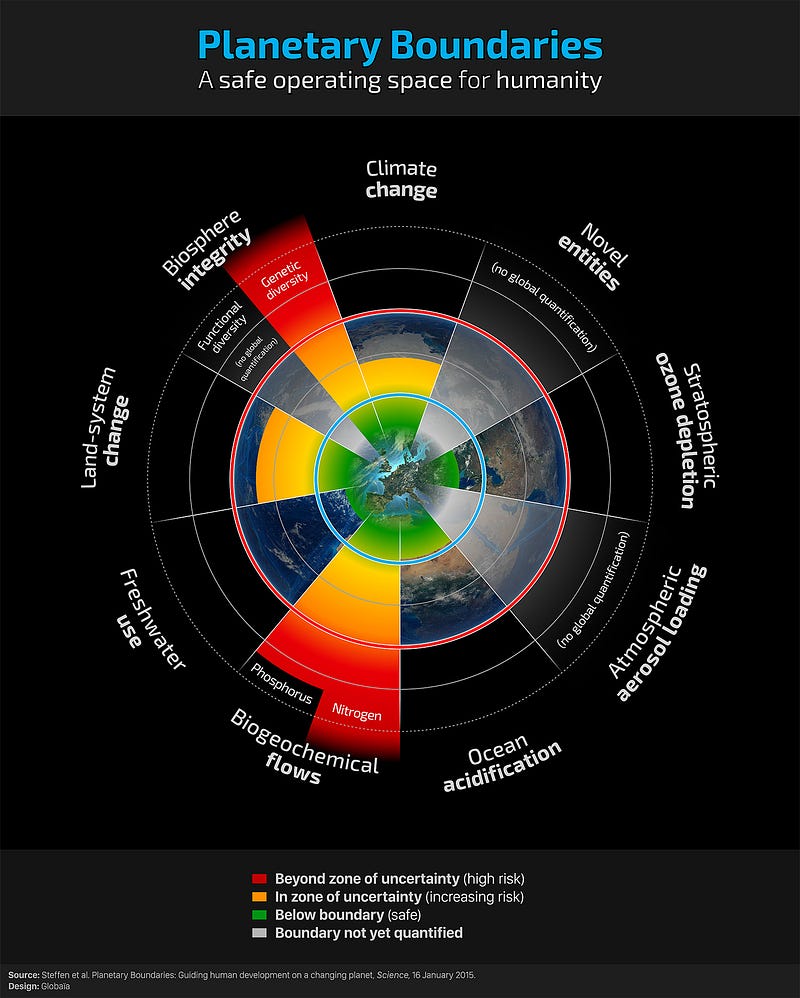
This picture shows the planetary boundaries and if we stay within them (or not). As you can see, climate change is not far out yet, nitrogen and biodiversity are. Credit: Stockholm Resilience Center.

As you can see: biosphere integrity and biochemical flows are much more out of limit than climate change is. Things like genetic diversity, nitrogen and phosphorous are much further beyond the zone of uncertainty (high risk) than climate change seems to be. And things that really held our attention some years past, such as ozone layer depletion, seem to be in the safe zone at the moment.

For the people who want to get into these facts more deeply: please have a look at the publications from the Stockholm Resilience Center. The paper from 2015 has raised lots of debate and the models are being improved with lots of cross-over scientific knowledge from many sources.

So, back to the first question. We now know that climate change is not our biggest problem. But is that relevant? In my opinion: NO. Not if we look at the problems we face.

There will always be a debate. With heated voices at that. Who’s right? Who’s wrong? If we bicker over the details, we will never get deeper into the real problems. Let alone find solutions. And that’s where we want to go.

In September Catalin Matei wrote the piece: ‘Maybe Greta Thunberg is wrong and climate change is not the most important thing to focus on’ and I answered her: ‘Yes, maybe Greta is wrong…’

But it doesn’t mean there is no problem. There IS a problem! More than one, even. We cannot deny these planetary boundaries and if we do not learn as a human species to live within them, our problems will only grow. Some sense of urgency is needed…

Although framing climate change as our biggest problem is not relevant when we look at problems, it IS relevant when we try to find solutions. We should not have tunnel vision and just look at climate change. We cannot think that if we just capture CO2 out of the air, our problems will be solved. ‘It’s not so simple.’

The answer has to be found in systemic thinking. Problems are connected, so the right solutions will only climb to the top of the list when they solve more than one problem and not cause trouble in other areas.

A practical example: renewable energy can never be the only solution. We do not have enough scarce metals to build enough windmills, solar panels, and water power stations for the energy consumption we have now. And our technologies are only consuming more energy, not less. And with damming for water power, our freshwater problems will only increase…

Here is a thought-provoking article about lithium mining by Logic Magazine.

In short, we are on the wrong track if we just put all of our eggs in the renewable energy basket with our current technologies. Let’s look at local sources for renewable energy, different grids (12 and 24 Volts DC power) and don’t overlook the technologies to do with consuming less energy. Biomimicry gives lots of inspiration here…

And there are also completely new avenues to walk on, such as nanotechnology batteries made from abundantly available materials. Or let’s look closely at Thorium. Here is an article about it by Jordan Flagel.

People are working on this! We need to see the problems in relation to one another before we can weigh any solutions and make wise choices. I don’t have all the answers, but let’s discuss and weigh…

And one advice: stop the tunnel vision! We have killed many technologies that could have saved us (car on water, free energy out of the air, etc.) just because of their threats to the status quo. Let’s look past that now. The urgency is too big not to…

Systemic thinking is key here!

And don’t think systemic thinking is too complicated. I agree it’s not linear. It requires a different approach. But complicated? No. The more radical choices we dare to make on what we really want from life, the easier it gets.

It’s a matter of phasing-out what we don’t want. And stimulating what we do want. Step by step, day by day. Every step a foundation for the next one.

“Any intelligent fool can make things bigger, more complex, and more violent. It takes a touch of genius — and a lot of courage — to move in the opposite direction.” ― E.F. Schumacher

Okay, on to solutions now. What are the steps to be taken?

  • Look at the problems in connection with each other
  • Find nature-based solutions that solve several of these problems and not cause damage in other areas
  • Prioritize the solutions for minimum effort, maximum impact
  • Go for a diversity of flexible solutions, depending on the local situation
  • Choose combinations of solutions with short term benefits (people can see those) and long term impact

To move from abstract theory to practical application, let’s look at a real-life example.

In my country, the Netherlands, our government tried to find shortcut ways to deal with nitrogen-levels and PFAS, the ‘forever chemicals’ that are found in too high quantities in our soil. The court of justice, however, told them off.

As a result, at the end of 2019, our government was forced to stop many building permits and farmer expansions. Farmers and builders were protesting fiercely in The Hague.

And let’s be realistic. That fear is very valid. The farmers’ anger is valid. They see their jobs change and don’t know what the future will bring. The picture at the top says: ‘Papa can I still become a farmer?’

Children ask these kinds of questions and what can we answer? People just cannot live with long term catastrophes in mind without becoming paralyzed, fearful, angry… We don’t want to feel guilty every day. Who can blame us? I certainly won’t.

So what can be solutions then? We have to look at connecting factors to find them. What is one big connecting factor here?

Nitrogen is in the soil, leaking into our water. PFAS is in the soil. And CO2 can be absorbed by healthy soil. So the way I see it, the soil is one of the big connecting factors that would be somewhere on the top of the list in terms of solutions.

I wrote about how it can halt climate change for 20 years while we work on other nature-based solutions.

So what can we do to better the situation long term?

  • First of all, make a long term vision of how to align people’s real priorities (health, love, basic needs) and the planet. And present it in such a way that people understand where we are going and why. The vision should have more than just money-driven values in it. We are no homo economicus. We are not just rational beings, we have hearts… So lots of attention to clean water, clean air, food, health, and well-being
  • Put your money where your mouth is. That means: governments should make laws to stop damaging technologies, such as PFAS. Stop subsidizing damaging technologies that do not go into the direction wanted. Give subsidies only as a stimulant, empowering those who go in the right direction
  • Start a big program on innovation with nature-based and nature-inspired technologies. Entrepreneurs, here is the role for you! You can be the changemakers having a fulfilling life in your business. Creating jobs, while changing the world with the great new technologies we need
  • And the role of individuals is to become active in their own neighborhoods. Build your communities! Find diversity in your teams and complement each other in achieving a goal. And spend your money just on the things you really love. Put your money where your heart is…

In this specific case of nitrogen and PFAS, actions can be:

  • Phase-out damaging technologies, such as PFAS, and invest in the technologies of the future instead
  • Use farmer subsidies to help them transition away from chemical fertilizers and pesticides and towards healthy soil to prevent nitrogen flushing out and store carbon in the soil
  • Stimulate the building sector towards healthy buildings. Use local, abundantly available materials, and creative building methods
  • Use spaces in cities to dense the urban environment in a smart way. This way we do not have to build on soil and still find ways to solve the housing crisis. Arie Voorburg has done some great projects in this field
  • At the same time, use all wasteland areas in cities and business areas to regenerate the soil and plant food forest or temporary food/nature projects among the buildings
  • Start a dialogue about minimalism and choosing what is really important in your life. Let’s not create buildings just for storing stuff or boosting egos, but build for housing LIFE instead…

One big aspect here is that we should please be kind to each other. Let’s inspire instead of being self-righteous and judgmental. There is not just one right way. There is a broad path of possibilities. Big opportunities for qualitative growth even. And if we think the economy will not flourish this way. Think again!

Let’s explore. Let’s see the path as one big experiment. We cannot fail, we can only go forward. Let’s take flexible steps that can change again when needed. Let’s not put ourselves in the next technological lock-ins.

Life is about change. Let’s try things. Let’s motivate each other. And let’s have lots of fun in the process!

Some suggestions for the technologies of the future? Well, we can start to look at the 100 technologies Project Drawdown identified.

We can also look at this article in the Guardian, where many technologies for the built environment are mentioned. There are really inspiring things going on in the world! And as said, there are hundreds of nature-based technologies for the built environment that have not been explored yet.

Personally, I think that the only way to go to align people and the planet is to look for nature-based solutions. The principles of the Blue Economy are very helpful to identify what is really bringing us forward and what isn’t. Let’s go for fully biodegradable, it’s just a matter of time. And for local, abundantly available resources. And for temperature and pressure as found on site.

Let’s invest all our efforts in physics, biology and green chemistry and combinations of all three.

Now, we invest in many projects that kill the planet, let’s instead invest in projects that will help us stay within planetary boundaries. No subsidies for anything else and lots of job creation in these sectors…

But for the time being, we are not there yet. Lots of people cannot see the bigger picture yet, so I agree with economist Angela Francis that we should not try to get these problems to the top of everyone's list. We should show that we actually improve everyday lives by making the right decisions.

‘It’s not so simple.’ But we can definitely make it understandable, choose what is important in our lives and take action.

And if you want to connect or discuss, you can always find me on LinkedIn, Facebook or somewhere enjoying nature’s vast intelligence…

More reading

Climate Change
Systems Thinking
Protest
Sustainability
Environment
Recommended from ReadMedium