
Teaching about Nature Has Many Faces. Don’t Limit It to Biology
Trigger our children’s curiosity. ‘Gunter’s Fables’ and ‘8 Shields’ will help you along.
Awareness of our current situation and finding solutions for a sustainable world needs many teachers. And they will all approach the job in a different way. Which is good, I love biodiversity!
However, whatever way you go at it, this kind of teaching requires stimulation of the child’s capacity to think differently. It’s not up to us to teach our children the way we do things. Because the side effect of our way, we now know, is the destruction of ecosystems and the overshoot of our planet’s boundaries.
It’s up to us to inspire children to explore and find ways to do it differently within the boundaries of our planet.
Inventors of the future
Our children and grandchildren will be the inventors of the future. They will find ways to restore our ecosystems and learn together how to live within these restored ecosystems.
They will be the scientists, the teachers, the entrepreneurs, the carpenters, and the civil servants who do it differently. When we succeed in inspiring them and guiding them in finding their own answers, there is hope. And many teachers are working hard to achieve this. I applaud them!
Personal development and biology
Many teachers think that the only answers to this kind of teaching are in personal development and biology. And they are right: these two are very important! The skills for the 21st century require wisdom and curiosity, really lots of it! Also knowledge of biology and roaming around in nature.
There are many great examples of teachers who do this, and I want to tell you about one of mine. Jon Young and his organization 8 Shields. I met Jon on a course he taught at Schumacher College in Devon, UK.
He taught us a great deal about exploring nature, about how to stimulate learning in young people, about using all senses, about the location of your classes (go outside and nature helps you teach!), and about storytelling.
Around the fire
Jon is a great storyteller! We sat around the campfire, there were around 15 of us. A little slice of the moon looked down and winked. I was a bit nervous and my head was running overtime.
What would I talk about that isn’t boring? Would my language skills be good enough to find creative words, as English is not my mother-tongue? Would I find the right structure while talking? I definitely didn’t want to go first…
Jon was calm and silent. He started to speak just when an owl made a loud, screeching noise. We laughed. And the tension broke.
He started telling his story. I don’t even know anymore what it was about, but it was a great adventure in the wild. We listened with awe, but the more the story evolved I also got inspired.
Oh, maybe I’ll tell this to the group when I’m next. Or this… Or this…
Inspiring to dare
Jon’s best achievement was not his story as such, it was the way he told his story. We all dared to tell our own stories next. Not competing, but sharing, laughing together, feeling the bond.
Some people told very short snippets, some were clumsy, it didn’t matter. Some stories were about travel and the wilderness, some were about a bird in the back yard.
Jon didn’t just impress us with his skill and taught us by example.
He really made us want to create our own stories. No shame or feeling we would not be good enough. What an inspiring teacher! If you want to know more about his teaching methods, I can recommend the book ‘The Coyote’s Guide to Connecting with Nature’.
Physics, biology and smart chemistry
Nature gives us wonderful entrance points for explorative learning. But please, don’t limit this learning to biology and intuitive learning in nature.
Physics and smart chemistry can also be great inspirations for our future inventors. If you look at technology the way nature does it, you will find inspiration in abundance!
One influential thinker and doer, Gunter Pauli, the founder of the Blue Economy, provides us with tools to inspire our children with. He calls them Gunter’s Fables. They are published by ZERI: Zero Emissions Research and Initiatives. One book consists of five fables in two languages.
They have been translated into many languages, but there are always two in one book. Their subjects are natural technologies for e.g. energy, housing, ethics, food, etc. and they are an abundant well of information.
Going against the current
The fable itself takes center stage. Last week I used one of them for a workshop during the Changemakers Festival in the Cube Design Museum in The Netherlands.
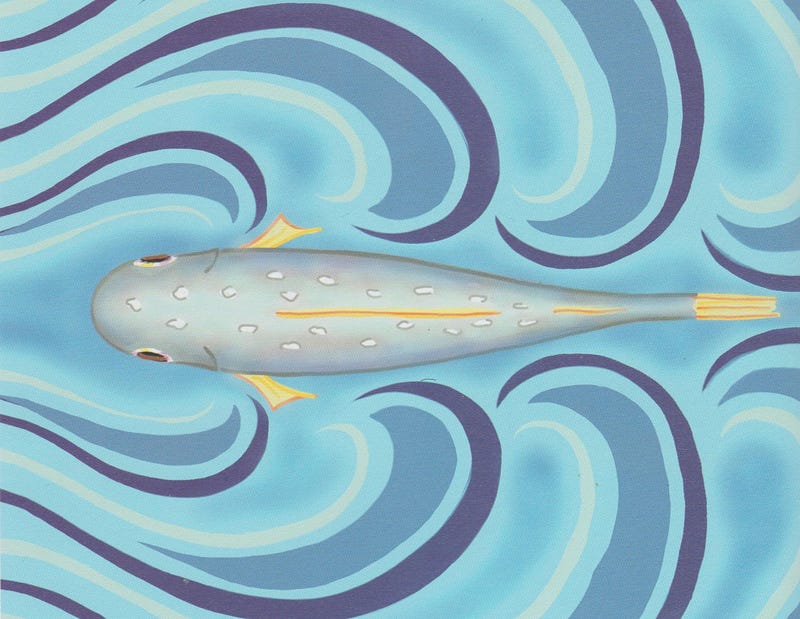
I chose ‘Going Against the Current’ about a trout and a butterfly discussing the way they use currents in water or air to move their bodies.
The trout asks: “Are you drunk?”
The butterfly answers: “No, I am windsurfing”
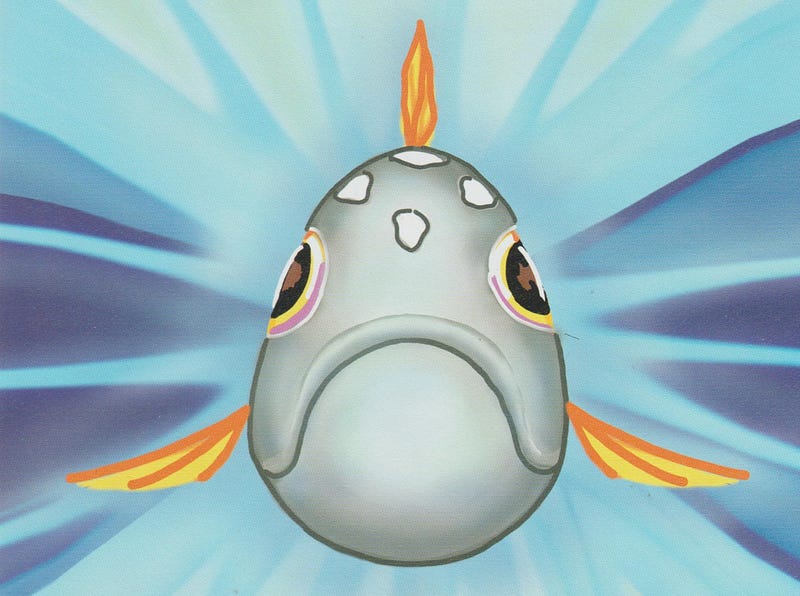
The butterfly wonders how the trout can swim upstream. The trout explains that his head is shaped like an egg. The water curls around him and pushes him forward. The stronger the current, the stronger the push of the water.
Just like Martial Arts: you use the energy of your opponent to build up your own energy for movement. There is also a page about the Austrian scientist Viktor Schauberger, the source of this knowledge about water and fish and how movement creates different water.
Experimenting
And then it gets interesting. Because we do not want to just transfer information, we want children to explore, become curious, experiment, think for themselves.
So there are extra sections in Gunter’s Fables:
- Did you know that… with e.g. the Monarch butterfly who travels long distances with a speed of up to 65 km/h. And remember, butterflies don’t fly, they windsurf
- Think about it… do you think the trout felt bad about thinking the butterfly was drunk? Particularly when he found out it was not true?
- Do it yourself! This is my favorite part because here is a suggestion for an experiment.
Each fable closes with a teacher and parent guide on the five sources of intelligence: academic knowledge, emotional intelligence, arts, systems (making connections) and capacity to implement.
Storytelling and experimenting
So how did we use the fable during the Changemakers Festival?
1 I started out with storytelling. I showed the images on a screen, used my voice and asked questions to get my audience interested.
2 Then we started making a large mobile with natural materials of different structures. A ventilator made the current we were using for movement. We experimented with shapes, connected materials together with natural binding techniques and found balance by moving the cords in- or outwards.
3 All the while we could throw in little snippets of knowledge to trigger. About how nature uses structure instead of material choice to give a material its functionality.
4 How does nature scale up? We could show the fractal structure of our mobile to make one big installation.
Asking questions
It was fun! As a family workshop, it was interesting for adults and children alike. The workshop was definitely inspiring and good enough, but not perfect. Room for improvement…
It was a first-time collaboration between my food forestry friend Derk Alting Siberg and myself. The thing I always find most difficult is asking questions and triggering curiosity without overwhelming with too much of my own fascination.
However, we definitely inspired the boy who loved technical stuff ánd ballet dancing. He liked it a lot and might become a great inventor in this century… Enough reward for us.
Experienced teachers wanted
With this article, I hope to inspire other teachers like you, who are much more experienced than me in triggering curiosity.
Please take up the challenge to teach the skills of the 21st century to our children. Gunter’s Fables will help you find the detailed knowledge for physics, biology and smart chemistry together with emotional intelligence and art.
In the end, the museum’s curators asked if they could use the installation, together with the story of its birth, in their exposition. Of course! Spread the word, we would love to do it more often…
Physics and smart chemistry
Why do I say: don’t limit our teachings to biology? Well, nature has more entrances than just biology. And we will need them all to really innovate for our future.
Physics has many unused technologies that can make the imagination going.
One of Gunter’s favorites is mentioned in this simple show movie about the Blue Economy.
“Entrepreneurs do not care how the apple falls down from the tree. Newton figured that out hundreds of years ago. They want to know how the apple got up in the tree in the first place. Defy the law of gravity.” Gunter Pauli based on the fable ‘Can Apples Fly?’
And there is so much more. What if we would widely use a law of physics that says that hot air rises? Use it for natural ventilation in our buildings and we don’t need air conditioners anymore…
Smart chemistry is also a skill we should learn. Novamont in Italy produces living chemistry for quality of life. That’s what we need! They started out producing bioplastics from thistles. Yes, thistles!
These pioneer plants are abundantly available in Sardinia and an excellent resource for bioplastics. Their products are fully compostable and biodegradable in fresh and saltwater.
And our children should know at least a little about it in order to get intrigued. To become curious, wanting to know more…
Systemic design
Nature is so very rich and abundant. Full of little miracles in unexpected places. We can definitely inspire our children and do stuff with that inspiration, that knowledge.
Not taking the shortcuts as we are doing now, but working with nature to build a world that fits into our planetary boundaries. One skill is essential for this. We need to embrace systemic thinking and intuition. We need to recognize the connections in our systems.
We need to teach systemic design. We need to treasure our children’s natural awareness and keep their intuition intact. Let’s not be afraid to experiment. That’s how we learn as a species. And let’s have fun doing it. It’s time to play!
As a last bit of inspiration, I want to share the TED talk from John Hardy, founder of Green School Bali, where I gave an inspirational talk about Blue Economy and the opportunities of an island economy for Bali in the beginning of 2020. View and be inspired…
Further reading
I am always open to connecting. You can find me on LinkedIn or in our food forest where I learn every day about ecology and do lots of experiments with fermentation and healthy soil…


