
Maybe Greta Thunberg is wrong.
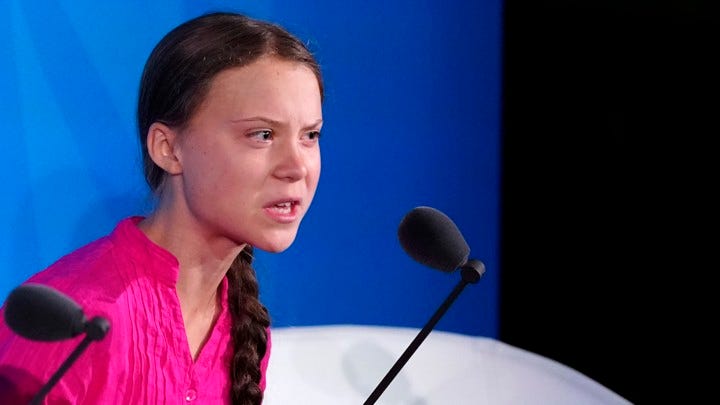
Why is nobody daring to question Greta Thunberg? Why is nobody questioning the validity of her arguments?
With the risk of being unpopular and after some thought, I decided to write this post on why Greta might be wrong by putting together some research I’ve done in the last couple of months as well as some arguments I’ve been thinking about.
This is by no means a complete argument and my goal here is to start a more balanced/less radical conversation on the issue of climate change by putting together the best argument I could, while not being a climate change expert.
Why do I believe this to be important? Not specifically because of climate change alone but because I believe that young people and people, in general, need a good sense of what’s important in the world, what are the important problems to work on and how to go about solving them, including having good role models when doing so. And my hypothesis is that Greta, even though well-intended, might not be as good of a role model as she’s perceived by people and the press, as well as her ways (activism) not being as effective and her thoughts on the most important problems (climate change)we are facing not as accurate.
I also believe that in order to hold one particular opinion, one needs to know the other side of the argument better than they do themselves, and when it comes to politically correct topics such as climate, this seems to not be happening. This is a principle that I've learned from someone infinitely wiser and smarter than me, which is Charlie Munger (Berkshire Hathaway).
With that being said, here are a couple of contra-arguments based on Greta’s video and her overall efforts and message:
1. An emotional speech is good but comprehensive solutions are a lot better.
From what I’ve been able to analyze from Greta’s speech, she focuses on the importance and urgency of climate change by defining the urgency of the problem while pushing or deferring total responsibility unto those people , and slightly attacking them I would add, without discussing any suggestions for pragmatic solutions.
While her speech was emotional, it does not provide any progress in the solution department. I believe that everyone knows that the warming up of our planet is happening. The devil is in the details though. How do you know the warming up is because of us or something we could alter? How do you justify spending billions of dollars on climate change while balancing it with other important issues in a world with limited resources? How do you track climate change results and assess causality? How long will it be until we see any results?
And while attacking the “perceived powerful” it’s attractive, maybe collaboration on answering the above questions will be more productive than mere problem and urgency reinforcement.
2. There are at least 24 better things we could do with our money than spend it on climate change initiatives.
If we try to assess what problems we should focus, we could look at where people and the press are paying attention and think that one of the most important issues today is climate change. If we listen to Greta’s emotional speech, we might be sure of it. But is that really the case?
In 2015, the world’s governments have picked 169 well-meaning targets under 22 core issue areas, including education, health, poverty, equality and climate change. But too many targets means no priorities, which is something they haven’t been done most likely because they “don’t want to piss each other's off”.
A group of people wanted to change that and prioritize them. The Consensus Project did that. They brought together renowned experts from the UN, NGO and private sectors with 60 teams of economists producing 100+ research papers to establish the most effective targets or the post-2015 development agenda within the UN Open Working Group’s 22 core issue areas. The difference that rank-ordering has made? Doing $62.5 trillion more good for the world.
This was based on peer-reviewed analyses from 82 of the world’s top economists and 44 sector experts, including numerous Nobel Laureates, so I encourage you to verify their methodology.
Here is a document showcasing their research — http://bit.ly/un-goals-prioritised
Based on their research, what are the top priorities that would bring the most amount of economic, social and environmental good? Surprisingly, or maybe not, here we can see free trade as being number 1 ($2011 returned for every $1 invested), universal access to contraception ($120 returned for every $1 invested) and many others.
Where is climate change on this list? Priority number #25, and that is energy research ($11 returned for every $1 invested) which is something Bill Gates has been focusing on with his nuclear energy research and reactors, while the 2 degrees target being close to the bottom of the list of priorities with less than $1 returned for every $1 invested. So even if climate change might be “cooler to talk about” (pun intended), there might be better ways to spend billions and billions of dollars.
This research can also be a guide for what’s important in the world to work on, which might be more accurate than looking for what people or the press is paying attention on social media and the internet.
Some sources of information here include: The smartest targets for the world 2030 (http://bit.ly/un-goals-prioritised), Jordan Peterson’s interview with Bjorn Lomborg who’s leading the Consensus Project (https://youtu.be/prrbooi9PNw).
3. Climate change activism might just be insecurity and a need for social belonging disguised as virtue and morality.
Activism is highly correlated with the belief system that change needs to happen at a government and large corporation level and therefore differs personal responsibility from that.
How many people who are like Greta or supporting Greta or doing other kinds of activism actually understand the science behind? How many of them are just revolting/being activists because it’s “the cool thing to do”?
It might be that if you are an activist for climate change but have not taken the time to do your research properly, you are just being dogmatic. So in that case, why are you being an activist? Maybe it’s because once personal responsibility is gone, a victimhood mentality takes its place and maybe a somewhat nihilistic attitude that goes along with that.
And with that in mind, maybe you’re using climate change as a way to signal how virtuous you are to other people, wherein the fact is that's just insecurity. I know that I, for myself, feel this need, and without checking myself, I often find my thoughts being directed in “saving the world” type of thought patterns that make no sense whatsoever if I haven’t got my life in order first. And maybe this is something that young people do, especially. Myself, being 22, I certainly feel this drive to be “virtuous” and “save the world” but also see a huge benefit in focusing on taking things step by step and taking care of myself, my family, community, country and only then focusing on the world. The opposite seems rather foolish.
Conclusions
In conclusion, I don’t deny climate change exists nor that Greta has bad intentions. I’m sure she’s well-intended (I hope, actually), but I don’t think her approach is a good role model for world-scale change for all people to look at.
I hope that this message gets across to people and starts a conversation on the opposite side, while maybe providing more guidance on what problems people should be working on.
Thank you for reading the article! Would love to know your thoughts on the article in the comments. If you wish to follow me on social media, here is my Instagram, YouTube, LinkedIn, Facebook, and even email address: [email protected]. I am a 23-year-old entrepreneur that has numerous projects in fields such as social media marketing, education, dance/entertainment, and others — with the sole goal of working on ever-increasing more important problems that have an impact — that is — if I can — so that’s where the ever-increasing part comes in! Would love to connect!