
Christians Need To Admit There Is No Objective Moral Law
Even if it exists, we certainly cannot know exactly what it is
Every time I hear Christians gloat about their knowledge of moral absolutes and question atheists about what moral standards they have, I just can’t stand it. By the end of this article, I hope you can understand why I can’t put up with this sort of rhetoric.
There is no need for deep philosophical discussion on this topic. I simply ask two questions, and it will quickly become obvious that Christians themselves don’t believe in an objective standard of morality. At a minimum, they cannot tell what it is exactly, rendering their claim meaningless.
First question: God commanded ancient Israelites to annihilate Canaanites (Deuteronomy 20:16–17) and Amalekites (1 Samuel 15:3), killing all men, women, children, and babies. Was it objectively moral to follow through with this command?
Some Christians would try to avoid facing such questions by saying that Israelites did not actually follow through with God’s command, so I focus my question on the command itself. Even if Israelites did not completely wipe out Canaanites or Amalekites, should they have done so?
There are three common responses from Christians to this question:
1. Genocides in the Old Testament was not the will of God in the first place.
This response usually comes from progressive Christians. With this answer, they indirectly admit there is no objective standard of morality. At least it could not be found in the Scripture. It also implies denial of biblical inerrancy. They believe that parts of the Bible reveal truth about God, while others contain human error and should be filtered out.
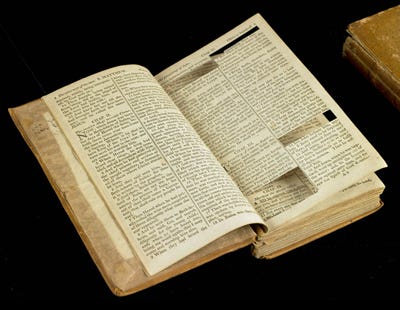
My question to this position is: How do you determine which part of the Bible is divinely inspired, and which part is a mere human invention? The answer, inevitably, is their own judgment.
In effect, they cannot glean objective moral values from their Scripture because they are using their subjective lens to read and interpret it.
Some may say God imprints objective moral values into the heart of each person (or believer). People can use that moral intuition as a guide in interpreting the Bible. Since genocide clearly goes against moral intuition, it must not be God’s will.
But if that’s the case, why did the majority of Christian churches throughout church history take the divine command to annihilate Canaanites literally (and come up with a bunch of reasons to justify it)? It is hardly convincing to say that all of them simply dismissed or misunderstood the absolute moral laws Holy Spirit implanted in their heart.

If the supposed moral sense given by God can vary from person to person, it can’t be objective.
Let’s look at the second response.
2. No, God adopted the moral standard of that time so ancient people would come to understand who God was. It would be an error of presentism to criticize the past using modern moral standard.
In other words, it was not appropriate to reveal or teach objective morality to ancient Israelites. It was better to go along with the moral standard of the day. This response may not blatantly deny the existence of an objective standard of morality, but it implies its uselessness.
If God accommodated ancient people’s cognitive limitations and went along with their understanding of morality, wouldn’t He do the same today? The inevitable conclusion is that the so-called objective moral law, which modern Christians supposedly espouse, turns out to be subjective at its core. In the past, God gave ancient Israelites a set of moral codes to suit their understanding. Today, God gives another set of moral codes for modern believers.
In essence, this response is saying that ancient people thought genocide is one legitimate way for a tribal deity to show their prowess and superiority, so it was right for the God of Israel to present Himself as superior to other deities by helping Israelites commit genocide against their foes. BUT in modern times, genocide is considered inhumane and unethical, so God would not condone or command Christians to do such a thing.
In other words, no objective morality.
By the way, I don’t think genocide can be justified in any period of human history. It troubles me that some people actually think that it once was right and moral.
3. Yes, if God commanded it, it is objectively moral, even if it goes against our moral intuitions.
Out of the three responses, this one is more consistent with the belief that the Bible teaches objective morality. It recognizes that human intuitions are subjective, so should not be used to judge or override objective moral laws. After all, who are we to question God’s command? It is probably blasphemous to suggest that God’s commands recorded in the Bible sometimes are immoral.

For those who agree with this response, here is my follow-up question.
Second question: How should we implement this objective moral principle in today’s society?
I mean, if you believe that genocide in the Old Testament embodies objective moral standards, you would want the same standard to be applied today, right? After all, it is objective and does not change over time, right?
So if it was ok to kill children and babies for the sin committed by adults in the Old Testament, should we implement the same rules today?
Yes or no?
At this point, some Christians may appeal to the difference between Old Covenant and New Covenant, and say that since Jesus established the New Covenant, this genocide command no longer applies, and would be immoral if practiced.
Oh, so the command of genocide in the Old Testament is, after all, not objectively or universally moral. OK, glad to hear it.
I think any decent human being, whether they are Christian or not, would say that the divine command of genocide simply cannot be applied today. What happened in residential schools in Canada was nowhere close to the scope of genocide, but it was intolerably horrendous and outrageous already.
Still, the more ‘zealous’ ones, in striving to be consistent and obedient to the Word of God, would be willing to say:
If God commands genocide today, we should do it.
I did not make this up. I heard it from time to time.
Let that sink in a little bit.
In other words, as long as God says it, it is moral. If God does not say it, doing the same action could be immoral.
But where is the objectivity in that? When we talk about objective moral standards, we usually mean something is moral or immoral in itself, disregarding any external variables such as culture, motive, or context. If God’s will can effectively transform an action from being immoral to moral, it is no objective morality.
Think about it.
Some Christians may still argue that God’s will IS objective morality. They say there is no separate set of ethical rules residing outside or independent of God’s will.
Well, in that case, there is indeed no objective morality. They can just call it God’s arbitrary will. To name it ‘objective moral law’ is just tautology. It does not add anything more to its meaning. They can get rid of the ‘objective moral law’ part, and not lose anything when they refer to it as God’s will.

Furthermore, if objective morality can be boiled down to God’s will, these Christian can never be sure what God’s will is now because it can change depending on the circumstances (or God’s mood?). Genocide is usually wrong, but under certain circumstances, for example, when God commands His people to do it, then it apparently becomes a righteous thing to do. But how can these Christians discern what God’s will is today?
They can’t!
Not only that, if someone claims that God told them to kill their neighbors, can these Christians confidently say that they are wrong?
They can’t!
So much for objective moral standards!
Here I use a Christian YouTuber as an example. Someone asks him, ‘What do you think of people who commit murder and then state, “God told me to do it.”?’ He responds, ‘If God really told them to do it [murder], then they were right. If God did not tell them to do it, then they were wrong.’
If you think like me, when you hear this YouTuber’s response, the first glaring issue that pops into your head is probably: So you cannot decide if this person’s act of murder is wrong or not, unless you know if it’s God’s will?
Seriously?
But the more important question is: How can he know if God really told someone to commit murder or not?
Like I said previously, he simply can’t know.
Those who claim that God told them to kill may say that they had a vision, or they had a strong feeling about it, but how can anyone be sure it was genuinely from God, and not an instance of delusion or hallucination?
Christians can say murder goes against biblical moral principles, so it cannot be from God. Ok. We are back to square one. Then was God violating such principles when He ordered Israelites to kill all Canaanite babies? If God is free to override general moral rules, who are we to question it when someone claims it is God’s will for them to murder someone?
With this understanding of ‘objective morality’ being the synonym for God’s will, there is no external reference or standard we can use for verification purposes.
Claiming to know what is objectively moral thus becomes meaningless, and we might as well treat it as non-existent, relying more on the combination of social norms, our own conscience, education, and reasoning.

Conclusion
With the two questions I discuss in this article, I hope it has become clear that Christians have no moral high ground to stand on. They should not act as if they possess knowledge of objective moral laws while atheists and agnostics don’t.
Please let me know in the comment section if you think I missed anything.
A great video clip that more or less expresses the same point:
Further reading


