Medium Writers Challenge Winner | Work
Black Personhood Does Not Have Equitable Access to the Work of Homeownership
My people have been systemically denied the promises of Special Field Order #15. A meditation on what it takes to maintain a house.
“Whenever three respectable negroes, heads of families, shall desire to settle on land, and shall have selected for that purpose an island or a locality clearly defined within the limits above designated, the Inspector of Settlements and Plantations will himself, or by such subordinate officer as he may appoint, give them a license to settle such island or district and afford them such assistance as he can to enable them to establish a peaceable agricultural settlement…each family shall have a plot of not more than forty acres of tillable ground, and, when it borders on some water-channel, with not more than eight hundred feet water front, in the possession of which land the military authorities will afford them protection until such time as they can protect themselves, or until Congress shall regulate their title.”
— General William Tecumseh Sherman, Special Field Order №15.
My 34th birthday was during the summer of 2019, during the Before Times. I woke up that morning having taken off work and with my wife’s family moving freely throughout the house without the fear of infection that has imperialized my anxieties. Pops proudly walked into the house with my gift. Bald and bearded, he reached into the back of his metallic Silverado and plopped it down in front of me — a black canvas bag containing a handyman starter kit.
“Picked this kit out myself!” he exclaimed as I emptied its contents on the dining table. As I put the tools on the table, an ancestor’s whisper filled my head. The power drill was red and black, as was the screwdriver set, the needle pilers, the level, and the wrench. John Witherspoon’s dialogue from “Boomerang” about the importance of matching swelled in my ears. When it came to these tools, Pops had to make sure to coordinate.
I started putting the tools back. Pops stares at you when he expects something. It was when only the power drill remained that I looked up and noticed his gaze.
“Thanks for the gift, Pops.”
“Your fence outside is leanin’,” he gruffly stated. Damn, Pops. It’s my born day.
“I know.”
“Get up and let’s go fix it.” And with that, my birthday behavior began. We spent the next few hours working outside. Pops taught me the basics of fence repair and maintenance. We both work in public education and he gave me skillful guided practice. He pulled out a two-inch long wood screw from the tool kit and affixed the fitting bit into the power drill. Pops then taught me a trick of the trade. “If you drill in from the front, the screw may not make it all the way through,” he educated. “Instead, go in from a diagonal ‘till the board sticks.”
I held the faltering fence against the post as he modeled the diagonal affixing. Pops powered the drill on and let the wood screw bite into the fence. He then put all his weight onto the drill, both hands behind the motor, and let the machine do its work until the screw disappeared into the wood. 1/18th inches of the screw popped up behind the post.
“Boom.” He handed the drill to me. “Show me you’re as good a student as you are a teacher.” I spent the next few minutes diagonally drilling more wood screws into the fence until little bits of them poked out the fence post. By the time we were done, the fence felt as if it could easily tolerate tornado winds.
“Looks brand new,” I remarked with contentment. I felt like Ozymandias. Our work will stand forever.
“Don’t thank me yet, son. Let’s see what else needs fixin’.”
We spent the rest of the morning surveying the house and using the tool kit to reinforce fencing, tighten the screen door, and assemble yard furniture while shooing away mud daubers. It all felt so foreign to me. This was the first home I lived in where I had both the ability and, after his tutelage, the knowledge to modify it.
There are many ways to be Black. The story Pops and I wrote that humid birthday morning was of one expectation of Blackness meeting another — a city boy unaccustomed to being able to repair his own space with a country man who learned how to do so for his family’s comfort. Only now, in this pandemic land where I am confined to the home and am reluctant to let outsiders inside to fix plumbing and air, that I can appreciate the melding of our stories.
We were respectable Negroes, the ones Sherman and Farragut ordered thousands of men to kill and die so we could be free.
Homeownership, in the American tradition, is freedom. Our Bill of Rights contains the Third Amendment, which is specifically about the sanctity of our domiciles. “No Soldier shall,” the amendment reads, “in time of peace be quartered in any house, without the consent of the Owner, nor in time of war, but in a manner to be prescribed by law.” Designed to ensure that the government cannot turn a citizen’s home into a garrison, it also protects property rights by requiring government soldiers to get permission from the owner of the property before converting it to their needs. Within the penumbra is the consensus from the Founders that a person’s house is inviolable. Home, and the work of maintaining it, is the private arena where Americans get to flex their Protestant work ethic.
The first real birth of freedom for all citizens of this nation, however, was the Civil War, where a forward-thinking military leader decided the formerly enslaved need land to work into a home. General William Sherman lit a trail of fire across the south in his March to the Sea campaign. He burned every town and city his army came across, twisted every railroad tie, and broke the spirit of the slave society he warred against in the name of perpetual Union. As his grim troop strode toward the Atlantic, liberated slaves followed. To support them, Sherman issued Special Field Order №15 in 1865, setting conditions for the newly free to acquire land to farm. From his command comes a stock phrase in Black personhood — 40 acres and a mule. Though the order said nothing about being given a mule, the animal is a metaphor for the work it takes to transform soil into a place to raise children. The Northern military gifted to Black personhood, freshly liberated from bondage, the promise of the Third Amendment — a home they could labor toward.
It was not to be. President Andrew Johnson rescinded Sherman’s order, leaving Black people who only knew agricultural work with no land to turn into a home. Thus began two stories of Black personhood. One, which belongs to my matrilineal line, had us travel to make a home in different regions. The other — Pop’s story — had Black personhood work to pursue homeownership in the South, the white man’s absolute dominion for a century after the Civil War.
My ancestors and elders left in response to such an environment, jumpstarting the plot of my mother’s story of Black personhood. My late grandfather left his birthland of West Virginia. My grandmother took the bus from Lancaster, South Carolina, all the way to Brooklyn. They were amongst the last travelers of the Great Migration. They met, fell in love, and launched their family — my momma and two uncles — from the Farragut Houses in what is Brooklyn’s DUMBO neighborhood. Those projects were named after Admiral David Farragut, who served in the Civil War. In escaping their homeland, my maternal grandparents ended up in a place evocative of the South.

The Brooklyn Eagle newspaper reported on September 1st, 1949 that the city approved over $15,000,000 to erect the Farragut Houses near the Brooklyn Navy Yard. The first residents moved in during 1951, with the average rent being $44 a month max, including electricity and gas. During this time period, many of the residents of public housing were white and working class. The origins of the city’s housing projects were to clear the slums of the cities and to replace them with housing that would only house the “working poor” that met the moral standards of governments. Men had to work. Women had to be married. No single-mother families were allowed. Residents had to have a record of gainful employment. These standards, when combined with the racial discrimination Black folk faced in American society, made for a majority white clientele. For meeting the social and racial standards needed for government assistance, the working poor got houses that the New York City Housing Authority (NYCHA) maintained. “They had their job, they did their job, and they were qualified for their job. You’d call, and it would be fixed right away,” one longtime resident of Queensbridge projects testified. Despite living on the lowest economic rung of capitalism, the working white poor were given warm housing with working elevators and speedy maintenance service.
Demographic change and racial progress challenged that social contract. By the end of the 1960s, the NYCHA eased many of the standards regarding who they let into the housing projects such as Farragut Houses in response to the pressure from the Civil Rights movement. More Black people began moving in. The influx of Black people finally able to utilize the public services cause a reflexive, conservative retraction of public services and money; whiteness only works for itself. When you combine this political behavior with the arrival of crack cocaine in working-class and poor Black communities in the 1980s, the progressive dream of public housing became the shattered neighborhoods of lore, where tight-knit families endured roaches, rats, pissy broken elevators, and shootings. “The 1980s is the first time when you’re more at risk of criminal violence on [NYCHA] property than you are in the surrounding neighborhood,” Gregory Umbach, a professor who researched New York’s housing projects, told the New York Times. The crime was not a result of the character of the newly melaninated inhabitants, but the steady withdrawal of government funding combined with an acute infestation of a highly addictive drug.
These were the conditions my grandparents raised my mom and uncles in during their formative years. In the 1990s, after my first conscious experience of home was taken away via being evicted from our apartment, Farragut Houses also became a formative experience of home and the lack of labor government put in maintaining it. The elevators often did not work, leaving us to climb six stories at 111 Bridge Street to get to our apartment. I cannot ever recall maintenance men or women on the grounds to exterminate the pests or take care of the surroundings. In the old days, white people would work and expect the government to take care of the building. But Black people have never been a part of such a social contract. Every adult in the apartment we lived — mom, my two uncles, my grandma and grandpa — were gainfully employed in banks, by UPS and the MTA, a government agency, and a furniture store, respectively. But no one came to make sure the elevators worked despite us being taxpayers. The disrepair was the point white supremacy was making. Your professional work will not matter in improving this home; we will not work to improve it either. We were respectable Negroes, the ones Sherman and Farragut ordered thousands of men to kill and die so we could be free.
It did not matter.
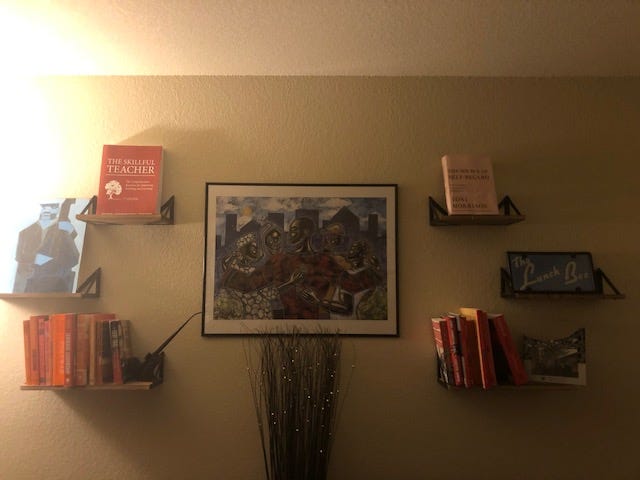
What I remember most about that home in the projects was that we worked to make our beautification of the place skyward. We could not modify anything in the house by painting or affixing shelves onto the walls. Instead, we stacked. We had a chest freezer and a washing machine and a dryer that my brother and I would climb on top of while playing. We have shelves and consoles to hold TVs, photos, and my grandpa’s collection of elephant statues. But because that home was not our house, we could not customize it to better suit us. It was a structural sort of misery. Our labor, Black labor, was universally devalued. We did not feel free as the American traditions of the Third Amendment and Special Field Order №15 suggested were our birthrights as citizens. The labor was ennui, a cycle of going through the motions to repel vermin. This was the story that resulted from my grandparent’s Great Migration, which finally ended when all five adults living in that squalid place combined their incomes to jointly buy a house in the Queens neighborhood where Malcolm X used to reside.
The most precarious aspect of living the projects, and my current suburban ownership, was air conditioning. At Farragut Houses, it meant watching my uncles pull out the heavy unit from the closet when the heat arrived mid-June and navigate it into the window without letting it fall. My uncles were strong and athletic. While they never feared dropping the AC, I was always scared for them.
I felt a similar fear when my central AC here in Arkansas broke down during a summer night when the heat index was north of 100 degrees. It was the evening before Father’s Day. Cool air flowed from the vents. The AC’s fan, however, was not pushing the hot air out. My son and I sweated the entire evening as my wife worked her final night shift as a first-year radiology resident. The toddler dripped with sweat and tears.
I was told never to mess with AC units because of the amount of electricity flowing through them. One mistake and a shock would sever my soul from my body, into the space beyond. Pops’ lessons emboldened me, though, and I felt I could handyman the issue.
I got to work. I got my toolkit and donned shorts, a muscle shirt, flip-flops, and a bucket hat. I strode out into record-breaking heat and shut off all power to the house. I used my red and black flathead to open the central AC’s panel, which revealed a capacitor with rust all over the top. Capacitors, as I learned on YouTube beforehand, store large charges of electricity that jumpstart the AC’s fan when you adjust the thermostat. I removed the wiring, taking pictures beforehand for reference. Once I got the capacitor out, I traveled out to Lowe’s to see if they had a replacement.
I prefer Lowe’s for my homeownership needs because the CEO, Marvin Ellison, is Black. That sensibility influences how I navigate the spaces I enter. In Lowe’s, I was one of the only Black customers. It made me think of the whiteness my wife and I often watched on HGTV. The Property Brothers. Chip and Joanna on “Fixer Upper.” Hilary and David on “Love It or List It.” Kortney and Dave on “Masters of Flip.” Throughout the years of manufactured conflicts between the hosts on the shows (is it really worth getting into a screaming match if you bust down a wall to make the kitchen open concept?), I became aware of a subtle bit of othering in my mind. “I hate HGTV,” Ijeoma Oluo wrote in her essay Why I Hate How HGTV Portrays Home Ownership. “I hate the glorification of homeownership as the ultimate goal of citizenship. I hate the overwhelming whiteness. I hate the gratuitous wealth. I hate the celebration of privilege.” She links mortgages and deeds to being a true American, which also means she links the work of homeownership to white supremacy. “We were constantly chased out of neighborhoods by the same people I’m now seeing on my TV screen: hip white people with money who want to ‘get in early’ on an ‘up and coming’ neighborhood, buying as much square footage as their privilege will allow.” Our money, our work to get that money, our work to maintain a home — my nation gives subtle messages to us that Black people should be segregated and redlined away from being able to own and work property. For white supremacy, our absence was the demand. Finding out, then, that Lowe’s did not sell the capacitors at all was thus an experience of structural racism. Having a Black CEO at the top of the structure does not change how the system operates.
When your toilet backs up, you call a plumber. When your air breaks, you call an HVAC specialist. Given that my central AC pulled a Solomon Grundy and died on a Saturday, and that HVAC supply stores were all closed on a Sunday, I had to call in someone else for repairs. He was a white man who gladly put covers on his boots as he walked in the house but looked at me sideways when I asked him to put on a mask. Even in the space of the home I owned, I had to deal with that cross look when I gave him one of my fashionable, black disposable masks. For $450 dollars, he invaded the space I made virus-free for my son’s sake and fixed the issue I had correctly identified within ten minutes of arriving.
The structural racism of homeownership, and being able to work that home, is reinforced by the demographics of homeownership support services. The United States Census reports that the white homeownership rate is 74.2% by this year’s second quarter, 29.6% points higher than the Black rate. That structure neatly translates to who homeowners would call if they lacked the know-how to upkeep their property. If you call someone employed within the homeownership support services, he will almost always be white. The U.S Bureau of Labor Statistics compiled in 2020 their Labor Force Statistics, which shows that most employees in these sectors are white. If your shower stops working, you have an 88.1% chance that the plumber who comes to fix the valve is white. If your roof needs to be replaced, you have an 86.9% of having the crew that patches it up be white. The man who came to charge me over $400 for the work he did represented the 81.5% of the white people who make up the HVAC profession.
To avoid this structural racism in the future, I ordered a spare capacitor. It lives in the black tool bag Pops got me.
Home. Getting it, keeping it, maintaining it, is work.
Again — whiteness only works for itself. The racial composition of homeownership and the support services that allow mortgages payers to enjoy hot water and cold air point to a political consensus. In the 2020 election, 58% of white people voted for Donald Trump over Joe Biden in the presidential election. The majority of all classes white people, save for the college-educated white men and women, voted for Trump. These are now the same people, months after he propagated belief in his Big Lie and resistance toward vaccines and masking, that correlate with the data of homeownership and its resident support services. Many political commentators focus on white people’s obsession with the Second Amendment and their desire to own weapons of war for domestic use. The homeownership data, however, suggests that an examination of white attitudes toward the Third Amendment, of the sanctity of the home and who gets to work to maintain and improve their homes, is overdue for scholarly study.
That amendment was not written with Black people in mind. Instead, Black personhood made into hagiography General Sherman’s order. I had mentioned before the story of Black personhood I am descended from, the Great Migration. Pops’ is the second.
The second story. Home. Getting it, keeping it, maintaining it, is work. Besides the labor of making a house on land and modifying that house into a home is constantly having it imperiled by white supremacy. Imagine sharecroppers who lived in debt peonage, never able to escape owning credit to white male feudal lords, suddenly having the Klan show up on their property for something they did, or their son said while walking to the market. Homeownership, during that time, meant never being able to have protection from the Grendel at the gates that— ever hungry for Black flesh and mana — stalked the periphery.
Pops springs from the stock of Black people who stayed in the only homeland they can claim. The rural Arkansan town of Helena and its surrounding villages is his people’s ancestral seat. His ancestors did not migrate. Instead, they stayed and did their best to get their 40 acres in a hostile land. They managed and, in defiance of the limited views of the Founding Fathers, owned farmland and homes that form the basis of the modest wealth of my wife’s family.
I channeled that history when my shower faucet made a loud snap as I turned the handle. It was a hot day that started with a morning bench press workout, interceded with me smoking a few racks of dry-rub baby-back ribs in the afternoon and a long, luxurious smoke of a La Flor Dominicana during dusk. Reeking of sweat, hickory, tobacco, and by the transitive property of mathematics, manliness, I was frustrated that no water ran from my shower when my body needed it most.
I picked up my toolkit and began dissembling the shower faucet. After a few turns with my red and black flathead, I pulled off the handle and saw that the grub screw inside that connects said handle to the water valve had snapped. Despite me using the needle-nose pliers to extract the broken screw, it still did not work. I was tired of inviting white men inside my house to charge me a fortune to fix where my Black family lives — our planet in a universe white supremacy seeks to control.
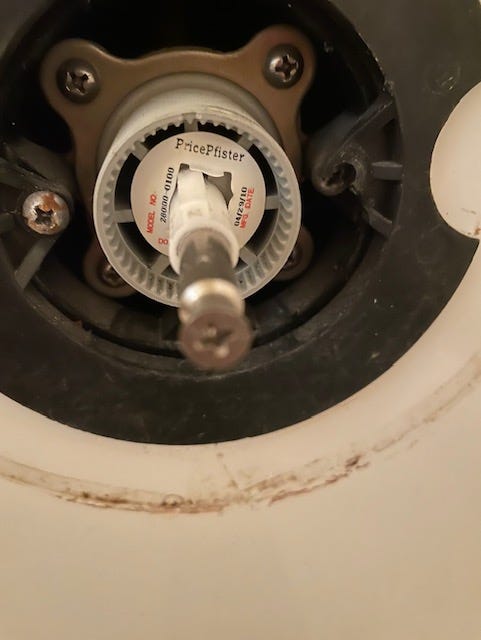
Through some YouTube research, I realized the problem was with the water cartridge, the structure inside the wall that regulates hot and cold water flow. I wielded my flathead again and, after five minutes of work, was able to extract the cartridge and see its classification. Through an Internet search, I saw my local Lowe’s had a replacement. A few hours later, I was back in the bathroom to install the new cartridge. I went outside, turned off all water to my house, and installed the hardware.
The work got scary when I turned the main water line back on and my bathtub would not stop filling up, no matter how firmly I turned the shower handle. Sweating, I turned off the main water line and thought about what to do. I finally took the flathead screwdriver and disassembled the entire shower handle and faucet. I put it back together again and made sure to use extra elbow grease for all the screws. This time, the water cooperated when I turned the mainline back on. I took a long hot shower in victory.
Afterward, I sent Pops some before and after pictures of my work. His response was as gruff as ever. “Good, son. Now fix that slowness in your kitchen sink and you’re good.”
The work of homeownership never ends.
This is the second of four essays I have written in response to the Medium Writers Challenge. These stories are meant to be read in a particular order to help the themes between them resonate fully. Please use the links below to continue reading the series!
https://readmedium.com/how-do-black-people-memorialize-the-afterlives-of-slavery-3619e86a216


