
Becoming a (more) Technical Product Manager, Part II: Planning the Work
How to accelerate learning alongside my day job and a million other commitments
In this series, I will take you through my journey to improve my technical knowledge as a Product Manager in an early-stage startup. I hope it can provide you with inspiration for your own development plans, and that you can save time using the resources and frameworks I share. If you haven’t seen the first article in the series, you can read Part I: Diagnosing the Problem here.
In Part I of the series, I diagnosed myself with a problem — lack of technical knowledge — and decided to address it by achieving the following goals:
- Develop a deep understanding of how software is built and an awareness of what technologies exist
- Create a shareable resource for others
In this chapter, I plan to answer the follow-up questions:
- Where will I get the information from?
- How will I document my learnings?
- How can I do this work alongside my day-to-day work and other commitments, whilst keeping velocity and motivation high?
- Are there any risks I haven’t considered?

Do I have all of the resources I need?
As I had already decided not to take a pre-made course but to create my own, I needed to assess the information available to me.
- I looked into threads in my online communities to see if other PMs had crowdsourced information, and saved the resources they had been recommended
- I did a quick google for every ‘topic’ in my course to check there were enough relevant youtube videos and articles
- I bookmarked a few free computer science courses with relevant transcripts online
At this point, I’d like to mention some truly delightful sources of information I found online. I knew that there was a market for educational tech resources, but I had no idea just how many ‘tech influencers’ are out there!
I had imagined that certain topics would be a bit of a slog for me to learn— I was having flashbacks to my GCSE physics lessons — but was surprised to find that the top youtube results were overwhelmingly well-presented informationals by enthusiastic young techies. For example, “What’s in their Tech Stack” by Youtuber Sunshine In My Code. Or “How Does the Internet Work?” by Code.org.
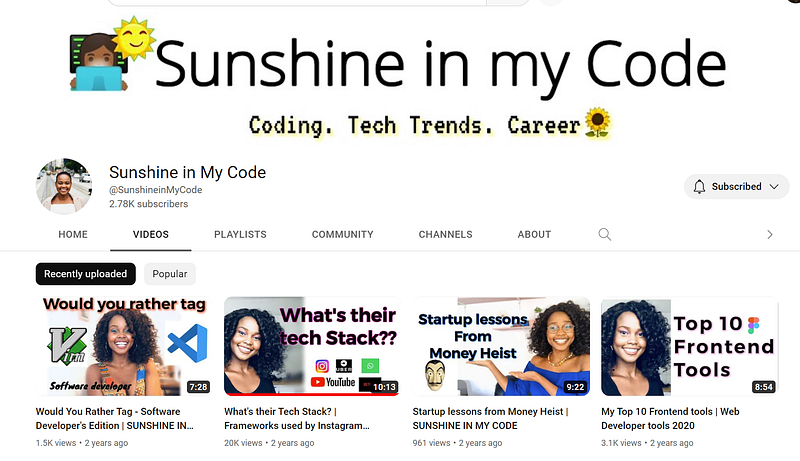
I’ll be sharing all of the sources I used with each chapter of the course itself, so do follow this account if you want to catch those lists as I share them.
Where will I document my learnings?
I came up with three rough requirements:
- I want to be able to move around the content and modify the topic order easily. I have my list of topics, but I may need to restructure the hierarchy of information to make the process of reading more intuitive for other product managers.
- Whilst working on the project, I want to be able to share my notes and allow others to comment. If I enlist friends to proofread, I want it to be easy for them to give feedback.
- Once I have finished learning, I want to share the entire content as a resource on Medium. From past experience, synthesising information to the point that a total beginner could understand it is the best way to consolidate learning.
I landed on Notion as a solution, primarily as I am already working there to document other personal projects and goals and find the UI much more pleasant for this kind of work than Google Docs. In addition:
- It is easy to create a hierarchy of information, change the data structure, and move content from one page to another.
- I can give friends editing rights without them incurring additional software costs.
- I forsee no issues copying the content over to Medium.
When will I actually find time to learn?
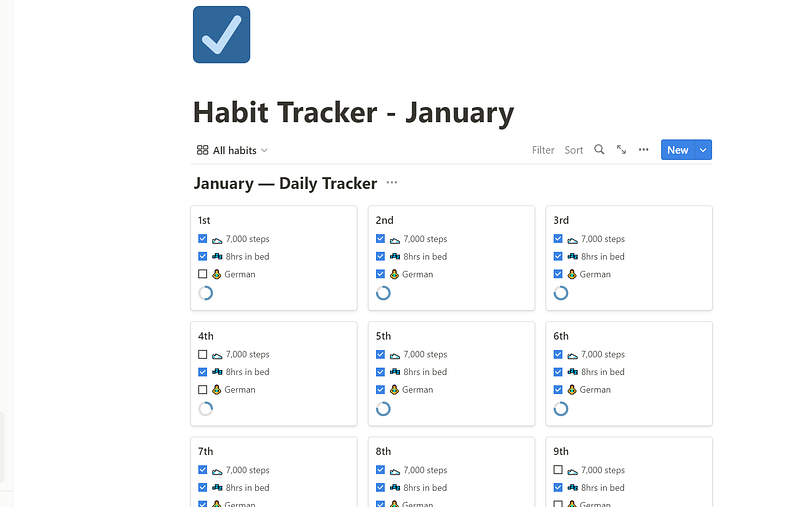
I work anywhere between 40–60 hours a week at the moment as a Product Manager in an early-stage start-up, where the workload can be unpredictable. I train for competitive sports around 10 hours a week. And as I approach my B2 German exam, I’ve committed to 30 minutes of exposure daily. My schedule is already packed. However, this project is one of my core goals, and so I am willing to make the time to push it through.
Initially, I thought about trying to cover this work in one or two weeks. I am a strong believer in both immersive learning, and front-loading effort to kickstart a goal.
Back when I was single, I had a tradition of taking a week ‘study vacation’ in January to focus on a topic that I was interested in. I found the change of environment and time commitment enabled me to accelerate learning, which I could follow up with smaller time commitments throughout the year.
Given that my work offers some educational benefits, I considered asking my boss for a week unpaid leave to do the same again. I sent him the list of topics I wanted to cover and why I thought it would help me in my current role.
However, he made me an even better offer. I could be paid for some additional days leave outside of my vacation, as long as I promised to bring the learnings back to my team in the form of a knowledge-sharing session. (Thanks Titian!)
However, he proposed that 4 days paid leave should be spread across a month, to reduce impact to the business. I was happy to agree. I suggested March, after my German exam, and Mondays, when I have the fewest scrum meetings with my team.
I’ve already started studying in every spare thirty minutes I can find, but those four days will allow me an 32 extra hours of study, paid for by my company.
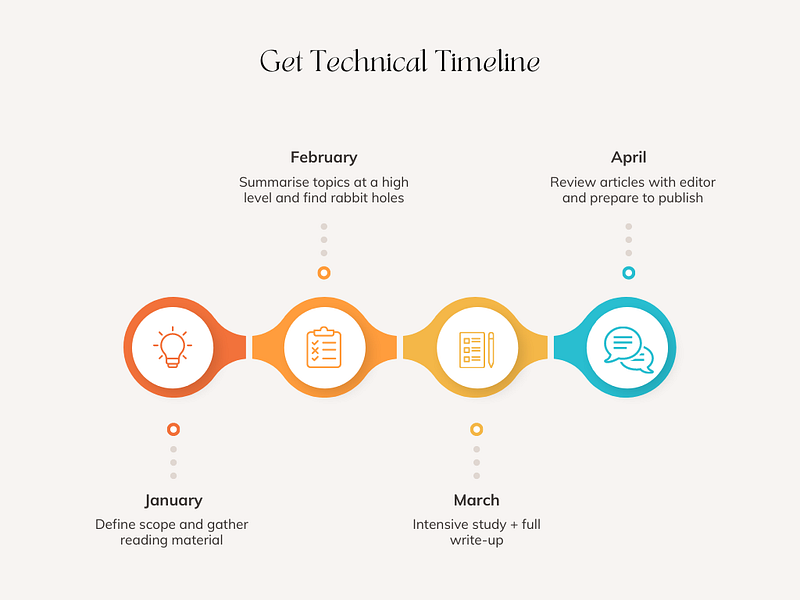
It’s a stretch goal, but I’m now aiming to have the course completed and shared in April, which would allow me to ‘finish’ before I enter my sports competition season… Seasonality is everything!
How do I ensure that I don’t eff it up?
My goal here is to deepen my knowledge of software development to improve my value as a Product Manager. My secondary goal is to improve my writing skills and create a resource for others to use. But I can see some potential risks in this project. What if I spent too long on topics that turned out to be irrelevant for my role? What if I thought I understood a topic, but what I wrote turned out to be absolute garbage? What if I published information that was inaccurate or outdated?
This is where my friend Adrian comes into play. Adrian Van Schie is a really smart guy, and we bonded last year over powerlifting, interest in the financial independence movement, and book recommendations. Most importantly, Adrian is a software engineer, currently working as a Tech Lead. And Adrian is going to be my QA.
Adrian has very kindly agreed to not only proof-read my final ‘content’, but also let me bounce my ideas and summaries off him earlier to check that I haven’t gone off the deep end. Thanks Adrian!

And so just like that, I am ready to begin the next step…
Give me a follow to see how it’s going, and of course get your hands on my course notes at the end. Which won’t be utter nonsense, thanks to Adrian…
Editor’s Note — 23/05
You can now go straight to the “meaty stuff” below!
The Introductory Content
The Technical Content