
Backspin: Pete Rock & C.L. Smooth — Mecca and the Soul Brother (1992)
Pete Rock & C.L. Smooth embodied the essence with a transcendent debut. (95.5/100)
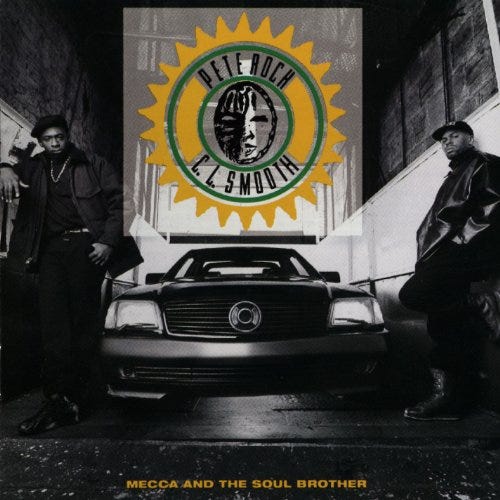
“To know the truth is to know the self,” Pete Rock’s majestic baritone ministers over the burrowing bass and solemn organ of Cannonball Adderley’s “Country Preacher” .
“To know the self is to know the mecca. Mecca’s not a state of mind or a place. Mecca is a way of life. It is the answer to all confusion.”
As quickly as the understated preamble to Pete Rock & C.L. Smooth’s immaculate full-length debut fades in, it drifts into the distance, giving way to the throbbing drums and elastic bass that power Mecca and the Soul Brother’s deceptively understated opener. A far cry from the frenetic frontal assault that made the duo’s 1991 EP, All Souled Out, an underground favorite, “Return of the Mecca” coalesces stealthily, taking its time to assemble the album’s sonic and thematic motifs piece by piece.
The percussions are allowed to settle, the bassline roaming for over a minute before airy horns float into the mix, seemingly out of another dimension. Before the ear can fully acclimate, Pete Rock snatches them away, thrusting attention back onto his partner’s measured flow. C.L. Smooth meticulously stacks syllables en route to the cacophonous collage of samples and scratches that make up the chorus. It’s as if Pete is connecting continuums — past and present, body and spirit, matter and energy — in service of, or in search for, the “truth” referenced in the intro.
For his part, C.L. draws lyrical through lines, weaving history, spirituality, and cultural touchstones into his braggadocious wordplay, as if to illustrate the origin and lifeblood of his linguistic potency.
Overstand, the Mecca in command Part of the plan is the man who built the land He began A scripture ripped out the piece of a scroll Better to know, yes, it foretold the beautiful and bold Start ‘em in Harlem with the motto, the Apollo Boogie to me, I’ll swallow hollow when you follow Stable like a turntable, lyrics I cradle No fable, label or run my tongue around your navel You’re coming to me, so therefore the program’s Mecca The silhouette, a weirder fella, darker than vanilla Talking about the theoretical, isometrical Alphabetical rebel, I dissect the devil
Pete Rock isn’t the first hip-hop producer to sample jazz, but Mecca and the Soul Brother is first hip-hop album to consistently reflect the fluidity of jazz, nestling into tight pockets long enough to catch a groove, only to dart that groove to and fro across the aural universe in free-wheeling flourishes.
“For Pete’s Sake” features the self-proclaimed Chocolate Boy Wonder in one man band mode. The soundscape transitions from the molasses thick drums of the freestyle intro, to the stutter stepping crispness of the main body, to jittery horns interspersing the verses, and finally the sepia filtered wall of sound that stands in for a traditional hook.
The production bears out the symbiosis between MC and producer that C.L. espouses in his understatedly abstract bars. The addition and subtraction of filtered flourishes usually signals a change in cadence or rhyme scheme from the voice behind the mic. Pete even repurposes his playful freestyle from the intro between his partner’s verses, highlighting not only their complimentary vocal textures, but the differing elements of the track with which their contrasting flows interact.
Lest anyone mistake him for merely a beat maker, Pete Rock flexes his producer muscles on “Lots of Lovin’” incorporating the ethereal keys of live session player, Neville Hodge and sultry crooning of Terri Robinson and Tabitha Brace into his soulful sample platter. The final product is not only the most mature rap ballad hip-hop had yet seen, but also the most well constructed. The track foreshadows the neo-soul sound that emerged in the mid-90s, proving (as did his 1998 solo burner, “Take Your Time”) that Pete could have been a top R&B producer had he wanted.
Such a transition was never in the cards. Pete Rock is hip-hop, through and through. For irrefutable proof, look no further than “The Basement”. A posse cut in the truest sense, “The Basement” features Pete, C.L., and their Mount Vernon, NY homies Rob-O, Grap Luva, Dida, and Pete’s legendary big couz, Heavy D passing the mic atop a rumblingly ominous boom-bap masterclass. Pete’s trademark filtered bassline paired with the off-kilter horns of Sister Nancy’s “Bam Bam” and a truncated guitar squeal looped to infinity create a sonic collage that feels like nighttime in the backroom of the places the old heads warned you not to go after dark. You can practically feel the smoke rising from grates (and blunts) as the MCs luxuriate in the darkest crevices of the beat.
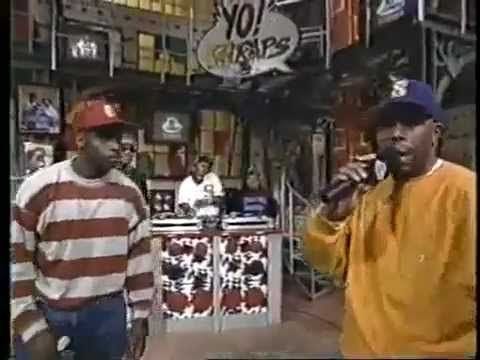
Pete Rock’s tracks unspool with a level of nuance and attention to detail only previously matched by the Bomb Squad. But while Public Enemy’s iconic production unit bristled with abrasive dissonance, Pete’s sonic portraits percolate in perfect equilibrium; an almost existential harmony. It’s tempting to get lost in the textures. Many listeners did, inadvertently making C.L. Smooth one of the era’s most overlooked frontmen.
In Brian Coleman’s book Check the Technique: Liner Notes for Hip-Hop Junkies, C.L. even underplays his own contributions, describing himself as as “an instrument”. He is, to be sure, seemingly always finding just the right rhythmic cadence to fit his partner’s often slippery pockets. But C.L. Smooth’s MCing delivers far more than a rhythm section in Pete Rock’s symphony. His words don’t always convey a clear theme or narrative, but his selection of them does. Like the notes from Miles Davis’s trumpet, C.L.’s often unorthodox syllabic combinations breathe life into the mood and attitude of a track.
Take the rollicking “Wig Out,” where Pete’s drums cascade like the echoes from a Harlem juke joint upon the arrival of a Friday evening moonshine shipment. C.L.’s free association tapestry of boasts, similes, pop culture puns, and lascivious flirtations bounces about with the buoyancy of a beach ball, conveying the ecstatic release of a good “wig out” more evocatively than a topically focused soliloquy ever could:
C.L., the A+, while you wear a F like a Fendi With your nine lives this arrives, here, kitty-kitty No more to savor, ’cause I’m here to kick flavor The most common denominator, said none graver Sufferin’ succotash, I run for the cash Whiplash, FloJo in a forty-yard dash Solid like a dome, never fall like Rome A notch for your crotch, so honey heat it, I’m home
As much fun as the free form tracks are, Pete & C.L. keep the album grounded with a handful of riveting topical excursions. “Ghettos of the Mind” offers stark portraits of decay, both environmental and internal, over washed out production. Intermittent horn samples pierce through like rays of light, buoyed by a resilient final verse.
A truncated guitar sample creates claustrophobic tension for a rigorous exploration of discord and dismay on “Anger in the Nation”. “Straighten It Out” serves up a clinic in the art of sampling, while genially chiding artists of the past quick to sue the very hip-hoppers keeping their legacy alive.
And then there’s “They Reminisce Over You (T.R.O.Y.)”. A mainstay on the shortest of shortlists of hip-hop’s greatest tracks (if it’s not in your top 20, your favorite rapper probably has purple hair), Mecca’s transcendent lead single elevates an album that was already soaring above the clouds into truly rarified air.
Inspired by the death of Pete & C.L.’s Mount Vernon homeboy and member of Heavy D. & the Boyz, Troy “Trouble T-Roy” Dixon, “T.R.O.Y.” goes far beyond simple en memorandum. C.L. Smooth delivers a vivid and intensely personal meditation on family, friendship, and the people and moments that shaped him.
When I date back, I recall a man off the family tree My right hand, Poppa Doc, I see Took me from a boy to a man, so I always had a father When my biological didn’t bother Taking care of his, so who am I to bicker? Not a bad ticker, but I’m clockin’ pop’s liver But you can never say that his life is through Five kids at 21, believe he got a right to Here we go, while I check the scene With a Portuguese lover at the age of 14 The same age, front page, no fuss But I bet you all your dough they live longer than us Never been senile, that’s where you’re wrong But give the man a taste and he’s gooone Noddin’ off ‘sleep to a jazz tune I can hear his head bangin’ on the wall in the next room I get the pillow and hope I don’t wake him For this man do cuss, hear it all in verbatim Tellin’ me how to raise my boy, unless he’s takin’ over I said, “Pop maybe when you’re older” We laughed all night about the hookers at the party My old man standing, yelling “Good God Almighty!” Use your condom, take sips of the brew When they reminisce over you, for real
Pete Rock layers an airily psychedelic saxophone loop from Tom Scott and the California Dreamers atop propulsive drums (a masterful manipulation of James Brown) and a haunting vocal harmony to create a track that at once ascends to the heavens and burrows into the deepest crevices of the soul.
“T.R.O.Y.” proved a true anomaly, crossing over to R&B and even pop radio, even as its musical sophistication and lyrical depth stood in stark contrast to the simple melodies and sing-along hooks that characterized “pop rap” at the time. It was a double edge sword, largely overshadowing the rest of the album, at least in the eyes of casual listeners. Mecca and the Soul Brother sold a respectable 400,000 copies, despite rampant bootlegging, but failed to collect the gold and platinum plaques lavished upon peers like Das EFX and Naughty by Nature.
But the people who mattered were listening. The heightened nuance of DJ Premier’s production on Gang Starr’s 1994 Hard to Earn compared to 1992’s Daily Operation, or the crisp precision of Q-Tip’s work on A Tribe Called Quest’s ‘93’s Midnight Marauders compared to ‘91’s The Low End Theory speak to how intently Pete Rock’s production peers were paying attention.
Mecca and the Soul Brother at once represents the culmination of the early ’90s transitionary period’s experimentation and the sonic foundation of the East Coast Renaissance next to come. Dr. Dre’s The Chronic would soon spark a parallel sonic (re)evolution out West. Given the 6 months between the two albums’ releases, it’s almost certain that Dre, ever the student of sound, spent time studying Pete Rock’s studio wizardry. Mecca is the most well-produced album of the transitionary period (yes, better than The Chronic), and arguably the best album, period (maybe not better than Death Certificate).
In the literal sense, the album’s title refers to the two principals; C.L. having been dubbed the “Mecca God” by crew member Adofo Muhammad, and Pete adopting the moniker “Soul Brother #1”. But on the plane of ethereal abstraction to which its soundscapes take us, it feels like something deeper; more fundamental.
If, as the intro establishes, “Mecca” is “the answer to all confusion,” an essence of sorts, then the “soul brother” would be the manifestation of that essence. It’s an apt description for an album that sonically embodies the elusiveness of the calibration that keeps life moving through time, and captures it in an intoxicatingly tangible form.
By the Numbers
Production: 10 Lyrics (how the words are put together): 9 Delivery & Flow: 9 Content (Substance): 8.5 Cohesiveness: 9.5 Consistency: 10 Originality: 10 Listenability: 9.5 Impact/Influence: 10 Longevity: 10
Total — 95.5
Next
Previous
SEE ALL..
Backspin is a look back at the albums that shaped and defined hip-hop. It explores what made them resonate, the impact they had on the culture, and where they fit in today’s ever-expanding hip-hop canon.