
Backspin: A Tribe Called Quest — The Low End Theory (1991)
By embodying the rhythms of the bottom, A Tribe Called Quest solidified their spot atop hip-hop. (95/100)
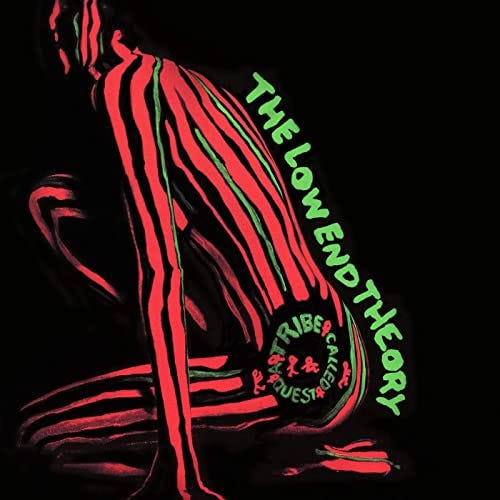
What is the low end theory? I’m not talking about The Low End Theory, A Tribe Called Quest’s watershed sophomore album. Any music fan with even a passing interest in hip-hop is already well versed in its rumbling soundscapes. I’m talking about the theory itself; the metaphysical foundation which the album embodies sonically and conceptually, but never quite spells out?
In returning to one of the defining albums of my youth nearly three decades after its release, I can’t shake the feeling that it’s a musical theory of evolution, both intensely personal for the members of the now iconic Queens rap group, and much bigger than them. It’s a philosophy too existential to pin down in a single album, too fluid to fit a fixed definition. Where it’s consistent is in its essential truth that the essence of everything starts in the bottom; the rumbling bass, the jiggling booty, the awakening of a dormant id.
In the fall of 1991, Q-Tip, Phife Dawg, and Ali Shaheed Muhammed tapped into that essence to deliver a tour de force romp through the low end. The end result was an artistic evolution, allowing the group to remain relevant in hip-hop’s rapidly changing landscape for nearly a decade. It also paved a new lane in hip-hop itself that would yield some of the the ’90s most timeless releases.
The propulsive bass chords of “Excursions” open The Low End Theory with edgy aplomb, wasting little time transporting listeners into the bottom heavy swamp of rhythm and groove through which Tribe will guide us for the next 48 minutes. On Art Blakely and the Jazz Messengers’ “A Chant from You,” from which the bassline is lifted, it has a feel of airy effervescence. Here (perhaps pitched down slightly?) the bass feels weightier and more driving, as if burrowing downward rather than floating up. Even Q-Tip’s vocals feel slightly heavier than those of the carefree kid who left his wallet in El Segundo less than two years prior, as he lends voice to the connections and contradictions that give the bottom its rhythmic tension:
Back in the days when I was a teenager Before I had status and before I had a pager You could find the Abstract listening to hip hop My pops used to say, it reminded him of be-bop I said, “well daddy don’t you know that things go in cycles The way that Bobby Brown is just ampin’ like Michael” It’s all expected, things are for the looking If you got the money, Quest is for the booking Come on everybody, let’s get with the fly modes Still got room on the truck, load the back boom Listen to the rhymes, to get a mental picture Of this black man, black woman venture Why do I say that, ’cause I gotta speak the truth man Doing what we feel for the music is the proof and Planted on the ground, the act is so together Bonafide strong, you need leverage to sever The unit, yes, the unit, yes, the unit called the jazz is We deliver it each year on the street for the beat ‘cause You can find it on the rack in your record store If you get the record, then your thoughts are adored and appreciated Cause we’re ever so glad we made it We work hard, so we gotta thank God Dishing out the plastic, you can dance ’til you’re spastic If you dis, it gets drastic Listen to the rhymes, ’cause its time to make gravy If it moves your booty, then shake, shake it baby All the way to Africa a.k.a. The Motherland (uh) Stick out the left, then I’ll ask for the other hand
“Excursions” brings to life the musical continuum on which Q-Tip waxes poetic. The throb of its bass and the thump of the percussion connect Harlem juke joints to African drum circles which seamlessly morph into to smokey rap ciphers.
“Buggin’ Out” plunges even deeper into the cavernous rhythms of the bottom. The album’s second track commandeers even the strongest speakers with a bassline that drops with the weight of Thor’s mighty hammer and drums that slap like the world’s angriest grandma at the end of of a long day of babysitting. Phife Dawg shows his bite with a torrid verse announcing his arrival as a formidable mic wielder, and providing the album with the first spark of an aggressive swagger absent from Tribe’s hypnotically whimsical debut, 1990’s People’s Instinctive Travels and the Paths of Rhythm.
The track refuses to let up, as Q-Tip grabs the baton from Phife for a lyrical eruption of his own, before finally giving way to the quietly persistent hook. When Phife returns, the theme of the track starts to come into focus.
Yo when you bug out, you usually have a reason for the action Sometimes you don’t it’s just for mere satisfaction People be hounding, always surrounding Pulsing, just like a migraine pounding You don’t really fret, you stay in your sense ‘Comafied’, your feeling of absolute tense You soar off to another world, deep in your mind Some people seem to take that, as being unkind
In the bottom, freedom, in art and life, is achieved through letting go of boundaries and pre-packaged conceptions. It’s through “buggin’ out” that we ultimately discover and embrace our true selves, and there’ no better avatar of that self-actualization on this album than Phife.
The five-foot assassin serves mainly as a sidekick on People’s Instinctive Travels, providing a slightly tentative voice for Tip to play off of on occasional tracks. On The Low End Theory, the bottom’s frenetic grind liberates Phife to step into his own. The solo track, “Butter,” allows him to hone a distinct persona to compliment his new found lyrical gravitas. Breezily talking up his mack game and putting high saddity women in their place, Phife positions himself as the street smart everyman with a bit of a napoleonic chip on his shoulder. It’s a Yin to the Bohemian abstractions of Tip’s Yang that was sorely needed to keep Tribe current in the quickly coarsening early ’90s hip-hop scene.
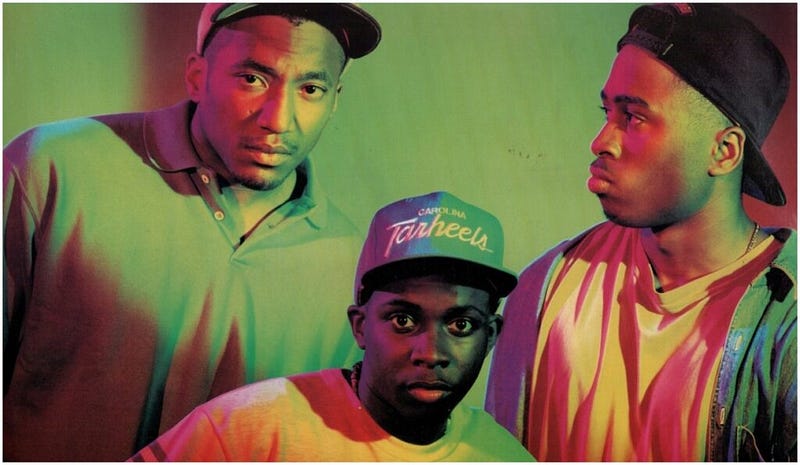
With Phife keeping the album grounded, Tribe’s chief creative engine is free to indulge his esoteric impulses on “Verses from the Abstract,” a breezy bit of free form jazz in which Q-Tip wields his earthily nasal voice like an instrument, inflecting and modulating with every nuance of the track. The bubbling bass of jazz legend Ron Carter serves as the perfect counterpoint. Adding to the improvisational feel is the seemingly impromptu roll call Tip provides atop Vinia Mojica’s mellow hook, shouting out not only his Native Tongue brethren, but other rising “new school” innovators like Large Professor and Pete Rock & CL Smooth. As organic as it feels, it’s also a canny bit of re-branding — expanding the “Tribe” beyond the colorfully avant garde Tongues and positioning them as the leaders of New York’s post-Golden Era generation of low end disciples.
That adaptation continues on “Show Business,” on which Diamond D. and Brand Nubian’s Lord Jamar and Sadat X join the Tribe to lament the seedy side of the music industry. (It’s rumored that Brand Nubian’s flashiest member, Grand Puba, was supposed to be on the track as well, but overslept and missed the session.) Like the earlier “Rap Promoter,” the track reflects a world weariness notably absent from People’s Instinctive Travels. The MCs ruefully draw a distinction between the liberating power of their art and the shackles of the business; the “low end” of the world they now inhabit.
Tribe’s perspective on women also takes a dark turn from the sweet woo pitched on the previous year’s “Bonita Applebum.” To the modern ear, “Skypager” feels at once antiquated, with its homage to beepers, and prescient in its early adoption of advancing communications technology to facilitate transactional sex. “The Infamous Date Rape” makes use of a lascivious Cannonball Adderley sample to delve into the blurred lines between consent and coercion. The sly mischievousness of the former track works. The petulant entitlement of the latter does not, making it the album’s only slight misstep. Luckily, sandwiched between the hypnotic “Vibes and Stuff” and the timelessly infectious “Check the Rhime,” it blows by quickly. By the time Tip and Phife hit the legendary lead single’s call and response bridge, any residual sour taste is cleansed.
Deftly transforming Minnie Riperton’s slow burning quiet storm staple, “Baby, This Love I Have,” into a slappingly funky bed over which Tip and Phife trade clever braggadocio, “Check the Rhime” exemplifies the organic blend of musical ingenuity and easy accessibility that make Tribe one of hip-hop’s all-time elite acts. In fact, on an album that is so deeply rooted in the thick rumble of the bottom, all three of the singles were eminently inviting.
“Jazz (We Got)” glides along on a cloud of warmth, even as it rigorously puts the low frequencies of your speakers through their paces. And “Scenario” closes the album out with a frenetic energy every bit as contagious today as the first time we heard Busta Rhymes roar like a dungeon dragon while rounding into the final lap of his closing verse. A boisterous collaboration with Leaders of the New School, the posse cut is the explosive culmination of the album’s heady pilgrimage through the bottom, the five emcees marauding their way across a booming track completely untethered by couth or convention. They chant, yell and growl; rhyme non-existent words and onomatopoeias. The track kicks into gear with Phife threatening to “bust a nut inside your eye to show you where I come from,” and careens toward its conclusion with Busta touretticly ejaculating “chickety-charcoal, the chocolate chicken!” And it all comes together with near spiritual synchronicity.
What is the low end theory? Perhaps it’s the postulation that it’s the bottom that connects it all. Past, present, and future. Art and exploitation. Exploitation and sex. Rhythm and blues. Beats, rhymes, and life. And like with all great philosophical revelations and infectious grooves, as soon as you think you’ve got a handle on it, it slips through your fingertips, remaining every bit as elusive as it is instinctive. That’s what compels us to return to it again and again. That’s what makes a classic album.
By the Numbers
Production: 9.5 Lyrics (how the words are put together): 9 Delivery & Flow: 9 Content (Substance): 9 Cohesiveness: 9.5 Consistency: 9.5 Originality: 10 Listenability: 9.5 Impact/Influence: 10 Longevity: 10
Total — 95
Next
Previous
Backspin is a look back at the albums that shaped and defined hip-hop. It explores what made them resonate, the impact they had on the culture, and where they fit in today’s ever-expanding hip-hop canon.


