
Backspin: Ice-T — Power (1988)
Ice-T’s “reality rap” broke down the machinations of power through the eyes of a gangster. (76.5/100)
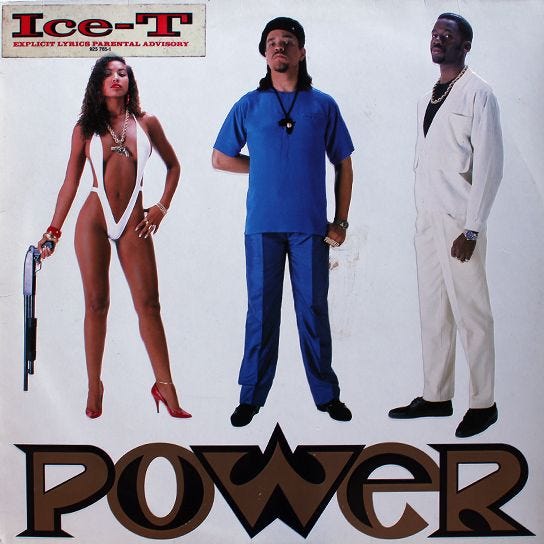
Despite being commonly lauded as one of the founding fathers of gangsta rap, Ice-T has never embraced the now ubiquitous moniker of hip-hop’s most profitable subgenre. For over three decades he has consistently countered danger seeking interviewers with the decidedly less hyperbolic “reality rap.” The term fits Ice-T. Sparse, economical, incisive, and layered far thicker with substance than meets the casual eye. Unlike most of his fellow late 80s O.G.s, Ice-T doesn’t simply spin street tales for sensation’s sake. He uses the philosophies of gangsters, hustlers, and pimps to explore the underpinnings of the systems and institutions that control the world. In other words, power. His ambitious sophomore album, tellingly titled Power, is a deceptively measured exploration of who has it, how they got it, and what others will do to take it.
The title track launches the album like a heat seeking missile. Over a frenetic uptempo track, Ice lets loose one of his most ferocious flows. While the track begins as a brash proclamation of his own power, over the course of five verses Ice delves progressively deeper into the machinations of power itself. After methodically putting law, sex, fame, and money under his piercing microscope, he concludes by identifying the strongest power of all. The one that gives his rhymes their weight: truth, and the fearlessness to speak it.
So you say that I’m a fake, think — you really must be a fool I been to jail more times than you have probably been in school Shot at, shot back, hit, and seen my buddies kill’t That’s the foundation upon the raps of Ice-T are built I say what I think, the system does stink Money, you walk; you short, you’re writin’ from the klink Come on, what’s up, you know the laws are full of bull Prey on the lame, release those with pull Power! I know you wanna try it Well check it out, money can buy it Control and mold the world to do your wishin’ The knowledge of power is mine, so just listen Money controls the world and that’s it And once you got it, then you can talk s***
“Drama” puts Ice-T’s storytelling ability to effective use with a vivid first person narrative laying bare the exploitative power dynamics of a legal system that fosters the predatory power struggles of the street. While not as flamboyant as Slick Rick or as cinematic as The Notorious B.I.G., Ice-T is one of hip-hop’s greatest storytellers thanks largely to the the no-frills clarity of his tales. It’s fitting that Ice’s acting career would come to be defined by his two decades on Law & Order: Special Victims Unit. Like the long running television franchise, his stories are rendered with a minimalist efficiency that makes timely themes of corruption, deceit, and (in)justice cut through all the more pointedly.
“Radio Suckers” takes on censorship at a time when rap records often struggled to make it past timid radio programmers. While the song starts as a screed against gatekeepers wielding their power to keep silence substantive hip-hop, Ice deftly flips the script and takes the power back, proclaiming “they’re making radio wack, people have to escape/but even if I’m banned, I’ll sell a million tapes.”
Once again, Ice-T’s message to fans and fellow rappers alike is clear: systems only have as much power over you as you allow them to have, and speaking truth to power is the way to break free from it.
Speak the word, your voice will definitely be heard Lie to yourself, you’re destined to be to the curb
Indeed, Ice takes rap’s biggest star of the moment, LL Cool J, to the woodshed for a perceived lack of substance on the otherwise pedestrian posse cut, “The Syndicate.”
The free speech envelope gets pushed even more explicitly on “Girls L.G.B.N.A.F.” A gleefully raw plea to “get butt naked and f***,” the track plays like a finger in the eye (or something) to the romanticism that was beginning to creep into hip-hop at the time, thanks to the rap balladry of radio favorites like Whodini, Heavy D., and Ice’s most frequent target of scorn, LL. Though it felt naughtily irreverent at the time, even used in the movie Pump Up the Volume to embody the elicit content of an illegal pirate radio station, it feels tame by today’s standards. Unlike, say, Snoop Doggy Dogg’s “Ain’t No Fun,” it’s simply not engaging enough as a song to endure once the shock value has warn off.

“Girls L.G.B.N.A.F.” is one of several moments on Power where you can feel Ice-T still finding his voice as an artist. He never embarrasses himself on the mic. Still, he doesn’t do freaky tales as well as Too $hort. His attempts at the b-boy braggadocio (“Heartbeat” and “Personal”) that was the stock and trade of New York MCs for rap’s first decade feel remedial compared to the lyrical whirlwinds unleashed by Rakim and Big Daddy Kane that very same year. But he successfully finds his wheel house spinning philosophical street narratives and analyzing the systemic structure of the world through the eyes of a hustler. It’s there that he defines the persona that has made him a fixture in the entertainment industry going on four decades. Look no further than the album’s two singles for Ice at his coldest.
“I’m Your Pusher” re-imagines Curtis Mayfield’s “Pusherman” for an extended metaphor in which music is the dope and Ice is the supplier who keeps the junkies fiending for the next hit. It’s the hustler’s take on supply and demand. He who controls supply chains controls the market. In this case, it’s Ice who has the power, slinging the most potent high on the market. Unlike what the other pushers are peddling, his hits feed the soul rather than corroding it, making “I’m Your Pusher” perhaps the least preachy anti-drug song hip-hop had seen to date.
“High Rollers” is a clinic in precision with Ice methodically breaking down the lifestyle and worldview of the flashiest players in the street game over a minimalist beat. He doesn’t glorify or condemn, he simply presents the game from all angles and leaves it for the listener to draw their own conclusions.
Speed of life, fast It’s like walkin’ barefoot over broken glass It’s like, jumpin’ rope on a razor blade All lightning quick decisions are made Lifestyle, plush Females rush This high profile personality Who earns his pay illegally Professional liar Schoolboys admire Young girls desire Very few live to retire
There’s one form of power that Ice-T neglects to explore: the power of timing. Re-visiting Power with the benefit of distance, it’s hard not to wonder how differently it might have been received had it hit the streets a mere six months earlier. For context, Power was released on September 13th, 1988. That’s five weeks after N.W.A obliterated the previous hip-hop landscape with the napalm bomb known as Straight Outta Compton. Like N.W.A, Ice-T was from LA and his rhymes were rooted in the inner city underworld, making it all too easy to toss him under the “gangsta rap” umbrella carried by the Compton bad boys.
In actuality, he could hardly have been more different. N.W.A got the adrenaline pumping with sonic and lyrical mayhem, dropping explosive lyrics over cacophonous beats. Ice-T hit on a cerebral level, his steely flow rarely rising above a conversational tone as he methodically analyzed the conditions behind the nihilistic chaos depicted by N.W.A.
He was 30 when Power hit the streets; a full decade older than Ice Cube, who penned the lion’s share of Straight Outta Compton’s lyrics. As a result, Ice-T approached the pen with a measured maturity more akin to Kool Moe Dee and Public Enemy’s Chuck D than the teenage bluster of N.W.A and the cavalcade of clones that followed. Had Power predated the gangsta rap phenomenon, perhaps it would have been received in the context of the social commentary presented by those elder statesmen, and Ice-T wouldn’t have had to spend the remainder of his career pushing back against a label he never asked for.
While Ice-T’s distinct contributions to rap’s formative phase may never be fully appreciated by casual observes, his impact can still be felt throughout the culture. There’s a distinct subset of rappers crossing generations, from Scarface to Jay-Z to Griselda, who position themselves as O.G.’s drawing on the street exploits of their youth to inform their navigation of a world ruled by gangtas, be they in trap houses, recording studios, or corporate boardrooms.
That’s one of the most lasting measures of power: impact.
By the Numbers
Production: 6 Lyrics (how the words are put together): 8 Delivery & Flow: 8 Content (Substance): 8.5 Cohesiveness: 8.5 Consistency: 7 Originality: 9 Listenability: 7.5 Impact/Influence: 8.5 Longevity: 5
Total — 76.5
Next
Previous
Backspin is a look back at the albums that shaped and defined hip-hop. It explores what made them resonate, the impact they had on the culture, and where they fit in today’s ever-expanding hip-hop canon.