
Backspin: The Roots — Things Fall Apart (1999)
When the collapse of hip-hop’s center forced artists to pick a lane, The Roots paved their own. (88/100)
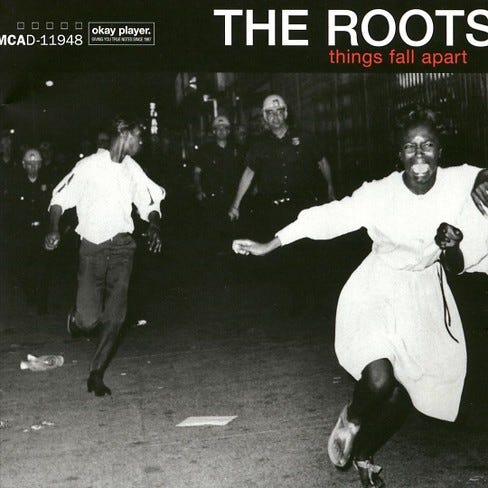
“Things fall apart; the centre cannot hold; Mere anarchy is loosed upon the world.”
That’s the quote from William Butler Yeats’ poem, “The Coming”, from which the title of The Roots’ third album is drawn. It’s also an apt description of the state of hip-hop that informed the project’s conception as the 20th Century drew to a close.
Hip-Hop’s “center,” which had pushed the genre to once unthinkable popularity during the ’90s, was no longer holding. Where acts as diverse as Public Enemy, Snoop Doggy Dogg, and A Tribe Called Quest had once been able to coexist at the nexus of cultural authenticity, artistic integrity, and commercial viability, lines were now drawn in the sand. Jiggy vs. Backpack. Gangsta vs. Conscious. Player vs. Hater.
The compartmentalization left The Roots as a band without a country; emphasis on “band.” They were a group of instrumentalists in sample driven genre. Their MCs were largely of the improvisational free association school of rhyming, even as rap’s biggest singles were growing increasingly topic and narrative driven. They hailed from Philadelphia in a hip-hop universe where “East Coast” was synonymous with New York.
Things Fall Apart strives to be a statement album, a project on which The Roots summarily reject the corporate-driven pressure to “pick a lane” and pave a road all their own. After a meandering opening featuring an excerpt from Spike Lee’s Mo Better Blues debating the merits of artistic integrity vs. accessibility and the disjointed “Table of Contents (Parts 1 & 2),” the album starts in earnest with the tellingly titled “Next Movement.” It’s a fitting gateway into the unique sonic world the band deftly explores over the next hour and change. Kamal Grey’s fluid Fender Rhodes and Leonard “Hub” Hubbard’s thick bassline place the song squarely in the Neo-Soul universe familiar to late 90s R&B fans, while ?uestlove’s crisp drums signal that the sound is being served on a hip-hop platter. The ethereal backing harmonies of the JazzyFatNastees add an eeriness to the stark scene set in Black Thought’s opening verse.
Yo, one, two, one-two one-two That’s how we usually start, once again it’s the Thought The Dalai Lama of the mic, the prime minister Thought This directed to whoever in listening range Yo the whole state of things in the world ‘bout to change Black rain fallin’ from the sky look strange The ghetto is red hot, we steppin’ on flames Yo, it’s inflation on the price for fame And it was all the same, but then the antidote came The Black Thought, ill syllablist, out the Fifth This heavyweight rap s*** I’m about to lift Like a father lift up his seed to sunlight I plug in the mic, draw like a gunfight I never use a cordless, or stand applaudless Sippin’ cholorophyll out of ill silver goblets I’m like a faucet, monopoly’s the object There ain’t no way to cut this tap, you got to get wet Your head is throbbin’ and I ain’t said s*** yet
The mood grows even darker on “Step Into The Realm,” with cinematic keys cascading off a menacing bassline and Malik B providing verbal snapshots of a dystopian hellscape in which his urgent rhymes feel like the only thing staving off psychological anarchy. Black Thought’s verse leans more towards the braggadocio at which he has always excelled, but the distorting effects on the vocals keep the feel of the track consistent. At this stage in their development, Malik, who passed earlier this year at the age of 47, was actually the more focused writer, as he displays on the solo showcase “The Spark,” where he details what “sparks” his creative process against a hypnotic track.
Thought is in his free-flowing lane on “Dynamite!” a jazzy tour de force that features he and longtime Roots associate Sayeed trading braggadocios bars over a spry Jay Dee produced track. After the self-conscious seriousness of the early tracks, it’s a welcome breath of fresh air to hear The Roots loosening up a bit to capture a touch of the inspired chemistry that has long made their live shows a treat.
One of Black Thought’s most under appreciated skills is his ability to rock the mic within the context of a band, using his voice like an instrument in service of the groove. Often it’s the more minimalist tracks that bring his vocal virtuosity to the forefront. “Without a Doubt” is hip-hop in its purest form, with Thought’s rhythmic rhyming serving as a percussive counterbalance to ?uestlove’s propulsive recreation of the Wild Magnolias’ “Soul Soul Soul” breakbeat immortalized on Schooly D’s “Saturday Night.” Likewise, Thought and Mos Def deftly weave in and out of the crevices of the xylophone driven re-imagining of the b-boy anthem “Double Trouble.”
But Mos’s ebullient personality and charismatic showmanship highlight Thought’s ability to blend in as a double edged sword. While it adds to the cohesive sonic texture that made early Roots albums standout, it can also leave a void, particularly on an album as ambitious as Things Fall Apart, that at times fails to truly hunker down and delve the heady concepts it persistently hints at. A more dominant front man with a more clearly defined persona might have been able to grab the reins and steer the ship with as steady a hand on the lyrical front as ?uestlove does sonically.
’90s Black Thought was generally his most focused when he had a story to tell, particularly about a girl. So teaming with Common on “Act Too (Love of My Life)” to build on the hip-hop-as-lover metaphor from the latter’s “I Used to Love H.E.R.” is a natural fit to bring the album back to its theme. Over a celestial track that intersperses ?uestlove’s crisp drumming with Rahzel’s vocal percussion, Common succinctly summarizes the erosion of the “center,” while reaffirming his commitment:
When we perform it’s just coffee shop chicks and white dudes Over H.E.R. I got into it with that n**** Ice Cube Now the fight moves to in life, making the right moves Besides God and family, you my life’s jewel
The homage shifts the album into a home stretch in which the heartfelt reverence for the art form it espouses shines through the foreboding sonics. “100% Dundee” ups the tempo on the ethereal texture of “Act Too” with throbbing vocal percussions and shimmering keys setting the stage for Thought and Malik’s most ferocious flows. A brief interlude, “Dierdre vs. Dice” ratchets up the tension without scuttling the moment, highlighting the group’s third MC, Dice Raw ripping a furified freestyle over a tsunami of strings courtesy of chellist Dierdre Murray. It seamlessly sets the stage for “Adrenaline, which lives up to its name with the Roots triumvirate of MCs and a young hungry Beanie Sigel devouring the propulsive track like the first batch of 4th of July cheeseburgers. All three tracks capture the infectious spontaneity of The Roots whimsically jazzy debut, Do You Want More?!!!??!, while grounding it with a measured command of craft meticulously honed through years on the road.
The song suite, the strongest of the album, and arguably The Roots’ entire catalog, concludes with “You Got Me,” the Erykah Badu and Eve featured slow burner that landed the band their only radio hit. Black Thought is at his most deliberate, slowly unspooling a low key love story in which human connection serves as the “centering” force in a world of moving parts. It would make for a fine album closer, as would the spookily slapping hidden bonus cut, “Still Out There.” Unfortunately, the nondescript “Don’t See Us” and the melodramatic Ursula Rucker spoken word piece, “Return to Innocence Lost” sit conspicuously between the two standouts, stymying much of the closing momentum.
The inclusion of the Rucker poem is emblematic of the Achilles Heel that, perhaps, held The Roots back from breakout success in the early stages of their career. There’s a self-awareness to their aspirations of high art that creates distance between band and listener. It’s as if early Roots albums are meant to be appreciated rather than enjoyed with the reckless abandon of, say, a Tribe record. Things Fall Apart is one of the most impeccably produced hip-hop albums of all time. But that distance, combined with the the MCs’ failure to fully develop the themes they tease, hold it back from being all-time great.
Black Thought has continued to evolve as an MC, growing more focused in his writing and defined in his point-of-view. Spinning 2006’s Game Theory or 2008’s Rising Down as a chaser make it hard not to imagine the masterpiece that could have been had the band waited until its center was a little firmer to take on such a heady and nuanced concept.
By the Numbers
Production: 10 Lyrics (how the words are put together): 8 Delivery & Flow: 8.5 Content (Substance): 7.5 Cohesiveness: 9 Consistency: 9.5 Originality: 9 Listenability: 9 Impact/Influence: 9.5 Longevity: 8
Total — 88
Next
Previous
Backspin is a look back at the albums that shaped and defined hip-hop. It explores what made them resonate, the impact they had on the culture, and where they fit in today’s ever-expanding hip-hop canon.


