
Backspin: Juvenile — 400 Degreez (1998)
The Nolia’s old soul solidified hip-hop’s southern invasion. (84/100)
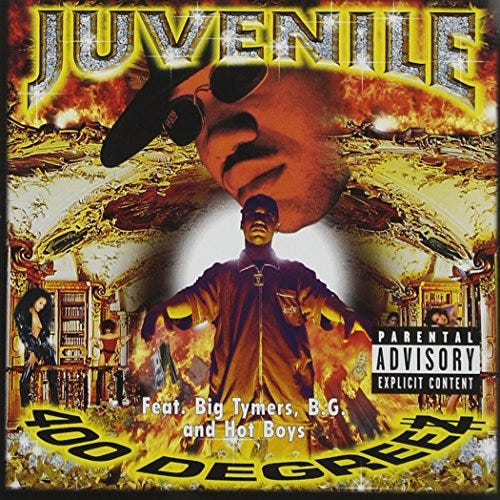
By 1998, the dust had settled on the voracious East Coast/West Coast feud that both invigorated and contaminated hip-hop’s greatest decade, revealing the battle’s singular winner: the Dirty South.
The West floundered, 1997’s murders of 2Pac and Biggie rendering their trademark gangsta style a little too real for comfort. The East became a coast divided, with backpack revivalists assailing the celebratory excesses of the mainstream’s shiny suited indulgences.
True to the region’s rich tradition, the South won by focusing on the music. By turns innovative and immediate, soulful and ethereal, the music of the late ’90s southern invasion stormed the culture from all sides at an unrelenting clip.
New Orleans’ Cash Money Records didn’t launch the incursion; the opening salvos came from their crosstown contemporaries, Master P’s No Limit Soldiers. Nor did they garner the fawning critical acclaim showered upon the ’98 releases of Atlanta’s Dungeon Family affiliates, Goodie Mob and Outkast. But it was the emergence of the Cash Money Millionaires in the back half of the year that catapulted the South onto airwaves, dance floors, and boomin’ car systems from Atlantic to Pacific, Mexican border to Canadian.
Juvenile’s 400 Degreez was the album that opened the floodgates. The first release following an unprecedented partnership between the formerly independent label and Universal Music Group, the transcendent third offering from Cash Money’s first franchise player was lightening in a jewel case. It gave a shellshocked hip-hop nation exactly the respite it didn’t know it needed: a N’Awlins excursion.
After a brief intro establishing the album’s sound (a soulfully ethereal synth bounce), place (New Orleans’ Magnolia Housing Projects, “home of the soldiers”), and tone (down home, hood, and playfully resilient), the break through single, “Ha”, places us dead in the center of the action. In contrast to most late era gangta rap, “Ha,” is an ironically rendered cautionary tale.
Juvie’s unconventional decision to deliver the entire song in the second person proves ingenious. Not only does the sheer unorthodoxy of the approach grab us by the throat from the first bar (the first words are literally “that’s you”), it takes us from mere spectators to participants in a hustle as relentless as it is backward:
That’s you with that badass Benz, ha? That’s you that can’t keep your old lady ’cause you keep f***in’ her friends, ha? You gotta go to court, ha? You got served a subpoena for child support, ha? That was that nerve, ha? You ain’t even much get a chance to say a word, ha? I know, I ain’t trippin’, don’t your brother got them birds, ha? You wan’ bust one of them n****s’ head, ha? You ain’t scared, ha? You know how to play it, ha? I know you ain’t just gon’ let a n**** come and punk you, ha? Stunt and front you, ha? Straight-up run you, ha? You know who got that fire green, ha? You know how to use a triple-beam, ha? S*** ain’t hard as it seems ha? You keep your body clean, ha? You got a lot of Girbaud jeans, ha? Some of your partners dope fiends, ha? You don’t really want to f*** with them n****s, ha? You come up with them n****s, ha? You stuck with them n****s, ha?
Equally unorthodox is the song’s structure. By ending each line with a rhetorically questioning and sardonically mocking “ha,” Juvie, in effect makes the verses the hook, and the melodically rendered chorus the bridge.
Mannie Fresh’s propulsive production, replete with digital tics and fidgets, sets a tone of jittery tension. It resolves when the pattern we’ve come to expect is broken, and the parade of “ha”s gives way to Juvie reaffirming your unwavering, if ultimately fruitless, commitment to the game on the hook/bridge:
You a paper chaser, you got your block on fire Remainin’ a G until the moment you expire You know what it is, you make nothin’ out of somethin’ You handle your biz, and don’t be cryin’ and sufferin’
Juvie’s plainspoken dispensation of hard won wisdom grounds 400 Degreez throughout, even as Fresh’s digital orchestration often levitates. “Gone Ride with Me” delivers a hustlers’ anthem, but it’s a far cry from the mafioso aesthetic of its northern counterparts.
“Me and my people hustle just to pay the rent,” he ruefully confesses in the first verse, in route to painting a vivid picture of the deadly conflagrations that can erupt in a world where desperation surrounds desperation. The weight of Juvie’s étouffée rich voice putting struggle to melody over Fresh’s ominous keys places him squarely in the mold of a modern day bluesman, wise and weary well beyond his 23 years.
“Ghetto Children” lands even more squarely in the southern blues tradition, with Juvie laying bare the cost of aspiration. He nimbly contrasts the life to which he aspires with the specter of death with which he’s willing to dance to attain it.
“Follow Me Now” embodies the eclecticism of New Orleans’ music scene, riding the cha-cha shuffle of Tito Puente’s Latin jazz standard “Oye Como Va” to one of the album’s most accessible moments. Juvie synchs his delivery to the interpolation’s mellifluous keys, giving them a sing-songy feel. The delivery makes his casually dropped truth bombs about roadblocks in route to the come-up go down like a spoonful of molasses syrup.
It might be Fresh’s finest moment on the album, his double time percussions adding urgency to Puente’s mellow groove, while the horns that creep in with chorus place it firmly in the NOLA tradition. Descending organ keys add a layer of bluesy grit to the second verse as a counterbalance to the “Oye” keyboards, as if to convey the struggle that fuels the aspiration.
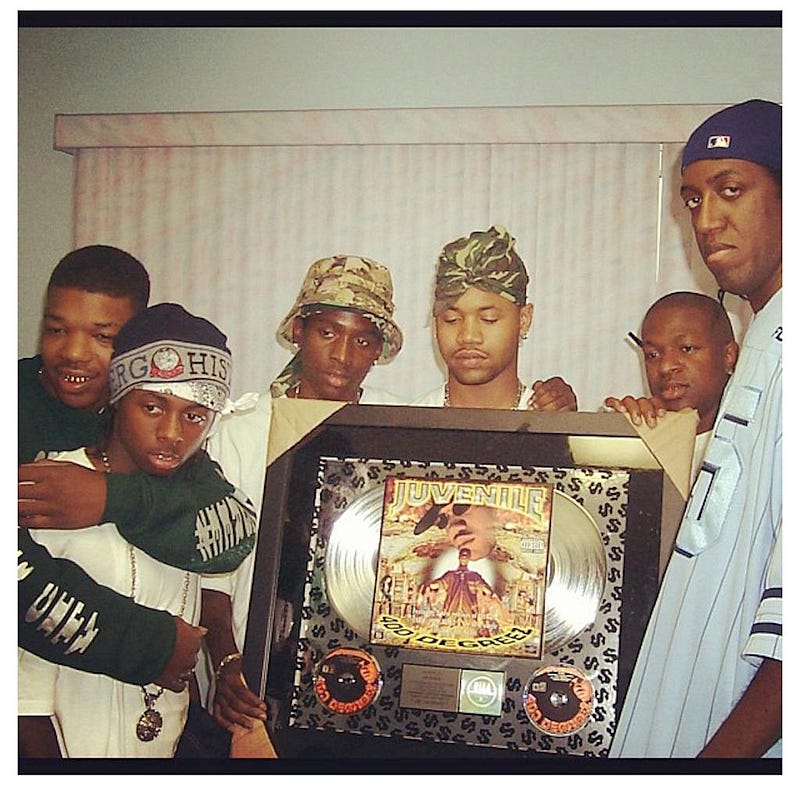
“Follow Me Now” is one of two moments where 400 Degreez’s gumbo of finely seasoned sounds coalesce into near perfection. You’ll recognize the second the moment the pulsating keyboards begin their ominous build. Given the 13 seconds that Fresh allows the keys to mount tension, the uninitiated could be easily forgiven for expecting a heart pounding street narrative. But when the first drum kicks, it’s clear this throw down is headed straight for the dance floor.
In the context of the album, “Back That Azz Up” is the cathartic moment of carnal escapism amidst the 24/7 grind of a hustler on the come up. We’re not reconciling the past or planning for the future, we’re fully in the moment, every fiber of our being thrown with frenetic abandon into a grind of a different kind.
You got a stupid ass, yeah, make me laugh, yeah Make a n**** wanna grab that, autograph that I’m sweating on the draws, yeah, aw Lawd, yeah Wanna walk it like a dog, yeah, break you off, yeah Get mine, you gon’ get yours, yeah, that’s for sure, yeah You f***in’ with my nerves, yeah, to the curb, yeah
Juvenile’s biggest hit was the subject of much derision when Rolling Stone magazine awarded it a much deserved spot on their 500 Greatest Songs list. I’ll bet dollars to crawdads that none of the naysayers have ever experienced “Back That Azz Up” in a public setting. In the longstanding tradition of New Orleans funk, it’s not made for the critic’s ear or to be played through Airpods in an office cubicle.
It’s modern day juke joint music meant to be experienced over slightly distorted house speakers in a back alley dive packed past fire code with sweaty bodies compelled into lascivious motion by brown liquor and pheromones. Perhaps more tellingly, it’s one of the few tracks that can turn a prim and proper midwestern college bar into a back alley dive, with even the most stridently empowered Women’s Studies major calling her bespectacled dance partner “big daddy” by the time the second chorus hits.
Clocking in at 73 minutes, 400 Degreez shares the affliction of overstuffing that plagues many (most?) of its late ’90s counterparts. Some of it is earned. As the first Cash Money release of the Universal deal, it not only carried the burden of having to introduce Juvenile to the masses, but the entire crew.
A 15 year old Lil Wayne proves electric on the galvanic “Run for It,” his cartoonish vocal pitch proving the perfect counterpoint to Juvie’s seasoned drawl. Turk stands out with a measured delivery that cuts through the rowdy bounce of “Welcome 2 That Nolia” and a seemingly effortless ability to paint vivid pictures with an economy of language. “Flossin’ Season” highlights the chemistry of the entire crew, with future star B.G. stealing the show with his bourbon smooth flow.
But a few of the later tracks like “Off the Top” and “Juvenile on Fire” feel like lesser retreads of previously covered ground. And were three versions of “Ha” really necessary, especially considering Jay-Z’s refusal to comply with the song’s titular motif on his remix? Isn’t that what maxi singles were for? As a result of the bloat, the album feels more like a series of snapshots of the same scenery from different angles than a cohesive journey.
Still, in many ways, it’s the defining album of the southern invasion; the coronation of the Dirty South as the dominant force in hip-hop. By commandeering clubs and airwaves in the Northeast, it also exposed the loose thread in the shiny suits of the jiggy era that ultimately lead to its unraveling.
For all its bounce and bling, the Cash Money aesthetic is rooted in blues and soul, in all their visceral humanity. The ultimately empty opulence of Puff Daddy’s Bad Boy formula suddenly felt hollow by comparison. It’s no coincidence that the first step in Jay-Z’s gradual migration back to a more soulful style, Vol. 3… Life and Times of S. Carter, featured a heavy dose of southern seasoning, including a guest appearance from Juvenile.
Like the city that provides the inimitable backdrop for Juvenile’s rhymes, 400 Degreez crackles with a palpable life force, at once real and surreal. It’s perennially in the moment, soaking in its surroundings like the humidity itself; both oppressive and soul sustaining. As a result, it transcends the uniquely transformative moment that it will forever embody.
By the Numbers
Production: 9.5 Lyrics (how the words are put together): 8.5 Delivery & Flow: 8.5 Content (Substance): 8 Cohesiveness: 7 Consistency: 7.5 Originality: 9 Listenability: 9 Impact/Influence: 9 Longevity: 8
Total — 84
Next
Previous
SEE ALL..
Backspin is a look back at the albums that shaped and defined hip-hop. It explores what made them resonate, the impact they had on the culture, and where they fit in today’s ever-expanding hip-hop canon.