
Backspin: Big Daddy Kane — Long Live the Kane (1988)
Big Daddy Kane sired swagger in an effortlessly confident debut. (88.5/100)
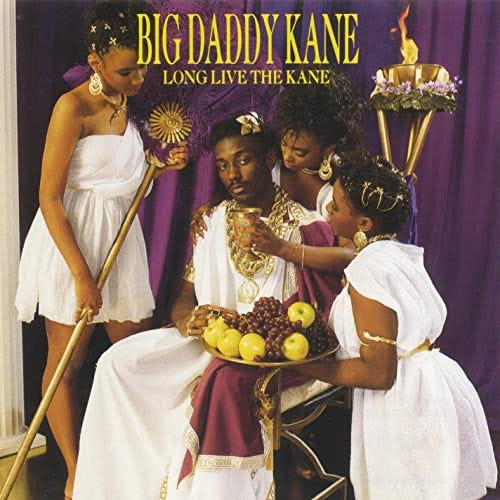
When hip-hop came of age at the zenith of the Golden Era, an elite cadre of artists embodied the fundamentals of what the genre, in its adulthood, would look like. Rakim brought the technique. Public Enemy brought the ideology. KRS-One brought the philosophy.
Big Daddy Kane defined the attitude. Simply put, Kane is the father of swagger.
Plenty of rappers flexed bravado prior to Big Daddy Kane’s electric debut. Boastful machismo had been bountiful in the larger than life rhymes of microphone masters from Melle Mel to LL, asserting their prowess as the lyrical bullies on the block. But Kane infused his brash boasts with an indelible combination of easy charisma and dismissive condescension that made it feel like his outclassed opponents didn’t even belong in his zip code. It fundamentally evolved the persona of the MC.
Long Live the Kane, his now iconic debut, is a clinic in cool. The title track is an immaculately crafted tone setter, thanks as much to Marley Marl’s funk fried production as Kane’s microphone mastery. Marley expertly melds a pair of Meters samples to place Kane in the lineage not just of ’80s sweat suited b-boy fly, but of the zoot suited cool of the ’70s that wove its way into the DNA of urban masculinity for decades to come. The double time drum break from “Here Comes the Meter Man” is crisp enough to provide a wicked rhythm to ride, but offers just enough open space for Kane’s personality to play.
For his part, Kane, immediately distinguishes himself from his illustrious Golden Era peers with with a lyrical assault seemingly as effortless as it is ferocious. He rarely breaks a sweat while extending rhyme patterns to near infinity, only to switch schemes with the ease of a luxury sports coupe.
Party people in the place Embrace the bass as I commence to pick up the pace And make you motivate, and accelerate ’Cause like Tony the Tiger, I’m grrrrrreat! Always seem to come off, hard for you somehow I mean, me being wack? Oh come, come now That’s quite ridiculous, so just admit you was Thrilled, it’s on your face, and it’s conspicuous
While “Long Live the Kane” provides plenty of runway, it’s the next two iconic tracks where Big Daddy Kane truly ascends to rarified air. “Raw”, the lead single, is Kane’s equivalent of “Eric B. For President”. Where “Eric B. For President” was Rakim’s inauguration of the methodology that would define MCing for the Golden Era and beyond, “Raw” is Kane’s coronation of the style with which countless descendants would strive to execute said method.
With its 1987 release, “Raw” established Kane as the first bona fide rival to come through the door behind Rakim after The God revolutionized MCing a year prior. Kane rhymed with a similar calm and sophistication, unfurling multi-syllabic rhymes with smirking nonchalance.
But if Rakim was Bruce Lee, a master technician landing lethal blows in meticulous combinations, Kane was James Bond: a smooth operator who got the job done through mastery of craft, to be sure, but also relished in deploying state of the art lyrical gadgetry. His tool kit was fully equipped with clever punchlines and timely pop culture references. Vocal inflections and verbal tricks (in this case clearing his throat by way of growling the word “alllll”) are cannily placed as “dismounts” to highlight the level of skill deployed prior.
I work like a slave to become a master And when I say a rhyme, you know that it hasta Be perfectly fitted, cause I’m committed The entertainer and trainer and Kane’ll get with it I go, and flow, and grow to let you know I damage ya, I’m not an amateur, but a pro- -fessional, unquestionable, without doubt superb So full of action, my name should be a verb My voice will float on every note When I clear my throat, that’s allllll she wrote!
“Set It Off” continues the lyrical acrobatics while accelerating the already breakneck tempo set on “Raw”. Marley Marl uncorks 120 BPMs of aural amphetamine, topping a relentless drum loop from Grady Tate’s “Be Black Baby” with a piercing guitar stab from James Brown’s “Get Up, Get Into It, Get Involved”.
Kane delivers a clinic on rhyming with speed without sacrificing control. His cadence, timing, and enunciation remain impeccable. Even while landing his rhyming syllables precisely on the snares, he finds (or creates?) pockets in which to settle, making everything between the rhymes feel leisurely. It’s as if he’s making the track ride him, and then rubbing it in by boasting “e-e-e-ven if I stutter, I’ma still come off” only to land right back on the beat.
Though Kane set the gold standard for uptempo flows, it’s the mid-tempo menace of “Ain’t No Half Steppin’” over which he delivers his coup de grâce. In Marley’s masterful hands, the delicate keys from The Emotions’ “Blind Alley” suddenly sound ominous when paired with washed out wind instrumentation reminiscent of the air raid sirens that open Public Enemy’s It Takes a Nation of Millions to Hold Us Back. The deliberate pacing and atmospheric sonics provide Kane’s persona space to steep. Each syllable cuts like, well, a Ginsu (Why strain for a simile when Kane has already provided the perfect one?) as he dissects not only his opponents, but the elements of his own lyrical supremacy.
Rap Prime Minister, some say sinister Non-stoppin’ the groove until when it’s The climax and I max, relax and chill Have a break from a take of me actin’ ill Brain cells are lit, ideas start to hit Next the formation of words that fit At the table I sit, makin’ it legit And when my pen hits the paper, awww s***! I stop and stand strong over MCs And devour with the power of Hercules Or Samson, but I go further the length ’Cause you could scalp my Cameo and I’ll still have strength And no, that’s not a myth, and if you try to riff Or get with the man with the given gift Of gab Your vocab, I’ll only ignore Be sleepin’ on your rhymes ’til I start to snore (Zzzzz) You can’t awake me, or even make me Fear you, son, ’cause you can’t do me none
Kane’s charisma proves just as commanding when he allows his lighter side to come out and play. “Just Rhymin’ with Biz” is hip-hop in its purest form as Kane trades spirited verses with his good friend, the late Biz Markie, over a bare bones drum machine beat. The free association silliness of Biz’s opening salvo proves the perfect set up for Kane’s densely packed lyrical exhibition.
Hip-hop lure has long held that “Just Rhymin’” originated from a tape of the two Juice Crew MCs simply goofing around, kicking improvised rhymes. Whether urban legend, canny marketing scheme, or stone cold fact, the story circulated through New York’s tri-state area like a commuter train in 1987. The buzz not only made Biz’s boy the most anticipated MC since Rakim, but fundamentally changed the perception of what it meant to “freestyle”.
Through the mid-80s, a freestyle was simply a non-topical rhyme that the MC had yet to spit publicly. According to Kool Moe Dee’s book, There’s a God on the Mic, “off the dome” MCs were generally met with disdain by lyrical heavyweights, who viewed the improvisation as a crutch to take the pressure off a subpar pen game. After Kane’s ferociously impromptu barrage, the paradigm flipped, and true MCs were expected to possess improvisational acumen on par with their writing.
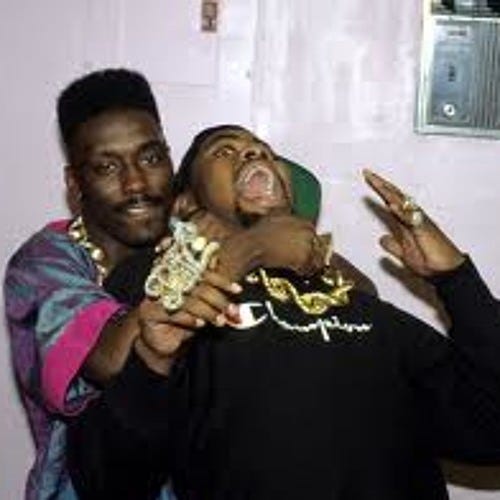
Kane’s “Just Rhymin’” boasts proved so potent, he recycled a portion of his verse for Long Live the Kane’s posse cut, “On the Bugged Tip,” on which he lets back up dancers, Scoop and Scrap, share the mic. As filler tracks go, it’s passably entertaining, thanks to the playful bounce of the sampled loop from Fab 5 Freddy’s b-boy burner “Down By Law” and the carefree chemistry between the three rappers. But, it’s clearly filler nonetheless.
In possibly its most overlooked innovation, Long Live the Kane is, perhaps, the first (or at least the first first notable) hip-hop album to deploy the formula that Big Daddy’s Brooklyn descendants The Notorious B.I.G. and Jay-Z would later perfect of providing something for everybody.
A year removed from LL Cool J’s chart topping, “I Need Love”, Kane shot his own romantic arrow on “The Day You’re Mine”. On paper, Kane, with his warm baritone and suave delivery, was a perfect fit for rap balladry. On wax, “The Day You’re Mine” is an unmitigated disaster. Rife with Hallmark cliches and saccharine platitudes, the dumbed down rhymes pull Kane out of character rather than expanding on his persona. We don’t want Kane as a lovelorn romantic, we want him as the debonair playboy that he would successfully inhabit on 1989’s legendary “Smooth Operator”.
An obligatory conscious track, the utopian-waxing “I’ll Take You There”, similarly flounders. Kane jettisons his cocky delivery for a carefree lilt carrying shades of Slick Rick’s “Hey Young World.” While the wide-eyed idealism works in the context of Rick’s fantastical world of wonder, from Kane it rings hollow. The sampled voice of Mavis Staples earthily crooning “Big Daddy” on the hook is easily the most entertaining part of the song, but also raises the dispiriting possibility that the entire raison d’être of Kane’s “I’ll Take You There” is to sample the Staples’ original.
To his credit, Kane’s second attempt at consciousness, “Word to the Mother (Land)” is far more organic. Its Afrocentric ethos foreshadows an element of his repertoire hinted at in his moniker (“King Asiatic, Nobody’s Equal”) and expanded upon on subsequent releases. It closes the album on a third-eye opening note befitting the burgeoning social awareness of late ’80s hip-hop.
Big Daddy Kane was ahead of his time, and ultimately suffered for it. It’s standard practice today for mainstream hip-hop artists to aggressively court the female audience with love ballads and club bops. But the harder Kane leaned into his loverman tendencies in the early ’90s, the more he was shunned by the diehards who worshiped at his alter only a couple of years prior. As a result, his legacy is truncated, limited mainly to Long Live the Kane and 1989’s It’s a Big Daddy Thing.
Yet, his DNA is alive and well in chart toppers and underground kings alike from every generation since. Biggie’s sardonically suave slow flow on “One More Chance/Stay with Me?” Pure Kane. Ditto for Eminem’s warp speed syllable strings. Every fiber of Jay-Z’s laconically condescending being is steeped in the stylings of the original Brooklyn GOAT at whose side he apprenticed.
What’s now commonly defined as “swagger”, in 1988 was simply known as Big Daddy Kane.
By the Numbers
Production: 8.5 Lyrics (how the words are put together): 10 Delivery & Flow: 9.5 Content (Substance): 8.5 Cohesiveness: 8 Consistency: 7 Originality: 9 Listenability: 9 Impact/Influence: 10 Longevity: 9
Total — 88.5
Next
Previous
SEE ALL
Backspin is a look back at the albums that shaped and defined hip-hop. It explores what made them resonate, the impact they had on the culture, and where they fit in today’s ever-expanding hip-hop canon.


