
Backspin: Eric B. & Rakim — Paid In Full (1987)
Eric B. & Rakim’s seminal debut is a masterclass in technique and a paean to process. (91.5/100)
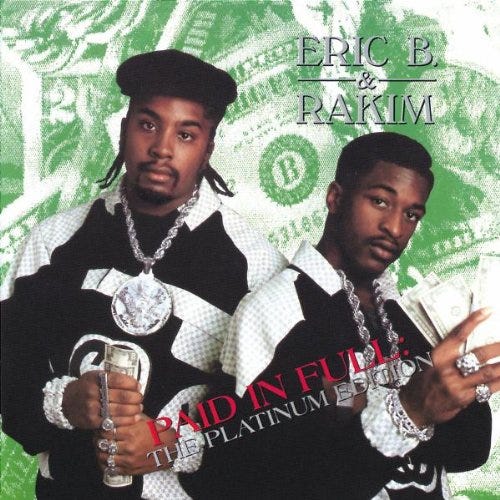
Like the Gregorian calendar, the art of MCing can be divided into two eras. There’s BR: Before Rakim. And, as with the calendar, there’s Anno Domini (AD), “in the year of our lord.” In this case The God is the man who single handedly redefined the MC’s relationships with his pen, his microphone, and his audience.
I’m not going to rehash what Rakim did that revolutionized emceeing. A cursory Google search will return a veritable library of content expounding upon his innovations. Instead, I want to highlight the oft-overlooked how. Because at its soul, beneath the cerebral boasts and intricate syllabic tapestries, Eric B. & Rakim’s seminal debut album is an ode to process. Paid In Full is equal parts dissertation, instruction guide, and love letter to the craft of MCing.
Rakim tipped his hand almost immediately on “Eric B. for President.” Eric B. & Rakim’s 1986 debut single is ostensibly a party rocking tribute to the duo’s DJ half. But tucked impeccably into the crevices of Marley Marl’s infectious track is a meticulously detailed and poetically rendered depiction of the synergistic chemistry between MC, DJ, and audience that inspired a generation to devote their lives to hip-hop culture:
Eric, be easy on the cut, no mistakes allowed ’Cause to me, MC means move the crowd I made it easy to dance to this But can you detect what’s coming next from the flex of the wrist? Say “indeed” and I’ll proceed, ’cause my man made a mix If he bleed, he won’t need no band-aid to fix His fingertips sew a rhyme until there’s no rhymes left I hurry up because the cut will make ’em bleed to death But he’s kickin’ it, ’cause it ain’t no half stepping The party is live, the rhyme can’t be kept inside
By ’86, countless MCs had spit clever couplets about rocking parties, but Rakim brought a level of detail and precision that was every bit as exacting as the interior rhymes schemes for which “Eric B. for President” is most often lauded. Marley Marl utilizes the flawless syncopation of Rakim’s syllables like an additional percussion on the track, making it easy for partygoers to dance right past the lyrical sophistication. It’s the single’s B-Side, “My Melody,” which thrust Rakim to the forefront. He not only rose to the occasion, but brought the bar for elite MCing with him.
Clocking in at nearly 7 minutes, “My Melody” could just as easily be called “My Methodology,” as Rakim unspools his approach to the art of MCing over the course of five exactingly constructed verses.
Rappers of previous generations were fabulists, making their names with larger than life boasts of seemingly superhuman powers of rhyme. Clever rhymes, they seemed to imply, simply came to them as if divined by the power of their sheer magnificence. Or in the words of Run, “I just made the motherf***ers up last night.”
Rakim’s boasts are grounded in the truth that, as with any true art form, emceeing is not easy. Like a martial arts master, he espouses preparation, discipline, and attention to detail as part and parcel of a never ending path toward excellence. In the third verse, he offers a masterclass on the power of patterns, both stringently adhered to and judiciously broken.
Rhymes are poetically kept and alphabetically stepped Put in a order to proceed with the momentum, except I say one rhyme out of order, a longer rhyme or shorter Or pause… But don’t stop the tape recorder
Later in the track Rakim introduces the 7 Emcee Theory, on which he would expound throughout his career. The ethos reveals that even his approach to battling is strategic, carefully constructed to maximize economy of motion while taking out the greatest volume of challengers.
I take seven emcees, put ’em in a line And add seven more brothers who think they can rhyme Well, it’ll take seven more before I go for mine Now that’s twenty-one emcees ate up at the same time
In his book There’s a God on the Mic, Kool Moe Dee, the closest figure Rakim has to a stylistic forefather, describes “My Melody” as “the official coronation of the paradigm shift” in rapping. If “My Melody” created the new paradigm, “I Know You Got Soul” defined it.
“I Know You Got Soul” feels like the hip-hop equivalent of Magic Johnson’s Game 6 of the 1980 NBA Finals: a young virtuoso harnessing his prodigious talents and assuming the captain’s mantle to secure his first title. A clinic in the power of open space (the “pause” alluded to in “My Melody”), “I Know You Got Soul” finds Rakim in complete control of all his surroundings - not only the stuttered drum loop and slowed Bobby Bryd sample, but also the listener. He literally provides a process by which we will consume the record with every bit the detail used to describe its construction.
So you sit by the radio, hand on the dial, soon As you hear it, pump up the volume Dance with the speaker ‘til you hear it blow Then plug in the headphone, ’cause here it go It’s a four letter word, when it’s heard it control Your body to dance (You got it) soul
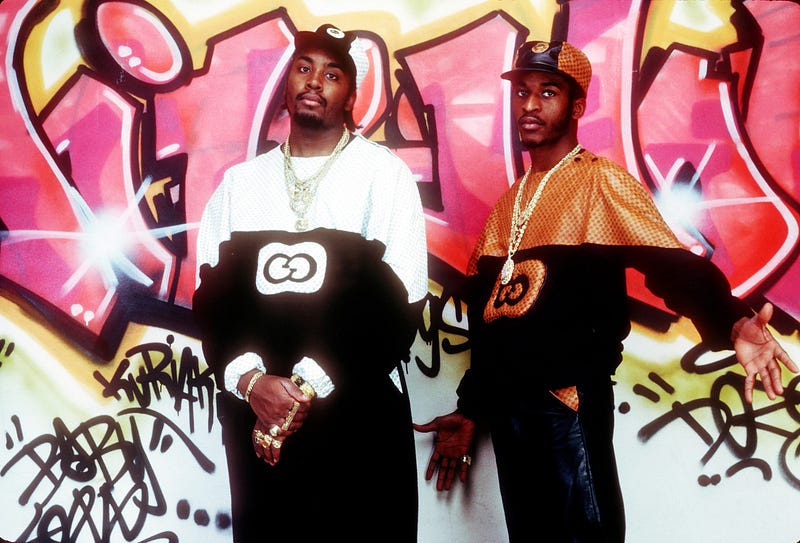
The song’s opening verse also provides the most forceful use of the technique Rakim flirted with on “My Melody” of rhyming the middle sections of his sentences. The technique, which became common place in the AD era, not only added fluidity to rappers’ flows, but also to the verses themselves, allowing for thoughts to unfurl naturally, rather than in the choppy fragments common in early ’80s raps.
All three of the aforementioned classics hit dance floors and airwaves well before Paid In Full hit shelves in July of 1987. So, in a sense, the first true single from the album was “I Ain’t No Joke,” which proved to be Rakim’s most relentless lyrical assault yet. As the title suggests, beneath the bravado lies a testament to the seriousness with which Rakim approaches his craft. Contrasting his approach to that of his competitors, Rakim presents himself “in deep concentration, cause I’m no comedian,” while “jokers are wild,” and to be dismissed like children.
Rakim’s evangelizing of MCing as craft represented the first step in hip-hop’s emergence into adulthood. To sustain the genre’s continued growth, a fundamental evolution out of the park jam mindset, upon which it had gained its first foothold, was required. There’s a time and place for throwing your hands in the air and waving them like you just don’t care. But there comes a point when the practitioners of an art form have to care enough to begin moving strategically.
The title track and final single provides the loan lyrical departure from Rakim’s treatise on MCing. Beginning as a relatable story of the timeless early adulthood struggle to find purpose while making ends meet, “Paid In Full” quickly takes shape as a roadmap. Turning his methodical approach to lyricism toward life, Rakim concisely lays down the blueprint for transitioning the mentality of the street hustle into building the art of hip-hop into a viable path to prosperity. It’s a model that has been followed in studios and boardrooms for nearly four decades and counting, as hip-hop continues to expand its reach in the corporate worlds of entertainment, media, and commerce.
Thinkin’ of a master plan ’Cause ain’t nothin’ but sweat inside my hand So I dig into my pocket, all my money’s spent So I dig deeper, but still comin’ up with lint So I start my mission, leave my residence Thinking, “How could I get some dead presidents?” I need money, I used to be a stick-up kid So I think of all the devious things I did I used to roll up: “This is a hold-up, ain’t nothing funny Stop smilin’, be still, don’t nothing move but the money” But now I learned to earn, ’cause I’m righteous I feel great, so maybe, I might just Search for a 9 to 5, if I strive Then maybe I’ll stay alive So I walk up the street, whistling this Feelin’ out of place ’cause, man, do I miss A pen and a paper, a stereo, a tape of Me and Eric B and a nice big plate of Fish, which is my favorite dish But without no money, it’s still a wish ’Cause I don’t like to dream about gettin’ paid So I dig into the books of the rhymes that I made So now’s a test to see if I got pull Hit the studio, ’cause I’m paid in full
The two Eric B. DJ cuts, disruptive in ’87, are borderline unlistenable in the 21st Century, and you’d be hard pressed to find a single listener who routinely sits through the closing “Extended Beat.” Still, the highs of Paid In Full soar to such heights that even significant warts only feel like minor blemishes. Unless you’re a hopeless completist (guilty as charged), simply remove those three tracks from your phone and you’re essentially left with hip-hop’s greatest EP.
A rarity for 1987 releases, the album actually does benefit from being consumed as a full body of work, as motifs reappear throughout, connecting songs and providing a fuller understanding of Rakim’s Jedi level approach to his art. “My Melody”’s 7 MC theory is deftly called back in “I Ain’t No Joke” as a form of shorthand, while “Eric B. Is President”’s definition of an MC is expanded upon with a full track - “Move the Crowd.”
I almost excluded Paid In Full from the Backspin series. It felt like everything there was to say about it had already been said, often by people far more knowledgable and eloquent than I am. But, a series purporting to chart the story of hip-hop’s formative years through analysis of seminal albums simply wouldn’t be complete without it.
Not only did it raise the bar for the output we expected from MCs, it also elevated the level of input that was expected of them if they wanted to be taken seriously as craftsmen. It even forced us to become more sophisticated as listeners, as verses rewarded close attention and cerebral dissection.
That thousands of MCs in the following decades have taken Rakim’s template and run with it in every imaginable direction is a testament to his vision. That his impeccable technique on Paid In Full is just as mesmerizing as it was when we first heard it, despite the countless machinations served up by his successors, is a testament to his mastery.
By the Numbers
Production: 8 Lyrics (how the words are put together): 10 Delivery & Flow: 10 Content (Substance): 9 Cohesiveness: 8 Consistency: 7.5 Originality: 10 Listenability: 9 Impact/Influence: 10 Longevity: 10
Total — 91.5
Related
Next
Previous
SEE ALL..
Backspin is a look back at the albums that shaped and defined hip-hop. It explores what made them resonate, the impact they had on the culture, and where they fit in today’s ever-expanding hip-hop canon.


