
Backspin: Beastie Boys — Licensed to Ill (1986)
Is the ‘80s’ top selling rap album a hip-hop high mark, or necessary evil? (75.5/100)
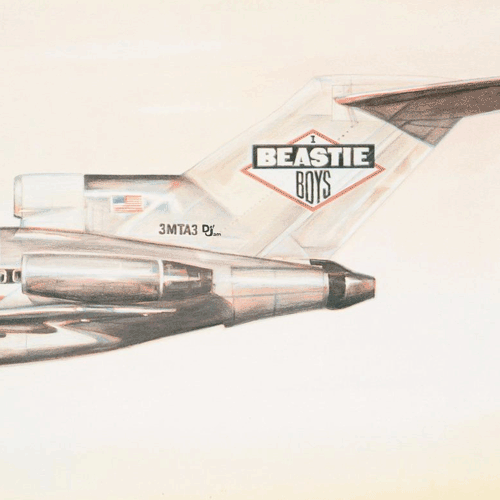
Let’s move the elephant out of the corner and into the center of the room. Licensed to Ill is the embodiment of white privilege.
Three white upper middle class punk rockers stumble ass backwards into an art form created by inner city Black and Latino youth out of turntables, old records, and ingenuity in lieu of the resources that enabled their monied counterparts to pursue traditional instrumentation. The rocker dudes land an album deal with the urban art form’s hottest label off the strength of a parody single (“Cookie Puss”). They score some of the best beats from one of the genre’s preeminent producers (also a white guy), pepper them with rudimentary rhymes and awkwardly appropriated slang, and ride their whimsical lark to the biggest selling album of the genre’s inaugural decade on wax.
It’s a painfully familiar story played out over and over again in nearly every facet of American life. It was also essential in hip-hop’s evolution from stigmatized niche art form to driving force of popular culture.
By 1986, white America was already familiar with rap music. Hipsters had embraced its dynamic sounds and clever lyricism in underground clubs in coastal cities. A handful of crossover records had earned rotation on middle America’s still dominant Top 40 radio. Earlier that year, Run-DMC had even positioned the rapper as rock star with their multi-platinum Raising Hell album.
But while the genre’s white fanbase was broadening, it wasn’t necessarily deepening. White fans enjoyed rap music, but didn’t yet have skin in the game (so to speak). With the exception of a handful of early adopting New Yorkers, they absorbed the culture from the outside looking in. The rhythms, the styles, the slang were exciting, but foreign. In the Beastie Boys, they could finally see themselves as active participants; not just on the fringes, but the main stage.
Licensed to Ill isn’t just a hip-hop album by a white group, it leans all the way into its whiteness. “Rhymin’ & Stealin’” blasts the album off with a massive breakbeat, but it isn’t cribbed from the R&B and disco crates that had provided the rhythms for most early hip-hop. It comes instead from Led Zepplin’s hard rock staple “When the Levees Break,” offering an instant sense of familiarity to palates trained on college radio rather than Soul Train.
As big as the drums are, the guitars are even more massive; possibly the loudest unleashed on a hip-hop track to that point. The sonic blast is as infectious as it is jarring, practically daring even the most die hard hip-hoppers to head bang like metal moshers.
The rhymes, yelled over the guitars rather than flowed atop the beat, revel in the absurd rather than the aspirational, as was characteristic of traditional hip-hop boasts. Pop culture references are interspersed with characters from children’s lore, creating a drunken Pee-Wee’s Playhouse in which frat boys and suburban teens could feel instantly orientated.
I’ve been drinking my rum, a def son of a gun *I fought the law* and I cold won Blackbeard’s weak , Moby Dick’s on the chicks Cause I pull out the jammy and squeeze off six My pistol is loaded, I shot Betty Crocker Deliver Colonel Sanders down to Davey Jones’ locker Rhymin’ and stealin’ in a drunken state And I’ll be rockin’ my rhymes all the way to Hell’s gate
Producer Rick Rubin serves up more traditional hip-hop soundscapes on the album’s early singles, allowing Mike D, Ad-Rock, and MCA to trade oddball rhymes over dynamic collages of familiar samples.
“Hold It Now Hit It” showcases the Beasties’ undeniable vocal chemistry over Bob James’ tried and true “Take Me to the Mardi Gras,” further seasoned with snippets from seminal hip-hop classics like “La Di Da Di” and “Christmas Rappin’.”
“The New Style” offers arguably the album’s most rhythmically precise display of flow, with the rappers dropping unrelenting bars over the instantly recognizable “Two, Three, Break” beat that was already ubiquitous in B-Boy circles. Rubin introduces the rock element judiciously, dropping a piercing AC/DC riff as sonic punctuation, just as he did on LL Cool J’s vastly superior “Rock the Bells”. It was an ingenious choice, allowing hip-hoppers to acclimate to the Beasties’ unconventional vocal tones and lyrical content within the confines of familiar sounds, while providing rockers just enough comfort food to orient them in this “new” style of music.
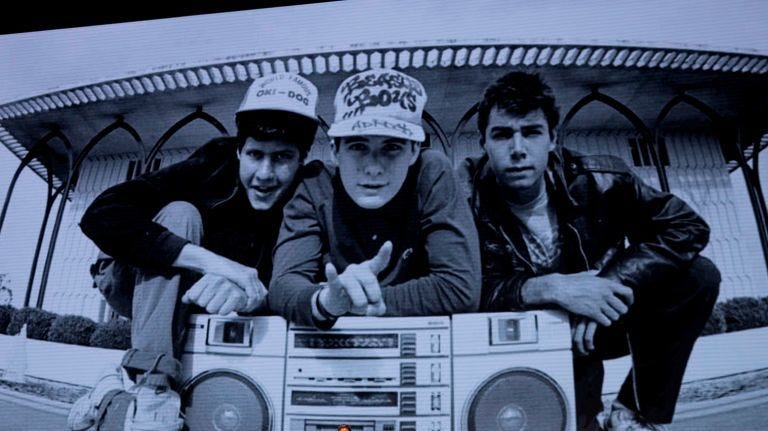
But if the aforementioned tracks played like well executed novelty excursions, it was “Paul Revere” that hinted these petulant punks might have something beyond Rick Rubin production, cheeky wit, and an undying affection for White Castle.
A preview of the zany surrealism that defined the Beasties’ sophomore masterpiece Paul’s Boutique, “Paul Revere” weaves a tall tale of an origin story about how the three rappers came together. Unsurprisingly, it involves beer.
I had a little horse named Paul Revere Just me and my horsy and a quart of beer Riding across the land, kicking up sand Sheriff’s posse’s on my tail, ’cause I’m in demand One lonely Beastie I be All by myself without nobody The sun is beating down on my baseball hat The air is gettin’ hot the beer is getting flat Lookin’ for a girl I ran into a guy His name is MCA, I said, “Howdy” he said, “Hi”
He told a little story that sounded well rehearsed Four days on the run and that he’s dying of thirst The brew was in my hand and he was on my tip His voice was hoarse, his throat was dry, and he asked me for a sip He said, “Can I get some?” I said, you can’t get none Had a chance to run He pulled out his shotgun Quick on the draw, I thought I’d be dead He put the gun to my head and this is what he said
“Now my name is MCA, I’ve got a license to kill I think you know what time it is, it’s time to get ill Now what do we have here, an outlaw and his beer I run this land, you understand, I’ve made myself clear” We stepped into the wind, he had a gun, I had a grin You think this story’s over but it’s ready to begin
Where many of the album’s rhymes feel self conscious and forced, on “Paul Revere,” the Beastie Boys sound comfortable in their skin, adapting the conventions of hip-hop to their sensibilities rather than belligerently appropriating an over-the-top caricature of rap verbiage.
Similarly organic, “No Sleep Till Brooklyn” provides another highlight. The Beasties’ high octane irreverence is perfectly suited to the free wheeling ode to life on tour, while Slayer guitarist Kerry King’s high decibel shredding captures the potent mix of testosterone and adrenaline fueling the antics described in the lyrics.
It proved fortuitous that Rubin was producing Slayer and the Beasties concurrently, greasing the skids for King’s involvement in Licensed to Ill. His blaring power chords are integral to the frat house energy that made “Fight for Your Right to Party” the album’s breakout hit.
I would argue that “Fight for Your Right to Party” is not actually a hip-hop record at all, but rather a rock song with rapping. Like most of the entries into the “rock rap” subgenre that the song would spawn (see “Bizkit, Limp”), it’s not particularly good . But it does capture a unique brand of angst that seems to afflict millions of privileged suburban males around the time puberty hits. As a result, “Fight for Your Right” became a staple in Walkmen on school buses across the country and frat houses on countless campuses long after its run at the top of the charts, bringing the entirety of the album with it.
Was it a bit rankling to see a lightweight, if fitfully entertaining, album embraced as the holy grail of hip-hop by a subset of cultural outsiders seemingly a little too eager to co-opt the rebellious attitude of hip-hop detached from the urban culture out of which it grew? Of course.
By November of 1986, when the album hit shelves, Eric B. & Rakim, Boogie Down Productions, and Ultramagnetic MCs had already dropped watershed singles introducing a nuanced sophistication in flow and lyricism that rendered the Beasties’ raps downright remedial.
But the Beastie Boys primed the pump. Their raucous rhymes prepared white suburban teens for the in-your-face attitude of N.W.A and the sonic assault of Public Enemy. As hip-hop continued to grow into music’s biggest selling genre and the driving force behind popular culture in decades to come, those same white suburban teens would emerge as its biggest consumers. How many of them would have cold copped up a tape of It Takes a Nation of Millions to Hold Us Back had the Beastie Boys not given them agency in the genre and culture? The Beasties directly introduced many of them to Public Enemy, who served as an opening act on the 1987 Together Forever tour.
It’s a testament to the Beastie Boys that after touring with the likes of PE and Run-DMC, they appeared to grow a genuine respect for the art form they entered as a goof. With Paul’s Boutique, they seemingly went to great pains to create an album that embodied the essence of hip-hop, with its intricate tapestry of dusty samples and imaginative lyricism. The sophomore effort doubled down on the group’s knack for clever turns of phrase in place of the bratty bromide that grows grating by the end of Licensed to Ill’s run time. In a career that has since spanned over three decades, the Beasties have evolved into global ambassadors for hip-hop, while crafting a consistently creative body of work.
So perhaps Licensed to Ill’s true place in the hip-hop canon is as the necessary evil that enabled the genre to reach heights of commercial and cultural ubiquity that its ingeniousness warranted, but its hue would likely have continued to stifle. That surely merits a lifetime license for the Beastie Boys to get as will as they wish. I’ll even spring for the beer.
By the Numbers
Production: 9 Lyrics (how the words are put together): 4 Delivery & Flow: 6 Content (Substance): 5 Cohesiveness: 9 Consistency: 7 Originality: 8.5 Listenability: 7 Impact/Influence: 10 Longevity: 10
Total — 75.5
Next
Previous
SEE ALL..
Backspin is a look back at the albums that shaped and defined hip-hop. It explores what made them resonate, the impact they had on the culture, and where they fit in today’s ever-expanding hip-hop canon.


