
Backspin: Westside Connection — Bow Down (1996)
Was Ice Cube, Mack 10, and WC’s clap back gangsta rap’s call to arms or its swan song? (78.5/100)
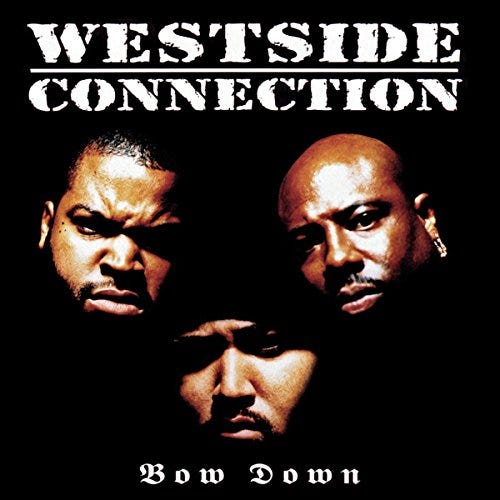
When Westside Connection dropped Bow Down square in the middle of 1996’s fractious hip-hop landscape, it felt like a landmark moment. The funk fueled west coast gangsta rap that had driven hip-hop to the top of the charts and the forefront of the cultural zeitgeist over the past 8 years was suddenly taking fire from all sides. A new generation of hood minted New York MCs were agitating to move the gravitational center of the genre back to its birthplace, and taking the fight directly to the chin of west coast icons. Additionally, a rising wave of traditionalists were loudly denouncing and savagely mocking gangsta rap’s tried and true tropes.
Perhaps most tellingly, the good ship gangsta was quietly taking on water. OGs like Ice-T and Ice Cube slid music to the back burner in pursuit of burgeoning Hollywood careers. Dr. Dre departed Death Row Records, casting a dark question mark over the future of both southern Cali’s definitive producer and its mightiest label. As a result, his superstar protege, Snoop Doggy Dogg, caught a resounding brick with his rudderless sophomore album. Tupac Shakur, the lone west coast rapper still commanding a national spotlight, was tragically murdered, bringing to the forefront the ugly reality behind the increasingly cartoonish violence that had grown to define gangsta rhymes.
So when left coast luminaries Ice Cube, Mack 10, and WC joined forces to form Westside Connection, their defiant debut album hit like a napalm bomb. It felt like a call to arm for a coast, a culture, and an era.
The intro quickly and clearly lays out the trio’s objectives: “world domination” and the creation of “a world word westside, making everybody bow down to the W.” The opening title track proves a formidable salvo. If Cube was guilty of sleeping walking through portions of his previous solo album, 1993’s Lethal Injection, the assault on his musical milieu was the wake up call he needed.
Here he’s fully engaged delivering the album’s inaugural verse, pairing his vintage intensity with veteran gravitas, and setting the tone for the lyrical broadside to come. After an anthemic hook, Mack-10 ratchets up the west coast swagger with a flow that seems to gangsta boogie with the track’s piercing synths. But it’s WC who proves the standout, as he does throughout much of the album. The unsung vet unleashes an elastic flow paired with a guttural ferocity befitting a minor league slugger determined to make the most of his long overdue turn at the big league plate.
While “Bow Down” has all the hallmarks of an anthem, and indeed stands as one of the definitive volleys in the coastal wars, the album’s second single is the true gem. “Gangsta’s Make the World Go Round” is a hoo-riding re-imaging of The Stylistics’ simmering slow-burner, “People Make the World Go Round.” Cedric Samson’s mid-tempo production accentuates the underlying ominousness of the original, pairing it with surgical rhymes espousing the timeless allure of the gangsta lifestyle. Who better than Ice Cube, who introduced a generation of suburban teens to the vicarious thrills of gangsta rap with N.W.A eight years prior, to start the dissertation?
I’m gettin’ dizzy as the world keeps spinnin’ like a Frisbee Gangstas and girls make the world twirl No hesitation, I can run a nation from incarceration 30 years is what I’m facin’ But give me seven seas and eleven G’s I’ll make enough cheese to bring Wall Street to its knees N**** please, I got enough guns To fill the Empire State Building full of ones “Go to school” is what you tell us But n****s in school is scared of the Goodfellas We got the yayo You can just say no But nobody makes a f***in’ move until I say so That’s how it is and that’s how it’s gonna be Kids when you grow up, who the f*** you wanna be? Like me, your black superhero Got enough zeros to hire Bob Shapiro Your Honor, I’mma have to get rid of ya Because it ain’t no trivia about my flat in west Bolivia! I blew the jury a kiss They rather dismiss Than swim with the big fish You f***in’ guppies!
Cultural significance of the gangsta firmly established, “All the Critics in New York” sets its sites squarely on the northeastern hip-hop establishment, whose condescension and open hostility has clearly worn thin on the Westside. Over a murderous track pairing thick bass with foreboding synths, the three MCs call out New York rappers attempting to minimize the west, while following its lyrical lead by jettisoning lyrical braggadocio for gritty crime rhymes. The New York based media and corporate institutions catch hot ones as well for their perceived bias toward their own.
On “Do You Like Criminals” Westside Connections shows they can court the ladies with every bit the aplomb of New York’s Versace clad Bad Boys, but without sacrificing their street swagger. Cube makes clear what he thinks of supposed hard rocks smoothing down their rough edges to appeal to the fairer sex, derisively spitting:
Don’t you want a motherf***er that’s hard? Or a b****-made n**** cute as El Debarge?
“The Gangsta, The Killa, and the Dope Dealer” offers a conceptual trick to keep the subject matter fresh, with each MC rhyming from the perspective of a different criminal archetype. The production, accented by an acoustic guitar riff from 9 Inch Nails’ “Hurt” and a slightly atonal vocal call, makes the song feel like an impending wild west showdown.
If the album’s front half offers a triumphant reminder of gangsta rap’s cultural salience and visceral power, the second half inadvertently begins to reveal its limitations. “3 Time Felon” is a standout, thanks to the immaculate mid-tempo production from Bud’da and a catchy multi-part chorus, but the remaining tracks offer increasingly diminished returns.
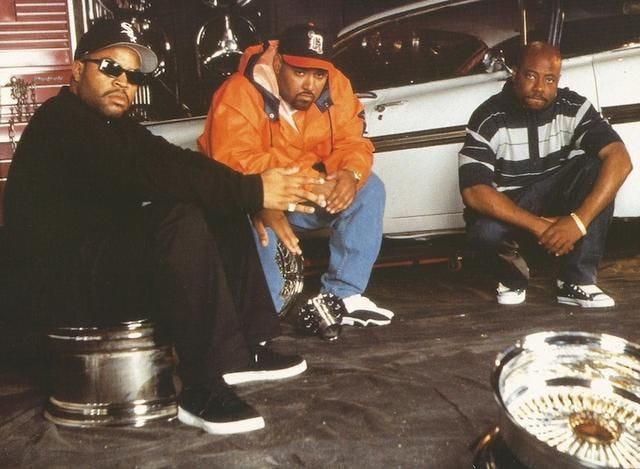
In the absence of the conceptual clarity that grounded the early highlights, the chest pounding bravado, generic threats, and endless boasts of coastal supremacy grow repetitive. When Westside Connection does name check specific adversaries for pointed rebuttals, they fall surprisingly flat.
“King of the Hill,” devotes a full song to Ice Cube’s beef with Cypress Hill, which was three years old by the time of the album’s release. Repeated references to “No Vaseline,” Cube’s searing evisceration of his former N.W.A compatriots, only invites comparisons for which “King of the Hill” simply isn’t equipped. Castigating B-Real for his marijuana use doesn’t exactly land as a dis, when by ’96, the Cypress front man’s entire brand was built around being hip-hop’s cannabis ambassador. With Common having just devoted a complete track to immolating Ice Cube’s entire career, Cube’s proclamation that the Chicago lyricists’ hometown “is mine n****, hit the fence” barely even registers.
Ultimately, Bow Down’s trajectory mirrors that of gangsta rap in the ’90s. After a dynamic and urgent start, it narrows rather than expanding, eventually growing stagnant and losing its social currency behind one dimensional caricatures. Like the late ’90s iteration of the subgenre itself, the album would have greatly benefited from a sprinkling of the social commentary and simmering militancy that underscored Ice Cube’s seminal solo classics AmeriKKKa’s Most Wanted and Death Certificate.
While the immediacy of the moment made Bow Down feel like a call to arms for west coast gangsta rap in ’96, with the benefit of hindsight, it’s closer to the milieu’s last stand. By bringing back the aggression of gangsta rap’s early years that had gradually eroded beneath the dulcet tones of cool G-Funk grooves, it succeeded in rallying the troops. It gave the west a testosterone fueled soundtrack by which to take the battlefield in rap’s raging civil war.
But ultimately it did little to stem the tide of encroaching waves. Artists from the midwest built upon the sonic staples of G-Funk, adding their unique brand of melodic syncopation and high speed rapping, making acts like Bone Thugs-n-Harmony feel fresher than their west coast influences. The sounds of the south also embraced the heightened musicality of the west, but seasoned it with their own soulful mystique, making music that ultimately offered greater sustenance.
As the decade approached its close, a new generation of east coast cliques like Ruff Ryders, Murder INC., and Roc-a-Fella ascended to national prominence with regionally agnostic sounds that proved the precursor to the boundary shattering digital age of the 21st Century.
All good things come to an end, and the ’90s iconic brand of west coast gangsta rap was no exception. It’s only fitting that it would go out with a bang instead of a whimper. Hip-Hop has Ice Cube, Mack 10, and WC to thank for packing the last batch of gunpowder.
By the Numbers
Production: 8.5 Lyrics (how the words are put together): 8 Delivery & Flow: 8.5 Content (Substance): 7.5 Cohesiveness: 9 Consistency: 8 Originality: 7 Listenability: 8.5 Impact/Influence: 7.5 Longevity: 6
Total — 78.5
Related
Next
Previous
SEE ALL..
Backspin is a look back at the albums that shaped and defined hip-hop. It explores what made them resonate, the impact they had on the culture, and where they fit in today’s ever-expanding hip-hop canon.


