
Backspin: Ice Cube — AmeriKKKa’s Most Wanted (1990)
Ice Cube mixed revolutionary rhetoric with gangsta bravado for an incendiary solo debut. (93/100)
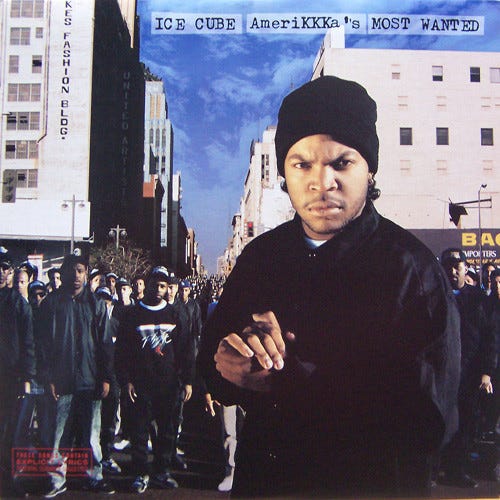
Gangsta and revolutionary rap have always been two sides of the same coin. It’s a coin minted in the stigma of criminality thrust upon unchained blackness since the inception of the United States. Outside the confines of smiling servitude, a N**** with Attitude is, by definition, a Public Enemy. In May of 1990, Ice Cube put the flames of righteous rage to that coin and wielded it as a searing brand to stamp a blistering rebuke on a nation perpetually squeamish about truth.
Upon his departure from N.W.A., Ice Cube fled the Los Angeles sunshine for the cold concrete of New York City. There he connected with Nation of Islam offshoot the 5 Percent Nation and enlisted Public Enemy’s vaunted production team, The Bomb Squad, to architect his solo debut. The unorthodox pairings positioned Cube at the intersection of many of the most prevalent schisms that were fracturing hip-hop at the dawn of the ’90s. Gangsta and conscious, east and west, lean funk and cacophonous walls of sound all coexist and miscegenate on AmeriKKKa’s Most Wanted. It’s not always a peaceful coexistence, but the bubbling tensions and contradictions, both sonically and lyrically, only add to the scorching intensity that drives the album forward.
“F*** all ya’ll,” Ice Cube snarls at the close of the opening skit, “Better Off Dead,” in which we accompany him on a one minute walk from prison cell to electric chair. It sets the tone for what’s to come, establishing the journey of the black man in America as a steady death march and Cube’s strident defiance in the face of it. The sizzling of the electric chair segues into “The N**** You Love to Hate,” an explosive table setter in which Cube fully owns the criminal tag that comes with his pigment. In a bitch’s brew of gangsta swagger and righteous militance, he unloads on the establishment, the Black bourgeoisie who dance to its beat, and anybody else who gets caught in the crossfire.
I heard payback’s a motherf***ing n**** That’s why I’m sick of getting treated like a goddamn stepchild F*** a punk, ’cause I ain’t him You gotta deal with the nine-double-M The day is coming that you’ll all hate Just think if n****s decide to retaliate They try to keep me from running up I never tell you to get down, it’s all about coming up So what they do, go and ban the AK? My s*** wasn’t registered any f***ing way So you better duck away, run and hide out When I’m rolling real slow and the light’s out ’Cause I’m about to f*** up the program Shooting out the window of a drop-top Brougham When I’m shooting, let’s see who drop The police, the media, and suckers that went pop? And motherf***ers that say they too black Put ’em overseas, they be beggin’ to come back And say we promote gangs and drugs You wanna sweep a n**** like me up under the rug Kickin’ s*** called street knowledge Why more n****s in the pen than in college? Because of that line, I might be your cellmate That’s from the n**** ya love to hate
Cube continues to fire off high impact rounds of lyrical fire over funk infused Bomb Squad noise on the title track, but with a subtle shift in perspective. For all its chest thumping bravado, the track ultimately positions Cube’s young black male not as the predator, but the prey — both of a system that has long used laws to maintain racial hierarchy, and of his peers trapped on the bottom with him. In an example of the masterful song structure displayed throughout the album, the song’s closing couplets synthesize the theme with blunt force precision:
I think back when I was robbin’ my own kind The police didn’t pay it no mind But when I start robbin’ the white folks Now I’m in the pen with the soap-on-a-rope I said it before, and I’m still taunted Every motherf***er with a color is most wanted
The next three tracks bring the brutal nihilism of the inner city into sharp focus, as Cube switches gears from polemicist to storyteller. While the ferocity of the Bomb Squad’s sonic assault remains unabated, Cube’s gift for painting vivid pictures that crackle with life and dark humor lightens the mood just enough for the listener to breathe.
“What They Hittin’ Foe” tag teams Average White Band’s “The Jugglers” and Stanley Turrentine’s “Sister Sanctified.” The tonal shifts between the two samples accentuate the mounting tension in Cube’s vignette of a corner dice game that quickly escalates to a potential robbery.
“You Can’t Fade Me” introduces a new predator for the black male to navigate: the scheming “neighborhood hussy” aiming to trap him with a baby. The narrative construction is as impeccable as Cube’s “solutions” are cringe worthy to the modern ear, but the sinewy funk collage keeps your head nodding through even the most brutally misogynistic moments.
“Once Upon a Time in the Projects” rounds out the trifecta, offering some funky foreshadowing of Cube’s later forays into screenwriting. Like his Friday movie franchise, “Once Upon a Time” gradually escalates the stakes in what begins as a a humorous misadventure.
All three tracks underscore the tenuousness of black male existence, with seemingly mundane scenarios quickly escalating into deadly violence, generational poverty, and the criminal justice system respectively.
The vitriol picks up along with the BPMs as AmeriKKKa’s Most Wanted’s near flawless A-side roars to a close with “Turn Off the Radio” and “Endangered Species (Tales from the Darkside).” The former excoriates black radio, which Cube stridently derides as a tool of the system using smooth R&B grooves to “calm the savage beast” of urban angst while silencing hip-hop’s hard truths. In hindsight, it’s hard not to wonder what 1990’s Ice Cube would have thought of 1993’s Cube embracing heavy rotation by rhyming about a “good day” in the hood over a tranquil Isley Brothers ballad.
“Endangered Species” synthesizes the album’s themes in a crescendo of righteous indignation over a bed of frantically layered funk samples. Cube drags the omnipresent subtext of black males as America’s prey to the forefront. The second verse blisters the Pan-Africanism prominent in the conscious hip-hop of the moment (“You wanna free Africa, I’ll stare at ya/Cause we ain’t got it too good in AmeriKKKa”) before segueing into a heart pounding narrative of urban warfare. Public Enemy’s Chuck D tears through a fire and brimstone closing verse that matches Cube’s “f*** you” defiance with a sociological sermon.
The term they apply to us is a n**** Call it what you want, cause I’m comin’ from the corner Same applies to a Ph.D Who’s black — don’t wanna roll Sells his soul Watch his head go rollin’ Who the f*** are they foolin’? Nobody knows, but I suppose the color of my clothes Matches the color of the one on my face As they wonder what’s under my waist
In any other context, AmeriKKKa’s Most Wanted’s B Side would feel first rate. But following the unrelenting intensity and laser sharp focus of Side A, it plays as a slight letdown. “A Gangsta’s Fairytale,” with its minimalist production and witty adaptation of common children’s stories to the world of gangsta rap, provides a seemingly lighthearted respite from Side A’s frontal assault. But dig a little deeper, and it also plays as a subtle commentary on how white audiences often consumed hip-hop: as tantalizing entertainment from a fantastical world far removed rather than a stylized commentary on reality.
But the Flavor Flav featured “I’m Only Out for One Thing” and “Gett Off My D*** and Tell Yo B**** to Come Here” stray a bit too far from the meticulously established themes of the album. While far from wack, they certainly don’t shine bright enough on their own merits to warrant to the detour.
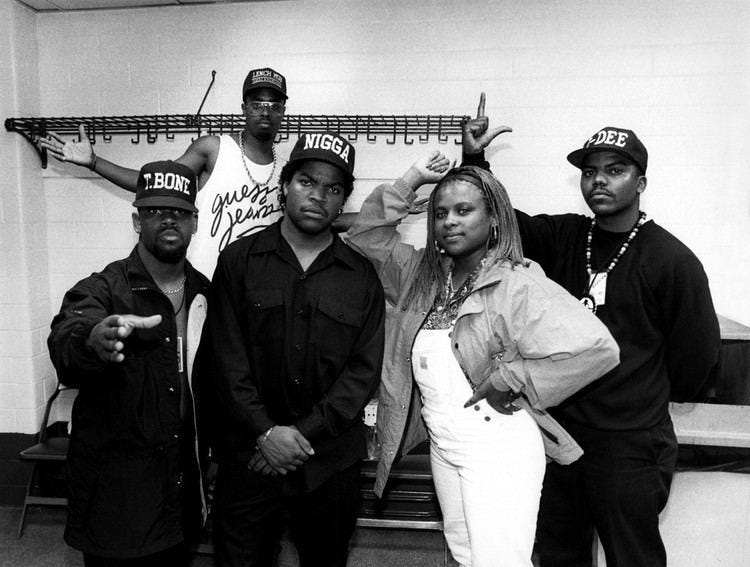
While the production on “Rollin’ Wit The Lench Mob” doesn’t quite replicate the controlled chaos of the Side 1 soundscapes, Cube still manages to get things back on course, introducing his post-N.W.A posse to the the world. In a no-punches-pulled call to arms, he lays bare the the necessity of a crew to have your back when maneuvering the treachery of the streets, the system, and the music industry.
“Who’s the Mack” is the track that benefits most from the distance of hindsight. At the time, its selection as the only track to receive a video raised more than a few eyebrows due to its decidedly less confrontational tone. Listening now, it actually stands out as one of the album’s best written songs. Cube deploys his impeccable eye for detail and penchant for gallows humor to breakdown the anatomy of the “hustle,” which in the context of the album’s thesis, black men must engage in order to subvert the system. The samples aren’t as abrasive as those on the rest of the album, but they’re layered every bit as meticulously to craft the track’s molasses thick thump.
“The Bomb” lives up to its name with an explosion of braggadocio atop a nuclear mushroom cloud of a track. Coming at the end of the journey we’ve just taken, it plays as a defiant embrace of black manhood in the face of systemic dehumanization rather than simply rhyming for the sake of riddling. It’s a fitting end to one of hip-hop’s most visceral and uncompromising albums; a project that re-imagined hip-hop going into the ’90s, eviscerating barriers and forcing artists from all corners of the spectrum to up their game.
AmeriKKKa’s Most Wanted forced gangsta rappers to broaden their horizons, underpinning their rhymes with an awareness of the forces responsible for the urban anarchy they portray. It forced conscious rappers off their ivory tower to reconnect with the the streets they were purporting to save. Its densely layered sonic textures upped the ante for production on West Coast albums, while forcing East Coast purists, previously dismissive of outside artists, to take note.
Perhaps most exhilarating, you can feel Ice Cube still taking shape as an artist. Not only is the genesis of his subsequent classics Death Certificate and The Predator palpable, so is the creative sensibility behind movie touchtones like Friday and Barbershop.
Well into the 21st Century, Ice Cube has gone from hunted to hunter, to cultural icon, and AmeriKKKa’s Most Wanted still crackles as a visceral reminder of the true length of the odds he had to defy along the way.
By the Numbers
Production: 9 Lyrics (how the words are put together): 8.5 Delivery & Flow: 9.5 Content (Substance): 9.5 Cohesiveness: 9 Consistency: 9 Originality: 9 Listenability: 9.5 Impact/Influence: 10 Longevity: 10
Total — 93
Next
Previous
Backspin is a look back at the albums that shaped and defined hip-hop. It explores what made them resonate, the impact they had on the culture, and where they fit in today’s ever-expanding hip-hop canon.


