
Backspin: Scarface — Mr. Scarface is Back (1991)
Chronicling the war inside him, Scarface delivered one of gangsta rap’s most brutal albums. (87/100)
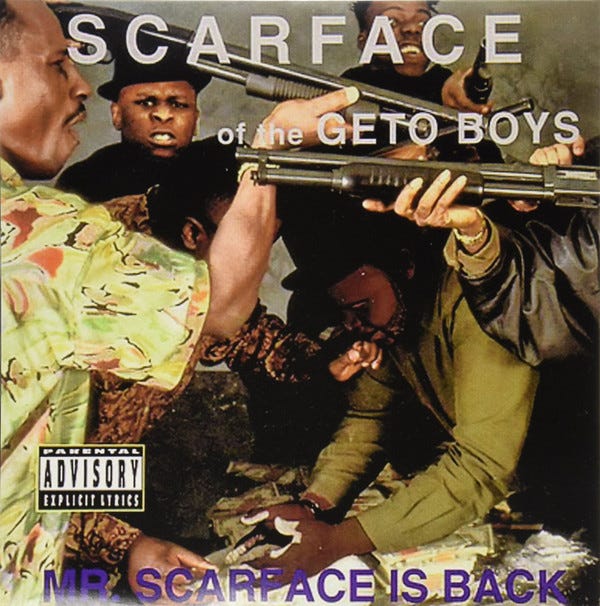
Mr. Scarface is Back is one of hip-hop’s most overlooked great albums from one of its most under appreciate GOATs. Certainly regional bias plays a part. New York was still the epicenter of hip-hop in 1991, with Los Angeles rapidly tightening its stranglehold on the burgeoning gangsta rap phenomenon. Both coastal meccas were largely insular and fiercely resistant to outsiders. Scarface made little effort to adapt his blues drenched Houston, Texas sensibilities to either.
But in re-visiting the enigmatic MC’s sneakily influential solo debut, I was struck by an inherent structural anomaly that may well have confounded audiences, at least subconsciously. Mr. Scarface is Back is essentially an inversion of the prototypical gangsta rap album of the time. Specifically, it feels like the flip side of the same coin as Ice Cube’s AmeriKKKa’s Most Wanted, which expanded the artistic scope of gangsta rap the previous year.
Face is every bit as artistically ambitious as Cube, and he writes with a similar cinematic immediacy. But while Cube aimed his ire at the external forces responsible for the violence of his world, Face focuses inward. Cube bristles with rage, Face wrestles with depression. Cube’s grasps at salvation are political, Face’s spiritual. Cube’s soundscapes bubble with the futurism of funk, Face’s soak in the southern tradition of blues. I suspect in Mr. Scarface is Back, listeners recognized familiar parts assembled into an unfamiliar whole. Cognitive dissonance resulted.
Mr. Scarface is Back does not present a linear story. Yet taken as a whole, it feels like one of the most cohesive narratives the still burgeoning genre had seen. The lead single, “Mr. Scarface,” wastes little time thrusting us into the zero-sum world of greed and brutality through which Scarface stoically maneuvers. The track’s frenetic sample collage is reminiscent the Bomb Squad’s Wall of Sound that influenced both coasts at the start of the ’90s. But the selection of sounds, including a jaggedly chopped church organ, place this aural assault squarely in the south. Even the slightly muddy mastering evokes the oppressively sticky heat unique to the region. Like the heat itself, the sound heightens the tension. On the mic, Face unfurls four of the most visceral verses of violence committed to wax with a matter-of-fact steadiness that makes them all the more chilling.
Sticky production and X-rated lyrics make”The Pimp” one of the rawest sex songs this side of Too $hort. But there’s very little freak in these tales, which are told with the same cold detachment as the previous track’s murderous episodes. It’s not until “Born Killer” and “Murder By Reason of Insanity” that Scarface begins to offer snippets of insight into the inner workings of his mind. The former features a frank account of his battles with manic depression’s emotional rollercoaster and the medications prescribed to keep the demons at bay. The latter slows the pace down to a sinewy deep soul grind that brings the subtleties of Scarface’s matter-of-fact delivery to the forefront. He grounds his story of murderous revenge in the dark ruminations that haunt his mind.
With “Diary of a Madman,” the psychological components of the album emerge to the forefront. Placed as the last track on the A-Side, it’s literally the centerpiece of the album, informing everything that comes before and after. The production pairs the sonic chaos of the early tracks with the deliberate bluesy pacing of the later ones to convey the struggle of trying to corral a mind in turmoil. Scarface establishes the “confessional” style that would become his signature, piecing together his innermost thoughts as if the track is literally his diary.
Dear Diary, I’m having a little problem I can’t make it by myself, maybe you can help me solve em I’m confused and I don’t know what to do I’m hoping you can help me, cause there’s no one else to talk to I want to die, but it ain’t for me I try to talk to my dad, but my old man ignores me He says I’m delirious And I drink too much, so he doesn’t take me serious But little does he know I’m really losing it I got a head, but ain’t no screws in it I be thinking deep That’s one of the reasons at night I can’t sleep I thought it would change when I was older But even now I’m still peeping over my shoulder Is there life after death too? And what about the n**** with the cane and the black suit? And what about cancer? Too many motherf***ing questions, and not enough answers Ain’t no use in trying We might as well face it, we were all born dying There’s a black book in Brad’s hands And it’s the diary of a madman
“Diary of a Madman”’s introspection sets the tone for the album’s second half, which is decidedly more measured and reflective in its representation of Scarface and his world. “Body Snatchers” finds Face envisioning himself sentenced to 20 months in a mental institution following a murderous eruption. Over a muscular blues groove, he unleashes a revenge fantasy, in which he strangles and blasts his way out of the hospital en route to a showdown with the shrink who committed him. A teenaged Brad Jordan spent time in a psych ward following a series a failed suicide attempts, making the tale all the eerier and surfacing the blurring of life and art that grounds much of the album.
For jaded purists still questioning his MC bonafides, “Body Snatchers” also displays the album’s most intricate flow, proving that in addition to being the most evocative storyteller of the time, Scarface was more than capable of holding his own in any cypher.
But it’s Face’s masterful storytelling that anchors the album’s second half, cementing his singular identity as a gangsta-gothic griot that is just as riveting today as he was in ’91. “Money and the Power” offers a meticulously constructed first person narrative of an alienated young man drawn to the drug game by the lure of quick cash and status. It’s a standard premise, but Scarface’s attention to detail and effortless integration of internal thoughts and emotions with external action makes it feel fresh. “Good Girl Gone Bad” plays like a movie on wax, packed with colorful characters, intricate plots, and brutally vivid imagery. The story concludes with a jaw dropping twist that’s at once confounding, haunting, and perversely poetic. The reveal exemplifies the layers of complexity through which Face builds his characters.
“A Minute to Pray and a Second to Die” uses a third person narrative, allowing Face to observe at a distance as the cold blooded tale unfolds. Face doesn’t include himself in the story, yet his previous stories inform it, giving him OG credibility as he sprinkles his narration with world weary commentary. The sample of Marvin Gaye’s brooding “Inner City Blues” coupled with the narrative distance imbues the song with a mournfulness that offers needed balance to the album’s trademark stoicism.
Life goes on in the streets of my hood when you die But some cry and gets by, while others choose to wonder why His life was took at such an early age A young n**** who lived in a rage died by the gauge He used to hustle on the street corners His mom would always beg him to quit, but he didn’t wanna As he got older, he got even worse ‘Til a real n**** showed him the purpose of a hearse A cold night in his hood, he had a tangle The brother he was squabblin’ with, had broke his ankle Laid him out in the driveway Some people knew he wouldn’t survive, but hey I ain’t the one to speak up on another’s All I can do is try to open his eyes and help the brother He chose the wrong way and that’s the route he took Born and brought up as an angel but he died as a crook He had a baby that he couldn’t raise And she will never see her father again, ’cause he’s in a grave Hey yo, let’s think about it, nilla “My daddy was a dopeman, so I’ma be a dope dealer”
“I’m Dead” brings the album to an ominous close. The title gives away the big reveal, but the power of the song isn’t in its 6th Sense like sleight of hand, but its raw emotive power. In a concise two and a half minutes, Scarface manages to convey both a man witnessing his own demise and passing through his own life as a ghost.
The former adds yet another layer of texture to the bloody barrages that dominate the album, underscoring the reality for many in the streets that he so evocatively portrays. From the earliest days of adulthood, a generation of youth was confronted with the seeming inevitability of their end. The latter plays out like a heightened representation of the detachment with which Face has moved through the rest of the album, stripped of all humanity by the unrelenting brutality of his surroundings.
Too often, discussions of Scarface’s place in the hip-hop canon begin with 1994’s The Diary. While the incorporation of the melodic G-Funk sound of the time makes the stellar third album the more accessible listen, Mr. Scarface Is Back is the more visceral record, and I would argue the more influential. While it may not have been bumping out of New York boom boxes or LA low riders, the next generation of standard bearers was clearly listening. Be it Biggie’s cinematic style of storytelling or 2Pac’s poetic explorations of his own damaged psyche, they’re building from a blueprint laid here. It also marks the inflection point at which the lines between gangta rappers and the characters they portrayed on wax began to fade; the bridge between the the episodic fiction of early Ice-T and Pac’s nakedly autobiographical expositions.
It also helped lay the groundwork for what southern rap would ultimately become, embracing the rich musical and cultural traditions of the region. Perhaps most resoundingly, it set the table for one of hip-hop’s most consistently compelling discographies that, over three decades, has taken us into the deepest crevices and darkest corners of one of the genre’s most honest, insightful, and creative minds.
By the Numbers
Production: 8.5 Lyrics (how the words are put together): 8.5 Delivery & Flow: 9 Content (Substance): 9.5 Cohesiveness: 9.5 Consistency: 9.5 Originality: 9 Listenability: 8.5 Impact/Influence: 9 Longevity: 6
Total — 87
Next
Previous
SEE ALL..
Backspin is a look back at the albums that shaped and defined hip-hop. It explores what made them resonate, the impact they had on the culture, and where they fit in today’s ever-expanding hip-hop canon.


