
Backspin: Dr. Dre — The Chronic (1992)
In 1992, Dr. Dre prescribed a hit of musical medicinal that elevated gangsta rap to “high” art. (93/100)
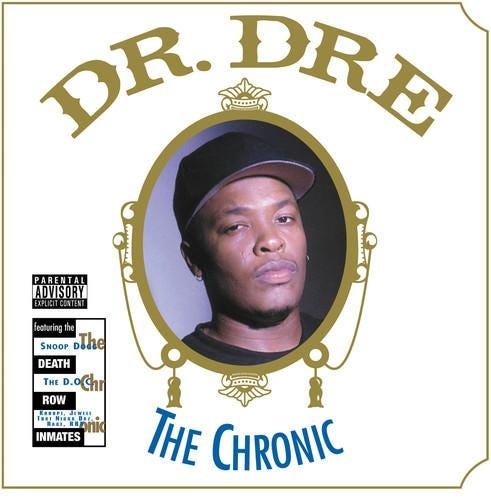
You’d be hard pressed to find a more ironic lyric in hip-hop than Dr. Dre’s 1988 proclamation that, “I don’t smoke weed or sess” on N.W.A’s “Express Yourself.” Of course, 4 years later, Dre would not only name his album after LA’s most potent brand of cannabis, he would craft a sound that would embody the potency of its high.
By ’92, Dr. Dre had already solidified himself as one of hip-hop’s top producers, but The Chronic introduced a whole new strain to the genre’s musical dispensary. By turns booming and brooding, sweet and sticky, but always meticulously crafted, The Chronic elevated the level of musicality in hip-hop, mellowing out even the harshest of gangsta lyrics for mainstream consumption. If N.W.A’s sonic aggression made gangsta rap irresistible to suburban boys, The Chronic’s sumptuous melodies had their mama’s belting “it’s like this and like that and like this and uh,” in the carpool line. Albeit probably in its radio edited form.
The fact that The Chronic’s lead single “Nuthin’ but a ‘G’ Thang” even existed in a radio version, which spun in heavy rotation during the day, was nearly unimaginable at the time, and a testament to Dre’s musical mastery. “Nuthin’ but a ‘G’ Thang” is one of hip-hop’s greatest records, and served as the perfect primer on the sub genre of G-Funk that Dre was about to spark on the world. Constructed with deceptive simplicity, “’G Thang’” is a hallmark of the technical precision that would become Dre’s signature. A bubbling bassline and slinky synths slide in and out of the track creating a dynamic momentum belied by the leisurely pace, and emphasizing the breezy tag team performance of Dre and his now iconic protégé Snoop Doggy Dogg. Snoop’s nasal tone and elastic flow make the perfect counterpoint to Dre’s molasses-heavy slow flow. In hindsight, it seems almost unfathomable that these two legends never came together for a full-length album as a duo. Their voices and vocal presences complement each other with a magic akin to Ruffin and Kendrick or Lennon and McCartney.
The pair set off the album, following a slightly too long spoken intro, with “F*** Wit Dre Day.” It’s an immersive excursion into the cosmic slop of the P-Funk that Dre had long counted as an influence, but on The Chronic became a sonic template. Over a bassline as thick as swamp air and keys as piercing as the gaze of a jilted lover, the good Dr. surgically settles a trifecta of scores. If Ice Cube’s “No Vaseline” is hip-hop’s most brutal dis track lyrically, “Dre Day” delivered an equally potent sonic bludgeoning. The production is so menacingly spellbinding that it’s easy to lose track of the fact that the last two verses are devoted to petty beefs long forgotten. (Tim Dog? Really?)
The P-Funk inspiration also manifests in the way the album was made. Just as George Clinton masterminded magic by assembling great musicians in the studio with great drugs, and letting the creativity flow, Dre surrounds himself with a team of young hungry MCs, including Tha Dogg Pound (Kurupt and Daz), RBX, and the Lady of Rage, and places them like chess pieces on his masterful tracks. The varying line ups lend each track a distinct identity, with rappers clearly fitted to beats with deliberate precision. Each grouping delivers a unique chemistry, while staying within the overarching vibe of the album. Posse cuts “Stranded On Death Row” and “B****es Ain’t S***” bring the improvisational dynamism of smoke-filled cyphers into Dre’s meticulously structured framework, and give each of the young spitters a chance to hone the personas that would catapult most to solo success in years to come.
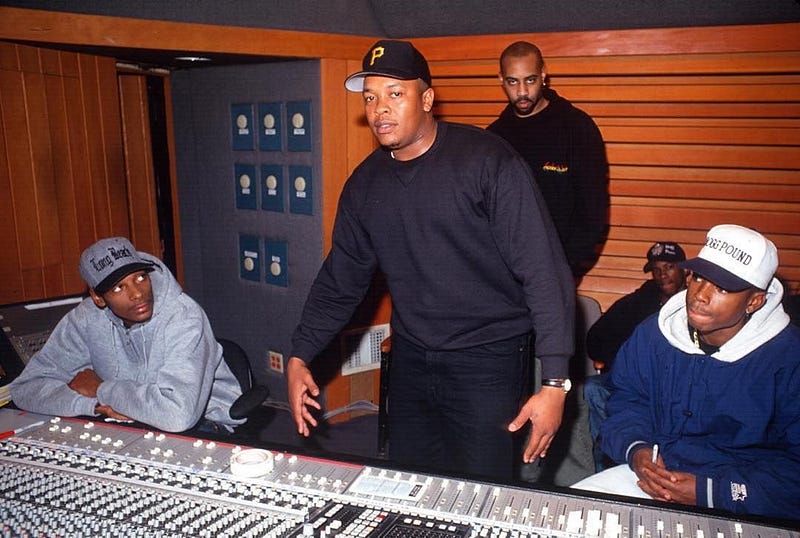
Adept as he is at deploying the talents of others, Dre uses “Let Me Ride” to let the doubters know that he is more than capable of holding down a song solo. In many ways, “Let Me Ride” is the song that most personifies what G-Funk would become. It’s hardly the first rap record to sample James Brown’s “Funky Drummer,” but while the break had typically been used for its crispness, Dre manages to turn it into the butter smooth backdrop for a breezy musical tour through the culture that would come to define the G-Funk aesthetic.
Just another motherf***in’ day for Dre so I begin like this No medallions, dreadlocks, or black fists it’s just That gangster glare, with gangster raps That gangster s***, that makes the gang of snaps, Word to the motherf***ing streets And word to these hyped ass lyrics and dope beats, that I Hit ya with that I, get ya with As I groove in my four on these, hitting the switches B****es relax while I get my proper swerve on Bumping like a motherf***er ready to get my serve on But before I hit the dope spot I gotta get the chronic, the Reme Martin and my soda pop Now I’m smelling like indo-nesia Bus stop full of fly b****es and skeezers On my d***, cause my four on hit Pancake front and back, side to side and all that s*** So when I crawl I comes correct Now, if your b**** in my s***, it’s your b**** you check n**** Now let the Chevrolet slide As I dip a n**** trip to the south side, yeah (Rollin in my six-fo’) with all the b****es sayin’
The most overlooked part of Dr. Dre’s vast repertoire is his proficiency (and efficiency) as a rapper. He’s not a lyricist (it’s widely known that he has employed a cadre of writers throughout his career), and he doesn’t dazzle with tongue twisting acrobatics, but as a sayer of rhymes he is stellar. His heavy voice and Southern Cali drawl convey an easy command of the mic without over powering the track. He had his moments with N.W.A, but on The Chronic, he truly masters his instrument, riding slightly behind the beat, and letting his textured tones seep into the crevices of tracks like maple syrup on Belgian waffles. It makes for a solid anchor upon which his more flamboyant compatriots can launch their theatrics. A pair of tracks where he doesn’t appear (“Lyrical Gangbang” and “High Powered”) meander slightly, contributing to the album’s slight loss of momentum toward the end.
While The Chronic is not polished quite to the pristine sonic sheen of Snoop’s Doggystyle, arguably the album that best personified the quintessential G-Funk sound, I slightly prefer it (5 days out of 7, anyway) precisely because it maintained a few rough edges. “The Day the N****z Took Over,” in particular, eschews the melodic synthesizers in favor of a bass heavy sonic assault that feels like a stripped down adaptation of the controlled chaos Dre deployed on N.W.A’s Straight Outta Compton. The album’s hedonism gives way to the very real frustrations of the moment, as Dre, Daz, and RBX deliver LA-riot inspired narratives of catharsis and retribution. Such moments ground the album, where many subsequent G-Funk releases floated into glorified gangsta fairytales.
Some albums are great because of superlative quality, others because of outsized impact. The Chronic is both. With it, Dr. Dre elevated hip-hop’s level of musicality, birthed a sub genre that helped define a decade, and simultaneously transcends that sub genre to deliver one of hip-hop’s greatest albums ever.
By the Numbers
Production: 10 Lyrics (how the words are put together): 8.5 Delivery & Flow: 9 Content (Substance): 7.5 Cohesiveness: 9 Consistency: 9.5 Originality: 9.5 Listenability: 10 Impact/Influence: 10 Longevity: 10
Total — 93
Backspin is a look back at the albums that shaped and defined hip-hop. It explores what made them resonate, the impact they had on the culture, and where they fit in today’s ever-expanding hip-hop canon.


