
Backspin: N.W.A — Straight Outta Compton (1988)
Re-visiting the album that permanently changed the trajectory of hip-hop with the strength of street knowledge. (88.5/100)
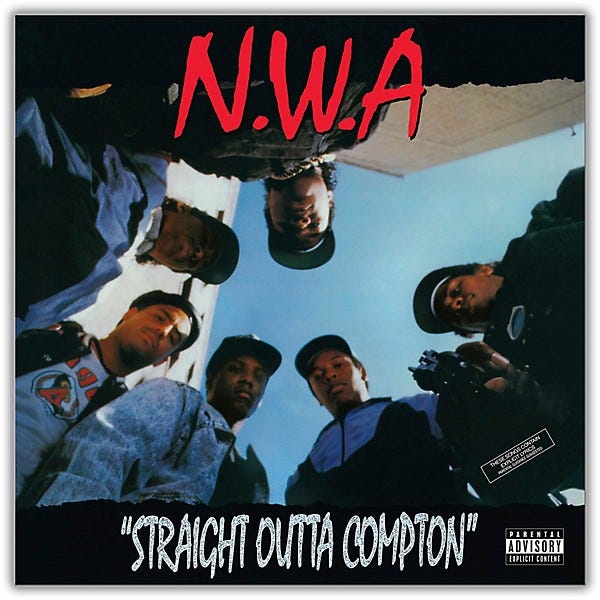
Hard as it may be to imagine for listeners reared on rappers dominating the pop charts and headlining Hollywood movies, hip-hop was never invited into mainstream popular culture. At every turn it had to forcibly break down the barriers, like Run-DMC kicking through the partition and commandeering Aerosmith’s stage in the iconic “Walk This Way” video. In 1988, N.W.A’s Straight Outta Compton served as the sonic shell toe Adidas kicking gangsta rap into the Walkman of seemingly every teenaged male in America — from its grittiest ghettos to its picturesque suburbs.
The five Compton cohorts were not the first to spin street stories on wax — Schoolly D, Boogie Down Productions, and Ice-T had unloaded their analog clips years prior — but by the time Eazy-E dismounted from his menacingly climatic verse on “Gangsta Gangsta,” closing out arguably the most dynamic opening trifecta ever pressed on a rap album, it was clear that we were in the presence of the definitive gangstas.
It’s worth examining that opening suite in more detail, since so much of the culture-shifting ingeniousness for which the album is rightly lauded essentially lives in those three tracks. The title track is still a marvel, a whirling dervish of pounding drums, foreboding guitar, and riotous horns, topped off with the devil-may-care bravado of Ice Cube, MC Ren and Eazy-E. The beat is clearly influenced by the controlled chaos unleashed by the Bomb Squad earlier in the year on Public Enemy’s equally earth-shaking It Takes a Nation of Millions to Hold Us Back, opening Straight Outta Compton with the same visceral immediacy. But, while Public Enemy positioned themselves as the elder statesmen, leading hip-hop culture through the urban armageddon of the crack era of the Reagan ’80s, N.W.A were the next generation. They were the product of that armageddon, reveling in its nihilism and capping any punk who got in their way.
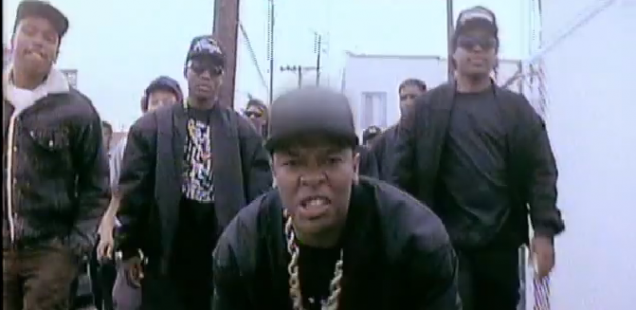
“F*** Tha Police” follows with its unrelenting rebuke of police abuses. In the subsequent years, a mythology has developed, lionizing the song as a quintessential protest anthem. In actuality, it unleashes more like an explosive catharsis, venting generations of frustration over a relentless collage of samples anchored by a propulsive Roy Ayers bassline. The result is one of the most stinging social commentaries in the genre, resonating not only with other black men who shared the experiences brought to life in the song, but young people across the social spectrum who embraced it as an anthem of resistance against the abusive authority figures in their own lives, real or imagined.
Closing out the opening triumvirate is the track that mostly clearly defined the ethos of the group, the album, and ultimately the subgenre that they elevated to the forefront of popular culture.
Here’s a little somethin’ about a n***a like me Never should’ve been let out the penitentiary Ice Cube would like to say That I’m a crazy mothaf***a from around the way Since I was a youth, I smoked weed out Now I’m the mothaf***a that you read about Takin’ a life or two, that’s what the hell I do You don’t like how I’m livin’? Well, f*** you! This is a gang and I’m in it My man Dre’ll f*** you up in a minute With a right left, right left, you’re toothless And then you say: “Goddamn, they ruthless!” Everywhere we go they say: “Damn!” N.W.A’s f***in’ up the program And then you realize we don’t care We don’t just say no, we’re too busy sayin’, “Yeah!” About drinkin’ straight out the eight bottle Do I look like a mothaf***in’ role model? To a kid lookin’ up to me Life ain’t nothin’ but b***es and money ’Cause I’m the type of n***a that’s built to last If you f*** with me I’ll put my foot in your ass See, I don’t give a f***, ’cause I keep bailin’ Yo, what the f*** are they yellin’?
“Gangsta Gangsta” is not the album’s most sophisticated track musically or lyrically, but it’s simply a perfect hip-hop song. The production is minimalist but propulsive, pushing Ice Cube’s irreverent rhymes to the forefront. For his part, Cube gives us a preview of why his later success as a movie mogul was, perhaps, inevitable. In the first verse he crafts a charismatic character, all street smart swagger and testosterone-charged bombast. In the second, he spins a vivid story of a night in the life of a “gangsta,” complete with game spit at “b***es with the big butts,” a fist fight turned shootout, and ultimately a quick exit to duck a murder rap.
It’s precisely those elements of character and story that would largely distinguish the best of the west coast gangsta rappers that followed. As a result, the titans of the west often achieved greater commercial success than their east coast counterparts, who were still more focused on technical lyricism highlighted in dense raps about rapping. Dr. Dre also provides a glimpse of the future, briefly switching the beat behind Eazy E’s lethal closing verse to serve up the first notes of the slinky synthesizers that would become a hallmark of his subsequent G-Funk sound that would come to define the next iteration of gangsta rap.
From there, the album loses a bit of momentum. Most of the remaining tracks are strong. A couple are even classics. However, in combination, they make for a slightly schizophrenic whole, with many having been recorded a year or two earlier, and carrying the sonic earmarks of that era (“8 Ball”, “Dope Man,” “Compton’s In The House”). Listeners revisiting the album in full for the first time in decades may even be surprised to discover that, for the definitive gangsta rap album, Straight Outta Compton has an awful lot of less-than-gangsta moments. “If It Ain’t Ruff” and “Parental Discretion Iz Advised” are both infectious tracks that highlight MC Ren’s raw skills on the mic, but both fall much more in line with the braggadocio of New York’s mic-wielders than the gangsta ethos that kicks off the album. Ren and Dr. Dre spitting lighthearted couplets in giddy unison on “Something Like That” actually feels almost “cute” to ears since jaded by three decades of gangsta decadence.
An honest 21st Century re-listen reveals Straight Outta Compton as an all-time great rap album, but not due to wall-to-wall musical excellence. (Even in ’88, how often did we really let the tape run through “Quiet On the Set” and “Something to Dance To”?) Its greatness springs from the soaring height of its highs, and the near unparalleled scope of its influence.
After its explosion, rappers from coast-to-coast began sharpening their personas, honing their stories, and co-opting N.W.A’s “life ain’t nothing but b****es and money” (and guns) aesthetic. Lines from throughout the album have been sprinkled into so many MC’s bars that they are practically public domain. When Dr. Dre warned us at that we were about to witness the strength of street knowledge, even he couldn’t have possibly known that the entire hip-hop culture (and to a large extent the popular culture) would embrace it, imbibe it, and absorb it into its DNA for generations to come. Yet, three decades later, we’re still yelling “gangsta gangsta,” and Straight Outta Compton still lands on any credible shortlist of definitive hip-hop albums.
By the Numbers
Production: 8.5 Lyrics (how the words are put together): 8 Delivery & Flow: 8.5 Content (Substance): 8.5 Cohesiveness: 8 Consistency: 8.5 Originality: 9.5 Listenability: 9 Impact/Influence: 10 Longevity: 10
Total — 88.5
Backspin is a look back at the albums that shaped and defined hip-hop. It explores what made them resonate, the impact they had on the culture, and where they fit in today’s ever-expanding hip-hop canon.


