
Backspin: Puff Daddy & the Family — No Way Out (1997)
Hip-Hop’s top mogul ushered in the “jiggy” era with an epic of directionless decadence. (66/100)
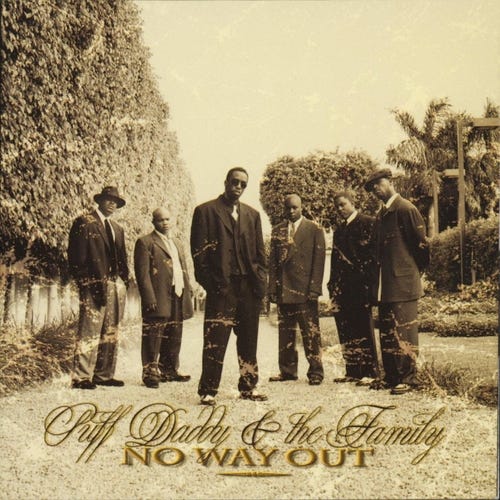
Love it or loathe it, the “jiggy” era of the late ’90s was a truly singular moment. Unapologetic in its grandiosity, the fashion was as glossy as the beats. Its definitive anthems were a champagne soaked embodiment of celebratory spectacle.
In hindsight the decadence was a desperate grasp for escapism from a traumatized culture in disarray. The implosion of the Renaissance era of the mid-90s, marked by battle lines drawn in numerous directions and culminating in the murders of its two biggest stars, left hip-hop reeling inwardly. Yet, those very same tragedies propelled it to unparalleled heights of commercial success, leaving its most public figures to sort through the rubble under the hottest of spotlights.
In the the summer of ’97, no living figure was more public than Bad Boy Records CEO and self proclaimed keeper of the Biggie Smalls legacy, Sean “Puff Daddy” Combs. Commonly credited with launching the jiggy era, Puff Daddy’s larger than life debut album, No Way Out, is far from the non-stop party its often remembered as. Beneath the shiny exterior, all of the tensions, uncertainties, and cynicism of the moment percolate. It makes for a listen as frenetically futile as the moment itself.
The tonal dissonance begins right away. The contrived melodrama and performative spiritualism of “No Way Out (Intro”), which literally closes with Combs reciting The Lord’s Prayer, abruptly gives way to the triumphant frenzy of “Victory”. The Biggie and Busta Rhymes featured rampage is easily the album’s strongest track, highlighting Puff Daddy doing what he does best: orchestrating an immaculate production.
Pairing the rumbling menace of Biggie’s suede-smooth vocal texture with the manic histrionics of Busta’s electric hook proves a masterstroke of sonic contrast. Stevie J’s cinematically orchestral track feels equal parts celebratory and apocalyptic, like the ring music for a gladiator match on the eve of a cataclysm. Even Puff’s typically stilted delivery is deployed perfectly, his chanted pledges of dominance feeling more like a prelude to B.I.G.’s lyrical carpet bombing than proper verses in and of themselves.
If “Victory” is a pledge to achieve world domination at all costs, “Been Around the World” is the celebration of the vision board brought to fruition. The album’s fourth smash single builds on the “jiggy” template established on Biggie’s “Mo Money, Mo Problems” and later perfected on Ma$e’s “Feels So Good”. An extended sample of an instantly recognizable crossover hit paired with a similarly appropriated hook bolster slickly rendered rhymes extolling the high life.
Here, David Bowie’s “Let’s Dance” provides the buoyant backdrop, while Biggie croons a tongue-in-cheek adaptation of Lisa Stansfield’s “Been Around the World” for the hook. Puffy and Ma$e prove the perfect pairing to embody the the burgeoning Bad Boy brand. Ma$e’s molasses drawl oozes uptown cool, while Puff’s brusque cockiness breathes swagger into rhymes that land right in his wheelhouse at the intersection of the club and the bank vault:
I was in one bedroom, dreaming of a million Now I’m in beach houses, cream to the ceiling I was a gentleman living in tenements Now I’m swimming in all the women that be tens Went from bad boys to the crushed linen men Now my dividends be the new Benjamins
“Don’t Stop What You’re Doing” returns to the same diamond encrusted well to diminishing, but still imminently danceable returns. It works thanks largely to the irrepressible synth lines from Yarbrough & Peoples’ “Don’t Stop the Music”, Faith Evans’ soulful recreation of its hook, and Lil’ Kim’s Girl Boss gravitas.
It’s telling that No Way Out is remembered for just such moments, when, in actuality, they make up only a small portion of the album. Combs would have been well served by leaning into the luxury nightlife aesthetic and simply crafting the glossiest party album the world had ever seen. Perhaps a carefree bacchanal of ostentatious revelry was exactly what we needed to recover from the preceding trauma. The “denial” stage of grief.
Things go awry when Puff tries to temper the debauchery with awkward attempts at introspection. Or worse, the dark street narratives that now suddenly hit a bit too close to home.
“Don’t Stop What You’re Doing” is inexplicably followed by “If I Should Die Tonight,” a three minute spoken interlude of Combs musing about his inevitable end. Nothing particularly poignant is said, and Carl Thomas’s affected caterwauls atop the melodramatic piano backdrop give the whole unfortunate episode the feel of an extended director’s cut of a Tyler Perry scene.
The manufactured introspection continues on the interminable “Do You Know”. Ghostwriter extraordinaire Sauce Money (allegedly) provides a structurally solid meditation on Puff’s improbable rise juxtaposed with the perils of fame, but Combs’ myriad deficiencies on the mic are left with nowhere to hide on the ploddingly bland production. His delivery is defiant, where it should be vulnerable, flat where modulation is demanded. Despite obvious punch-ins, he falls out of pockets faster than an overstuffed wallet in skinny jeans.
If nothing else, “Do You Know” should have been instructive, making clear to Combs’ army of co-producers that their boss should never be allowed to rap solo on any track, let alone a five-plus minute one. Yet, all of its mistakes are repeated on “Pain,” and compounded by an uncomfortable verse recounting B.I.G.’s murder within the context of the causes of Puff’s existential angst.
It’s really not about you, Sean.
I don’t doubt the authenticity of the pain that Sean Combs, the man, had to be feeling in the aftermath his friend’s murder. Puff Daddy, the rapper, simply fails to render it convincingly.
Similarly, in the hands of the Notorious one, off whose pen it clearly originated, “What You Gonna Do” would have been a darkly cinematic revenge saga in the mold of “Somebody’s Got to Die”. Delivered by the man whose stage moniker is derived from the childhood nickname “Cream Puff,” coined in reference to his legendary softness, it feels like an elaborate exercise in cosplay. It also exemplifies the post-Renaissance formulization of hip-hop, by which corporate suits (Combs) too often thought a rapper (Puff Daddy) could simply be retrofitted to a proven template and success would follow. It worked just often enough to self-perpetuate.
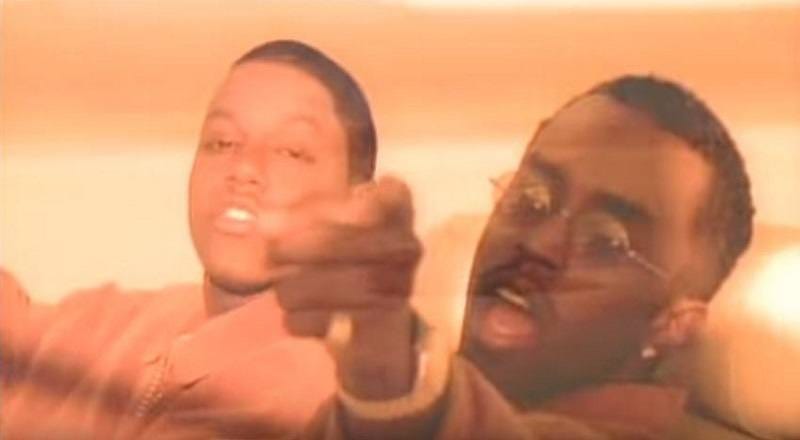
No Way Out is at its most organic when Combs takes a step back, allowing his Bad Boy all-stars and outside guests to bask in the spotlight. “Young G’s” marks the third and final pairing of arguably the two most naturally gifted MCs to touch a mic, with Biggie and his Brooklyn homie Jay-Z once again drawing the best out of each other. Both GOATS effortlessly embody the streetwise hustler done good persona that seems to elude Puff Daddy’s grasp.
The late Black Rob, maybe the most underrated Bad Boy alum, delivers a masterclass in street storytelling on “I Love You, Baby,” a hood soap opera complete with greed, betrayal, and a cast of vividly drawn characters.
The album’s signature banger, “It’s All About the Benjamins”, lands on the perfect Bad Boy formula. The relentless minimalism of Derek “D-Dot” Angelettie’s iconic beat has enough rumble for the jeeps and ample floss for the clubs. The rhymes from Puff Daddy and LOX’s spitters Jadakiss and Sheek Louch (Styles was reportedly removed from the record at the behest of uncredited co-producer, Missy Elliot) toe the line between street corner swagger and VIP lounge fly. All three MC’s deliver truncated verses leading into the first chorus, taking the weight off of Puff to carry an entire song section. His belligerently ostentatious swagger works perfectly in tandem with the menacingly slowed sample from Love Unlimited’s “I Did It For Love,” setting the tone for a distinctly New York flex fest:
Ain’t nobody’s hero, but I wanna be heard On your Hot 9–7 every day, that’s my word Swimmin’ in women with they own condominiums Five plus five’s, who drive Millenniums It’s all about the Benjamins, what? I get a fifty pound bag of Euk for the mutts Five carats on my hands with the cuts In somethin’ European chromed out with the clutch, what?
After a string of filler tracks, No Way Out closes with its two lead singles. Both were ubiquitous radio hits, but embody the blatant commodification of hip-hop that put many Golden Age heads off the jiggy era entirely.
“I’ll Be Missing You,” ostensibly a tribute to Biggie, feels hollow beneath the pristinely melancholy keys of the Police staple, “Every Breath You Take”. Despite immaculate backing vocals from Biggie’s widow, R&B powerhouse Faith Evans, and 112, the track ultimately feels like an assembly line exercise in sentimentality.
It’s no secret that Puff Daddy isn’t a writer. But something doesn’t sit right about employing a ghostwriter to pen your “heartfelt tribute” to your best friend, especially given the simplistic Hallmark boiler plate of the lyrics.
Did Combs really need to pay Sauce Money tens of thousands of dollars to scribble:
It’s kinda hard with you not around Know you in heaven, smilin’ down Watchin’ us while we pray for you Every day we pray for you ’Til the day we meet again In my heart is where I’ll keep you, friend
“Can’t Nobody Hold Me Down” samples the iconic keys of Grandmaster Flash & the Furious Five’s “The Message” for a paint-by-the-numbers party record.
“The Message” is arguably hip-hop’s most important song, introducing both street level realism and incisive social commentary into the genre. The exploitation of its instantly recognizable melody to get designer-clad asses on dance floors epitomizes the inevitable commodification of the culture the jiggy era came to embody. It was the moment when the exploitation of hip-hop’s counter culture status as a tool to sell assembly line pop products became acceptable practice, not only from corporate opportunists, but also from within the culture itself.
The jiggy era sparked an inevitable backlash. From it sprung the musically ingenious Soulquarians collective and the left of center subset of hip-hop and neo-soul they birthed. It also gave us the short lived Backpack revival, exemplified by quasi-indie labels like Rawkus and Def Jux, which quickly grew nearly as formulaic as the mainstream hip-pop they railed so stridently against.
While the ’80s recycling and shiny suit extravagance of Puff Daddy and his acolytes began fading with the turn of the century, its ethos of synthesization was already fully matriculated into the bloodstream of the industry, adapting with each new style and trend.
It speaks to the power of the brand that Puff Daddy built that once he lured a reeling culture into his immaculate funhouse of decadence, there was truly no way out.
By the Numbers
Production: 8 Lyrics (how the words are put together): 7.5 Delivery & Flow: 6 Content (Substance): 7 Cohesiveness: 4 Consistency: 5 Originality: 5.5 Listenability: 5 Impact/Influence: 10 Longevity: 8
Total — 66
Next
Previous
SEE ALL
Backspin is a look back at the albums that shaped and defined hip-hop. It explores what made them resonate, the impact they had on the culture, and where they fit in today’s ever-expanding hip-hop canon.


