
Anti-Aging Drugs: A Quick Review
Many compounds have been proposed to mitigate the effects of aging. Here is a status report.
The eternal quest for immortality
To beat death has been a goal for some people as far back as we have written accounts. One of the earliest known stories, the epic of Gilgamesh (written over 4,000 years ago) involves the quest of the hero for immortality.
Spoiler: he didn’t succeed.
Most of us want to grow up, but nobody wants to grow old.
Old age, after all, comes with a suite of unpleasant changes.
Our immune function declines, the risk for cancer increases, muscle turns flabby or disappears, joints creak, connective tissue loosens, and your memory is no longer what it used to be. Even our microbiome changes.
The quest for immortality, though, persists.
As science and technology progress, we become ever more able to untangle the biological complexities of aging. We are beginning to identify the molecular processes and pathways that elicit changes associated with aging. This has led to, among others, two advances:
- Biomarkers that allow us to assess these processes and possible interventions. Such biomarkers can be the basis for more objective lifespan ‘clocks’, including some based on human blood proteins. By tracking these markers, we can study how certain compounds affect aging.
- The compounds themselves. Now that we have molecular proxies for aging, we can pursue the scientific study of intervention on the aging process. Word of caution: progress has mostly been made in animal models, and everything is looking a lot more complex and context-dependent than we thought.
Still, there are some compounds that are being studied for their potential effects on (parts of) the biology of aging.
Drugs against aging
Several strategies for mitigating the effects of aging are under investigation: a healthy lifestyle (which is a nebulous term, but move and eat your fruits and veggies), caloric restriction (the evidence for which in humans, certainly concerning the required deficit or specific protocol, is less clear-cut than some people think), genetic interventions, and stem cells.
But, there are also some chemical compounds (aka drugs) that could potentially affect certain points in the aging pathways. A recent review provides an overview of drugs that could affects cellular senescence. This is the phenomenon where cells stop dividing. This is useful, for example, to regulate development and prevent cancer, but when the balance of dividing versus non-dividing cells tilts in the wrong direction, our tissues age.
The review discusses three types of drugs: senolytics, senescence-associated secretory phenotype (SASP) inhibitors, and nutrient signaling regulators.
Senolytics
Senolytics are compounds that promote the cell death of senescent cells. Clearing aging cells from a tissue is known to improve health, even in humans. Several compounds that are being studied as senolytic are repurposed anti-cancer medications.
Some senolytics are BCL family inhibitors, Navitoclax, Panobinostat, catechins, PI3K/AKT inhibitors, Dasatinib, quercetin, fisetin, HSP90 inhibitors, and FOXO regulators.
The use of senolytics, however, still has a few key problems that need to be addressed:
Since different senolytics may target different types of senescent cells, senolytic drugs should be selected according to distinct senescent cell types. Some senolytics have significant adverse effects, so they need to be assessed to determine whether their administration is therapeutic or deleterious. Hence, more research is needed to confirm the safety and efficacy of senolytics drugs.
Senescence-associated secretory phenotype (SASP) inhibitors
SASP, as the name implies, is what happens when a senescent cell starts to secrete molecules that negatively affect neighboring healthy cells. A senescent cell can start to release inflammatory-promoting molecules, immune suppressors, protein digesting enzymes, and other kinds of stuff we generally don’t want sloshing around in our bodies unchecked.
SASP inhibitors put the brakes on this process. Compounds that act as SASP inhibitors are various antioxidants (e.g. MitoQ, SS31, SKQ1, melatonin, astaxhantin, and equol), Ganoderma lucidum, Wnt/β-catenin inhibitors, Klotho, ICG-001, and JAK inhibitors.
But here too, care is needed:
Though SASP inhibitors have health benefits, careful consideration should be taken before their application. For example, proper intake of antioxidants may benefit health, while excessive intake of exogenous antioxidants may inhibit the synthesis of endogenous antioxidant enzymes… Besides, SASP of senescent cells may also have beneficial effects in certain conditions. For example, study has shown that, in the mouse model, senescent fibroblasts and endothelial cells appear very early in response to a cutaneous wound and they accelerate wound closure…
Nutrient signaling regulators
We need nutrients to survive. Our body needs to sense those nutrients and shuttle them to where they are needed. The pathways responsible for this sensing and shuttling eventually determine whether these nutrients are invested in: growth (and aging) or maintenance (and less aging). So, tweaking these pathways might allow us to control that balance a little bit.
Nutrient signaling regulators known to affect (some aspects of) aging are sirtuin regulators (e.g. resveratrol), mTOR inhibitors (e.g. rapamycin), spermidine, AMPK activators (e.g. metformin), curcumin, and Lycium barbarum.
However, the effects of these molecules appear to be context- and organism-dependent (what works in worms or mice might not work in humans). There are also side-effects such as a suppressed immune system, slower healing from injuries, and so on. Finally, the effectiveness of these compounds can depend on the presence/absence of certain gene variants.
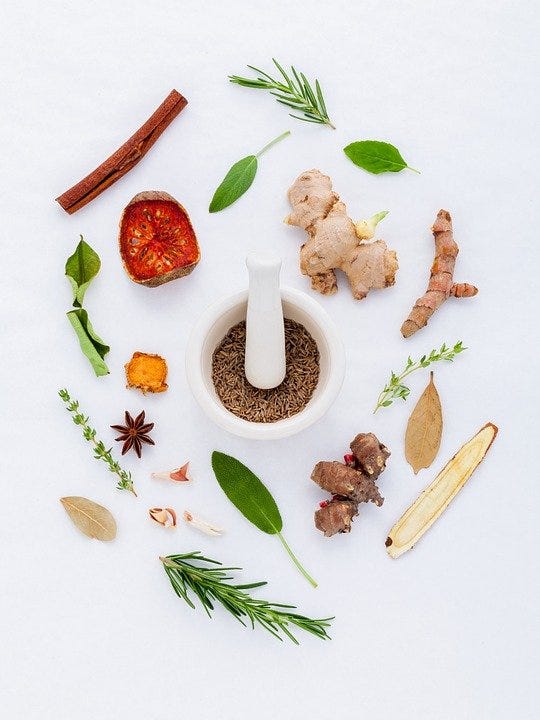
What is interesting about the list of the three potential classes of anti-aging drugs, is that some proposed compounds can do more than one thing. For example, catechins (found in green tea) act as senolytic, but also have a SASP inhibiting function.
Another interesting observation is that several of the above compounds can be found in food. Catechins in green tea, equol in soy, resveratrol in the skin of grapes, blueberries, raspberries, mulberries, and peanuts, curcumin in turmeric, quercetin and fisetin in various plant foods (sensing a plant-based theme here…), and the plants Ganoderma lucidum and Lycium barbarum used in traditional Chinese medicine.
Overall, though (emphasis is mine):
…healthy aging is increasingly recognized as a healthcare priority. Hopefully, some drugs are very promising in this regard. However, exploration of the best application of strategies in more clinical trials is also needed. Nevertheless, our review provides important clues for the use of future prospective drugs that exhibit healthy aging activities.
The quest continues.


