
Andrew Huberman’s Complete 5-Step Human Optimization Protocol
Condensed into 1, handy read.
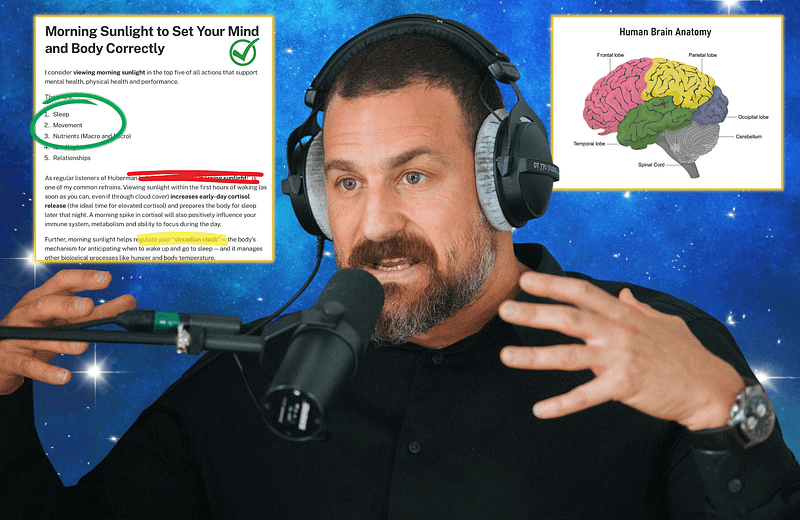
If you’ve been anywhere near the self-improvement world lately, you’ve likely heard of Andrew Huberman.
The uber-popular productivity scientist and Stanford professor turned podcast mogul has taken the internet by storm, with his ongoing research into human optimization.
On his podcast, “The Huberman Lab”, he condenses life’s most complex questions into simple, actionable advice.
Breaking down topics such as how to be happier, more productive, sleep better, gain muscle, lose weight, and everything in between — without needing a college degree to understand.
The kicker is, even his condensed works are often too much to absorb in one sitting. So, being a long-time listener of Andrew, I felt compelled to condense his work even further.
Here’s how to fully optimize your brain, body, and biology — by Andrew Huberman…
Why does the internet love Andrew?
I remember the days of pre-social media, where the title of “doctor” was akin to a religious leader.
PhD-brandishing healthcare professionals would frequent morning television shows to share their latest health and wellness discoveries with the world — often with a book tour to go along with them.
The real, hard-hitting information was either withheld from the general public or made too complicated to understand.
But, social media changed everything.
Social media gave anyone with access to a digital microphone the ability to broadcast their knowledge to the world. And, many healthcare professionals began offering their expertise online. But once again, it came at a cost.
With so much access to information, came the spread of misinformation. Savvy marketers began to manipulate the public, offering magic cures through clickbait headlines:
- “Shocking New Research Shows…”
- “You Won’t Believe What This Scientist Discovered…”
- “Try This Ancient Secret To Instantly Melt Away Stubborn Belly Fat…”
With so much information coming from all angles, it was hard to know who to trust — and nearly impossible to verify the information.
The world yearned for transparency.
Something popular figures, like Andrew, offer in spades.
After his first appearance on The Joe Rogan Experience, in July of 2021, Andrew’s popularity skyrocketed. He now hosts one of the most popular podcasts in the world, “The Huberman Lab”, and clips from it dominate the self-improvement sector of all major social media platforms.
This is largely due to his balance of:
- Scientific expertise
- Trustworthy demeanor
Not to mention an uncanny ability to convey information, simply.
As a neuroscientist, ophthalmologist, and tenured professor at Stanford University, Andrew’s podcast offers a college-level education, for free.
He’s become so popular, those who preach his practices have become memes of sorts, known as “Huberman bros”. In a world of misinformation, Andrew offers simple, research-backed, and transparent information, with nothing to sell until quite recently.
The internet’s beloved productivity bad boy —breaking down health, wellness, and human optimization into bite-sized pieces…
Andrew’s top-5 health hacks.
I never went to college.
Namely, because of… well, let’s be honest… money. But also, I can’t bare to sit still and listen to someone talk for hours on end. I prefer to learn through doing, and today, I gain 90% of my information through:
- Writing
- Listening to podcasts
But, even though Andrew condenses semesters’ worth of learning into 2–3-hour podcasts, they’re extremely information dense. And, I find myself taking weeks, if not months, to truly internalize and apply what I’ve learned to everyday life.
So, what I’ve outlined below are the core concepts behind Andrew’s most-popular teachings. Along with actionable data you can implement into your life, today…
#1. Boost athletic performance/recovery:
Over the years, Andrew has become a debunker of misinformation, in addition to sharing new research findings.
For example, for decades, bodybuilders would jump in ice tubs directly after their workouts to repair their muscles and help them grow. But today, this practice has been revealed to actually decrease muscle growth.
As a neurobiologist, Andrew studies and works closely with those who study human performance.
One of his main areas of interest is temperature control — how it can be manipulated to boost physical performance and recovery.
On his website, Andrew writes about how to use simple heat and cold exposure to drastically boost athletic performance and recovery.
“Cold causes levels to stay elevated for some time and their ongoing effect after the exposure is to increase your level of energy and focus, which can be applied to other mental and/or physical activities.”
In short, cold-shock therapy raises mental awareness, focus, physical energy, and the hormones responsible for peak athletic performance. So, deliberate cold exposure (ice bath/cold shower), is best used:
- As a pre-workout enhancer (20 minutes before a workout)
- 8+ hours after a workout (to repair muscles)
In addition, deliberate heat exposure (sauna/hot bath or shower) is best used post-workout to help muscles recover and/or at night time to aid in sleep.
#2. Better sleep:
Andrew is most known for promoting 2 major practices:
- Temperature control
- Light optimization
Personally, it’s been amazing to see how easily both can be applied to one’s daily routine, with a litany of benefits.
Namely, to promote a good night’s sleep.
On his podcast, Andrew talks about utilizing 90-minute chunks throughout the day to drastically improve your sleep and energy levels. Although there’s a lot to unpack, here’s the condensed version.
In the morning (within 90 minutes of waking up):
- Absorb sunlight through your skin, and eyes, or turn on overhead lighting
- Don’t consume caffeine
- Exercise/move your body
- Raise your core temperature (through cold exposure)
All of this sets your circadian rhythm, and autonomic timing, and clears your brain of leftover adenosine — in other words, it wakes you up properly.
In the evening (within 90-minutes of going to bed):
- Watch the sunset
- Move lighting to below your eye-line
- Relax your muscles (stretch/foam roll)
- Lower your core temperature (through heat exposure)
All of this helps your body, brain, and hormones wind down for a restful sleep.
👉 Here’s a full breakdown of what I call “The 90-Minute Rule”.
#3. How to focus/stop procrastinating:
What I’ve found perhaps most enlightening from listening to Andrew’s podcast, is how much of our daily behavior is controlled by dopamine.
Everything we think, feel and do is controlled by peaks and valleys of the natural brain drug we call dopamine. And, in his “Neural Newsletter”, Andrew explains how procrastination, in its simplest form, is a lack of dopamine:
“The simplest way to think about dopamine is that when our dopamine levels are elevated, we tend to focus our attention on outward goals… When dopamine levels are low, we feel unmotivated, derive less pleasure from pursuits and feel physically tired.”
In short, the answer to overcoming procrastination is to seek harder tasks than what’s in front of you. But, since the human brain is nuanced, here’s a full breakdown.
In addition, you can also increase mental focus with 2 simple bio-hacks:
- Breathing in sharply through your nose and passively through your mouth (25–30 times)
**Then, exhale your breath completely and hold for 10–30 seconds. It’s very similar to the Wim Hoff breathing method.
This pattern of breathing increases adrenaline while soothing your parasympathetic nervous system, creating a sense of calm alertness.
2. Looking upwards (yes, you read that right)
Looking upwards triggers the activation of cranial nerve centers, also helping to create a sense of calm alertness. Think of it as the reverse effect of closing your eyes to promote sleep.
Arranging your workstation so you’re looking slightly upwards (at a minimum, at eye level) can improve ongoing focus throughout your workday.
#4. How to optimize energy levels:
As I learn more about human biology and neuroscience, it’s cool to see how everything is connected. And, it’s comforting to see recurring habits offer numerous benefits in different areas of life.
For example, how light and temperature control can aid in both sleep and peak levels of energy.
Although, like everything in this article there’s a lot that goes into it, here’s a simple protocol for optimizing your energy levels.
In the morning:
- Do high-stress tasks (intense exercise, brain work, etc.)
- Cold exposure (raising your core temperature, giving you energy)
- Expose yourself to light (either through your skin or eyes)
In the afternoon:
- Avoid naps longer than 90 minutes
- Stop drinking caffeine a minimum of 4–6 hours before bed. Here’s how caffeine works.
- Backload your carbs until the evening (optional). Here’s why.
In the evening:
- Do low-stress learning and reflection
- Heat exposure (to lower your core temperature, promoting a restful sleep)
- Watch the sun set (and move lighting to under your eye line)
All of this, tunes your circadian rhythm and triggers healthy autonomic timing. Here’s a full breakdown.
#5. How to be happier:
Happiness is tough to quantify as perception is reality — and everyone sees the world differently.
So, something I really appreciate about Andrew’s research is how he focuses on the science of happiness. Dopamine is a neurotransmitter in our brains responsible for making us feel good. Amongst many things, it dictates how we derive pleasure from life.
Although the intricate details of an individual’s brain are different, human biology is something we all share.
Through 3 quotes, Andrew summarizes what makes life so difficult, at times. And, how we can all learn to enjoy the ride:
#1. “A peak in dopamine is followed by a trough in dopamine. That trough in dopamine is experienced as pain”.
Be it heartbreak or a mental hangover after achieving a goal, so much of our lives are controlled by a desire to feel good. And, after experiencing a spike in dopamine, we inevitably experience a proportional drop-off.
#2. “The depth of the trough after a dopamine peak is proportional to how high that peak was… and how steep it was.”
Although this doesn’t make life’s hardships disappear, I’ve found it incredibly beneficial to understand where sudden bouts of sadness or lack of fulfillment come from.
#3. “Don’t spike dopamine prior to engaging in effort. Don’t spike dopamine after engaging in effort. Learn to spike dopamine from effort itself.”
If you think of life as a roller coaster ride, it’s important to enjoy the peaks, valleys, twists, and turns — because as we all know, the ride will one day inevitably end.
Final thoughts: a daily super-protocol.
Although neuroscience and biology are largely universal when it comes to humans, our lives are vastly different.
And, for that reason, when it comes to optimizing one’s health and wellness, there is no one-size-fits-all approach. That said, I’ve always found simplicity to be the key to consistency.
So, here’s the super-condensed version of everything we’ve just covered.
To summarize — a daily super-protocol for complete human optimization:
In the morning:
- Wake up and absorb sunlight
- Avoid caffeine for the first 90 minutes
- Do high-stress & high-dopamine tasks (intense exercise/brain work)
- Cold exposure
During the day:
- Look up during work
- Avoid naps longer than 90-minutes
- Stop consuming caffeine 4–6 hours before bed
In the evening:
- Watch the sunset
- Move lighting under your eye line
- Do creative work and low-stress learning
- Heat exposure
And finally, perhaps the biggest positive change I’ve made in my life is an all-encompassing mindset. Not to run from challenging tasks — but embrace them. To remain happy and motivated, look to derive pleasure from the effort itself.
Hi, I’m Hudson! I hope you enjoyed this story. If you did, consider becoming a Medium member. For $5 a month, you’ll get unlimited access to stories like this one. Plus, you’ll be helping support me as a writer, as I will receive a portion of your membership fee at no extra cost to you. Click here to get started (+1,000 karma points). ❤️🙏
💸 Join 1,000+ people who enjoy getting free stuff (online store). 🧘


