
Use The 90-Minute Rule To Sleep Deeper & Better Optimize Your Energy
A complete sleep optimization system backed by science
Everyone’s looking for a competitive edge.
Yet, we often overlook the natural tools we have at our disposal. Sleep is perhaps our most powerful and intuitive tool for optimizing brain, body, and energy function.
Every year, new research re-affirms the benefits of a healthy sleep schedule:
- Athletic recovery
- Brain function
- Mental health
- Creativity
But how many hours of sleep per night are you actually getting?
Until my mid-twenties, I was notoriously bad at sleeping. I’d toss, turn, wake up in the middle of the night, and spend my days operating at 50% of my potential.
That is, until I learned that sleep is a 24/7 routine— not just for nights.
Nobody’s perfect, and thus no morning, evening, or daytime routine can guarantee a perfect night’s sleep.
But, by understanding a few simple rules of human biology, you can create a simple, powerful, and masterfully optimized sleep schedule of your own.
With a few mindful tweaks.
The basics of sleeping.
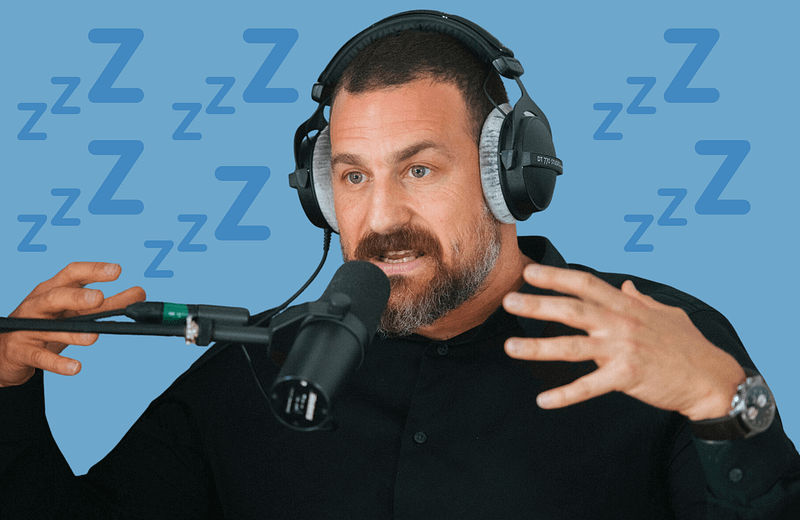
Andrew Huberman is perhaps the most popular scientist in the world — at least the podcast world.
As a neuroscientist and professor of neurobiology at Standford University, Andrew shares his wealth of knowledge (for free) via his podcast, “The Huberman Lab.”
He breaks down complex concepts of human optimization into clear and actionable tools for the every-person.
Each episode is essentially a University lecture — without the $60K per year price tag.
As much as I love free education, there’s one problem.
His podcasts are incredibly information dense. I find myself only being able to handle 10–20 minutes at a time without taking breaks. Unless it’s something I urgently need… like sleep.
After a few weeks of increasingly late nights and stressful life events, I found myself trapped in a string of wakeful nights.
Unsurprisingly, sleep is one of Andrew’s most popular topics. So, I dived into the literature (podcasts) for answers.
The following routine reflects hours of Andrew Huberman’s research shared across various podcast appearances.
Neatly condensed into one article.
Here’s how to optimize your body for deeper sleep, better energy, and all the other benefits sleep has to offer.
Let’s get started.
Sleep comes down to these 3 things:
- Autonomic timing (energy & hormone levels)
- Circadian rhythm (internal 24-hour clock)
- Body temperature
The 90-Minute Rule allows you to optimize all 3 through small habits. You can practice all or some of them at your discretion.
The first 90 minutes after waking up.
Andrew calls this “Critical Period #1.” There are 3 total.
The morning is a beautiful time. It’s fresh, invigorating, and sets the tone for the rest of the day.
It’s also the most popular time of day in popular culture.
Waking up at 5 AM, exercising, taking cold showers — these have long been staples of productive mornings and billionaire routines.
Although these habits do have merit, humans are far too complex for one-size-fits-all routines. We:
- Have naturally differing sleep cycles
- Live in different parts of the world
- Work different schedules
When it comes to optimizing your body and mind, effort isn’t the answer.
Education is.
Do these things within the first 90 minutes of waking up:
- Introduce your skin and eyes to sunlight. This tells your body you’re starting your day and sets a sleep timer for approximately 16 hours.
→ If you can’t absorb natural sunlight, overhead lighting is second best (it mimics the sun).
2. Raise your body’s core temperature. Our bodies naturally raise our temperatures in the early portions of the day and cool down later into the night. It’s one way your body regulates its energy and hormones.
→ Exercising within the first 90 minutes of the day raises your core temperature and triggers your autonomic nervous system to release hormones (such as adrenaline) early in the day, to help you get more done. And then lower as you move toward nighttime.
→ Cold exposure (cold showers or plunges) also raise your body’s core temperature. It’s counter-intuitive, but your body heats up to counteract the cold exposure.
3. Eating early in the day. This sends signals to your brain for you to be more alert during the day (although you will feel tired immediately after eating, as your body digests food).
→ If you prefer to fast in the mornings, then fast. It will have no negative impact on your sleep.
In simple terms, these 3 habits trigger your body’s naturally occurring sleep timer — your circadian (24-hour) rhythm.
Being that most people spend the majority of their time indoors, it’s important to be intentional with your light exposure and physical movement. This directs your body to produce hormones and energy at the optimal times of day.
Important: Avoid caffeine during the first 90 minutes of the day. When you first wake up, your body needs time to clear out residual adenosine (your sleep hormone) from the night before.
During the day & late afternoon.
Critical Period #2. Avoid the mid-day crash.
Most people can nail down a consistent morning routine without much trouble. It’s in the afternoon that things begin to fall apart.
In the past, the post-lunch crash would mark the end of my productivity for the day. I’d return to work groggy and sluggish.
Now, it’s perhaps my most productive part of the day— and where I get the majority of my creative work done.
On an episode of “The Jocko Podcast”, Andrew shared a great rule of thumb for how to optimize mental energy during the day:
- 0–9 hours after waking up is the best time for high-dopamine activities. Things you already know how to do (exercise, checking emails, repetitive tasks, etc.)
- 10+ hours into your day is best for creative work. Learning new things, developing new skills, exploring new areas of your brain, etc.
He’s also a big proponent of afternoon naps. They’re a great way to split up your day, separating high-dopamine activities and high-learning activities.
But back to sleep.
Don’t do these things during the day:
- Don’t nap for more than 90 minutes (if you like to nap).
- Don’t consume caffeine 4–6 hours before bed. Caffeine has a half-life of approximately 5 hours. This means drinking 1 cup of coffee 5 hours before bed is equivalent to drinking a 1/2 cup right before bed.
→ Personally, I stop drinking caffeine 10 hours before bed as I’m sensitive to caffeine.
3. Don’t raise your core temperature in the late afternoon. Avoid exercise and cold exposure in the late afternoon/evening as they will raise your core temperature, making it harder to fall asleep at night.
→ Stopping eating 3 hours before bed has also been shown to improve sleep quality.
Do this in the late afternoon/evening:
- Get outside and watch the sun set. The low light of the sun tells your brain it’s time to start winding down for bed.
Your energy hormones peak early in the day. These habits help them slowly decrease as you begin winding down for bed.
90 minutes before bed.
Critical Period #3. Time to wind down.
This period is where the majority of routines get ruined. You’re tired, it’s been a long day, and it’s easy to let habits fall by the wayside.
But this period is essential.
One of the major difficulties of sleeping in our modern era is that we are separated from the sun. Our bodies are tuned to rise and fall with the sun and can be easily confused by artificial lighting.
Do these things 90 minutes before bed:
- Move lighting from above your head to underneath your eye line. This mimics the setting of the sun and triggers your body to start releasing sleep hormones.
→ If you need to use light, moonlight is best. Second best is candle lighting (yes, like in the 1920s). Third and final, is soft lighting (like lamps) set under your eye line.
**Anything else (like your phone), will trigger wakefulness. Even if you only look at it for a few seconds.
2. Release muscle tension. Gentle stretching or foam rolling (without raising your core temperature) is a great way to wind down before bed. It also helps ease your brain into a restful state.
→ Every night, 90 minutes before bed, I turn off all the lights in my house, throw on a podcast and stretch in the dark. It sounds weird, but when I do this, I sleep noticeably better.
3. Lower your body’s core temperature. Ironically, taking a hot shower, bath, or sauna before bed is a great way to lower your body’s core temperature.
→ Just like cold exposure raises your core temperature, heat exposure lowers it as your body always looks to regulate its heat.
Your body has ways to regulate your heat as you sleep as well. If you get too hot, you’ll naturally remove a foot, hand, or your neck from under the covers. This is because those areas of your body have large clusters of heat-regulating veins known as AVAs.
Final thoughts: perfect doesn’t exist.
The above routine reflects perfect sleep optimization — but nobody’s perfect.
Use the knowledge above as tools to best serve your lifestyle and schedule. If you can’t practice all of them, practice some.
Remember, one is always better than none.
The 90-Minute Rule is a simple way to action the often overwhelming amount of information that comes with human optimization.
To summarize:
Here’s a macro mindset:
Think of how our ancestors lived before electricity — as hunter/gatherers.
We would wake up, use our bodies, eat, reflect on the day, watch the sun set, and go to sleep. Getting 5–10 minutes of each will drastically improve your sleep quality.
And 3 practical habits:
- First 90 minutes of the day: sun (or overhead lighting), exercise, raise core temperature, & avoid caffeine.
2. Mid-day: keep naps under 90 minutes & watch the sun set.
3. Last 90 minutes: moonlight (or low light), no screens, drop core temperature.
Lastly, when it comes to any form of human optimization, Andrew recommends making changes in this order:
First: behavioural tools (you’ve just read this article).
Second: nutrition (optimal eating routine for sleep).
Third: supplementation (Andrew’s natural sleep cocktail).
90% of the information in this article can be found in this episode of The Huberman Lab. Check it out for more learning.
Sleep tight and sweet dreams.
Hi, I’m Hudson. I hope you enjoyed this story. If you did, consider becoming a Medium member. For $5 a month you’ll get unlimited access to stories like this one. Plus, you’ll be helping support me as a writer, as I will receive a portion of your membership fee at no extra cost to you. Click here to get started. (+1,000 karma points). ❤️🙏


