
7 Breathing Techniques to Upgrade Your Body, Brain, Energy, & Focus
Take your first breath toward a better life.

I don’t love the term ‘bio-hacking.’
It suggests there’s a shortcut to thinking, feeling, or performing the way you’d like. And if I’ve learned anything in life, it’s that there are no shortcuts.
That said, breathing is a lost art — making the results feel like magic.
Intentional breathing triggers autonomic responses in your body and brain. It’s not bio-hacking, but rather clever programming.
It’s how “The Iceman”, Wim Hoff, is able to endure subzero temperatures without suffering frostbite. And David Blaine can lower his heart rate to perform extreme magic tricks.
Perhaps the most profound example of breath work is from a German woman named Katharina Schroth. After a failed back bracing, she cured her scoliosis with self-taught breathing techniques.
These are just a few examples of the power of intentional breathing.
Below are 7 techniques you can use to drastically improve your life. Everything from lowering anxiety to improving focus, and making you physically stronger.
All of which, simply involve:
- Inhaling
- Exhaling
- Holding your breath
That’s it.
By the end, I hope you’ve picked up 1–2 to use as back-pocket tools.
Everything is connected.
I don’t usually get vulnerable here — that’s what LinkedIn’s for. But, this is relevant, so what the heck.
I have a stutter.
It’s a daily struggle but if I practice regularly, I can manage it.
If I don’t, I’m almost incomprehensible.
One of the ways I manage my speech is through intentional breathing exercises.
I won’t go too deep into the science of stuttering, but it’s a neurological condition affecting about 1% of people. Speech (and disfluency) is heavily regulated by one’s autonomic nervous system — unconscious processes like heart rate, breathing, and digestion.
When anyone’s autonomic system is compromised, for example when you’re tired, stressed, or angry, speaking becomes more difficult.
When I speak, I struggle to catch my breath and have to consciously focus on pronouncing each syllable of each word.
Intentionally moving air deep into my lungs primes my autonomic system to be sharp. And makes speaking easier. My speech is the driving factor behind my interest in health, wellness, and mindfulness. Not to mention writing.
Because if I’m not taking care of myself, I can’t speak.
Your body and mind operate as a team— everything is connected.
How you breathe affects how you think, feel, act, and shapes your perspectives on life. Being that oxygen is our primary fuel source, it’s important to learn how to feed your body and brain, with healthy fuel.
Luckily, breath is one of the easiest fuel sources to adjust — it just takes a little bit of intentional effort.
Just like a healthy diet can have innumerable indirect benefits on mental health and productivity, a healthy flow of oxygen will:
- Reduce stress & anxiety
- Give you more energy
- Make you stronger
- Make you happier
- Help you relax
- Sleep better
And it’s much simpler than it sounds.
Breath work in a nutshell.
Breath work can seem very complicated. Autonomic nervous system, vagus nerves, breathing certifications… it’s all a little confusing.
So, here’s the simplified version:
Breathing affects your carbon dioxide (c02) levels, which in turn affects your mental, physical, and emotional state:
- Breathing in, increases c02: creating arousal in the body (increased alertness, heart rate, anxiety, etc.)
- Breathing out, decreases c02: creating a sense of calm (lowered heart rate, anxiety, and providing a sense of clarity)
Shallow breathing creates a surplus of c02 in our bodies. Over time, this can contribute to anxiety, stress, and fatigue.
Deep breaths, reaching all the way to the belly, offload c02, calming your autonomic system, creating a sense of calm and improving mood.
**This is why intense cardio puts you in a euphoric state — you’re offloading more c02 than you’re taking in. Cold exposure has a similar effect.
Using these basic principles you can design your own breathing techniques to achieve whatever results you would like.
These 2 practices are staples of all intentional breathing techniques:
- Breathing through your nose: has been shown to have profound benefits such as improved posture, whiter teeth, and improved physical performance.
- Breathing deep into your belly: allows for your body to fully utilize each breath. It also stimulates the vagus nerve, which is largely responsible for helping you relax.
All of the following 7 intentional breathing techniques have been shown to:
- Lower anxiety
- Improve digestion
- Boost immune function
- Decrease inflammation
- Improve mental well-being
Let’s get into it.
1. Intermittent air fasting
Believe it or not, you can breathe too much — and most people do.
In the book “Breath” (which I highly recommend) James Nestor reveals the optimal number of breaths per minute, for longevity, is 5.5.
Yet, the average person breathes around 12–20 times per minute. This over-breathing contributes to anxiety, fatigue, and insomnia.
Holding your breath intermittently, has been shown to improve brain function, reduce anxiety, and contribute to longevity.
Being that I’m a big proponent of intermittent fasting, I like to think of breath holds as “air fasting.”
Forcing your body to become stronger and more efficient.
Try this:
- Exhale completely, squeezing your core tightly to push out every ounce of air
- Hold it for 10–30 seconds
You will feel panicked — it’s natural.
It’s called air hunger.
But fight the urge to inhale. Eventually, you will find yourself in a calm, air-fasted state.
**It’s very similar to feeling hungry during food fasting. If you push past the first 8–12 hours, your body will adapt and you’ll begin to reap the benefits.
2. Sleep (the physiological sigh)
Think back to the moments just before falling asleep. If you can recall your breathing pattern, it probably resembled something like this:
2 short inhales through your nose, followed by one long exhale through your mouth.
As Standford professor, Andrew Huberman, writes:
“The physiological sigh is the fastest way to reduce autonomic arousal — aka “calm down” & causes activation of neural circuits specifically for calming.”
Jessica Stillman, in an excerpt from an interview on Inc.com, calls it a “kill switch for stress.”
This pattern has been ingrained into our brains to trigger relaxation, particularly before falling asleep.
You can emulate it to fall asleep quicker.
3. Relaxation (4–7–8 method)
The 4–7–8 method is great for relaxation, helping you wind down for bed or reducing stress/anxiety.
It’s also been shown to reduce food and dopamine cravings. The next time you feel anxious, instead of reaching for your phone or a delicious pastry, do this:
- Inhale through your nose for 4 seconds
- Hold your breath for 7 seconds
- Exhale through your mouth (pushing all the air out of your lungs) for 8 seconds
Repeat this 1–4 times or until you feel yourself begin to relax.
As is the case with all of these techniques, it’s not about the number of seconds — but rather the ratios and patterns. While making sure to breathe deeply.
If it takes you longer than 4 seconds to inhale, adjust the rest of the pattern accordingly.
Just keep the ratios the same. For example:
6–10–12 is the same as 4–7–8.
4. The Wim-Hoff Method (find inner heat)
The Wim Hoff method is perhaps the most popular breathing technique in the world. The Dutch extremist gained mainstream notoriety for his inhuman ability to withstand cold temperatures.
To this day, he holds the world record for sitting in a tub of ice (1 hour and 52 minutes) — not to mention 20 other world records.
He does this by creating internal heat through a series of breathing exercises he calls the “Wim Hoff Method.”
Although Wim Hoff brought breath work to the mainstream, his method is not anything new. Tibetan monks have been using similar breathing techniques as part of their “tummo” meditations to find “inner heat”, for centuries.
But as in the reality of modern life, marketing equals ownership.
Wim Hoff has carved out a marketable way to package his method, allowing any regular human to withstand the cold.
This is an intense exercise, so find a safe and comfortable place to sit.
Here’s how to do it:
- Breathe in and out 30–40 times in powerful bursts (in through the nose and out through the mouth)
- At the end of your last breath exhale all the air you can and hold. Fight the urge to breathe in for 30–90 seconds
- Breathe in deeply and hold for 15 seconds
That’s one round. Aim for 3–4.
And again, the seconds aren’t important but rather the pattern. Hold for as long as you can.
**When you inhale and hold try to push the air deep into your belly. One trick for this is to activate your pelvic floor muscle. Imagine you’re holding in a pee.
5. Physical strength (4–4–4 method)
The 4–4–4- method, or “box breathing”, is a technique Navy Seals use to remain calm in high-stress situations.
It does this by balancing your breath — creating a sense of calm and lowering cortisol levels.
Numerous studies also reveal that controlled breathing during exercise contributes to increased physical strength and endurance.
Here’s how to do it:
- Inhale through your nose for 4 seconds
- Hold for 4 seconds
- Exhale through your mouth for 4 seconds
- Hold for 4 seconds
Repeat 2–4 times.
Think of it like a literal box:
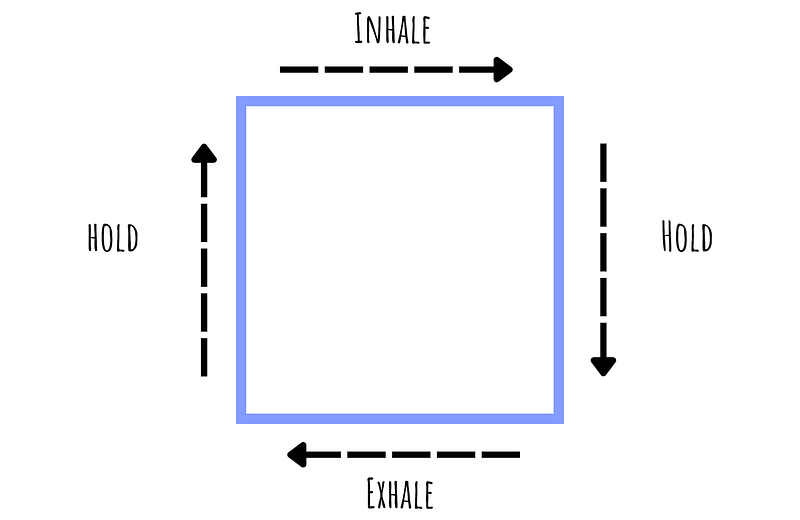
It really should be called the 4–4–4–4 method.
6. Increase energy levels
Before stressful events, you’ll notice yourself breathing more shallowly. This is because your body is priming itself for action.
Knowing this, you can reverse engineer your energy.
“Bellows Breath” is a traditional yoga practice used to energize the body and mind. It’s essentially forcing powerful breaths to tell your brain it’s time for action. You can use this throughout the day for a burst of mental focus or to get psyched up before a workout.
Here’s how you do it:
- Breathe in and out through your nose, powerfully and quickly
- Don’t exceed 15 seconds at a time as you will get lightheaded
Do this 2–4 times or until you feel energized.
**You may want to have a cloth or paper towel nearby as this can get messy.
7. Achieve flow state
This is perhaps the most complicated technique to perform — and one of the most powerful.
“Alternate-nostril breathing” is a staple of mindfulness and Pranayama yoga practices, helping to achieve a sense of mental balance. It does this by reducing nerves and anxiety while enhancing mental clarity and focus.
Neuroscientist Arne Dietrich describes flow state as,
“A period during which a highly practiced skill that is represented in the implicit system’s knowledge base is implemented without interference from the explicit system.”
In simpler terms, flow state is achieved when we can balance unconscious thought with conscious action. The key being balance.
How to practice it:
Start with a few deep breaths through the nose to warm up your nostrils. Then, put your forefinger and thumb over your nose as if you’re plugging it:
- Let go of one nostril and fully inhale
- Plug both and pause for a few seconds
- Exhale through the opposite nostril
- Plug both nostrils again and pause
- Inhale through the same nostril
- And exhale through the other
Do this 10–15 times.
**Think of your air creating a triangle as it passes through your nose. Switching nostrils at the top.
Final thoughts: you are what you breathe.
When it comes to healthy living, we focus so much on how we eat that we forget the importance of how we breathe.
Breath is your primary fuel source.
Breathing poorly is the equivalent of eating an all junk-food diet and expecting to lose weight. Only breath affects every aspect of your being.
Luckily, it’s free.
Changing your air diet is as simple as intentional behaviour. If you’ve saved any of the techniques above, great. If not, simply try to do the following things more often:
- Breathe deeper
- Breathe through your nose
- Pay attention to your breath
Lastly, if for nothing else, I’m sure you’ve breathed a little deeper than usual while reading this article.
And that’s a small win worth celebrating.
Hi, I’m Hudson. I hope you enjoyed this story. If you did, consider becoming a Medium member. For $5 a month you’ll get unlimited access to stories like this one. Plus, you’ll be helping support me as a writer, as I will receive a portion of your membership fee at no extra cost to you. Click here to get started. (+1,000 karma points). ❤️🙏